(OSV News) – The leader of the U.S. Catholic bishops has echoed Pope Leo XIV’s call for deescalation and dialogue in the Middle East, following the joint attacks on Iran launched Feb. 28 by the U.S. and Israel, which killed Iran’s longtime supreme leader, 86-year-old Ayatollah Ali Khamenei.
The attacks prompted a wave of strikes by Iran across the region, with deaths and casualties — including the loss of at least three U.S. military personnel — on all sides.
In a March 1 statement, Archbishop Paul S. Coakley of Oklahoma City, president of the U.S. Conference of Catholic Bishops, warned the “growing conflict risks spiraling into a wider regional war.”
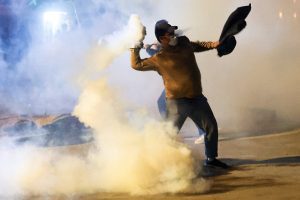
A protester throws a smoke-emitting object as supporters of Iraqi Shi’ite armed groups attempt to move toward the U.S. embassy located in Baghdad’s Green Zone March 1, 2026, while riot police deploy to block their advance, following the Israeli and U.S. strikes on Iran and the killing of Iran’s Supreme Leader Ayatollah Ali Khamenei Feb. 28. (OSV News photo/Ahmed Saad, Reuters)
Noting Pope Leo’s plea for peace in his March 1 Angelus remarks — with the pope warning of an “irreparable abyss” if the violence continues to spiral — Archbishop Coakley said, “We are faced with the possibility of a tragedy of immense proportions.
“My brother bishops and I unite our voice with our Holy Father and make the heartfelt appeal to all parties involved for diplomacy to regain its proper role,” Archbishop Coakley said. Quoting the pope’s remarks, he said, “We ask for a halt to the spiral of violence, and a return to multilateral diplomatic engagement that seeks to uphold the ‘well-being of peoples, who yearn for peaceful existence founded on justice.'”
The USCCB president stressed that “all nations, international bodies, and partners committed to peace must exert every effort to prevent further escalation.”
Describing the present moment as “critical,” Archbishop Coakley invited “Catholics and all people of goodwill to continue our ardent prayers for peace in the Middle East, for the safety of our troops and the innocent, that leaders may seek dialogue over destruction, and pursue the common good over the tragedy of war.”
His statement contained a link to a June 2025 appeal for prayer and diplomacy by Bishop A. Elias Zaidan, chair of the USCCB’s Committee on International Justice and Peace, after the U.S. had launched precision strikes on several of Iran’s key nuclear facilities.
In that statement, Bishop Zaidan, head of the Maronite Eparchy of Our Lady of Lebanon of Los Angeles, had urged “multilateral diplomatic engagement for the attainment of a durable peace between Israel and Iran.”
Archbishop Coakley concluded his March 1 statement by imploring “the intercession of our Blessed Mother, Mary, Queen of Peace, to pray for our troubled world and for a lasting peace.”
Social
(OSV News) – Pope Leo XIV issued a fervent appeal for return of diplomacy in “these dramatic hours” in the Middle East and Iran, condemning use of weapons that cause “destruction, pain, and death.”
Pope Leo spoke roughly 12 hours after the U.S. and Israel revealed that Iran’s supreme leader, 86-year-old Ayatollah Ali Khamenei, is among the country’s senior leaders killed in their initial assault on Iran, started in the early morning hours on Feb. 28.
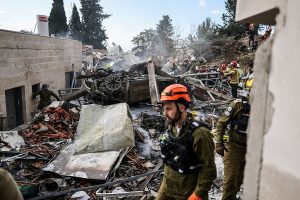
Emergency personnel work at the site of an Iranian strike, after Iran launched missile barrages following attacks by the U.S. and Israel on Feb. 28, 2026, in Beit Shemesh, Israel March 1. (OSV News photo/Ammar Awad, Reuters)
During his Sunday Angelus prayer March 1, the pope said he was “following with profound concern” these events and warned of a potential “tragedy of enormous proportions.” He appealed for the warring parties to assume “the moral responsibility of halting the spiral of violence” before it becomes “an irreparable abyss.”
The pope insisted the nations return to diplomacy.
“Stability and peace are not built through mutual threats, nor with weapons that sow destruction, pain, and death, but only through reasonable, authentic, and responsible dialogue,” he said.
The ongoing joint U.S. and Israeli attack on Iran has targeted Tehran and cities across Iran, with Gulf countries caught in the crossfire as Iran launches retaliatory strikes.
“Faced with the possibility of a tragedy of enormous proportions, I address to the parties involved a heartfelt appeal to assume the moral responsibility of halting the spiral of violence before it becomes an irreparable abyss,” he said.
“May diplomacy regain its role and promote the good of the peoples who yearn for peaceful coexistence based on justice,” he added, urging the world to “continue to pray for peace.”
What Pope Leo called a “spiral of violence” continued to unfold Sunday as mutual attacks escalated hour by hour throughout the Middle East.
Israel and Iran launched fresh attacks March 1, with the BBC reporting that Iran’s state-run Islamic Republic News Agency said Tehran has been hit by 60 attacks in 24 hours, leaving 57 people dead — numbers reportedly provided by the Tehran Province Red Crescent Society.
Israel’s military said on X March 1 that its strikes have killed 40 Iranian commanders, including Abdolrahim Mousavi, the chief of staff of Iran’s armed forces, Abdolrahim Mousavi. Iranian state television confirmed the death.
In the conflict’s opening 24 hours, two people were killed in Tel Aviv as an Iranian missile hit a residential building, while 120 people in Israel were injured from Iran’s counterstrikes, The Jerusalem Post reported.
The Guardian reported Iran’s president, Masoud Pezeshkian, was quoted as having called the killing of Iran’s supreme leader “an open war against Muslims” and having said that Iran “considers bloodshed and revenge against the perpetrators and commanders of this crime as its legitimate duty and right, and will fulfill this great responsibility and duty with all its might.”
Iran’s ally, Russia, condemned Khamenei’s killing, with President Vladimir Putin saying that the “murder” of Khamenei was a “cynical violation of all norms of human morality.”
President Donald Trump took to Truth Social on March 1 warning Iran to not retaliate further.
“Iran just stated that they are going to hit very hard today, harder than they have ever hit before,” President Trump wrote on his social network. He added, “THEY BETTER NOT DO THAT, HOWEVER, BECAUSE IF THEY DO, WE WILL HIT THEM WITH A FORCE THAT HAS NEVER BEEN SEEN BEFORE!”
Pope Leo, during his Angelus appeal, reminded people that in recent days, “we have also received disturbing news of clashes between Pakistan and Afghanistan.” He raised a “plea for an urgent return to dialogue.”
“Let us pray together that harmony may prevail in all the world’s conflicts,” he said, adding, “Only peace, a gift of God, can heal the wounds between peoples.”
Social
WASHINGTON (OSV News) – The U.S. bishops and a Catholic immigration advocacy group were among those who offered their support to a lawsuit challenging President Donald Trump’s executive order limiting birthright citizenship.
Oral argument in the case, Trump v. Barbara, is scheduled for April 1.
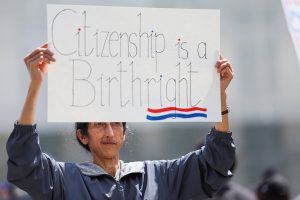
A demonstrator holds a placard during a protest outside the Supreme Court May 15, 2025, as the justices heard oral arguments in Trump v. CASA related to lower courts placing an injunction on Trump’s executive order of Jan. 20, 2025, to end birthright citizenship. In a 6-3 ruling, the Supreme Court June 27 limited the scope of federal courts to block presidential policies nationwide. On April 1, 2026, the court will hear oral arguments in Trump v. Barbara, a challenge to the order ending birthright citizenship. (OSV News photo/Leah Millis, Reuters)
Within hours of returning to the Oval Office in January 2025, Trump signed an executive order seeking to change the longstanding legal interpretation of the 14th Amendment, which states, “All persons born or naturalized in the United States, and subject to the jurisdiction thereof, are citizens of the United States and of the State wherein they reside.”
Trump’s order sought to end birthright citizenship for children born in the U.S. to parents without legal status or temporary visa holders. Lawsuits promptly followed.
Previously, the Supreme Court limited the ability of federal judges to issue nationwide injunctions against the order while litigation over it proceeds, but did not directly address the merits of the order itself.
A series of amicus briefs, sometimes called friend of the court briefs, were filed in either support or opposition to the order. Amicus briefs are filed by groups or individuals who are not a party to the case but have an interest in it, asking the court to consider certain arguments.
One such brief was filed by the U.S. Conference of Catholic Bishops and the Catholic Legal Immigration Network Inc., also known as CLINIC.
Their brief argued they were “motivated by the teachings of the Catholic Church,” including “the central belief that every person is imbued with an inviolable dignity, and that all human life, created in the image and likeness of God, is sacred.”
“It is through this lens that the Church stands for ‘treating people humanely, treating people with the dignity that they have,'” the brief argued, citing comments made by Pope Leo XIV at Castel Gandolfo Nov. 18, 2025. “These teachings extend to immigrants in the United States without legal status and their American children who were born in the United States.”
“Not only is the principle of birthright citizenship woven into our Nation’s history and Western tradition, but it is also consistent with Catholic teaching,” the brief continued. “Birthright citizenship aligns with the Church’s teaching that humans were created as social beings and that political authority is morally bound to affirm and protect the inherent dignity of every human person in the community. In turn, birthright citizenship reflects the Catholic principle of subsidiarity by recognizing persons as members of the community from birth, thereby enabling their participation in civic life and ensuring that state power serves the human person as a social being.”
The brief concluded that “ending birthright citizenship lacks historical, legal, and moral support.”
“The principle of citizenship by birth is firmly rooted in Western legal tradition, enshrined in the Fourteenth Amendment, and reaffirmed by this Court’s precedent,” it said. “It is equally grounded in Church teachings, which affirms the inherent dignity of every human person, especially the innocent child.”
“As Catholics, our faith compels us to protest laws that deny the dignity of the human person and harm innocent children, particularly when such laws resurrect the very injustices the Fourteenth Amendment was enacted to repudiate,” it added. “At its core, this case is not solely a question about citizenship status or the Fourteenth Amendment. It is a question of whether the law will affirm or deny the equal worth of those born within our common community — whether the law will protect the human dignity of all God’s children.”
A brief in support of the executive order filed by the America First Policy Institute, a think tank that supports Trump-aligned policies, argued, “both the Executive and Legislative branches have broad constitutional authority over matters of immigration and foreign relations and have extensive powers related to national defense and sovereignty.”
“Accordingly, AFPI believes that each branch has the power and the duty to end birthright citizenship for children of illegal aliens, alien tourists, and aliens in the U.S. legally but temporarily,” they argued.
Other amici curiae, or those who filed briefs, included members of Congress, state attorneys general, legal organizations, and immigration policy groups.
Another brief from Evan D. Bernick and Jed H. Shugerman, professors who identified themselves as originalist scholars, argued, “For nearly all of the first 235 years under the Constitution, the citizenship of every child born in the United States to alien parents, with immaterial exceptions, was a given. Then, in 2025, the Trump administration changed course.”
Catholic social teaching on immigration balances three interrelated principles — the right of persons to migrate in order to sustain their lives and those of their families, the right of a country to regulate its borders and control immigration, and a nation’s duty to regulate its borders with justice and mercy.
Social
VATICAN CITY (Vatican News) – The following is the text of Pope Leo XIV’s introduction to his book “Peace Be with You!” published by HarperCollins and available in bookstores in the United States and English-speaking countries starting Feb. 24. The book is the English-language version of the volume “E pace sia!” published in August 2025 by the Vatican Publishing House.
Peace is one of the great issues of our time, and is both a gift and a commitment: a gift from God built by men and women throughout the ages.
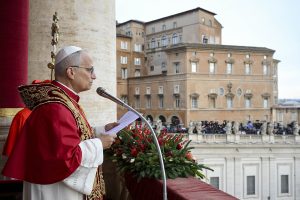
Pope Leo XIV reads his Christmas message before giving his solemn blessing “urbi et orbi” (to the city and the world) from the central balcony of St. Peter’s Basilica at the Vatican Dec. 25, 2025. (CNS photo/Vatican Media)
We live in a world wounded by too many conflicts and struck by bloody hostilities. Bitter nationalism tramples on the rights of the weakest. Even before it is crushed on the battlefield, peace is defeated in the human heart when we give in to selfishness and greed and when we allow partisan interests to prevail instead of looking to the common good. Many writers have said that it is when we refuse to listen to other people’s stories that we begin to deprive them of their dignity. Depersonalizing others is the first step in any war. To know others, on the other hand, is a foretaste of peace. But in order to know, one must first know how to love. Saint Augustine said that “no one can be known except through friendship” (Eighty-three Different Questions, 71).
I would like to reflect here on this dual dimension of peace, which is vertical (peace as a gift from Above) and horizontal (peace as the responsibility of each person).
Peace is a gift that God has given to men and women of every age through Jesus’ birth in Bethlehem. The angels announced peace on earth because God became man. He embraced humanity so deeply that with his cross he destroyed the enmity of sin. Saint Augustine writes: “We, too, shall be a source of additional glory to God in the highest when, after the resurrection of our spiritual body, we shall be lifted up in the clouds to meet Christ, on condition, of course, that we work for peace with good will while we are here on earth” (Sermons, 193). The glory of God descended upon the earth to make us participants in his infinite goodness. This gift calls into action the responsibility of our answer, of our “good will,” as the Saint of Hippo writes.
Furthermore, peace is the gift that the Risen One gave to his disciples. It is a peace “injured” by the wounds of the crucifixion, because Jesus’ peace gushes forth from a heart that loves and lets itself be struck by the suffering of every time and place. “The Lord appeared to His disciples after His resurrection, as ye have heard, and saluted them, saying, ‘Peace be unto you.’ This is peace indeed, and the salutation of salvation: for the very word salutation has received its name from salvation” (Saint Augustine, Sermons, 116).
However, peace is also a commitment and responsibility for each one of us. Peace means teaching children to respect others and not to bully others when they play. Peace means overcoming our personal pride and making room for the other, in our family, at work, in sports. Peace is when our heart and our life are inhabited by silence, meditation and listening to God; because God never blesses violence, he never approves of taking advantage of others, or of the frenzied abuse of the one Earth that is disfiguring Creation, a caress of the Creator.
We may feel powerless before the many wars being fought around the world. We can respond in various ways to what I called the ‘globalization of powerlessness’: believers can, first and foremost, give voice to prayer. Prayer is an “unarmed” force that seeks only the common good, without exclusions. By praying, we disarm our ego and become capable of gratuitousness and sincerity.
Moreover, our heart is the most important battlefield. It is there that we must learn the bloodless but necessary victory over the impulses of death and the tendencies toward domination: only peaceful hearts can build a world of peace. We must practice a culture of reconciliation, by creating non-violent workshops, places where suspicion of others can become an opportunity for encounter. The heart is the source of peace: there we must learn to meet rather than clash with each other, to trust and not of mistrust, to listen and understand instead of closing ourselves to others.
Finally, politics and the international community are responsible for facilitating the mediation of conflicts, utilizing the arts of dialogue and diplomacy. “O Lord God, grant your peace to us …, the peace of rest, the peace of the Sabbath which has no evening”: with these words of Augustine, let us ask the Father to grant our world, all people, especially those who are most forgotten and who suffer the most, the blessing grace of a just and lasting peace.
Social
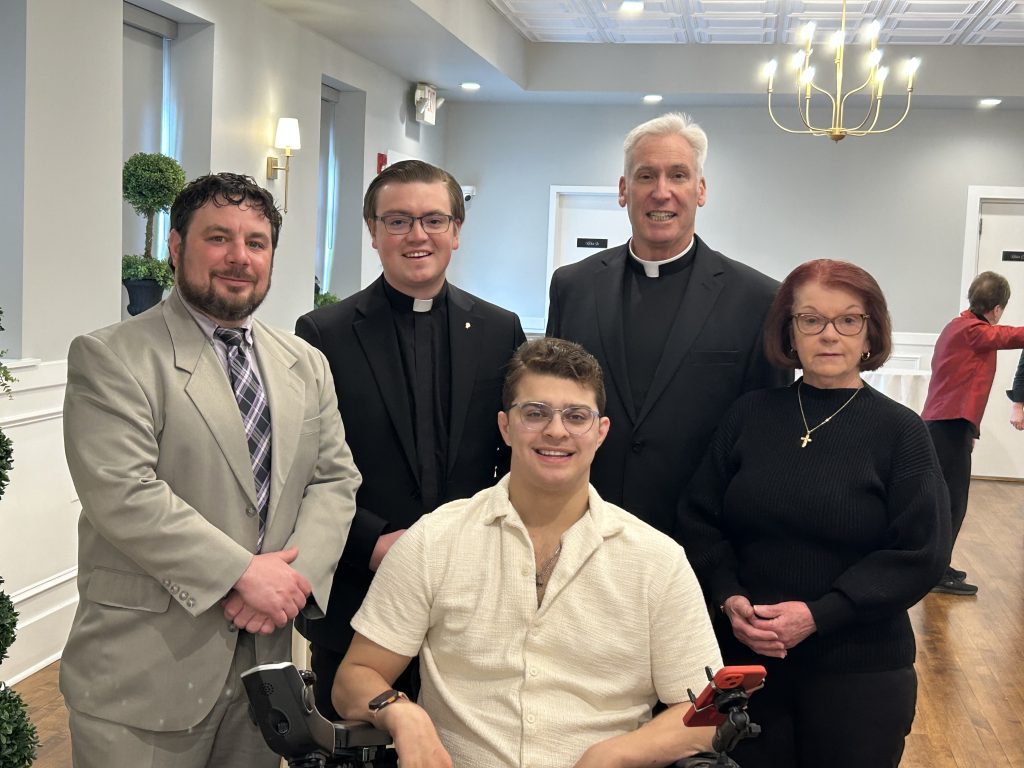
Group photo: Nick Carr, Alfredo Pisa, Fr. Tom Dzwonczyk, Assistant Pastor, Fr. David Cappelloni, Pastor, and Martha Gervasi.
SS. Anthony and Rocco and Our Lady of Mt. Carmel Parishes Holy Name Society and Altar and Rosary Society, Dunmore held its Annual Combined Communion Breakfast on Sunday, March 1st at La Buona Vita. The day began with 8:30am Mass at St. Anthony of Padua Church. Mass was celebrated by the Reverend David P. Cappelloni, Pastor.
Principal Speaker was Mr. Nick Carr. Toastmaster was Father Thomas Dzwonczyk. Mr. Alfredo Pisa offered remarks on behalf of both parish societies. Father Cappelloni offered the invocation, remarks and final blessing.
Social
ROME (OSV News) – Pope Leo XIV has pointed to Our Lady of Guadalupe as the model of “perfect inculturation” as Mexico prepares to mark the 500th anniversary of the apparition in 2031 with a jubilee year.
In a Feb. 24 message to the Theological-Pastoral Congress being held in Mexico City, the pope said Our Lady of Guadalupe “manifests God’s way of approaching his people.”
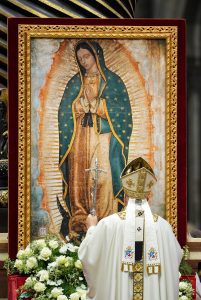
Pope Leo XIV prays before an image of Our Lady of Guadalupe at the conclusion of his Mass for her feast day in St. Peter’s Basilica at the Vatican, Dec. 12, 2025. (CNS photo/Lola Gomez)
The congress, running Feb. 24-26, was organized to prepare for the 500th anniversary of the Marian apparitions to St. Juan Diego on Tepeyac Hill in Mexico City. It is promoted by the Pontifical Commission for Latin America, the Mexican Episcopal Conference, the Knights of Columbus and the Pontifical International Marian Academy.
“Our Lady of Guadalupe is a lesson in divine pedagogy on the inculturation of salvific truth,” Pope Leo said. “She does not canonize a culture or absolutize its categories, but neither does she ignore or despise them: they are assumed, purified, and transfigured to become a place of encounter with Christ.”
In December 1531, Our Lady of Guadalupe appeared four times to St. Juan Diego, an Indigenous Mexican convert to Christianity, on Tepeyac Hill. She asked that a church be built in her honor on the site and left her image miraculously imprinted on St. Juan Diego’s tilma, or cloak, which remains on display today at the Basilica of Our Lady of Guadalupe in Mexico City.
Scholars and theologians have long noted how the image on the tilma is rich with symbolism that was intelligible to the Nahuatl-speaking peoples of central Mexico from her turquoise mantle, associated with a queenly status in Aztec culture, to the black band around her waist, which was a sign of pregnancy in Indigenous tradition. The four-petaled flower, located on her garment over Our Lady’s womb, was an Aztec symbol for the center of the universe and the fullness of the divine.
The pope said the apparitions on Tepeyac Hill can be seen as “a permanent criterion for discerning the evangelizing mission of the Church, called to proclaim the True God for whom we live, without imposing him, but also without diluting the radical newness of his saving presence.”
Inculturation refers to the concept of making the Gospel incarnate in different cultures. The pope clarified that “inculturation does not equate to a sacralization of cultures or their adoption as a decisive interpretive framework for the Gospel message.”
“To legitimize everything that is culturally given or to justify practices, worldviews, or structures that contradict the Gospel and the dignity of the person would be to ignore that every culture — like every human reality — must be enlightened and transformed by the grace that flows from the Paschal mystery of Christ,” Pope Leo added.
He noted that Our Lady of Guadalupe exemplifies an inculturation that is “respectful in its starting point, intelligible in its language, and firm and delicate in its guidance toward the encounter with the full Truth, with the blessed Fruit of his womb.”
“Inculturation is, rather, a demanding and purifying process, through which the Gospel, while remaining intact in its truth, recognizes, discerns, and assumes the semina Verbi present in cultures, and at the same time purifies and elevates their authentic values, freeing them from what obscures or disfigures them,” the pope said.
Our Lady of Guadalupe is venerated as the patroness of the Americas. Pope Leo noted that “today, in many regions of the American continent and the world, the transmission of faith can no longer be taken for granted, particularly in large urban centers and pluralistic societies marked by visions of man and life that tend to relegate God to the private sphere or to dispense with Him altogether.”
Pope Leo, who is on his Lenten retreat this week, signed the message on Feb. 5, the feast of St. Philip of Jesus, the first canonized saint born in Mexico.
He pointed to the example of “many holy evangelizers and pastors” who can serve as examples and intercessors for the congress’ efforts, citing St. Toribio de Mogrovejo, St. Junípero Serra, Blessed Sebastián de Aparicio, St. Mamá Antula, St. José de Anchieta, Blessed Juan de Palafox, St. Pedro de San José de Betancur, St. Roque González, St. Mariana de Jesús and St. Francisco Solano.
“And may Our Lady of Guadalupe, Star of the New Evangelization, accompany and inspire every initiative leading up to the 500th anniversary of her apparition,” Pope Leo said.
Social
ROME (OSV News) – Pope Leo XIV will travel to six countries over the next four months, including a 10-day tour of Africa and trips to Monaco and Spain, the Vatican announced Feb. 25.
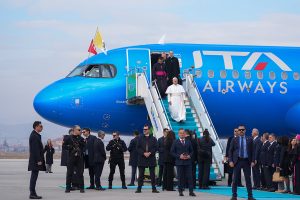
Pope Leo XIV arrives by plane from Rome in Ankara, Turkey, Nov. 27, 2025, at the beginning of his first international papal trip. The Vatican announced Feb. 25, 2026, that Pope Leo will travel to Monaco, Algeria, Cameroon, Angola, Equatorial Guinea and Spain. (CNS photo/Lola Gomez)
The pope’s international travel plans include a day trip to the Catholic principality of Monaco on March 28, a long journey across the African continent April 13 to 23, and a weeklong visit to Spain June 6 to 12 with expected stops in Madrid, the Canary Islands and in Barcelona to inaugurate the tallest tower in the Sagrada Familia.
In the first visit to the African continent since the start of his pontificate, Pope Leo will travel to Algeria, Cameroon, Angola and Equatorial Guinea. The Vatican has highlighted that peace and care for the poor will be central themes of the African journey, which will also bring him in the footsteps of St. Augustine.
Algeria: St. Augustine and Interfaith Dialogue
The pope’s apostolic journey to Africa will begin in Algeria, with stops in the capital Algiers and the northeastern city of Annaba from April 13 to 15. Pope Leo previously expressed to journalists his desire to visit the country to see the places associated with St. Augustine and to “continue the conversation of dialogue, of building bridges between the Christian world and the Muslim world.”
Annaba is home to the Basilica of St. Augustine, built near the ruins of the Basilica Pacis where the theologian died in A.D. 430 as Vandals besieged the city. A statue in the basilica contains a relic of one of Augustine’s arm bones.
Algeria is 99% Sunni Muslim, and the Catholic Church counts just 8,740 members, about 0.019% of the population, out of more than 45 million people, according to the 2025 edition of the Annuario Pontificio, the Vatican’s annual yearbook.
Cameroon: A Visit to a Conflict Zone
From Algeria, the pope travels to Cameroon from April 15 to 18, visiting the capital Yaoundé, the northwestern city of Bamenda and Douala, the country’s largest city and economic hub. The Bamenda stop brings Pope Leo directly into Cameroon’s Anglophone northwest, where a separatist conflict has been ongoing for nearly a decade.
The crisis began in 2017 when the government cracked down on strikes by English-speaking teachers and lawyers, triggering an armed insurgency that has since claimed thousands of lives and displaced hundreds of thousands more. Security concerns had cast doubt on whether the papal visit would be feasible.
Christianity is the predominant faith in Cameroon, practiced by more than 60% of the population, with more than 7.9 million Catholics in the country, making up 27.9% of the population, according to the Vatican’s latest statistics. Muslims account for approximately 30% of the population.
Angola: More than 17.9 million Catholics The pope will then travel to Angola from April 18 to 21, visiting Luanda, Muxima and Saurimo. Catholicism is the largest religious group in the country, which is home to more than 17.9 million Catholics, according to Vatican statistics, about 49% of the population.
Angola, despite its considerable oil wealth, continues to struggle with high poverty rates and deep economic inequality. Pope Benedict XVI was the last pope to visit Angola in 2009 following St. John Paul II’s 1992 trip to mark the 500th anniversary of its evangelization.
Equatorial Guinea: A Spanish-speaking African country
The final leg of the African journey brings Pope Leo to Equatorial Guinea from April 21 to 23, with stops in Malabo, Mongomo and Bata. About 81.58% of the country’s 1.37 million population is Catholic, according to the Vatican, making it one of the most Catholic nations in sub-Saharan Africa by percentage and the only Spanish-speaking country on the continent. It will be only the second papal visit in Equatorial Guinea’s history; the first was St. John Paul’s trip on Feb. 18, 1982.
In total, the apostolic journey to Africa will span 10 days, nearly as long as St. John Paul’s 11-day, seven country African trip in 1985.
Monaco: A Brief but Historic Visit
Before his African journey, Pope Leo will make a day trip to Monaco, the city-state nestled along the French Riviera, on March 28. His visit to Monaco, the second-smallest country in the world after Vatican City, will be his first international trip of 2026 and only the second of his pontificate. It will be the first papal visit to Monaco in the modern era.
The trip follows an invitation from Prince Albert II, who met with the pope at the Vatican in January and had previously invited Pope Francis. Roman Catholicism is the official state religion of Monaco, where roughly 82% of the population is Catholic, according to the Vatican.
Spain: Sagrada Família and the Canary Islands
Pope Leo’s international travel plans also include a weeklong visit to Spain from June 6 to 12 with expected stops in Madrid, Barcelona and the Canary Islands.
A highlight of the Barcelona visit will be the inauguration of the newest and tallest tower of the Sagrada Família.The visit falls during the centenary of Venerable Antoni Gaudí’s death; the architect was declared venerable last year, one step away from his possible beatification.
The Canary Islands, with expected stops in Tenerife and Gran Canaria, will likely draw attention to the issue of migration. The Atlantic archipelago, situated off the northwest coast of Africa, is one of Europe’s main entry points for migrants crossing from Africa, with tens of thousands of arrivals each year. The late Pope Francis had long hoped to visit the islands himself.
In addition to his international travel, the Vatican has previously announced that Pope Leo will make six trips within Italy this year, including visits to the shrine of Our Lady of the Rosary of Pompeii, the tomb of St. Augustine in northern Italy and the island of Lampedusa on July 4.
Social
PHILADELPHIA (OSV News) – On the fourth anniversary of Russia’s full-scale invasion of Ukraine, the Ukrainian Catholic bishops of the U.S. said “the people of God resist, trust, and pray” despite the “countless deaths and millions of casualties” the brutal conflict has claimed in 12 years of warfare.
The bishops, led by Metropolitan Archbishop Borys A. Gudziak of the Archeparchy of Philadelphia, issued a statement a day prior to the anniversary of Russia’s Feb. 24, 2022, invasion, while observing the war began with Russian-backed attacks on the country in 2014.
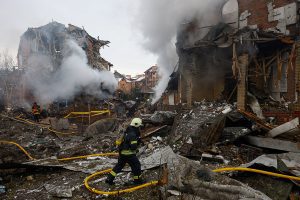
Firefighters work at the site of a residential building damaged during Russian drone and missile strikes in Kyiv, Ukraine, Feb. 22, 2026. (OSV News photo/Valentyn Ogirenko, Reuters)
In their statement, the bishops said “the genocidal intent is manifest” as Russia has regularly pummeled Ukraine’s energy grid, leaving millions without heat or electricity for days at a time, amid a winter that has been “the harshest in years.”
The bitter cold, with temperatures dropping well below freezing on a sustained basis, “has been deliberately exploited to break the spirit of a nation … standing for freedom, justice, democracy, and God-given human dignity.”
“It is a war against the people,” said the bishops.
They stressed that “Russia has systematically targeted Ukraine’s social and spiritual infrastructure,” pointing to “at least 2,881 attacks” on health care sites and personnel across the country.
Well over 4,000 educational institutions have been damaged, with 408 destroyed, said the bishops, noting Russia’s attacks on Ukrainian schools — which have seen children move to underground classrooms, or forego education altogether — affects “millions of children,” a number the United Nations recently put at about 4.6 million.
Russia has also taken aim at Ukraine’s religious communities, the bishops said, explaining that the Catholic Church and other Christians not affiliated with the Russian Orthodox Church have been systematically persecuted under Russian occupation.
“More than 600 churches and places of worship, representing various denominations, have been damaged or leveled,” they said, noting that “civilian prisoners, including clergy, are mercilessly tortured.”
In March 2024, the Russian Orthodox Church declared Russia’s war on Ukraine a “holy war.” Patriarch Kirill, the church’s head, told believers in a September 2022 sermon that Russian military personnel killed in Ukraine will have “all sins” washed away by their deaths.
Russian officials in the occupied Zaporizhzhia region formally “banned” the UGCC, the Knights of Columbus and Caritas.
Two UGCC Redemptorist priests, Father Ivan Levitsky and Father Bohdan Geleta, were abducted in late 2022 and subjected to torture while held in Russian custody for some 18 months prior to their Vatican-brokered release.
Multiple human rights reports have documented that torture — including beatings, mutilation and burning — and execution are commonplace and systematic in Russian captivity.
The bishops underscored these events to highlight how Ukrainians “stand and fight evil and tyranny to live and witness to the truth” at tremendous cost.
“Despite it all,” said the bishops, Ukrainians “live with gratitude. First, to God. And to all people who help.”
“They thank Americans and all people of goodwill throughout the world for their prayers,” the bishops said. “Prayers move mountains.”
In addition, Ukrainians “are grateful to all who stay informed, who counter disinformation, and who advocate for justice, a truly just peace,” said the bishops.
They concluded, “In their name, we ask that you continue until God’s truth prevails. It will. Our faith and our hope are in the Lord.”
Social
ASSISI, Italy (OSV News) – For the first time in eight centuries, the mortal remains of St. Francis of Assisi are being exposed for an extended period of public veneration, drawing hundreds of thousands of pilgrims from around the world to pray before “the Little Poor Man of Assisi.”
The bones of the beloved saint were unveiled for public display Feb. 22 in the Lower Church of the Basilica of St. Francis of Assisi. Pilgrims waited in line outside of the Assisi basilica, taking in the panoramic views of the Umbrian countryside from the medieval hilltop town, for their chance to pray before the relics.
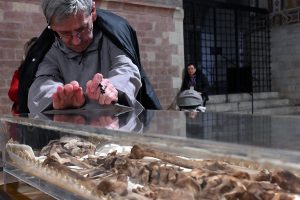
A monk prays during veneration of the remains of St. Francis during the first public display at the Basilica of St. Francis in Assisi, Italy, Feb. 22, 2026, to mark the 800th anniversary of the saint’s death. (OSV News photo/Alessia Giuliani, CPP)
The veneration runs through March 22 as part of the Catholic Church’s yearlong celebration of the 800th anniversary of St. Francis’ death in 1226.
Heather Martin, an American mother who has lived in Assisi for five years with her family, was among the first pilgrims to venerate the relics.
“St. Francis is by far the most important saint in my life. He’s shown up for me in so many ways and so many dark moments,” she told OSV News.
“This experience to be able to go and physically see his physical form has been utterly life-changing.”
Martin recalled a conversation she had with one of the Franciscan friars about the experience. “He felt like he was finally meeting a long-lost relative for the first time,” she said. “And I can’t agree with that more.”
Fabrizio Ballanti traveled from Ancona, Italy, as part of a care home run by the Focolare movement.
“We are a community for people with HIV and AIDS, and we all came together to live this experience,” Ballanti said.
Standing before the relics of St. Francis, he said, “I felt the presence of the Lord very strongly,” calling it “a truly powerful experience.”
For 21-year-old seminarian Gregory Maloney from the Archdiocese of St. Paul and Minneapolis, the moment was an opportunity to ask St. Francis for the gift of a deeper conversion “to grow in the virtue of poverty.”
He said that the long wait in line to view the relics gave him an opportunity to reflect on the life of St. Francis in prayer. “Here is the man who wanted to live poverty as Christ really said it in the Gospel,” Maloney said. “He wanted to give up his whole life, to give up all the things of the world to focus on the pearl of great price … the treasure of heaven.”
“And so that was a great encouragement for me then to say, ‘OK, what are the areas in my life I need to give to the Lord? I need to focus more on the things of heaven,” the seminarian added.
Franciscan friars opened the sarcophagus to exhume St. Francis’ remains Feb. 21, placing his bones on a specially prepared table in the crypt before carrying them in procession through the Lower Church while praying the Litany of the Saints.
Franciscans from across the world participated in a solemn vespers with the exposed relics beneath the basilica’s frescoed ceiling on the evening before the relics opened to the public.
Friar Ignacio Ceja Jimenez, a Franciscan friar from Mexico, called it a historic moment of fraternity for all branches of the Franciscan family “because we all recognize ourselves as children of St. Francis, heirs to his charism.”
“Seeing and praying before the body of St. Francis also means that we must commit ourselves to living what he lived,” he said.
“St. Francis reminds us that the Gospel can not only transform human beings, hearts, but that the Gospel can also transform the structures of our world and help us build a fraternal, peaceful world.”
Cardinal Ángel Fernández Artime, the pontifical delegate for the Papal Basilicas of Assisi, presided over both the vespers and the inaugural Mass Feb. 22.
The cardinal recalled St. Francis’ final hours on Oct. 3, 1226, in his homily for the Feb. 21 vespers.
“When St. Francis felt his death approaching, he asked a friar to read the Gospel to him. Not just any passage, but chapter 13 of John: ‘Before the feast of the Passover, Jesus, knowing that his hour had come … having loved his own who were in the world, he loved them to the end,'” Cardinal Artime said.
“His life had been this: a constant listening to the Word, a burning desire to conform himself to the poor and crucified Christ. Service and self-sacrificing love are the heart of Francis’s spirituality.”
Brother Jimmy Zammit of Toronto, now based in Rome as general definitor for the Franciscan order, shared his advice for Catholics unable to make the trip to Assisi who want to live out the special Jubilee Year of St. Francis in a particular way.
“If our heart becomes more Franciscan, we become makers of peace,” Brother Zammit said. “We seek out to help those who are less fortunate than we are to help the poor, but also to help those who are suffering because they’re feeling isolated and maybe even shunned in some way.”
Approximately 370,000 people from five continents have registered to venerate the relics, with Italians making up 80% of registrants. International registrations include 5,000 from the United States, 3,100 from Croatia, 2,000 from Slovakia and 1,500 each from Brazil and France. Some 400 volunteers from dozens of countries are giving of their time to make the monthlong historic event possible.
Entry to view St. Francis’ relics is free, but it requires advance registration at saintfrancisliveson.org. The exposition will close with Mass on March 22 in the Upper Church, to be presided over by Cardinal Matteo Maria Zuppi, archbishop of Bologna and president of the Italian Episcopal Conference.
“We are experiencing an event of extraordinary grace: For an entire month, in this holy land where St. Francis of Assisi lived and was buried, the exposition of his body is offered for the veneration of the faithful, on the eighth centenary of his death,” Cardinal Artime said.
“This body, fragile and poor, reminds us that the Gospel is also lived with the body, with real choices, with daily gestures. Francis did not love an idea of ??Christ: He loved Christ, poor and crucified, to the point of bearing his marks in his flesh.”
Social
VATICAN CITY (OSV News) – St. Peter’s Basilica inaugurated a new Stations of the Cross Feb. 20, with paintings by a young Swiss artist who won the Vatican’s international art competition and said in an interview with OSV News that he was deeply moved by the experience of painting St. Veronica’s encounter with Christ.
The 14 stations, which were prayed in St. Peter’s Basilica for the first time on the first Friday of Lent, will be displayed temporarily until Easter as part of the many initiatives to mark the 400th anniversary of the basilica’s consecration.
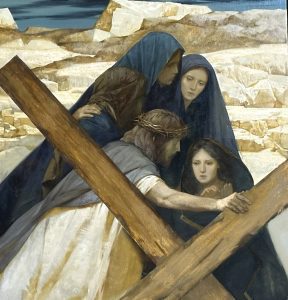
The eighth Station of the Cross, painted by a young Swiss artist who won the Vatican’s international art competition, is displayed in St. Peter’s Basilica. The new Stations of the Cross series by Manuel Andreas Dürr, a 36-year-old artist and father of three, was inaugurated Feb. 20, 2026. (OSV News photo/Courtney Mares)
Manuel Andreas Dürr, a 36-year-old artist and father of three, was chosen after a commission of art historians, liturgists and Vatican representatives unanimously selected his proposal from among more than a thousand submissions from 80 countries in the art competition that the Vatican opened in December 2023.
“To paint Jesus is very, very difficult because he is not someone I am introducing; he is someone that billions of people already have an idea of and have a relationship with,” Dürr said ahead of the inauguration in St. Peter’s Basilica Feb. 20.
Dürr is not Catholic, but describes himself as theologically “quite close to Catholic faith.” He is a member of the Jahu community, a Christian group with roots in the Reformed Church that he said is “very ecumenical and influenced by different traditions.” He had previously painted Stations of the Cross for his local church in Switzerland in past years. Now his Via Crucis hangs in one of the world’s most visited religious sites.
The experience of visiting the Vatican, he said, was the first time he understood the universal dimension of the Catholic Church.
“One thing that came as a bit of a shock, in a sense, was when I came to Rome, I suddenly realized that really this is a global Church,” he said. “My own church at home feels very provincial when I come here and I see people from all ages, from all continents, and from all income classes, are gathering around shared expressions of faith.”
Dürr spent eight months completing the paintings after winning the contest, which carried a cash prize of 120,000 euros, or about $131,000.
He had not sought out the competition himself. “I actually wasn’t aware of the competition,” he said. “A friend of mine suggested that I partake in it. Of course, I never dreamed that it would actually happen, but somehow here we are, almost two years later. And I’m really, really humbled by having the honor to attempt such a thing.”
Among the 14 stations, Dürr said one particularly moved him. “To my surprise, maybe, a little bit, Veronica was the most special station for me,” he told OSV News.
“She holds up a cloth which then has an imprint of the image of Christ. And I found basically that’s what I’m attempting to do. I’m painting on cloth in a small way. … And for me, this kind of dignified, I think, what the painter is attempting to do which is … to provide a trace of something deeper to be experienced.”
The Crucifixion scene, he said, was both the first oil painting he began and the last he completed.
“This story has shaped Christian art and European culture … the world’s culture, like no other story has,” he said. “And how this cross, which was intended as a symbol of terror, instilling fear into the subjects of the Roman Empire, suddenly becomes something that we wear around our necks as a symbol of hope.”
Cardinal Mauro Gambetti, rector of St. Peter’s Basilica, presided over the inauguration at the Altar of the Chair in the basilica, where afterward the Way of the Cross was prayed with the new images for the first time.
Among those praying before the paintings that day was Hannah Kemper, a 27-year-old American who had no idea she was among the first to see the works on display. She had simply been visiting the basilica and felt drawn to pray the Stations of the Cross when she spotted them.
“How could you not feel close to our Lord like in this place?” she said, looking around the basilica. “My senses are so heightened to his glory and to contrast that to his suffering on the cross — it’s just so beautiful.”