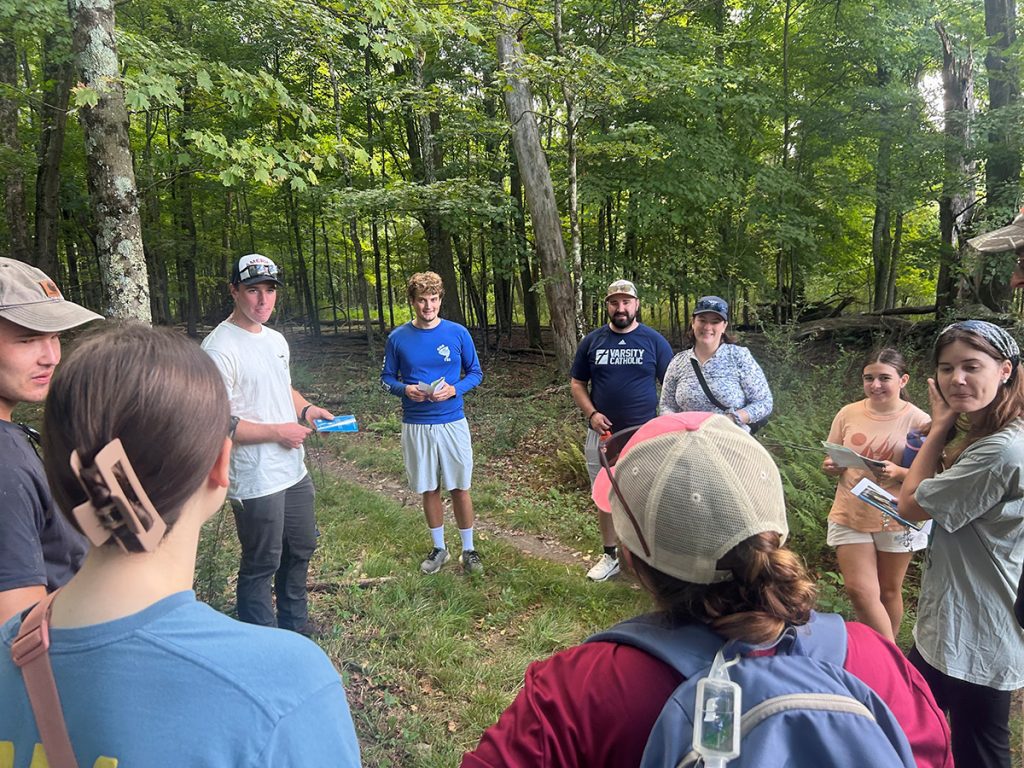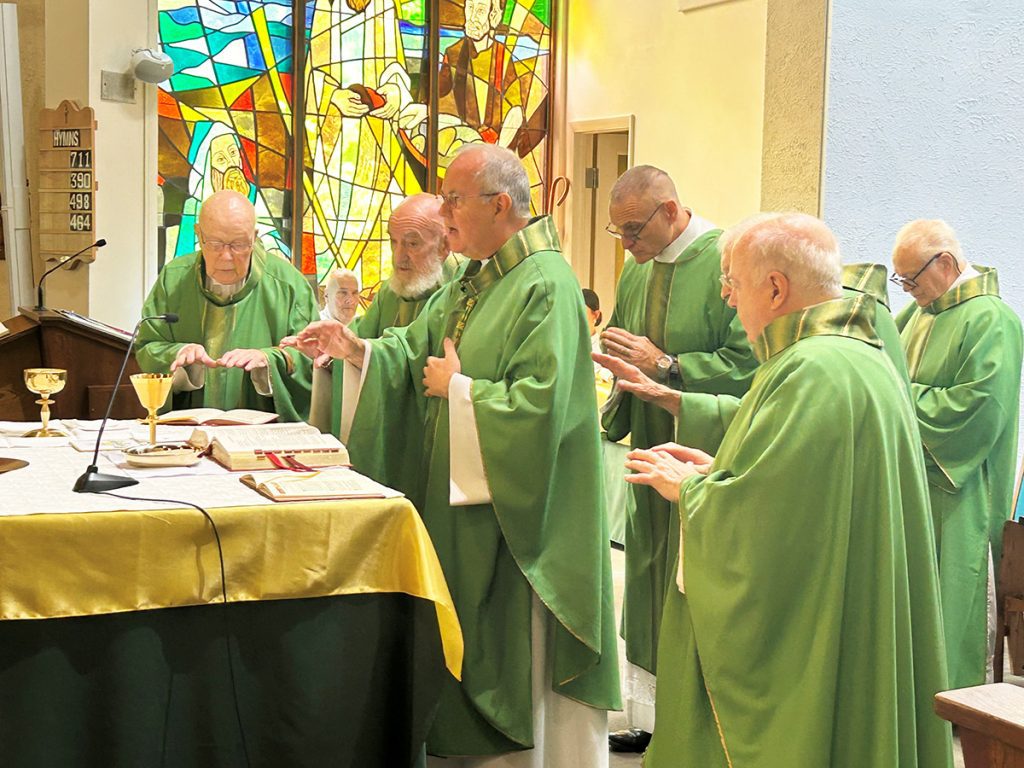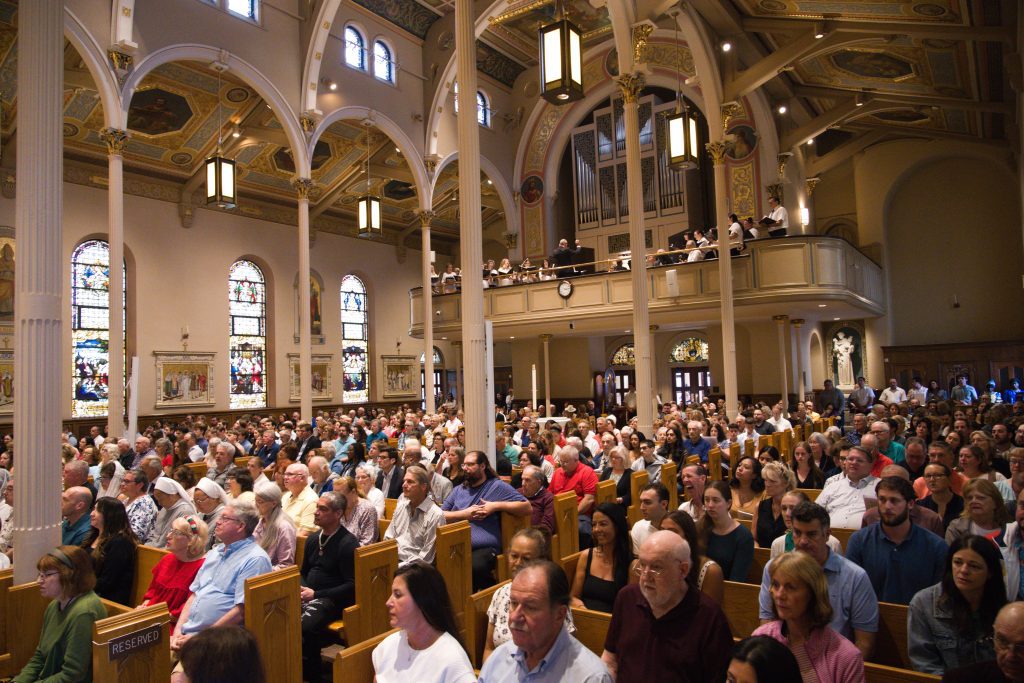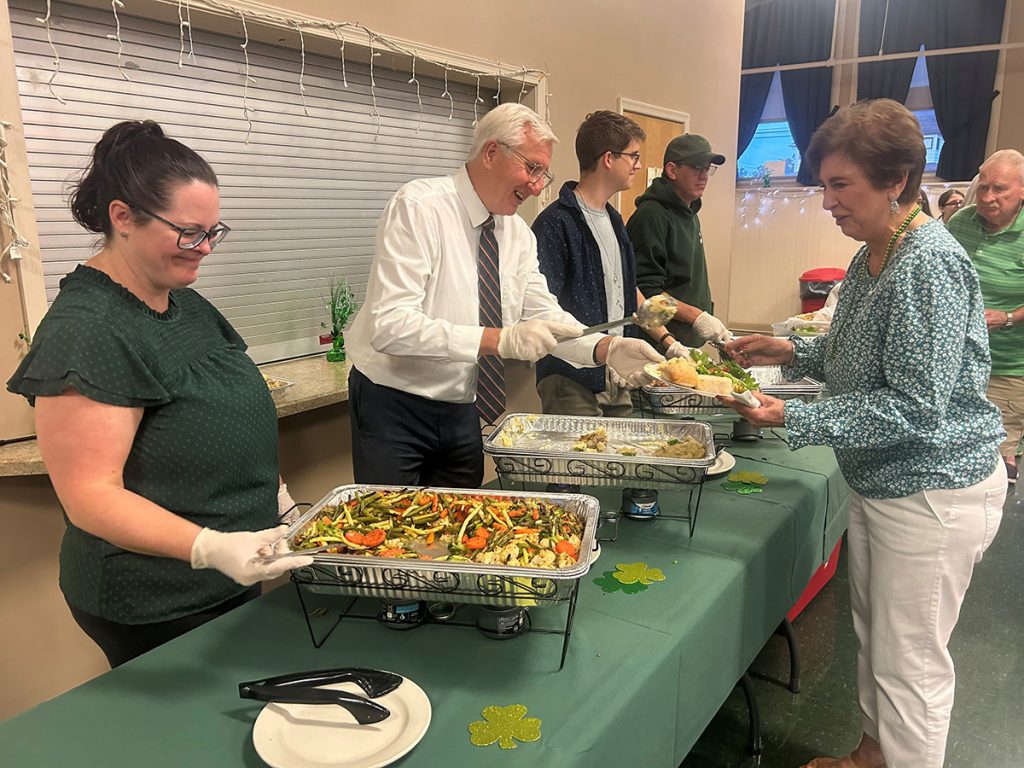
The 53 high school students from parishes across the Diocese of Scranton who participated in Quo Vadis and Fiat Days at Marywood University from June 29-July 1, 2026, pose for a group photo with Bishop Joseph C. Bambera, priests, religious sisters, and seminarians who made the summer camp experience possible. (Photo/Dan Gallagher)


SCRANTON – For many Catholic teenagers, living their faith can sometimes feel like a lonely experience.

As they navigate school, sports, and peer groups, they may wonder if anyone else their age shares a love for Jesus Christ and the Church.

For 53 high school students from across the Diocese of Scranton, Quo Vadis and Fiat Days offered a reassuring answer this summer: You are not alone.

Held June 29 – July 1, 2026, at Marywood University, the Diocese’s annual vocation camps brought together 34 young men for Quo Vadis Days and 19 young women for Fiat Days to pray, build friendships and reflect on how God may be calling them to serve Him.

Through daily Mass, Eucharistic Adoration, talks, games, small-group discussions and time with priests, seminarians and religious sisters, participants were invited to listen more closely for God’s voice while discovering a community of young Catholics striving to do the same.

“It feels great because, number one, I’m not alone out there,” Jake Sanchez of Saint Matthew Parish in East Stroudsburg, said. “I have other people to share my thoughts and ideas with. It’s nice to know that there are other people with a strong faith in God.”

Sanchez attended Quo Vadis Days for the second consecutive year. He said returning for a second summer was an easy decision.

“Everything about it, the experience, making friends, Mass, everything about it is amazing. I think everyone should try it out, even if they think they won’t like it, you never know until you try it,” Sanchez said.

Throughout the three-day experience, students learned about the many vocations within the Church, including marriage, priesthood, diaconate, and religious life, while also reflecting on how God is calling them to holiness today.

For Eddie Scavone of Our Lady of the Snows Parish in Clarks Summit, one of the most meaningful moments was Eucharistic Adoration.

“I really enjoy the Holy Hour,” he said. “It’s really nice to just sit in the Chapel during Adoration and enjoy the presence of God and have confessions at the same time.”

Still discerning what his future holds, Scavone said the camp has helped him approach that process with greater confidence.

“They’re definitely giving me good tips and ideas for how to correctly discern what God is calling me to do,” he added.

For the young women attending Fiat Days, the opportunity to spend time with religious sisters offered a unique perspective on vocational discernment.

Emily Lopez of Saint Teresa of Calcutta Parish in Scranton returned for her third year because she says each experience has drawn her closer to Christ.

“I think I look forward to it because the connection I feel each year toward God gets deeper,” Lopez explained. “I just learn more. I learn how to connect with Jesus and learn more about the Holy Spirit. It’s really nice and you feel peaceful.”

Lopez said one of the greatest blessings of Fiat Days is realizing there are many other teenagers striving to grow in faith.

“When you feel like you’re alone, it’s hard because you think you’re the only teenager who believes in God,” she said. “But when you surround yourself with people who are just like you and are also sinners but at the same time trying to get closer to God, it feels more relieving. You realize, ‘I’m not the only one.’”

First-time participant Emily Barrett from Saint Carlo Acutis Parish in Olyphant echoed that sentiment.

“I think it’s pretty awesome to spend time with other girls my age who share the same faith,” Barrett said. “It’s good to talk to them and get excited about it and just have fun with it.”

She described the opening Mass of Fiat Days as one of the highlights of the camp.

“I just felt like that was the closest I’ve felt to God in a while,” she said. “I go to church often, but I really felt something different that time.”

SCRANTON – Dozens of high school students who spent time discerning their vocation during the Diocese of Scranton’s annual Quo Vadis and Fiat Days summer camp this summer were given a firsthand glimpse of what answering the call to the Priesthood can look like.

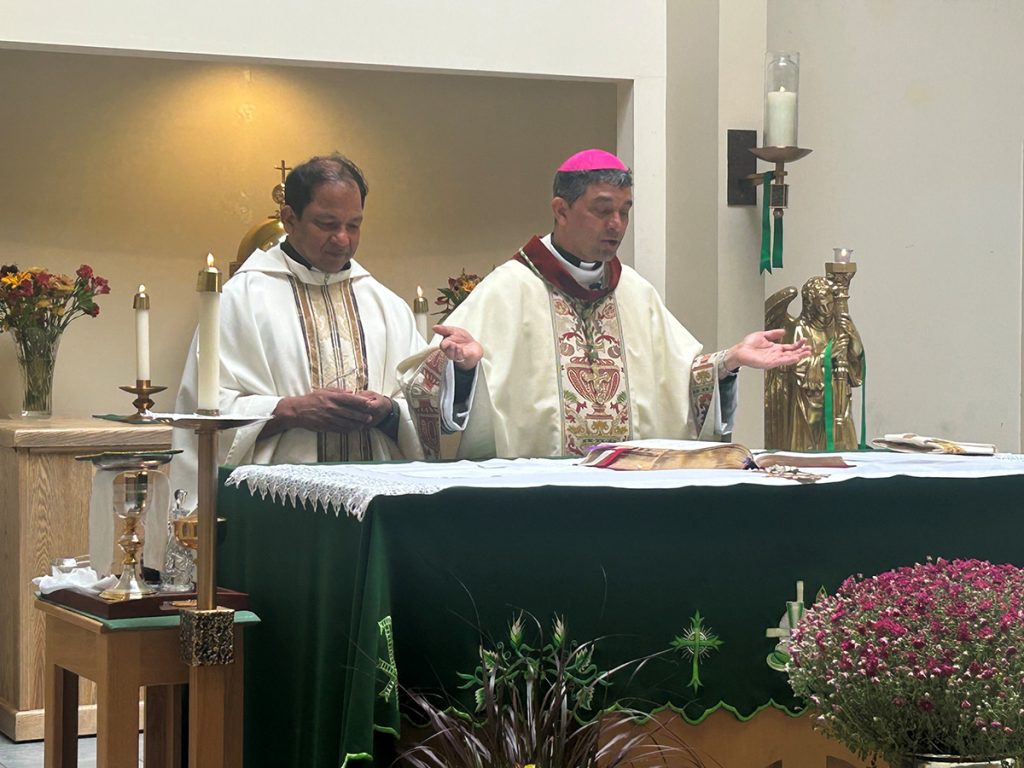
During a Mass celebrated by the Most Rev. Joseph C. Bambera, Bishop of Scranton, on June 30, 2026, at Marywood University, Diocesan seminarian Roberto Carlos Acevedo Ruiz took part in the Rite of Admission to Candidacy for Holy Orders, a significant milestone in his journey toward the priesthood.

Seminarian Roberto Carlos Acevedo Ruiz stands before Bishop Joseph C. Bambera during the Rite of Candidacy June 30, 2026, at Marywood University. (Photo/Mike Melisky)

Acevedo Ruiz, whose home parish is Saint Pius of Pietrelcina in Hazleton and who studies at Pope Saint John XXIII National Seminary in Weston, Mass., was presented to Bishop Bambera by Father Alex J. Roche, Diocesan Secretary for Clergy Formation, Rector of Saint Pius X Seminary, and Director of Seminarians.

After being called forward by name, Acevedo Ruiz stood before the Bishop and publicly affirmed his willingness to continue preparing for priestly ministry, responding, “I do,” as Bishop Bambera questioned him during the Rite.

Drawing from the day’s Gospel from Saint Matthew, in which Jesus calms the storm at sea, Bishop Bambera explained to those attending that they never face life’s challenges alone.

“No matter how harsh the winds and the waves of the storm that envelop you, Jesus walks with you. Jesus is with you in the midst of your struggles,” Bishop Bambera said.

Addressing Acevedo Ruiz directly, the Bishop encouraged him to place complete trust in the Lord as he continues discerning his vocation.

“Roberto, trust Him, trust Him, for He will never let you go,” Bishop Bambera added.

The Bishop explained that the Rite of Admission to Candidacy marks the Church’s formal recognition that a seminarian has demonstrated the qualities necessary to continue preparing for ordained ministry. At the same time, he said, the Rite challenges the candidate to deepen his relationship with Christ and strengthen his commitment to serving God’s people.

“Open your heart, Roberto, to the Lord’s call to serve the Church,” Bishop Bambera said. “Trust today like never before in His grace and mercy.”

Following the Mass, Acevedo Ruiz described the celebration as a profound moment in his vocational journey.

“I am very happy because responding to God’s call to the priesthood is a profoundly transformative experience,” he said. “I have discovered my life’s purpose and desire to dedicate myself to God and to serve others.”

Calling the Rite of Candidacy a “huge step,” he said he believes God continues to shape his heart for priestly ministry.

“God is forming within me what He has done with me, how He has called me and all the beautiful new things He has done in my life,” Acevedo Ruiz said.

He also expressed gratitude to those who have accompanied him throughout his discernment.

“I give thanks to God for my family, who support me, for the communities in the different parishes where I serve, for their prayers, for my Bishop, and for the guidance of Father Alex, who has been a great blessing in my life,” he said.

SCRANTON – Surrounded by family, friends, fellow clergy, and faithful from across the Diocese of Scranton, Father Jan Carlo Pérez was ordained to the Priesthood on Saturday, June 27, 2026, at the Cathedral of Saint Peter in Scranton.

The Ordination was conferred through the imposition of hands and the invocation of the Holy Spirit by the Most Rev. Joseph C. Bambera, Bishop of Scranton, at a joyful 10:00 a.m. liturgy.

Father Jan Carlo Pérez said one of the most meaningful moments of the Ordination Mass was when Bishop Joseph C. Bambera used Sacred Chrism to anoint his hands on June 27, 2026. (Photo/Mike Melisky)

The Ordination Mass marks the beginning of Father Pérez’s ministry as a priest of Jesus Christ in service to the Church.

Several hundred people were in attendance, including many from the East Stroudsburg area, where Father Pérez grew up and has been formed in faith.

A bus carrying more than 30 parishioners from Saint Matthew Parish made the hour-long journey to Scranton, while many others traveled on their own, arriving early to sit together prominently near the front right side of the Cathedral.

The Mass itself was marked by both solemnity and beauty.

The Diocese of Scranton Festival Choir and instrumentalists led powerful musical selections, including a stirring entrance hymn, “Lift High the Cross,” underscored by strong percussion that filled the Cathedral.

In his homily, Bishop Bambera reflected on the mystery of vocation and the trust required of those called to priestly ministry. Drawing from the Scripture readings picked by Father Pérez for the liturgy, the Bishop reminded him that God, not human strength alone, brings to completion the work He begins in each vocation.

“At the heart of authentic discipleship,” the Bishop said, “there must be a radical trust and belief that it is God who has begun the good work in us and God – not we ourselves – who will bring it to fulfillment.”

Following the homily, Father Pérez made his promises of priestly service, including obedience to the Bishop and commitment to the celebration of the sacraments, before prostrating himself on the Cathedral floor during the Litany of Supplication as the Church prayed for the outpouring of God’s grace.

The essential moment of the Ordination Mass followed: Bishop Bambera laid his hands upon Father Pérez’s head, joined by the other priests of the Diocese present, invoking the Holy Spirit in the ancient rite that marks a man forever as a priest of Jesus Christ.

After the Prayer of Ordination, Father Pérez’s hands were anointed with Sacred Chrism, and he was vested before receiving a chalice and paten – signs of his participation in the Eucharistic sacrifice.

A MOMENT STILL SINKING IN

In an interview immediately following the liturgy, Father Pérez described the experience as overwhelming and difficult to fully absorb.

“It’s kind of surreal to have actually gone through this after imagining it so many times,” he said. “To actually undergo all of these signs and symbols and be welcomed into the Order of Presbyters … it’s really something. I’m still letting it sink in.”

He pointed to the anointing of his hands as a moment that especially impacted him.

“That really struck me, that these hands have been set aside for God’s will,” he said.

Father Pérez also spoke with gratitude about the presence of so many parishioners from East Stroudsburg who traveled to be with him.

“It’s incredible. I looked out and thought, who are all these people who have come for me?” he said. “It really means a lot to me that so many people would come out to pray for me.”

At the conclusion of Mass, Bishop Bambera announced that Father Pérez was being assigned as Assistant Pastor of Our Lady Queen of Peace Parish in Brodheadsville.

Father Pérez said he looks forward to ministry in the Monroe County region, especially in Hispanic ministry and youth outreach.

“There are people who have been astranged from the Church or astranged from God for long periods of time and they can be called back,” he said. “If I can participate in that, I think that’s the greatest thing I could possibly do in my life.”

‘WE ARE SO PROUD’

Among those attending the Ordination was Angie Rose, a parishioner of Saint Matthew Parish, who described the Mass as deeply moving.

“We are so proud,” she said. “This is like being a mama almost. He is part of the church family.”

She credited parish life and Eucharistic Adoration for fostering vocations and spiritual growth in the community.

“It makes us so proud to be Catholic,” she said. “You want to go to the rooftops and say, I’m a practicing Catholic!”

For many in attendance, the Ordination Mass was also their first experience inside the Cathedral of Saint Peter – an experience they described as powerful and faith-affirming.

“This is so special,” Rose added. “We can see God’s hand. God is not dead. He is alive and He is working.”

HAZLETON – The church where Rev. Jose Luis Batista Castillo, O.S.J., first encountered the spirituality that shaped his vocation became the place where that calling reached its fulfillment on July 1, 2026.

Before a standing-room only crowd at Saint Gabriel Church in Hazleton, the principal worship site of Saint Pius of Pietrelcina Parish, the Most Rev. Joseph C. Bambera, Bishop of Scranton, ordained Batista to the priesthood for the Oblates of Saint Joseph.

Father Mariusz Beczek, O.S.J., former pastor of Annunciation Parish in Hazleton, greets Rev. Jose Luis Batista Castillo, O.S.J., with a fraternal hug during his Ordination Mass at Saint Gabriel Church in Hazleton July 1, 2026. (Photos/Dan Piazza)

The Ordination Mass carried special significance for the newly ordained priest, whose family immigrated to Hazleton from the Dominican Republic during his childhood. It was while the former Annunciation Parish was under the pastoral care of the Oblates of Saint Joseph that he first came to know the religious community and began discerning God’s call.

“Today I became more conformed to Christ, for the glory of the Lord and also for the service of His people,” Father Jose said following the Ordination Mass.

He explained that his vocation grew through prayer and a growing desire to give his life in service to God and the Church.

“I really wanted to give myself to God and the people. As I was praying and discerning in my life, I received the call to the priesthood. At first, it was a shock to me. But then, little by little, the Lord let me know He wanted me to give myself to Him,” he said.

The Ordination Mass included the ancient rites of the Church, including the Litany of the Saints, the Prayer of Ordination, the laying on of hands by Bishop Bambera and the concelebrating priests, and the anointing of the new priest’s hands with Sacred Chrism.

Reflecting on the Litany of the Saints, during which he lay prostrate before the altar, Father Jose described it as a moment of complete surrender.

“For me, that was a beautiful moment of just giving myself to the Lord and letting Him do the rest,” he said. “I asked for the intercession of all the saints to help me be open to the grace of God.”

One of the most emotional moments came at the conclusion of the Mass, when the newly ordained priest imparted his first priestly blessing on his parents.

“I’ve been in the seminary for a long time, almost 11 years now, and they were always asking ‘When are you going to be ordained,’” Father Jose explained. “For them to have the opportunity to witness my ordination, it was a very touching moment for me and also for them. When we are kids, our parents are the one who bless us and now I’m the one blessing my parents!”

Father Jose said he left the Ordination Mass with profound gratitude.

“I feel welcomed by God, by the Church and by His people,” he said. “Tonight I’m very grateful to God, and to the Bishop, and to all the people who made it possible for this to happen.”

On the evening following the Ordination, a Mass was Thanksgiving was celebrated in the Oblates of Saint Joseph Chapel in Laflin. Rev. Matthew Spencer, O.S.J., former provincial superior, who is currently serving at a parish in California, served as homilist for that Mass.

SCRANTON – For more than 70 years, Catholics found a spiritual home inside Immaculate Heart of Mary Chapel in West Scranton, where they celebrated baptisms and weddings, mourned loved ones at funeral Masses, and gathered week after week around the altar in prayer.

On Saturday, June 27, 2026, those memories filled the small church one final time as approximately 150 parishioners gathered with gratitude, but also sadness, to celebrate the Closing Mass of the IHM Chapel, which was a secondary worship site of Saint Patrick Parish in West Scranton.

More than 150 people attended the Closing Mass for Immaculate Heart of Mary Chapel in West Scranton on Saturday, June 27, 2026. (Photo/Eric Deabill)

Father Richard E. Fox, Pastor of Saint Patrick Parish, served as principal celebrant and homilist of the 5:30 p.m. Mass. Concelebrating was Father Joseph R. Kakareka, a retired Diocesan priest, who has assisted at the Chapel for many years.

“Thank you all for coming and being part of this sad Mass,” Father Fox said in welcoming the faithful. “It is certainly not a happy occasion for anybody.”

The history of Immaculate Heart of Mary Chapel dates back to 1953, when it was constructed at the direction of Bishop William Hafey, Fourth Bishop of Scranton, following a devastating fire that destroyed the nearby Saint Ann’s Maronite church.

In constructing the IHM Chapel, Bishop Hafey had hoped the new church would lead to a cooperative effort involving Saint Patrick Parish and Saint Ann’s Maronite Parish – but that did not materialize – with hundreds of letters exchanged between Scranton, Rome, Beirut, and Washington, D.C.

Fast forward to 2026, the decision to close Immaculate Heart of Mary Chapel came after discussion and consultation through the Diocese of Scranton’s Vision 2030 Pastoral Planning Process. After examining Mass attendance trends, the significant financial challenges facing Saint Patrick Parish, and mounting maintenance needs at the Chapel, the recommendation was made to close the worship site.

Rather than dwelling on those realities during his homily, Father Fox encouraged parishioners to reflect upon the countless memories of grace they had experienced inside the church since its dedication in 1953.

“So, I have to ask this question,” Father Fox began his homily by saying. “Has anybody in this church been here since the first Mass that started way back in the early 1950s?”

Several hands rose throughout the pews.

“You’ve seen the span from the first parenthesis when it opened to the second parenthesis tonight,” the long-time pastor continued. “It certainly is a world of experiences. Certainly, a world of memories.”

Looking around the church, Father Fox invited parishioners to absorb every familiar detail one last time.

“This Mass not only brings back all those memories, it helps us to experience once again all of those times in our lives,” he said. “After tonight, you are expected to be able to take those memories and carry them in your hearts.”

Comparing memories to dreams that quickly fade, Father Fox encouraged the faithful to create what he described as a mental “reel” of the chapel so they can continue sharing its story for years to come.

“When people talk about this particular place … you can enter into that conversation with your particular perspective because you remember all the things that happened,” he explained. “I believe that we can keep that same technique alive here in our own day and age – to continue to tell the stories of what happened here at the corner of North Garfield and Oram Street.”

The conclusion of the liturgy provided parishioners with a final opportunity to say goodbye.

Father Fox led prayers throughout the church, stopping at the ambo, the cry room, the Marian statue and finally the altar before inviting everyone to come forward individually. Each person was encouraged to touch the altar, make the Sign of the Cross, and process out of the church one final time.

Among those given the honor of locking the Chapel doors for the last time were longtime parishioners John (Jack) and Paula Keenan.

“It is a sad day, bittersweet because we have been coming here for so many years,” Paula Keenan said.

She said she will especially remember the chapel’s crucifix and Marian statute as well as the atmosphere that made the church unique.

“It was so intimate coming to Mass here,” she reflected. “That is what I appreciated the most.”

Following the locking of the doors, the Blessed Sacrament was reverently transferred by limousine from Immaculate Heart of Mary Chapel to Saint Patrick Church on Jackson Street, where the People of God will continue to carry the church’s mission forward.

SCRANTON – A total of 172 married couples from 69 parishes across the Diocese of Scranton gathered at the Cathedral of Saint Peter on Sunday, June 28, 2026, for the annual Diocesan Wedding Anniversary Mass which honors couples marking milestone anniversaries.

The liturgy was celebrated by the Most Rev. Joseph C. Bambera, Bishop of Scranton, on the Thirteenth Sunday in Ordinary Time and included couples celebrating 10, 25, 40 and 50 years of marriage and beyond.

In all, the couples attending the Mass signified 6,580 years of married life.

In his homily, Bishop Bambera reflected on the Sunday Gospel from Saint Matthew, acknowledging that Jesus’ words about the demands of discipleship might initially seem surprising in the context of a celebration of marriage.

He noted, however, that authentic discipleship is rooted in selfless love, sacrifice and perseverance. Those are all qualities that also define a faithful married life.

“Your marriage has endured not because the years have been perfect, but because you have come to see marriage as part of something much bigger than yourselves,” Bishop Bambera said, pointing to the “mystery of God’s love discovered in your lives together.”

He encouraged all couples to recognize both the struggles and blessings that shape their vocation, and to see “the face of God abiding within the heart of the one you love.”

Following the homily, couples renewed their marriage vows and at the conclusion of the Mass, a reception followed the Mass at the Diocesan Pastoral Center across the street from the Cathedral.

Among those celebrating their 10th anniversary were Thomas (T.J.) and Christina Masteller of Saint Jude Parish in Mountain Top, who reflected on the grace they have experienced in their marriage.

“There is so much grace in celebrating the sacrament,” Christina said. “We know that there is strength in that, and Lord knows you need that in a marriage.”

Her husband added that forgiveness is essential.

“There are going to be ups and downs and trials,” Thomas added. “Nothing is easy, but being able to forgive one another is the most important piece.”

John Gablonski and Rita Ives of Saint Faustina Kowalska Parish in Nanticoke, who are also marking 10 years, spoke of the gift of finding one another later in life.

“We’re actually second marriages. We’re both widows and just the fact that we met each other and we’re able to be together in marriage is a great gift for us,” Rita said. “I never thought that we’d celebrate any type of milestone anniversary.”

“It was a pleasure to be able to do this,” John added. “It was very spiritual. It was amazing.”

Celebrating 25 years of marriage, Katherine and Diego Pelaez of Saint Luke Parish in Stroudsburg emphasized faith and communication as the secrets to a happy marriage.

“To have Christ first in your marriage,” Katherine said.

Diego added, “Having God in the center of our life, in the center of our lives basically to keep us together, along with communication, quick forgiveness and compromise.”

Those were very similar sentiments shared by Bishop Bambera, who indicated that marriage is sustained through faith, forgiveness and the daily decision to love selflessly.

Quoting Pope Leo XIV, the Bishop reminded couples that “Marriage is not an ideal … but the measure of true love between a man and a woman.”

SCRANTON – The story of Moses being rescued from the Nile River is one that many children read in the Bible. At Mary Mother of God Parish’s Vacation Bible School, youngsters were able to watch a reenactment of it unfold before their eyes.

On the final day of the parish’s four-day Vacation Bible School, held June 22-25, children walked just a block from the Holy Rosary Church to Leggetts Creek, where volunteers reenacted the Old Testament story of the infant Moses being placed in a basket among the reeds and discovered by Pharaoh’s daughter.

Molly Fenwick, left, and other volunteers from Mary Mother of God Parish in Scranton reenact the story of Moses being rescued from the Nile River by using Leggetts Creek in North Scranton on June 25, 2026. (Photo/Dan Piazza)

The memorable lesson helped the young children better understand how God protected Moses, who would later lead the Hebrew people out of slavery in Egypt.

“We don’t have too many mountains around here, but we do have Leggetts Creek and it’s moving just enough that it can move the basket down the river,” Father Cyril Edwards, Pastor of Mary Mother of God Parish, said. “I’m not a teacher by trade but teachers say, ‘Teach me and I’ll get it, but involve me and I’ll understand.’”

Father Edwards said using the creek will hopefully help the children experience Scripture in a way that they will long remember.

“I hope they understand that God works in mysterious ways. The baby being in the river was a one in a million chance that it would be found by Pharaoh’s daughter,” Father Edwards reflected.

The reenactment complemented this year’s Vacation Bible School theme, “Jesus Loves Us.”

“God never abandons his people,” Father Edwards added.

The parish’s Vacation Bible School welcomed preschoolers through fourth-grade students for mornings filled with Bible lessons, music, crafts, games, and prayer, while teenage volunteers helped lead activities and mentor younger children.

“I love working with my church,” volunteer Molly Fenwick said. “I have such a strong faith, and I love getting to share my faith with the younger generation in hopes that their faith is very strong too.”

“I like being with the kids and just helping and giving back,” volunteer Anna Woody said.

For fourth-grader Annabelle Converse, the creek activity became one of the week’s highlights.

“People were down there and they showed examples to help people picture it,” she said.

Along with learning Bible stories, children also took home lessons that will last well beyond the summer.

“We’re learning kindness,” Annabelle said.

Her classmate, Anna Belle Mackey, agreed.

“Always be nice to everybody,” she said.

DUNMORE – From making colorful necklaces and singing songs for Mass to learning about God’s gift of creation, children participating in this year’s Vacation Bible School in Dunmore discovered that faith is best experienced together.

Held June 15-19, 2026, on the grounds of Saint Rocco Church, the weeklong program welcomed children from Saints Anthony and Rocco Parish and Our Lady of Mount Carmel Parish, just days before the two communities consolidated into what is now Saint John Paul II Parish.

Guided by teen and adult volunteers, campers rotated through music, craft, Bible stories, outdoor games, and hands-on activities, all centered around this year’s rainforest theme.

High school volunteers help to lead a music session during Vacation Bible School for students of the former Saints Anthony and Rocco and Our Lady of Mount Carmel Parishes in Dunmore on June 15, 2026. The two parishes consolidated on July 1, 2026, and took on the new name of Saint John Paul II Parish. (Photo/Dan Piazza)

For Avery Shivock, who will enter fourth grade this fall, this summer marked her final year as a Vacation Bible School camper before she hopes to someday return as a volunteer.

“There are a lot of fun activities here,” Shivock said. “You make new friends and learn new things. It’s really nice.”

Among her favorite activities is the craft station, where campers created colorful necklaces on the opening day.

“You learn how to be helpful; you learn a lot about the Bible. There is a great variety,” she added.

Many of the volunteers guiding the young campers once stood in their shoes.

“I’ve been doing this camp since I was a little girl and now helping at it is a great experience,” high school volunteer Mollie Urban said. “I honestly love being able to help the children. It’s very fun and I love seeing the smiles on their faces.”

Anna Polishan, a senior from Our Lady of Mount Carmel Parish, helped lead the music sessions, teaching songs the children would later sing during the closing Mass of Vacation Bible School.

“I want the kids to know that faith doesn’t have to be boring,” she said. “It can be fun and it can be joyful, and I think music is a really great way to do that.”

Throughout the week, children learned that God is present in every moment of their life.

Fifth-grader Grace Markovich said one lesson especially stayed with her.

“We learned that God is with us when we’re sad, happy, sick. He’s always with us, no matter what,” Markovich said.

For Sister Donna Cerminaro, M.P.F., Director of Religious Education, seeing former campers return as volunteers each year has become one of the program’s greatest blessings.

“We have been doing this for about 15 years,” she said. “We have many volunteers. In fact, our leaders are high school kids and seventh and eighth graders. They keep on coming back every year. They just walk through the door and say, ‘I am here to help.’”

Sister Donna loves to watch the program continue to bear fruit year after year.

“I hope they have a better understanding of God and a better understanding of the Bible,” she said.

WASHINGTON (OSV News) – The U.S. Conference of Catholic Bishops and other Catholic groups submitted public comments in opposition to a proposed government regulation that would expand insurance coverage for in vitro fertilization.

IVF is a form of fertility treatment opposed by the Catholic Church because it separates procreation from the marital act and often involves the destruction of human embryos, among other concerns.

An American flag hangs on the U.S. Department of Labor headquarters in Washington Sept. 6, 2025. The U.S. Conference of Catholic Bishops and other Catholic groups submitted public comments in opposition to a proposed government regulation that would expand insurance coverage for in vitro fertilization, or IVF. (OSV News photo/Daniel Becerril, Reuters)

The proposed regulation, announced in May by the U.S. Departments of Labor, Health and Human Services, and the U.S. Treasury, aims to help implement President Donald Trump’s February 2025 executive order to expand IVF access, the departments indicated. It would establish a new category of limited excepted benefits, similar to limited-scope dental or vision benefits, the departments said at the time.

In a 17-page public comment dated July 13 and addressed to the Labor Department, the Office of the General Counsel at the USCCB stated that it “appreciates the Departments’ recognition of infertility as a serious matter and their intent to support family formation.”

“The Church affirms the deep desire of spouses to welcome children and supports medical efforts to address infertility. At the same time, public policy should not promote practices that undermine the dignity of human life or sever the connection between procreation and the marital act,” the comment said. “The USCCB therefore evaluates the proposed rule both positively and critically.”

The comment was signed by William J. Quinn, general counsel for the USCCB, and Daniel Balserak, associate general counsel.

After explaining the Church’s objections to IVF, they urged the government to consider promoting instead what they called restorative reproductive medicine.

“RRM approaches generally recognize that infertility is a symptom of an underlying condition, not a disease in and of itself; and they therefore seek to restore normal reproductive function by identifying and treating its root causes,” they wrote. “In contrast to restorative reproductive medicine, in vitro fertilization does not aim to treat the underlying causes of infertility but seeks to bypass them — in a sense, overriding the symptom.”

The USCCB also urged that the final rule “should clarify that no employer, having chosen to offer fertility benefits, must cover any particular service, and should proactively protect the religious liberty and conscience rights of employers and employees.”

The comment was submitted on the final day of the public comment window for the proposed regulation.

“The proposed rule represents a valuable opportunity to advance real solutions to infertility that respect the God-given dignity of parents and of children, born and preborn,” the comment stated. “We urge the Departments to refocus the rule on therapeutic, restorative treatments, and to abandon its inclusion of IVF, which is profoundly flawed both legally and morally.”

The National Catholic Bioethics Center, the Catholic Medical Association and the National Association of Catholic Nurses USA filed a similar public comment. They argued that the proposal lacks sufficient conscience protections, among their other objections to IVF.

(OSV News) – Damage from two back-to-back earthquakes that struck Venezuela June 24 is “a lot worse than expected,” said a Catholic Relief Services disaster response worker, who asked people to “keep Venezuelans in their hearts.”

Arriving in the Latin American nation July 9, Robyn Fieser — who is coordinating CRS emergency communications on the ground — found “there were literally blocks of buildings that were just pancaked onto themselves. There was massive destruction for blocks.”

“It looked a little bit like a war zone,” said Fieser, speaking to OSV News from Venezuela in a July 13 call.

At least 4,500 were killed during the 7.2 and 7.5 quakes, which took place just 39 seconds apart.

A drone view shows debris of collapsed buildings in La Guaira, Venezuela, July 12, 2026, in the aftermath of the June 24 earthquakes. The death toll from the two earthquakes has risen to at least 4,500 with thousands still missing. (OSV News photo/Pablo Sanhueza, Reuters)

Thousands remain missing, with many survivors struggling to excavate the bodies of loved ones amid the rubble.

“I talked to one man who said he felt the earthquakes, immediately ran home, put his shoes on and went out to start helping,” Fieser said. “He was one of those just trying to help people get out any way they could.”

Electrical, water and sanitation infrastructure has been severely degraded by the quakes.

Catholic leaders and organizations quickly mobilized to provide aid, with CRS — the U.S. Conference of Catholic Bishops’ official overseas humanitarian and development agency — “working extremely closely” with its in-country partner Caritas Venezuela, CRS spokesperson Brittany Wichtendahl told OSV News July 8.

Both organizations are part of Caritas Internationalis, the universal Catholic Church’s global humanitarian network.

CRS and Caritas Venezuela have together distributed hundreds of emergency food and hygiene kits, along with tarpaulins for shelter.

“People have lost their homes,” said Fieser. “I met three nurses who are staying in tents in a little plaza right by their church.”

CRS and Caritas Venezuela are working to provide Venezuelans with the basic necessities for daily life as they work to rebuild, she said.

“They need food, they need water,” said Fieser. “We’re providing hygiene kits so people can wash and brush their teeth, and we’re taking care of diapers for their children. We’re providing blankets, food — they need everything, because they’re not home.”

The disaster compounds ongoing, multiyear crises in the Latin American nation. In a situation update posted to its website, CRS noted that prior to the two earthquakes, “an estimated 7.9 million people were already in need of assistance due to years of economic crisis, food insecurity and weakened public services.”

Current leader Delcy Rodríguez — who ascended to power following the U.S.’s January capture and indictment of then-President Nicolás Maduro and his wife, Cilia Flores — has faced growing ire from many Venezuelans, who have pointed to her government’s slow response to the quakes.

Fieser said that the damage is far more than physical.

“Every single person that I’ve spoken to is traumatized — every single person,” she said.

One woman with whom Fieser spoke emerged from her apartment after the quakes to see “people covered in dust, people lying on the ground” as an alarm sounded on her phone.

Now, “any type of loud noise that even resembles an alarm scares her,” said Fieser.

Those who still have access to their homes remain wary, especially since “there have been a lot of aftershocks,” she said.

“I’ve talked to people who say they can’t close the doors when they’re showering because they’re too afraid to be caught in a room,” said Fieser, adding that some “are sleeping next to the front door of their houses because they don’t want to be caught.”

Still others “are just crying nonstop,” Fieser said. “The trauma aspect of this is extremely powerful. And I think that emotional support is as important, in some ways, as other life-saving things like food and water. People are seriously traumatized by this.”

Fieser admitted that, with bodies still under the rubble, “you can smell” decomposition.

Yet despite the horrific consequences of the quakes, she said, “what’s so impressive is that even though people are traumatized — and they’re living, obviously, next to buildings where there are bodies, and many people still don’t know where their loved ones are — there’s a spirit of coming together.”

She pointed to the three nurses who are living in a tent “but went right back to work the next day at the hospital to tend to the injured and the grieving.”

“I feel like people are really getting some kind of relief by uniting and helping and being together during this really tragic moment,” said Fieser.

Still, she said, “it’s a long road” to recovery.

“It doesn’t happen in a day, and the need remains very tremendous,” said Fieser, asking people to “keep the Venezuelans in their hearts.”