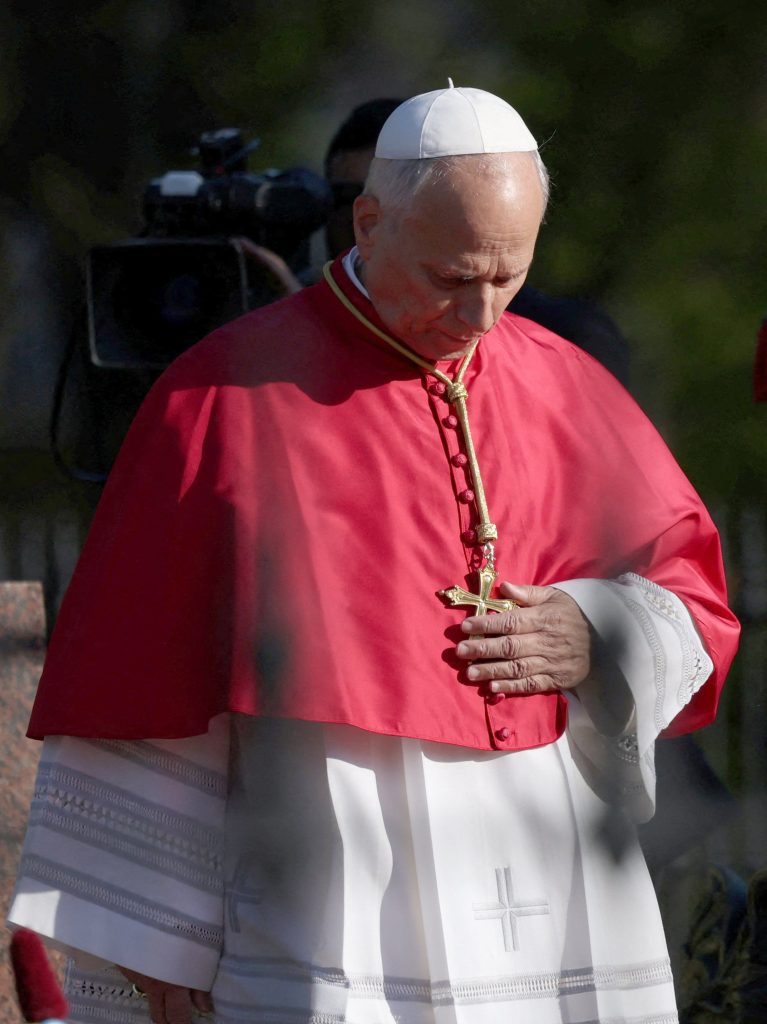
Pope Leo XIV pauses as he visits Plaza San Martín in Buenos Aires, Argentina, Nov. 8, 2026, after concluding his visit to Uruguay, and continuing his Nov. 6-17 apostolic journey to Argentina and Peru. Pope Leo met for more than an hour with five survivors of clergy sexual abuse while in Argentina Nov. 9, conveying to them and all victims “his closeness and his commitment to strengthening measures for protection, well-being, welcome and accompaniment within the Church.” (OSV News photo/Andrew Medichini, pool via Reuters)
BUENOS AIRES, Argentina (OSV News) – Pope Leo XIV met privately Nov. 9 with five people abused by clergy or Church institutions in Argentina, listening individually to their experiences during an encounter that lasted more than an hour, the Holy See Press Office said.
The meeting took place before the pope traveled to the Catholic University of Argentina for an encounter with representatives of the world of work. Earlier in the day, he celebrated Mass at Buenos Aires’ Monumento de los Españoles before approximately 2.5 million people, according to local authorities.
The five survivors were presented by the local Church, the Vatican statement said.
“The pope spoke with each of them individually, listening to their accounts, the painful experiences they had endured, and their suggestions for strengthening paths toward healing within the Church,” the statement said.
At the conclusion, Pope Leo greeted the survivors all together, blessed them and thanked them for the meeting and their “testimony of faith.”
“To them — and through them, to the other victims whom it was not possible to meet — the pope conveyed his closeness and his commitment to strengthening measures for protection, well-being, welcome, and accompaniment within the Church,” the statement said.
The encounter came during Pope Leo’s second day in Argentina, a country where the dimensions of the abuse crisis remain unknown. Argentina has not conducted the kind of nationwide investigation or accounting undertaken in other countries including the United States, Australia, France and Germany.
BishopAccountability.org, a U.S.-based watchdog organization, lists nearly 100 priests, religious brothers and women religious publicly accused of abusing minors or vulnerable adults in Argentina. Other allegations remain under criminal or canonical investigation.
The Argentine bishops have established a national safeguarding council and issued guidelines for handling allegations. Survivors and advocates, however, continue to criticize the absence of a comprehensive national accounting and the limited information released about canonical proceedings.
Among Argentina’s best-known cases is that of Father Julio César Grassi, a once-prominent priest who operated homes for disadvantaged children. Father Grassi was convicted in 2009 of sexually abusing and corrupting a minor and sentenced to 15 years in prison.
While archbishop of Buenos Aires and president of the Argentine bishops’ conference, the future Pope Francis commissioned a four-volume study challenging the criminal case against Father Grassi. Father Grassi remains imprisoned, with his sentence scheduled to end in May 2028. He remains a priest but is prohibited from publicly exercising ministry while awaiting a definitive Vatican decision.
At the Antonio Próvolo Institute in Mendoza, deaf and hearing-impaired children were sexually abused between 2005 and 2016. Fathers Horacio Corbacho and Nicola Corradi were sentenced in 2019 to 45 and 42 years in prison, respectively. Father Corradi later died while under house arrest. In September, former nun Kumiko Kosaka was sentenced to 20 years for her role in the abuse and mistreatment of students.
The case most directly connected to Pope Francis involved Bishop Gustavo Oscar Zanchetta, one of his first episcopal appointments. Bishop Zanchetta resigned as bishop of Orán in 2017 and was subsequently given a position in the Vatican’s financial administration.
Pope Francis later acknowledged that he initially accepted Bishop Zanchetta’s defense against allegations involving sexual images found on his phone. An Argentine court convicted Bishop Zanchetta in 2022 of sexually abusing two seminarians and sentenced him to four years and six months in prison. His conviction became final in February 2025, and he was conditionally released that September. Bishop Zanchetta remains publicly identified as bishop emeritus of Orán, and the Vatican has not announced the outcome of its canonical proceeding.
Argentina’s crisis is part of a broader reckoning across Latin America. The pope is expected to encounter that reality again in Peru, where he previously served as bishop of Chiclayo and helped survivors of the now-suppressed Sodalitium Christianae Vitae obtain a Vatican investigation and reparations.
Social
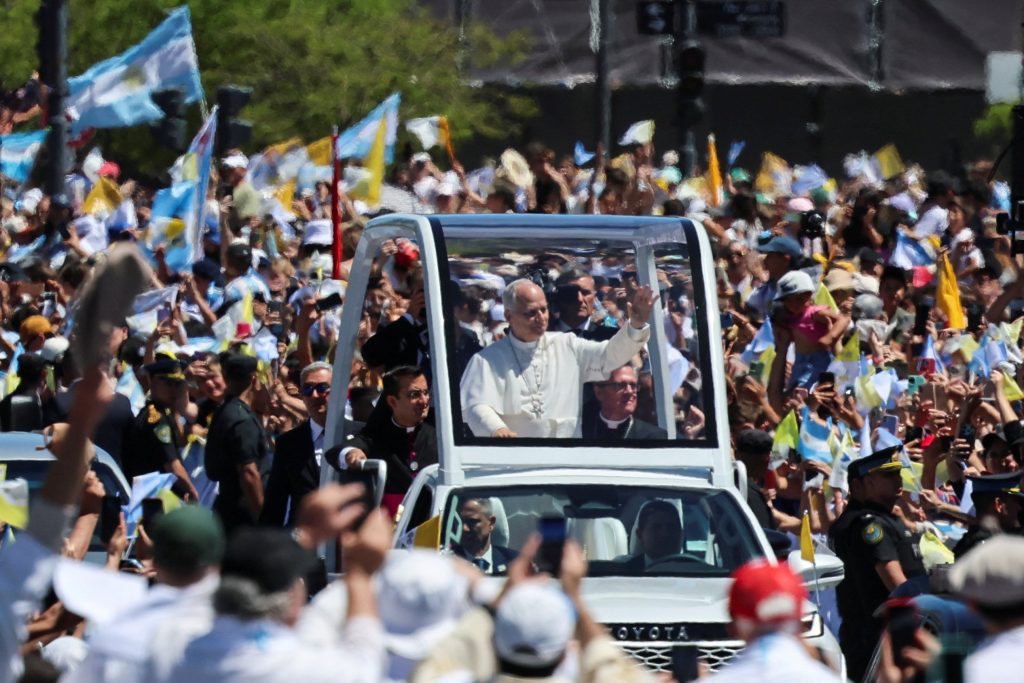
Pope Leo XIV greets people as he arrives to celebrate Mass at the Monument to the Spaniards in Buenos Aires, Argentina, on Nov. 9, 2026, during his apostolic journey to Argentina, Peru and Uruguay, which runs from Nov. 6-17. (OSV News photo/Yara Nardi, Reuters)
BUENOS AIRES, Argentina (OSV News) – Pope Leo XIV celebrated Mass with 2.5 million people in the heart of Buenos Aires on Nov. 9, drawing the largest crowd of his pontificate so far.
“Dear families, I encourage you to take a leading role in evangelization! The Church in Argentina needs you,” the pope said in his homily at the iconic Buenos Aires intersection at the “Monumento de los Españoles.”
“This Church is renewed and filled with enthusiasm when families, animated by faith, pray together and live out their ministry of proclaiming the Good News,” he added.
The crowd stretched for miles down several of Buenos Aires’ wide avenues intersecting at the monument with Argentines wearing hats and sunglasses under the bright sun and enthusiastically waving Vatican and Argentine flags as the popemobile passed by.
— A moment of ‘tremendous spiritual joy’ —
Among those in the front of the crowd was Alejandro Ribeiro, a seminarian from the Diocese of Zárate-Campana, who wore a traditional Argentine gaucho beret and sipped on mate in the hours leading up to the papal Mass.
“When I arrived, I shed a few tears, because ever since I felt this vocation, my dream has been to see the pope,” Ribeiro told OSV News.
“It’s hard to go to Rome, but the pope came here,” he added. “I’m really excited— — my heart is really racing.”
Pope Leo’s Nov. 8-11 visit to Argentina, the second leg of his 12-day tour of South America, is the first papal to Argentina in nearly 40 years.
For Sister Zulma Usqueda from Argentina’s Hermanas Misioneras Catequistas de Cristo Rey (Congregation of Missionary Catechist Sisters of Christ the King), the pope’s visit is a moment of “tremendous spiritual joy”.
Her congregation, which was an educational charism, was founded in Argentina by Servant of God Mother Mercedes Pacheco, whose motto was “to do good without making noise.”
“You really can’t explain it in words because it’s so moving — it overwhelms the soul,” Sister Zulma said.
“The pope has come to bring a message to all of us who are here — to those who have lost their faith, to those who don’t believe, and to those who haven’t been able to make it here due to a physical condition,” she told OSV News. “This Holy Father, the Vicar of Christ, calls us together, so that (God’s) embrace will reach everyone.”
— Pope Leo offers advice to families on passing on the faith —
In his homily, Pope Leo underlined the importance of the Christian family in society.
“The family is the place where faith, human virtues, a culture of work, respect for the elderly, the defense of life and fidelity to one’s word are handed on. Do not give in to those who dismiss the Christian family as outdated. On the contrary, today more than ever, it remains a pillar amid the many insecurities of our time,” the pope said.
“Open the doors of your homes to Christ!” he added. “Speak naturally to your children about Jesus, and remain united to him.”
The pope recommended simple gestures to pass on the faith in the intimacy of one’s home, “a blessing before meals, a prayer before going to bed, forgiveness and mutual listening, grandparents teaching their grandchildren to pray, going to Mass on Sundays, and preparing for a retreat or a pilgrimage.”
“The family is a privileged place for coming to know and encounter Christ,” he added.
— Argentine Catholics reflect on Pope Francis —
Pope Leo also paid tribute to his predecessor, the late Pope Francis, in a moment that was met by enthusiastic applause from the crowd.
“Our beloved Pope Francis, who was Bishop of this city, expressed with great conviction that ‘the family is called to join in daily prayer, to read the word of God and to share in Eucharistic communion, and thus to grow in love and become ever more fully a temple in which the Spirit dwells’,” Pope Leo said, quoting Pope Francis’ post-synodal apostolic exhortation “Amoris Laetitia.”
A native son of Buenos Aires, Pope Francis never returned to his homeland after his election as pope in 2013.
Catholics in the crowd acknowledged they had been waiting for their former bishop of Buenos Aires, Pope Francis, to visit, but said they were no less excited to be in the presence of his successor.
“It is sad, but I think Pope Leo XIV makes up for it all. Pope Francis is in heaven,” Iris Callupe told OSV News.
Ribeiro said that while Pope Francis never visited Argentina, he believes the late pope “had each of us in his heart.”
“We’ve always awaited Pope Francis with the same excitement we feel now for Pope Leo,” Sister Zulma said. “God knows. He had a better plan.”
“Pope Francis has already been here; we experienced it, we shared it –not as pope, but as archbishop …Today Pope Leo brings us a message — perhaps the one Argentina needs right now,” she added.
— Mass on the feast of the Dedication of the Lateran Basilica —
Pope Leo noted that the Mass was offered for the feast of the Dedication of the Lateran Basilica, saying the feast is a “sign of God the Father’s saving presence in his Church.”
“Our families often face difficult circumstances: instability, social hardship, precarious employment, domestic violence, painful separations and addictions that destroy young people’s futures and damage family relationships,” he said. “Amid all these hardships and crises, God’s word shines out as a source of hope: God is in our midst; we need not be afraid.”
Pope Leo entrusted all the families in the crowd to the Virgin Mary, Our Lady of Luján, and to her spouse, Saint Joseph, at the end of his homily, which was met with cheers of “Viva el papa!”
— Morning visit to ‘Little Cottolengo’ —
The pope began the day with a visit to a disability care home in Buenos Aires, the Don Orione “Little Cottolengo” in Claypole, known as “Pequeño Cottolengo Argentino Don Orione”, south of Buenos Aires.
Pope Leo listened to the testimonies of people with disabilities, including a moving story of Marta Torres, wearing grey braids on her head. Born with cerebral palsy, she can’t walk nor see.
“My mother abandoned me the day before my birthday; she left home and never returned. … My father and my siblings took care of me from a very young age,” she said.
Over the years, facing “many hardships, including hospitalizations, surgeries, and numerous treatments,” she searched for a home, and she found one in “Little Cottolengo.”
“For me, the Cottolengo has been a beacon of light that illuminated my life. It was not just a place to live, but a place where I was welcomed, sheltered, and loved,” Torres said.
Over time, she wrote a book, as she wanted her story “to be known and heard because I wish to do good.” Before handing her book to Pope Leo, she said “I offer this as an act of thanksgiving to God for having bestowed so many things upon me.”
The other woman who also gave her testimony — Norma Donato — exchanged the traditional papal skullcap, or zucchetto, with Pope Leo, to cheerful applause.
While visiting the charitable center, the pope also met privately with people suffering from addictions.
Argentina’s President Javier Milei, who met with Pope Leo upon his arrival in Buenos Aires, has defended extensive audits of the disability pension system as necessary after serious irregularities were uncovered. However, the government’s austerity measures, including cuts to disability programs and as well as other social services and government programs — along with measures that have eroded retirees’ purchasing power amid inflation — affected people with disabilities and their families.
“They’ve taken away so many things from us, many benefits, many therapies,” Clarisa Islas, whose two children attend “Little Cottolengo,” told OSV News before the papal trip.
“We are juggling to ensure our children don’t lose their rights or the visibility they have achieved,” the mother, whose two children have cerebral palsy and autism, said.
In his speech at “Little Cottolengo,” Pope Leo said, “A nation’s progress is also measured by how it welcomes all people with disabilities and particular needs.”
“In this special moment, I would like to share with you all my hope for this country: that Argentina may be capable of performing great works of charity, such as we see here, where the love of Christ triumphs over individualism and exclusion.”
In the afternoon, Pope Leo will meet with members of social movements at the Catholic University of Argentina before meeting with leaders of different religions. In the evening, the pope will celebrate vespers with bishops and Argentinian synodal teams at the Metropolitan Cathedral of the Most Holy Trinity.
Social
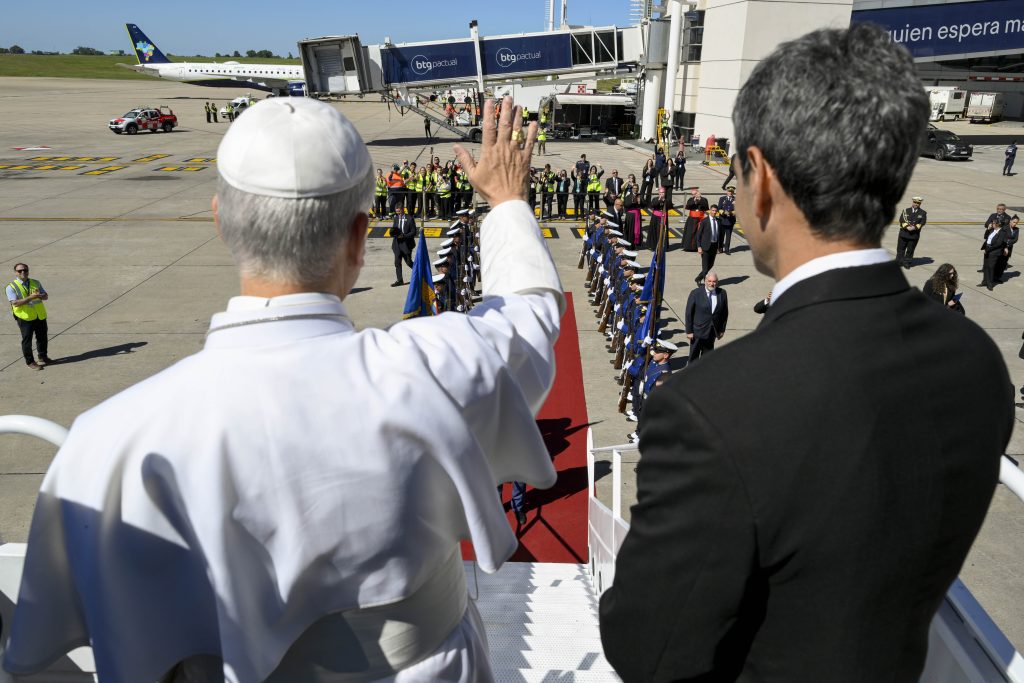
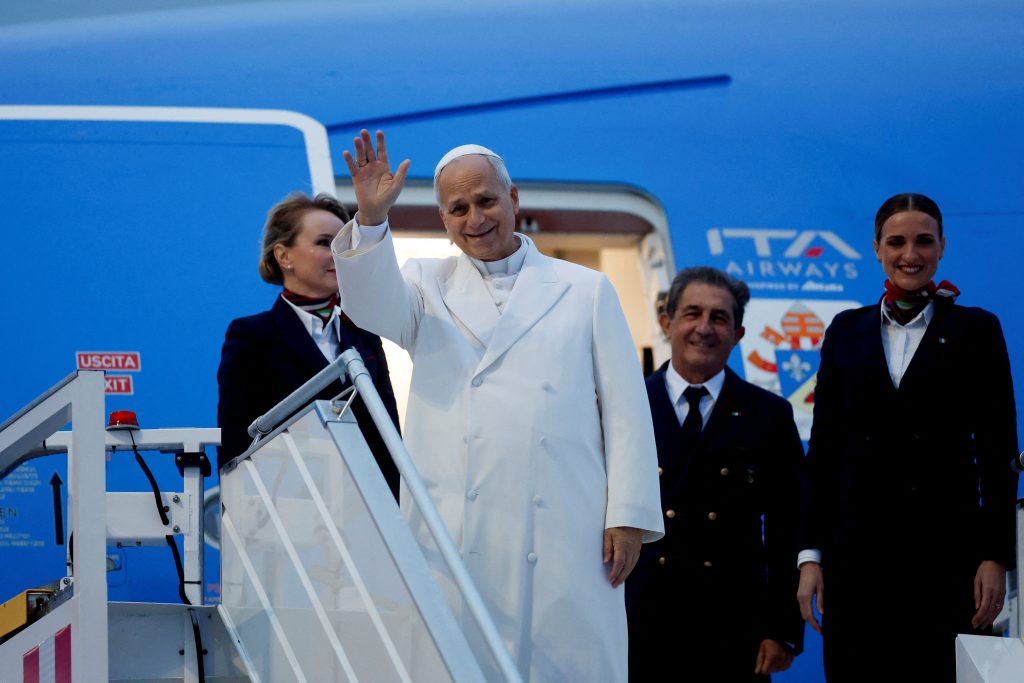
Pope Leo XIV waves as he boards the plane at General Cesáreo L. Berisso International Airport in Montevideo, Uruguay, Nov. 8, 2026, during his departure to Buenos Aires, Argentina, to continue his Nov. 6–17 apostolic journey to Argentina and Peru. (OSV News photo/Simone Risoluti, Vatican Media)
BUENOS AIRES, Argentina (OSV News) – Pope Leo XIV arrived in Buenos Aires Nov. 8 urging Argentina’s civil leaders to safeguard democracy, protect the unborn, and engage in respectful dialogue across political divides after meeting with President Javier Milei at the Casa Rosada presidential palace.
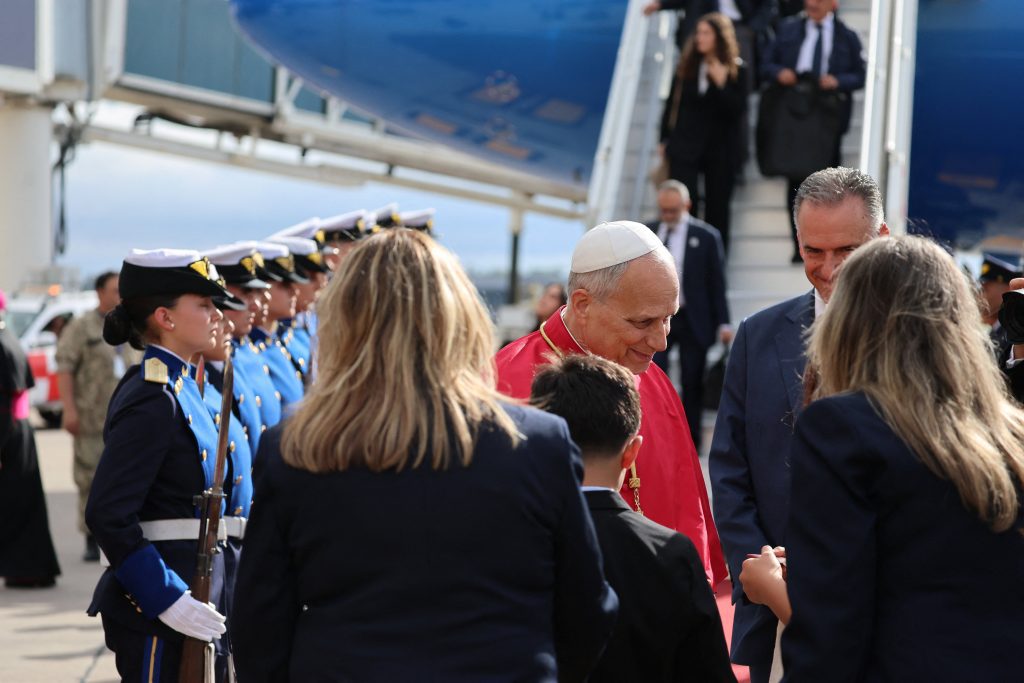
The papal flight from Uruguay on an Aerolineas Argentinas plane dubbed “Pontifex Maximus” touched down after 4:30 p.m. at Buenos Aires International Airport after a short 40-minute flight across the Río de la Plata. Milei, Argentina’s libertarian leader since 2023, personally welcomed Pope Leo on the tarmac.
Argentina is home to more than 43 million Catholics, according to the latest Vatican statistics from 2022, which state that over 92% of the country’s population is baptized Catholic. However, according to Pew Research Center, only 58% of adults self-identify as Catholic.
People waving Vatican flags lined the avenues of Buenos Aires, nicknamed the “Paris of South America,” as the pope made his way to the Casa Rosada, where Milei resides, for a private one-on-one meeting with Argentina’s self-described “anarcho-capitalist” leader who was raised Catholic, but has expressed a desire to convert to Judaism.
In the pope’s first speech in Argentina in the Palacio Libertad, Pope Leo honored his predecessor Pope Francis, who was a native son of Buenos Aires, but never returned to his homeland after his election as pope in 2013.
“My arrival in this land is personally meaningful,” Pope Leo said. “Today, as his successor in the Petrine ministry, I am in some sense retracing his steps in this country where the personal history of Pope Francis would later be joined to that of the entire Church.”
Pope Francis, born Jorge Mario Bergoglio, led the archdiocese of Buenos Aires from 1998 until he became pope. As the bishop of Buenos Aires, he was known for riding the subway, and regularly visiting poor barrios, or neighborhoods, of the city.
Milei, who previously derided Pope Francis as a “filthy leftist,” later eulogized him as “the most important Argentine in history” and shed tears while attending the late pope’s funeral in 2025. He told Radio Mitre in Argentina that he had apologized to Pope Francis. “He told me, ‘Don’t get upset, these are youthful mistakes.'”
In the Palacio Libertad, with Pope Leo seated nearby on stage, Milei lauded Pope Francis again, saying in his opening speech that Pope Francis’ death “left a huge void in our entire people, both for his faithful and for those who do not belong to the Church.”
“He was an exceptional figure who, through his humanity, inspired us all, regardless of our faith,” Milei said. “A person of immense generosity whom I had the honor of knowing firsthand.”
Pope Leo spoke after the Argentinian president in a diplomatic and measured tone, underlining the importance of ethical technological development, respect for the environment and the dignity of every human person.
Democracy, the pope underlined, is “strengthened by the daily conduct of public life: through willingness to listen, through careful use of words, through the patient search for agreement, and through the ability to see those who think differently as fellow citizens with whom we share a common future.”
“In this way, a spirit of trust is created, one that enables a society to deal with its differences without losing sight of the things that keep it united,” he said.
“Those entrusted with public office are charged with a particularly demanding task. Authority is most authentic when it is exercised as service, when it looks beyond the immediate, and when it uses its power to promote the welfare of all,” Pope Leo added.
In his speech, Pope Leo highlighted Argentina’s unique culture from the tango, “born from the encounter of different neighborhoods, ports and backgrounds” to the sharing of a drink of mate, which “turns a moment of relaxation into an opportunity for conversation and closeness.”
The pope also urged introspection on the part of Argentina’s leaders, saying, “a nation must seriously ask itself where it has failed when its young people have to leave their homeland in order to make their dreams come true.”
“What place do children not yet born occupy in our decision-making? Before asking ourselves what kind of world we will leave our children, we must first recognize their dignity,” Pope Leo added.
“That same dignity requires that particular concern be shown for those affected by illness, dependency and disability,” he said. “Here, too, we have a duty to care for others, to alleviate suffering, to accompany them, and to ensure that every person feels that his or her life always retains a value that no circumstance can diminish.”
Pope Leo’s speech to Argentina’s political authorities marked the end of public events on his first day in Buenos Aires. After leaving the presidential palace, Pope Leo was expected to hold a private meeting with members of the Augustinian Order at the apostolic nunciature before ending his day. Pope Leo will remain in Argentina until Nov. 11.
The pope is scheduled to celebrate an outdoor Mass in the center of Buenos Aires, one of the most populous cities in Latin America, on the morning of Nov. 9 before meeting with social movements at the Catholic University of Argentina, with religious leaders at the Palacio San Martín, and with the local Catholic community at the Metropolitan Cathedral of Buenos Aires.
On Nov. 10, Pope Leo plans to fly to Córdoba, the country’s second-largest city, to celebrate Mass on the grounds of the Military Aviation School and meet with Church leaders at the Cathedral of Our Lady of the Assumption. In the evening, the pope plans to preside over a youth vigil in Buenos Aires.
The pope’s visit to Argentina is scheduled to culminate in a Mass at the Marian shrine of Our Lady of Lujan, Argentina’s patroness and one of its leading pilgrimage sites, on the morning of Nov. 11 before he flies north to his much anticipated “homecoming” in Peru.
Social
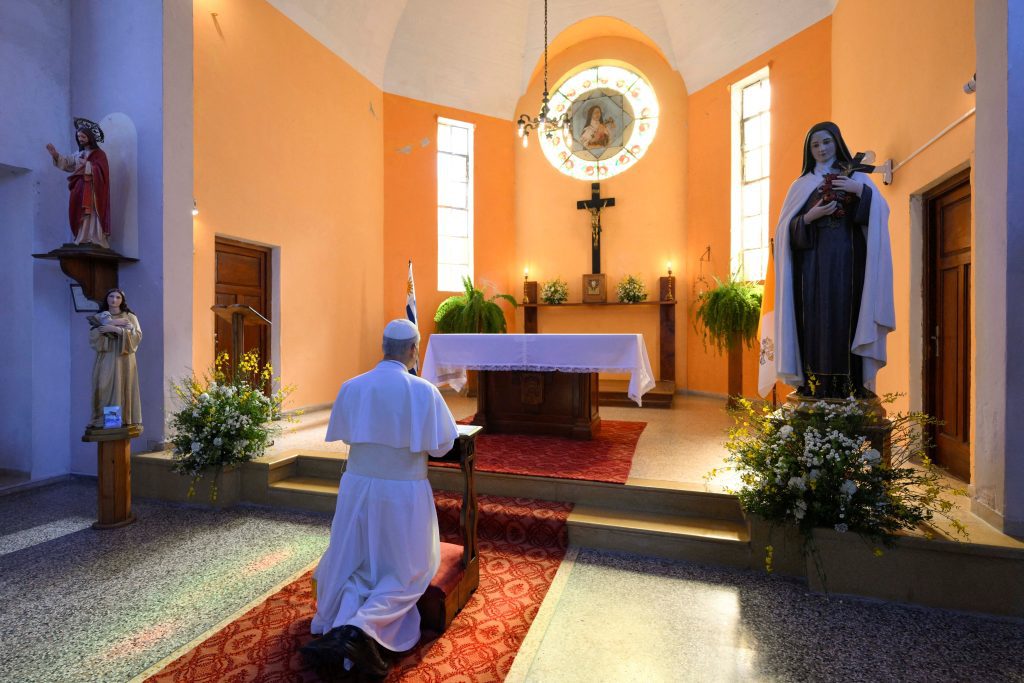
Pope Leo XIV prays at the altar inside St. Thérèse of the Child Jesus, or Santa Teresita, in Juanicó, Uruguay, Nov. 8, 2026, before celebrating Mass outside the Cathedral Basilica of Florida, National Shrine of Our Lady of the Thirty-Three, in Florida, during his Nov. 6–17 apostolic journey to Uruguay, Argentina and Peru. (OSV News photo/Simone Risoluti, Vatican Media)
FLORIDA, Uruguay (OSV News) – Pope Leo XIV made a pilgrimage to Uruguay’s national Marian shrine Nov. 8, where he shared a message of hope for mothers who feel the grief of seeing their children fall away from practicing the faith they were raised in.
“I know that many of you carry a very specific sorrow. You taught your children to pray, and today they no longer do so. You used to attend Mass together, and it has been years since they entered a church. You spoke to your grandchildren about God, and now you do not know if those words left a mark. Sometimes you wonder if you did something wrong or if it was all futile,” Pope Leo said in his homily.
The pope pointed to the witness of St. Monica, who “prayed for years for a son who seemed to be drifting further and further from God, but she never stopped trusting in his grace.”
“Mothers and grandmothers: never tire of passing on the faith! Preach with your lives as well as with your words. Insist on prayer, love, and hope; insist on them in season and out of season (cf. 2 Tim 4:2). Do so with patience, without harshness or discouragement. Even if your loved ones seem far from God, continue to place them before him. Do not stop blessing them, accompanying them, and simply reminding them of what they once received,” Pope Leo said.
“There are doors that you cannot open, but God can,” he added.
In his homily, the pontiff also offered words of encouragement to fathers and grandfathers, urging them to imitate St. Joseph.
“Dear fathers and grandfathers, young people need to see that you pray, receive the sacraments, treat your wives with respect, ask for forgiveness and live with integrity, even when doing so requires sacrifice. Children learn a great deal by seeing that their father can kneel before God without feeling that he is any less of a man for doing it,” Pope Leo said, to loud applause from those gathered at Mass.
“Your children and grandchildren need to see that the faith occupies a genuine place in the lives of the men in your family,” the pope added.
— Pope Leo at the beloved Uruguayan pilgrimage site —
The pope celebrated an outdoor Mass with 50,000 people in front of the National Shrine of Our Lady of the Thirty-Three, the cathedral basilica of the Uruguayan city of Florida on the morning of Nov. 8, the date of the country’s annual national pilgrimage to the Virgin Mary, which is closely tied to Uruguay’s historic struggle for independence from Brazil.
At this beloved pilgrimage site, Pope Leo renewed the consecration of Uruguay to the Virgin Mary, first made by St. John Paul II in 1988, imploring God that through Our Lady’s intercession “he may thwart the works of the evil one and preserve beloved Uruguay from whatever might lead it away from Christ.”
The unique Marian title of Our Lady of the Thirty-Three takes its name from the image from the 33 revolutionaries whose 1825 campaign sought to free the territory then known as the Eastern Province from the Brazilian Empire.
The Assembly of Florida, which declared independence Aug. 25, 1825, met beside the town’s church, and its members venerated the Marian image preserved there.
“This small image is linked to a decisive moment in Uruguay’s history. In 1825, those who were fighting for the freedom of this land also turned to Mary, to place the beginning of their efforts under her protection. That gesture reminds us that the history of peoples, too, cannot be fully understood without reference to God,” Pope Leo said.
“Since that time, generations have come and gone, circumstances have changed, including the relationship of many Uruguayans to the faith. Yet she has remained here.”
— Virgin of the Thirty-Three, the liberator of Uruguay —
The current cathedral basilica in Florida building was built in 1887, but the wooden image of the Virgin Mary preserved inside the national shrine traces its history back further to the late 18th century and has become closely associated with Uruguay’s national story. Carved from Paraguayan cedar, it is a small representation of the Immaculate Conception believed to have originated in the nearby Jesuit missions.
“This devotion did not originate in any miraculous event or an apparition, as many Marian devotions do,” Father Gabriel González Melano, a priest of the Diocese of Florida, told OSV News.
“It was the people who began to identify her with that campaign,” Father González said. “From 1825 onward, they gradually began to call her the Virgin of the Thirty-Three, with many also dubbing her the liberator of Uruguay.”
— Pilgrims overjoyed to meet the pope —
Martín Lage Ponce de León, who came on pilgrimage to the shrine with his family from the capital city of Montevideo, told OSV News that Our Lady of the Thirty-Three “represents a lot for all the people in Uruguay.”
“We are really excited about receiving Pope Leo,” he said. “It’s something that we are really grateful that he chose Uruguay to start his trip in South America. And we consider that this is because of something Uruguay really needed … his words of mission.”
Twenty-six-year-old Ximena Tejeria watched eagerly from her wheelchair as Pope Leo greeted the crowd of thousands waving Vatican flags from the popemobile. “This is my first time seeing the pope,” she said of Pope Leo. “I previously met Pope Francis, and now we get to see (Pope Leo) up close, which is wonderful for all of Uruguay, too. It’s been many years since a pope visited, so this whole event is a source of joy for everyone.”
Natalia Baccino, 45, from the capital city of Montevideo has made many pilgrimages to Florida’s Virgin in her life, but this was the first papal Mass at the shrine.
“I woke up really early at 4:30 a.m. to arrive here because … the routes, there were too many people coming here,” Baccino told OSV News.
— Argentina is next stop for Pope Leo after Uruguay —
The pope traveled about 60 miles by car from Montevideo to arrive at the shrine. The road included one pit stop to pray in the parish of St. Thérèse of the Child Jesus, or Santa Teresita, in Juanicó, to greet the mayor and to offer a blessing to people gathered there.
“The principal reason for Leo visiting the shrine is, of course, that the pope is coming to Uruguay, so he had to visit the country’s patroness,” Father González said. The convergence of her feast and the national pilgrimage, he added, makes the occasion particularly significant.
St. John XXIII authorized the image’s canonical coronation in 1961 and declared Our Lady of the Thirty-Three patroness of Uruguay in 1962. In 1975, Uruguay’s government designated the cathedral and the image national historic monuments, and in 1994 the cathedral became the National Shrine of Our Lady of the Thirty-Three.
At the end of Mass, Bishop Alfonso María Bauer Ormazábal of Florida told Pope Leo, “We are a country of close-knit communities, of sharing mate, and of gatherings of friends. And that country was born here, in Florida: next to the so-called ‘Altar of the Motherland,’ our Independence was declared, under the gaze of the Virgin of the Thirty-Three.”
“Today, we face different struggles, and we ask Mary to accompany us in these as well: the poverty of so many children and the lack of work, loneliness and a sense of meaninglessness, addictions and mental health issues, social fragmentation, and violence. With her, we wish to defend the dignity of every person, daughter and son of God,” the bishop said.
The Mass in Florida marked the final public event of Pope Leo’s Nov. 7-8 visit to Uruguay. After Mass and lunch with local bishops, he is scheduled to fly to Buenos Aires, Argentina, where he will meet President Javier Milei in the afternoon.
Uruguay’s national Marian shrine is one of three Latin American pilgrimage sites Pope Leo is visiting during his Nov. 6-17 tour of South America.
In Argentina, Pope Leo is expected to celebrate Mass at the Basilica of Our Lady of Luján, the country’s national Marian shrine. In Peru, he intends to visit Zaña, where relics of St. Turibius of Mogrovejo, the missionary archbishop of Lima and patron of the Latin American episcopate, are preserved.
Social
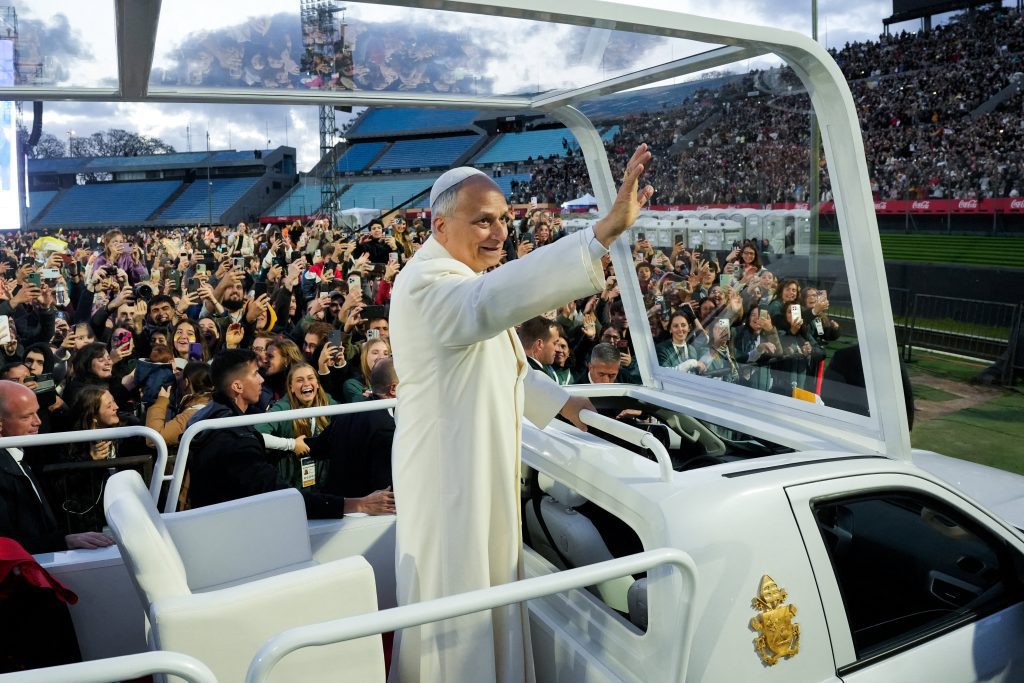
Pope Leo XIV waves as he arrives to celebrate a prayer vigil at Centenary Stadium in Montevideo, Uruguay, Nov. 7, 2026, during his Nov. 6–17 apostolic journey to Uruguay, Argentina and Peru. (OSV News photo/Andres Cuenca, Reuters)
MONTEVIDEO, Uruguay (OSV News) – The stadium built for the first-ever FIFA World Cup in Uruguay was filled with cheers on Saturday night, not for a soccer match, but for Pope Leo XIV, who told the 70,000 people inside that becoming a saint is the ultimate goal.
“Be saints!” the pope told the joyful crowd in Montevideo’s historic Centenary Stadium Nov. 7. “Do not settle for a merely decent life or for a habitual faith, content with doing only the essential. Do not give God only a part of yourselves — give yourselves completely!”
In a country where soccer is sometimes treated as a religion, the pope urged people not to settle for a mediocre life, but to discover a full and free life in Jesus Christ.
“Saints are men and women who overflow with the abundance of life in Christ,” he said. “They are free and authentic people whose lives make it attractive to say a resounding ‘yes’ to love, truth and happiness. Do not be afraid, then, to aspire to holiness. Christ did not call us to mediocrity; he called us to a new and full life like his own.”
Centenary Stadium was built in 1930 to host the soccer matches for the first FIFA World Cup. The open-air stadium in Uruguay’s capital city of Montevideo has been designated a world soccer monument by FIFA, the organization that organizes the World Cup.
Cardinal Daniel Fernando Sturla Berhouet, the archbishop of Montevideo, said that hosting the pope in the iconic soccer stadium is “a spectacular goal!”
“Soccer is very important in our culture; we even speak about life using the language of soccer,” the cardinal said.
“We have not come merely to cheer from the stands. We don’t want to just stay on the bench. Christ invites us to step onto the playing field of life — a match played out in our neighborhoods, our families and our workplaces,” he added.
The night was filled with musical performances, cheers, fireworks, and classic Spanish Catholic hymns. Many people in the stands sipped on yerba mate, a beloved drink in Uruguay, and held their cell phones in the air to illuminate the stadium.
“If the pope tries my mate, I’d be very happy,” 15-year-old Eros Recalde from Montevideo told OSV News. “I think Pope Leo would like mate.”
“This moment is very special because it’s been a long time since a pope came here to Uruguay; the last time was in 1988, quite a long time ago. And being able to experience this with my friends, with my companions, is really nice,” he added.
In his speech in the stadium, Pope Leo underlined that Jesus is truly present in the Eucharist and encouraged people to seek out Eucharistic adoration.
“That same Jesus who was born in Bethlehem, who died and rose again, lives forever and remains with us. He awaits us, truly present in the Eucharist,” the pope said.
“Today, therefore, we can continue to encounter him — so near and so humble — in every tabernacle. Seek him there, in Eucharistic adoration. Speak to him as you would to a friend, and let him look upon you,” he added.
Among those in the crowd was Ericka Cajo Cieza and her mother-in-law, Rosa Elena Castro, from Chiclayo, Peru, who now live in Uruguay. They have fond memories of attending Mass with the future Pope Leo when he was bishop of Chiclayo and were excited to be seeing him for the first time as pope.
“He is a pope who is deeply loved by everyone in Chiclayo, very humble, very loving,” Cajo Cieza said.
“He is a very humble priest, very charitable in everything,” she added.
For 14-year-old Illiana Alvarez, seeing Pope Leo in the soccer stadium was “a wonderful experience.” She has attended soccer matches in Centenary Stadium before, but this was the first time praying with a pope in person.
Her fellow high school classmates from Colegio Pio in Montevideo all agreed Pope Leo is better than Argentina soccer legend Lionel Messi.
“The pope is the best! Messi? So-so,” 13-year-old Franciso del Campo declared.
The students were among the many young people cheering loudly when Pope Leo arrived in the stadium in the popemobile.
During the prayer vigil, Pope Leo heard testimonies from young people who discovered the Catholic faith in their 20s, as well as a married couple with five children.
Twenty-two-year-old Giovanni shared why he recently made the decision to get baptized.
“In my family, no one practices the faith, except for my grandmother. I was not baptized, and I attended a secular school. I did not have a personal encounter with God until I was 20. I always felt a void that I tried to fill with fleeting things. I only heard about God through my grandmother, who prayed to the Virgin Mary for me, which sparked a desire within me that I did not understand,” he said.
“In 2023, I transferred to the University of Montevideo, where, for the first time, I encountered a chapel and a priest. A friend encouraged me to speak with the chaplain, and that was when I realized that what I had always been searching for was very close: It was God,” he added.
A Catholic family of seven, whose parents have been married for 30 years, huddled together on stage to share their testimony with the pope. The parents spoke about the realities of family life in the most secularized country in Latin America, describing Uruguay as a nation with “few marriages and a declining birth rate” where “ideological currents call into question the value of life, marriage and the family.”
In his speech in the stadium, Pope Leo addressed Uruguay’s secularization directly, saying, “When we try to build a world without God, we run the risk of leaving humanity without a place as well.”
He also encouraged young people not to be afraid of the challenge of giving up “time, money, comfort and plans to serve others” and to embrace a lifelong vocation.
“Young people, dare to take the step of marrying and starting a family yourselves. Do not be afraid of ‘forever,'” the pope said. “Married couples, open your home to life, even when the world tells you that a child is a burden.”
“Jesus Christ is our hope. Society may find many valuable things in other institutions, but none can replace the proclamation that God’s love is stronger than death, hatred, violence, war and sin. This is the joy we bring; the pope has come to remind you about this joy,” he said.
Pope Leo led the stadium in praying the Our Father prayer before giving the final blessing.
Pope Leo began his first full day in Uruguay on Saturday morning with a flight from Montevideo to the city of Paysandú, a cultural and economic hub on Uruguay’s border with Argentina, where he celebrated an outdoor Mass with 40,000 people. Upon his return to the Uruguayan capital in the afternoon, the pope visited a poor barrio of the city called Casavalle, where spoke with local residents, and later gave a speech at the Catholic University of Uruguay.
Before departing for Argentina on Nov. 8, Pope Leo will celebrate a morning Mass in honor of Uruguay’s patroness, Our Lady of the Thirty-Three, on the date of the annual pilgrimage to the national Marian shrine. Pope Leo will visit Buenos Aires, Cordoba and Lujan, Argentina Nov. 8-11 before ending his apostolic journey in Peru Nov. 11-16.
Social
Pope Leo XIV is greeted by young people as he arrives at Montevideo-Carrasco International Airport in Ciudad de la Costa, Uruguay, Nov. 6, 2026, the first day of his Nov. 6–17 apostolic journey to Uruguay, Argentina and Peru. (OSV News photo/Yara Nardi, Reuters)
MONTEVIDEO, Uruguay (OSV News) – Pope Leo XIV arrived in Uruguay on the afternoon of Nov. 6, telling journalists aboard his 13-hour transatlantic flight from Rome that he was “convinced that this trip had to go forward” following lung cancer surgery a little more than three weeks earlier.
“I know some people were doubtful about this trip taking place. I confess that from the first day I had no doubt and was convinced that this trip had to go forward,” Pope Leo told journalists as the papal plane flew over North Africa.
“And I’m very happy to say, praise the Lord, and thanks to wonderful medical assistance, I’m here today, I think, in fairly good shape. So you’re the witnesses of that.”
The 71-year-old pope appeared energetic as he interacted with journalists aboard the plane at the start of his 12-day journey to Uruguay, Argentina, and Peru, scheduled for Nov. 6-17.
— Pope Leo’s advice when facing a cancer diagnosis —
Asked by OSV News during the flight what advice he would offer people facing their own cancer diagnosis, Pope Leo responded, “Not to be afraid.”
“Early detection is obviously the best way to go, and so regular check-ups are a blessing. And, take care of yourselves,” Pope Leo added.
A journalist from NBC News asked the pope what was his secret to making such a quick recovery. He responded, “Trust in God, good doctors, good surgeons, and overall, a healthy lifestyle.”
The pope said that faith gave him the strength to face difficulties. “It is faith,” he said. “And the Lord who is very generous to me.”
Pope Leo also told OSV News that during the pilgrimage to the Marian shrine of Lourdes during his last international journey to France in late September, “there were no signs of any difficulties” with his health.
“I was much more concerned about the health of those there,” he added, referring to the many sick and disabled pilgrims who traveled to Lourdes to pray with the pope at the Marian apparition site.
Pope Leo told The New York Times that the experience of being sick gave him “a sense of commitment of wanting to continue to be close to those who are sick.” He added that he planned to speak in Uruguay about “how healthcare should be a right of all people.”
The pope is making the trip just 24 days after undergoing a lobectomy surgery for a localized lung adenocarcinoma on Oct. 13. During the surgery, doctors removed the lower lobe of the pope’s right lung. The pope’s doctors confirmed the following week that the pope did not require further oncological treatment after surgery.
Asked by the Italian newspaper, La Repubblica, what he read while recovering during his five-day hospital stay after cancer surgery, the pope responded, “my breviary, a prayer book, and newspapers.”
— Pope Leo says he is ‘proud to be an American’ —
Several journalists aboard the plane asked Pope Leo about his decision to vote in the U.S. midterm elections, to which the pope replied to CNN, “I’m proud to be an American and to exercise the right” to vote. But when asked about the election results in Texas, Pope Leo replied, “No comment.”
Pope Leo, who became a naturalized citizen of Peru in 2015, noted that he did not vote in the Peruvian presidential elections earlier this year because it was not possible, adding that he would have voted if he could have.
— Pope calls Peru ‘one of my many homes’ —
The trip marks Pope Leo’s first visit to Latin America since his election and brings him back to a region that shaped his ministry as an Augustinian missionary priest and bishop in Peru. The final and longest leg of the journey will take him to Peru, where he spent decades as a missionary priest and later led the Diocese of Chiclayo.
Reflecting on the trip ahead, Pope Leo said that he was happy to be returning to Peru, which he called “one of my many homes.”
The pope did not reveal much about where he plans to travel next in 2027. Asked if he would like to travel to Santiago de Compostela for the jubilee year of the Spanish pilgrimage destination, the pope said he wanted to go, but added that wanting to go is different from being able to go.
— Pope wants to proclaim ‘the good news’ in secular Uruguay —
The papal plane, a chartered ITA Airways flight, touched down in Uruguay’s Montevideo-Carrasco International Airport a little before 4:20 p.m. (2:20 p.m. EST) after flying more than 6,900 miles over France, Algeria, Mauritania, Senegal, the Atlantic Ocean and Brazil.
The motto for the pope’s trip to Uruguay is “I bring you good news of a great joy” (Lk 2:10), underscoring the importance of evangelization during Pope Leo’s visit to the most secularized country in South America.
Christians make up 44% of the population, the lowest share in Latin America, according to the Pew Research Center. The visit will be the first papal visit to the country since St. John Paul II visited in 1988.
In his comments to journalists, Pope Leo repeatedly emphasized his desire to proclaim the Gospel during his apostolic journey.
“The primary reason for making this trip is to continue the mission of the bishop of Rome — of the pope — in sharing the joy of the Gospel, announcing the good news, and walking together with people, expressing that closeness which is so important for people, whether in their moments of joy or in their moments of sorrow, that they very much are looking for the message of hope in today’s world,” Pope Leo said.
The pope also took the opportunity to personally introduce the new prefect of the Vatican’s Dicastery for Communication, Maria Montserrat Alvarado, whom he called “Montse.”
“Now we have the wonderful experience, the creativity, and the life and liveliness of Montse, who will be accompanying us on this trip and helping the Vatican and myself in the very important dimension of communications, so welcome Montse,” he said.
— Three days in Uruguay before heading to Argentina —
Montevideo is Uruguay’s capital, principal port and most populous city. The pope’s first stop in the capital will be Independence Square for an official welcome ceremony, where he will address Uruguay’s civil authorities before meeting one-on-one with President Yamandú Orsi.
The pope will next meet with the local Catholic community in Montevideo’s Metropolitan Cathedral of the Immaculate Conception and Sts. Philip and James before ending a long day of travel at the country’s apostolic nunciature.
On Nov. 7, the pope will fly to the city of Paysandú, a cultural and economic hub on Uruguay’s border with Argentina, to celebrate Mass. Upon returning to Montevideo in the afternoon, he will visit Casavalle, a poor neighborhood of the city, where he will hear testimonies from local residents before presiding over an evening prayer vigil at the soccer stadium that hosted the first World Cup.
On his final day in Uruguay, Pope Leo will celebrate the country’s patroness, Our Lady of the Thirty-Three, on the morning of Nov. 8. The date coincides with the annual pilgrimage to the national Marian shrine, which is closely tied to the country’s independence movement. The pope will then fly to Argentina, where he will visit Nov. 8-11.
Asked by The Washington Post whether the Argentina leg of the trip would be about remembering Pope Francis, Pope Leo reiterated that spreading the Gospel is the main reason for the apostolic visit.
“I’m sure there will be many important connections (with the late pope), but it’s not the primary business” of the trip, Pope Leo said, adding that the visit’s main purpose is to proclaim the Gospel.
Social
Pope Leo XIV waves as he boards the papal plane ahead of his first apostolic journey to Uruguay, Argentina and Peru, at Rome’s Fiumicino Airport on Nov. 6, 2026. (OSV News/Remo Casilli, Reuters)
ABOARD THE PAPAL PLANE (OSV News) – Pope Leo XIV departed Rome for Uruguay on the morning of Nov. 6 at the start of a 12-day trip to South America, the longest international journey of his pontificate, a little over three weeks after undergoing surgery for lung cancer.
The Nov. 6-17 trip will be his first visit to Latin America since his election as pope, bringing him back to the continent that shaped his life and ministry, first as a missionary priest then bishop in Peru, where he will spend the final and longest leg of the trip.
The papal plane, a chartered ITA Airways plane, took off from Rome’s Fiumicino International Airport at 7:05 a.m. Rome time at the start of the apostolic journey to Uruguay, Argentina, and Peru.
The 13 hour and 30 minute flight will bring the pope across the Atlantic Ocean, flying more than 6,900 miles over France, Algeria, Mauritania, Senegal, and Brazil before arriving in Uruguay’s capital city of Montevideo at 4:30 p.m. local time (2:30 p.m. EST).
It is the first of 14 flights Pope Leo will take in an ambitious itinerary that will bring the 71-year-old pope to a new destination nearly every day, including a 2,200-mile flight from Buenos Aires to Lima and a military helicopter flight Nov. 14 to the Andes mountain town of Santa Cruz de Succhabamba, Peru.
The pope is making the trip just 24 days after undergoing a lobectomy surgery for localized lung adenocarcinoma on Oct. 13 in which the cancerous lower lobe of the pope’s right lung was removed. Pope Leo’s doctors confirmed the following week that the pope did not require further oncological treatment after surgery.
Vatican officials said that no changes were made to the pope’s schedule in South America to account for his recent hospitalization.
“He is clinically fit to undertake this trip,” Vatican spokesman Matteo Bruni told journalists on Nov. 3.
His doctors “are very confident and he’ll have plenty of medical care on board should something happen. But we don’t see that in his prognosis,” Maria Montserrat Alvarado, the prefect of the Vatican’s Dicastery for Communication, added.
Pope Leo will start his journey in Uruguay — the most secularized country in Latin America. It will be the first papal visit there since St. John Paul II’s in 1988. Pope Leo will visit Montevideo, the capital and largest city; Paysandú, a cultural and economic hub on the border with Argentina; and Florida, home to the National Sanctuary of Our Lady of the Thirty-Three on the Nov. 8 date of the annual national pilgrimage to the Marian shrine.
In Argentina, where he arrives on the afternoon of Nov. 8, he will meet a challenge of stepping into the land of his predecessor Pope Francis, the Argentine pontiff who never visited his homeland as pope, and a country that Archbishop Jorge Ignacio García Cuerva of Buenos Aires recently described as “a wounded Argentina, a divided Argentina.” St. John Paul II made the last papal visit to Argentina in 1987, nearly four decades ago.
Pope Leo will visit Buenos Aires; Córdoba, the country’s second-largest city; and Luján, where he will celebrate Mass at the Shrine of Our Lady of Luján, Argentina’s patroness and one of its leading pilgrimage sites.
The trip culminates with Pope Leo’s homecoming to Peru, where he first arrived as an Augustinian missionary priest in 1985, including a two-day stay in Chiclayo, where Pope Leo served as bishop from 2015 to 2023.
In Peru, where he holds citizenship , the pope will also visit Lima, the capital and largest city; Chiclayo; Cusco, the former Inca capital in the Andes; and Pucallpa, a city on the Ucayali River in the Amazon rainforest that has long been a center of Catholic missionary outreach.
During the 12-day trip, Pope Leo will celebrate nine public Masses, visit seven cathedrals and preside over two stadium prayer vigils before returning to Rome on the morning of Nov. 17.
Pope Leo asked for prayers for the fruitfulness of his apostolic journey in his Nov. 4 general audience ahead of the papal trip.
“I entrust myself to your prayers, that this trip may strengthen faith, renew hope, rekindle the fire of charity, and serve as an impetus to continue proclaiming the Gospel with joy,” Pope Leo said.
Social
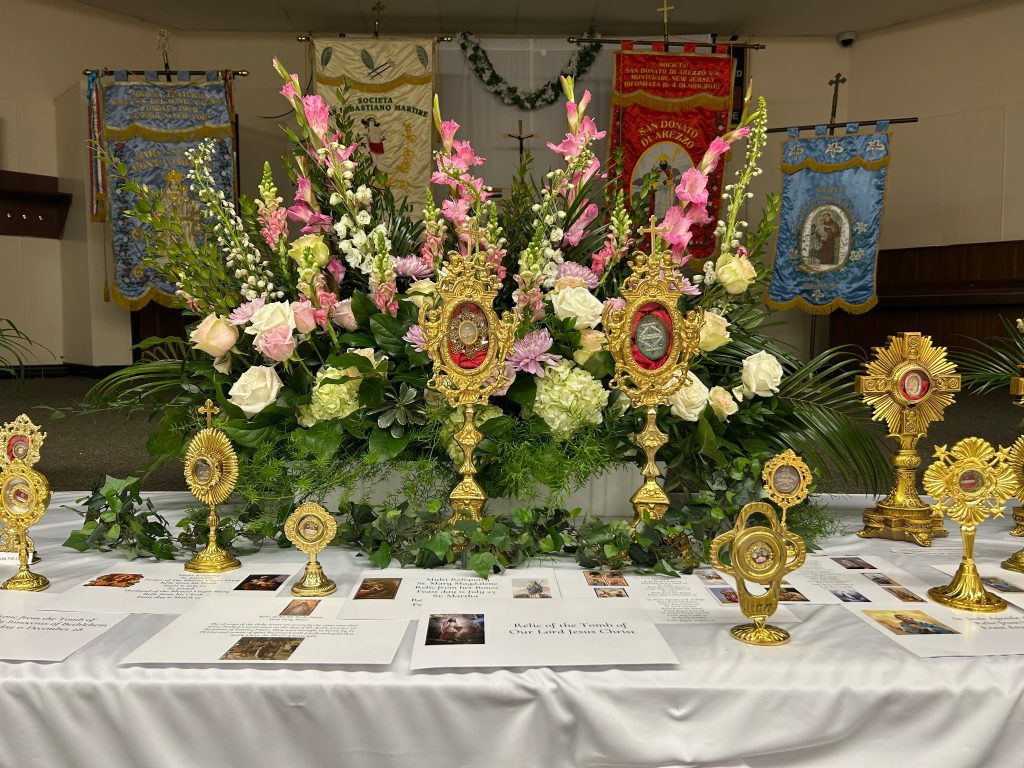
More than 600 major relics of saints and blesseds of the Catholic Church will be on display at the National Centre for Padre Pio in Berks County from Nov. 5 – 8, 2026.
BARTO, Pa. – The National Centre for Padre Pio will host a special Holy Relics Exposition Nov. 5 – 8, 2026, inviting visitors to venerate over 600 major relics of saints and blesseds of the Catholic Church.
Held in celebration of All Saints’ Week and the Feast of the Holy Relics, the four-day exposition offers an extraordinary, potentially once-in-a-lifetime opportunity for prayer and reflection before relics of many of the most important and influential figures in the history of Catholicism.
The exposition is a special part of the Centre’s Year of Saint Pio, which began June 16, 2026, and culminates June 16, 2027, with the 25th anniversary of Padre Pio’s canonization.
Through special events, Masses, and devotions, the Centre is inviting pilgrims to deepen their faith and draw closer to Christ through the life and intercession of Saint Pio.
The collection includes authenticated relics associated with Jesus and the Holy Family, some dating to biblical times, as well as relics of the apostles and evangelists.
Among the featured relics are the blood of Padre Pio, the hair of Pope Saint John Paul II, linen from the deathbed of Saint Carlo Acutis, and the hair scarf of Saint Frances Xavier Cabrini.
The veneration of relics is a longstanding tradition within the Catholic Church, honoring the saints whose lives bear witness to the transforming power of God’s grace. Relics offer a tangible connection to these holy men and women, whose bodies were temples of the Holy Spirit.
Through veneration, the faithful honor God’s work in the saints, seek their intercession, and find encouragement to follow their example of faith, love, and perseverance. This exposition invites pilgrims to encounter that tradition personally and deepen their relationship with Christ.
“Each of these 600 relics tells the story of someone who said yes to God. The saints show us that redemption and holiness are possible for every one of us. This exhibition is a unique opportunity to encounter saints whom we’ve read about our entire lives,” said National Centre for Padre Pio Executive Director Deacon Jim Friend. “I encourage you to join us to learn more about them, ask for their intercession, and leave inspired to deepen your relationship with Christ.”
As pilgrims prepare to celebrate Padre Pio’s canonization anniversary, the exposition invites them to reflect on the communion of saints and the call to holiness in their own lives. Individuals, families, and parish communities are welcome to make these days an occasion for spiritual renewal.
Exposition Hours will be as follows: Thursday, Nov. 5 – Saturday, Nov. 7 from 9:00 a.m. until 4:30 p.m.
Exposition Hours on Sunday, Nov. 8 will be from 11:00 a.m. until 4:00 p.m.
The National Centre for Padre Pio is located in Berks County at 111 Barto Road, Barto, PA 19504.
For additional information, visit www.padrepio.org or call (610) 845-3000.
Social
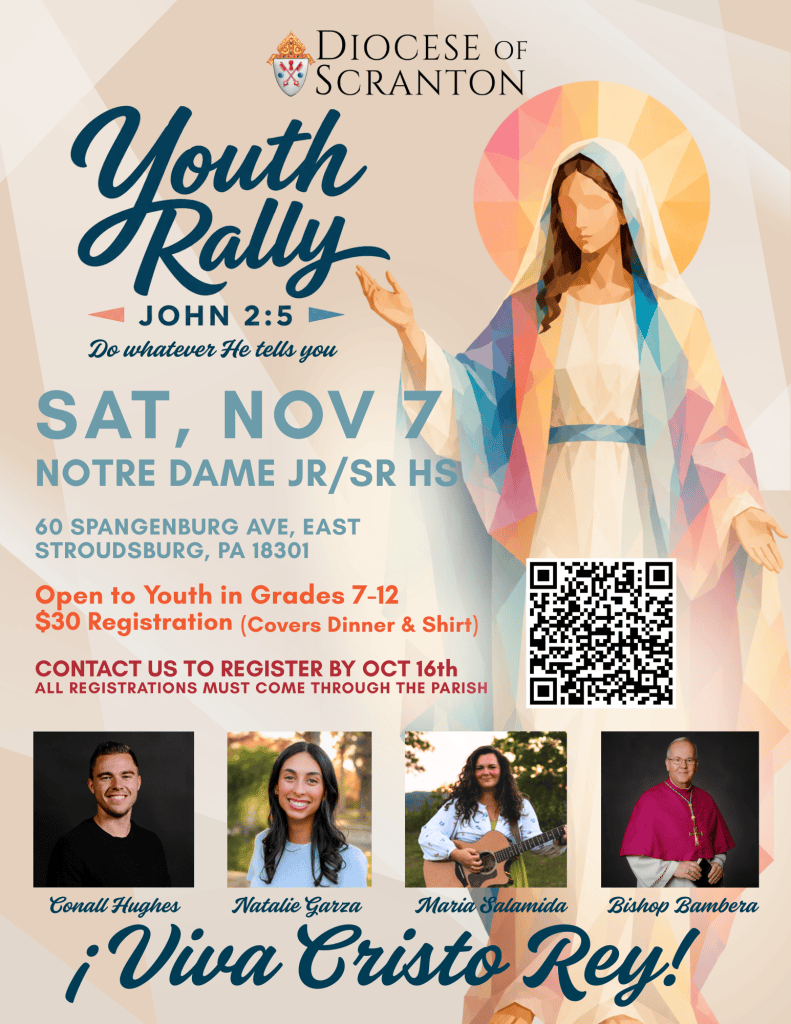
EAST STROUDSBURG – More than 300 young people in grades 7-12 have registered for the fourth annual Diocesan Youth Rally, which will take place on Saturday, Nov. 7, 2026, at Notre Dame Jr./Sr. High School in East Stroudsburg.
The theme for this year’s Youth Rally is “Do Whatever He Tells You.”
The participants – which come from 17 parishes throughout the Diocese of Scranton – will participate in ice breakers, small group talks, Adoration, Mass and more.
Participants will be invited to dive deep into prayer. When the wine runs dry in our own lives — whether that is when prayer becomes difficult, when our circumstances seem to overwhelm us, or when we deeply need God to meet us wherever we find ourselves — we can look to Mary to point us back to her Son by her instruction to “Do whatever He tells you.”
This day will focus on who God is, how to listen to His Voice, and how we as the Young Church can more fully align our wills to the will of God. It will be a day for students to deepen their faith, make new friends, and experience fun and fellowship.
The 2026 Diocesan Youth Rally will begin at 11:30 a.m. and run through 8:00 p.m.
Check-in will open at 11:00 a.m.
Youth will hear from several engaging speakers and musicians. The speakers for this year’s Youth Rally are Conall Hughes, evangelist and Director of Advancement for Damascus Summer Camps, and Natalie Garza, evangelist and teacher who has spoken at several youth conferences in the United States. Conall and Natalie plan to speak about the importance of cultivating a personal relationship with Christ, why it is important to “Do whatever He tells you”, and how to cultivate a deep prayer life.
Music will be led by Maria Salamida, from Franciscan University, and her Steubenville Worship Band!
Social
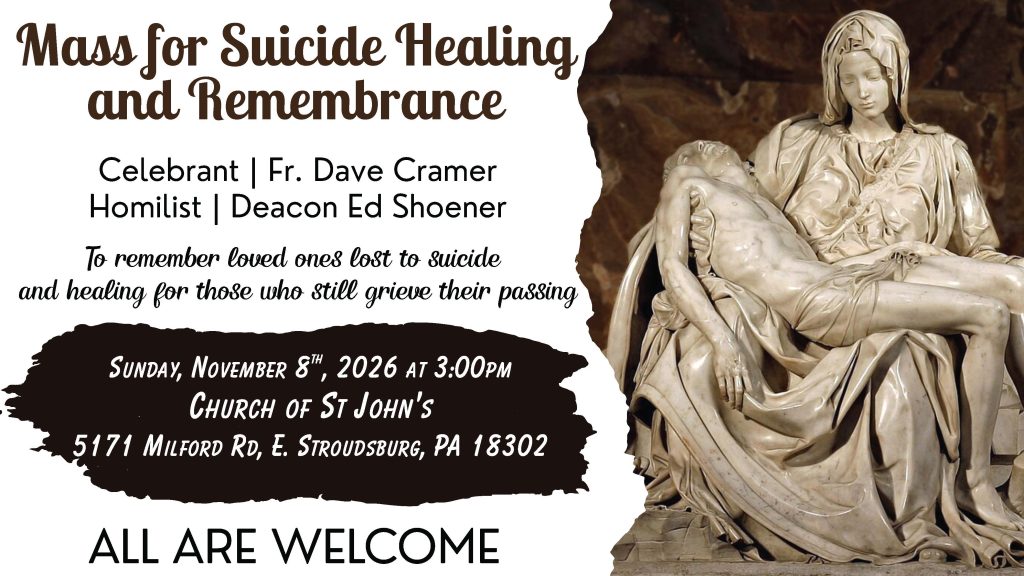
EAST STROUDSBURG – The Northeast Pennsylvania Mental Health Ministry team will hold a Mass for Suicide Healing and Remembrance on Sunday, Nov. 8, 2026, at 3:00 p.m. at the Church of Saint John, located at 5171 Milford Road, East Stroudsburg.
The Mass will serve to remember loved ones lost to suicide, and to promote healing for those who grieve their passing.
Rev. Dave Cramer, Pastor of the Church of Saint John, will be the celebrant for the Mass. Deacon Ed Shoener, President of the International Association of Catholic Mental Health Ministers and Deacon at the Cathedral of Saint Peter and Immaculate Conception Parishes in Scranton, will serve as homilist.