SCRANTON – For more than four decades, Catholics searching for an encounter with Christ have made the journey to Scranton each summer for a weekend of prayer, worship, and renewal.

That tradition continued July 31 through Aug. 2, 2026, as hundreds of people from across the east coast gathered at The University of Scranton for the 44th annual Catholic Charismatic Renewal Conference.

Donica Allen raises her hands in joyful praise during the Closing Mass of the Catholic Charismatic Conference on Aug. 2, 2026 at The University of Scranton. (Photo/Mike Melisky)

Through inspiring speakers, praise and worship, the celebration of the Eucharist, and time for fellowship, participants were invited to deepen their relationship with Jesus and return home renewed in faith.

For many, the conference has become a cherished annual pilgrimage.

“My prayer group usually comes every year to Scranton to praise the Lord, to learn about the Holy Spirit, and to be in fellowship with each other,” Thereze Hargraves of Brooklyn, N.Y., said.

She described the weekend as an opportunity to step away from everyday responsibilities and focus entirely on God.

“It’s like an oasis,” Hargraves explained. “It gives you encouragement that despite what is going on in your life, God is good and His presence is amazing.”

Michele Guerrier, who also lives in Brooklyn, has been making the trip to Scranton for approximately 25 years.

“It is a wonderful place to come to renew, to reflect, and to revitalize my own spiritual life,” she said.

Guerrier believes one of the conference’s greatest strengths is the sense of family that has developed over the years.

“The Holy Spirit is alive,” she said. “Most of us have been coming here for so long that you look forward to seeing everyone. I think that brings a whole other dimension to our faith as Catholics.”

While many attendees have made the conference an annual tradition, organizers were especially encouraged by the number of first-time participants who discovered the event this year.

“I came not really knowing what to expect,” Christy Ghigiarelli of Saint John Paul II Parish in Dunmore, said. “I came to just spend the day with God and be around people and be able to praise Jesus.”

Walking into the conference for the first time quickly made an impression.

“The best part was walking in and just everyone singing and literally praising Jesus,” Ghigiarelli added. “It’s just uplifting, it’s incredible … I’ll definitely be back.”

Karen McLain, who helped coordinate this year’s conference, said the annual gathering invites participants to express their faith with joy and openness to the Holy Spirit.

“The Catholic Charismatic Renewal is regular Catholics who love the Mass, who love the tradition and love the liturgy and the ritual, but they also like to be more expressive sometimes in their worship,” McLain explained. “We raise our hands when we praise. We sing more contemporary songs. Sometimes we dance and we clap.”

McLain said that some Catholics are uncertain about what “charismatic” means, but she emphasized that the movement is firmly rooted within the life of the Church.

“Our popes have been wonderfully supportive and have spoken to the Renewal many times over the last 50 years,” she said. “They’ve said this is a grace for the whole Church.”

Throughout the weekend, participants heard presentations from speakers that included Father Anthony Abraham of the Diocese of Saint Thomas in the U.S. Virgin Islands; Father Joe Freedy of the Diocese of Pittsburgh; Father August Ricciardi, spiritual moderator for the Diocese of Scranton’s Catholic Charismatic Renewal; evangelist Caroline Gambale-Dirkes; Timmy McCaffery of Pentecost Today USA; and Leonor and Genry Batista of Inmaculada Radio and TV.

The conference ended with a Closing Mass on Sunday celebrated by the Most Rev. Joseph C. Bambera, Bishop of Scranton.

Reflecting on his recent pilgrimage along Spain’s Camino de Santiago, the Bishop connected his own journey with the readings for the Eighteenth Sunday in Ordinary Time, reminding the faithful that every Christian is searching for lasting fulfillment.

Drawing from the prophet Isaiah and the miracle of the multiplication of the loaves and fishes, Bishop Bambera encouraged participants to seek satisfaction not in temporary things but in the life-giving grace offered through Jesus Christ and the Eucharist.

“Jesus is present,” Bishop Bambera said. “See Him here before us. Feel His love poured forth from the cross for you. Know that there is nothing in your past or in your life at this moment that cannot be forgiven and healed by Jesus.”

LARKSVILLE – More than three years after a devastating fire destroyed the former Saint Hedwig’s Church in Kingston, a cherished symbol of the parish has found a new home.

On Sunday, July 19, 2026, former parishioners and members of the Knights of Columbus gathered at Saint Hedwig’s Cemetery in Larksville to dedicate and bless a statue of the Blessed Mother, which was rescued from the fire scene, preserving an important piece of the parish’s history for future generations.

On July 19, 2026, Knights of Columbus participate in a blessing ceremony for a statue of the Blessed Mother at Saint Hedwig’s Cemetery in Larksville. The statue was rescued from a church fire in 2023. (Photo/Dan Piazza)

The statue, which now stands near the entrance to the cemetery, has been placed on a new base that is inscribed with the words, “Mother of Hope … Pray for Our Loved Ones.”

When fire engulfed the vacant church in February 2023, many people praised the quick-thinking of members of the Edwardsville Public Works Department who saved the special statue which had graced the church grounds for decades.

For decades, people paused at the statue outside the church to offer prayers and seek the Blessed Mother’s intercession. It had become one of the parish’s most recognizable landmarks.

“As the church was being torn down, the statue was on the ground and the people that were watching the demolition wanted the statue to be saved. They didn’t want the rubble and things to engulf it, so the folks from Edwardsville borough were kind enough to come with equipment and they took the statue out of the wreckage,” Ed Raver of the Knights of Columbus said.

Over the next two years, members of the Assumpta Council 3987 and Our Lady of Czestochowa Assembly 1928 of the Knights of Columbus worked alongside borough officials and local craftsmen to secure the statue, construct a permanent pedestal, and relocate it to Saint Hedwig’s Cemetery.

The cemetery was chosen as a fitting location because it is the final resting place for generations of parishioners from the parish.

“This is the cemetery for the parish. The statue was purchased by a former pastor (Father Richard Zavacki) as a tribute to his mother,” Raver added. “We see it as a place for people who were members of the parish to come and reflect and find peace.”

For former parishioner Michael Stretanski, who became a member of Saint Hedwig’s Parish when he married in 1969, the dedication brought back memories of a parish known for its close-knit community, vibrant choir, and popular annual bazaar.

“It gives us a memory to hang onto,” Stretanski said. “We no longer have a church. The church was closed and now it’s just an empty lot, and there is nothing to remind us … But to have Mary here is just a lovely gesture. It’s a beautiful spot for her.”

The dedication ceremony reunited several former choir members who spontaneously sang a traditional Polish hymn, the first time many of them had sung together since the parish closed in 2007.

Father Michael Boris, Assistant Pastor of Saint Ignatius Loyola Parish in Kingston, said the statue represents far more than a piece of salvaged stone.

“They realized that it is part of the heritage of the parish and people are very passionate about their roots,” Father Boris said. “They wanted to help keep that legacy going – not forgetting what was – but also looking ahead now.”

Father Boris said the preservation of the statue serves as a reminder of God’s providence and the Blessed Mother’s loving intercession.

“When people see her, driving out or coming in, they will remember that Our Blessed Mother is praying for our loved ones,” he added.

Michael J. Berish, a past grand knight who helped with the project, said the dedication also brought a long-awaited sense of closure.

“A lot of people didn’t know where it (the statue) was at,” Berish said. “Now she’s home. It just goes to show that from a fire, you can rise again.”

SCRANTON – For more than a century, generations of faithful have made their way to West Scranton each summer, carrying with them prayers, petitions and hopes – and the Solemn Novena to Saint Ann continues to give them a place to bring it all.

From July 17-26, 2026, thousands of people once again gathered at Saint Ann Basilica for the annual Solemn Novena to Saint Ann, filling the grounds for nine days of prayer and preaching and culminating with the Feast Day of Saint Ann and a Closing Mass celebrated by the Most Rev. Joseph C. Bambera, Bishop of Scranton.

This year’s Novena challenged attendees to consider how faith speaks to a rapidly changing world.

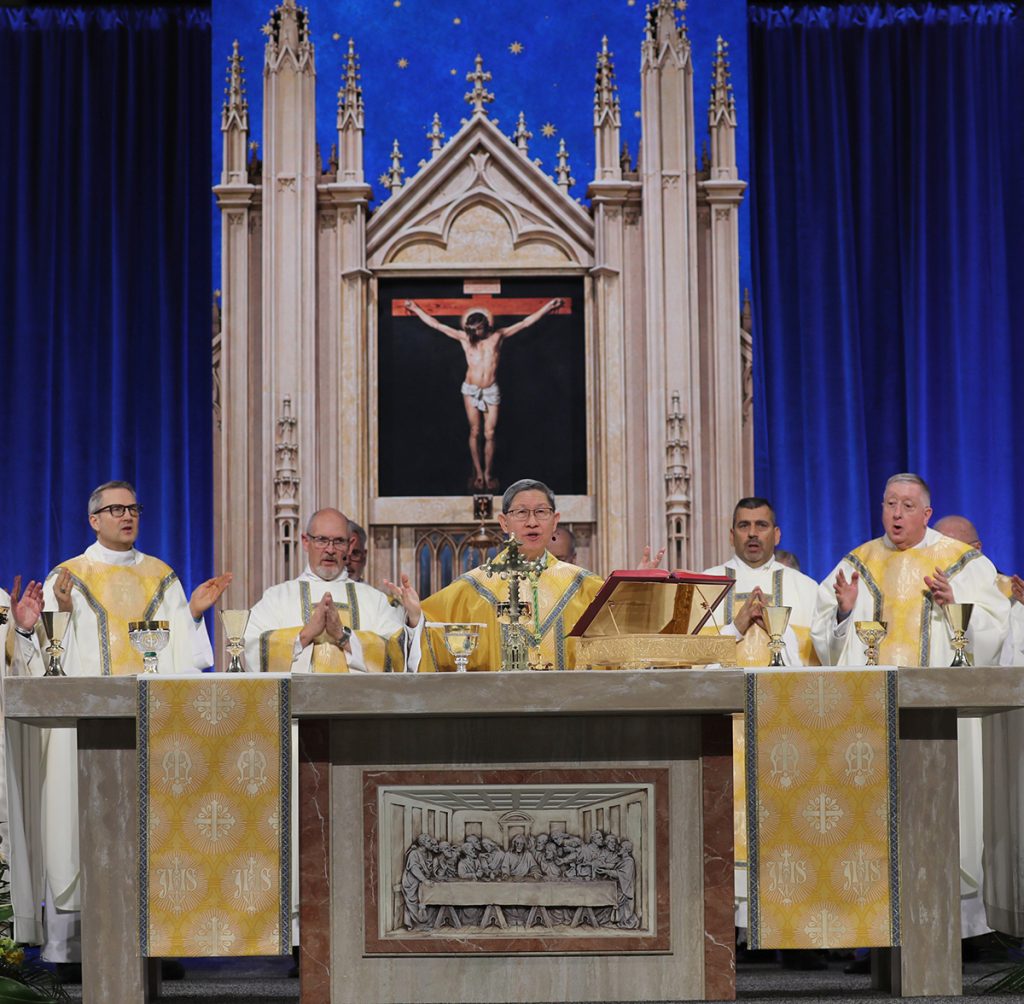
Bishop Joseph C. Bambera celebrates the Liturgy of the Eucharist at the Closing Mass of the Solemn Novena to Saint Ann on July 26, 2026. (Photo/Mike Melisky)

The theme for the 2026 Novena was “Reading the Signs of the Times,” with Passionist priests Father Rick Frechette, C.P., and Father Jack Conley, C.P., offering reflections throughout the observance.

Father Rick encouraged the faithful to look honestly at the blessings and challenges surrounding them and to consider how they could live the Gospel faithfully in an increasingly complicated world.

He spoke about the ways technology, artificial intelligence and constant connectivity can contribute to alienation, while also emphasizing the distinctly human gifts of compassion and community.

“We are made in the image of Trinity, a togetherness, a community,” Father Rick said in his reflection for the Novena’s first day, urging those gathered to bring their personal and collective needs to Saint Ann and seek God’s guidance in navigating the difficulties of the times.

Father Jack similarly challenged the faithful not to allow their faith to remain something learned only in childhood, but instead to continue growing in understanding and wisdom. His reflections explored faith formation, doubt, and the importance of listening for the voice of God amid the many competing messages of life.

As the Novena ended, Father Jack reminded pilgrims that faith is not static.

“As we conclude our Novena this year, we allow God to continue to transform us,” he said.

Domenica Matuszewski of Saint Ann Basilica Parish has attended the Novena since she was a child. She describes it as a highlight of her family’s summer and said she has experienced prayers answered through Saint Ann’s intercession.

“There is a peacefulness and a sacredness when you are here,” she said.

James Kryzanowski of Saint Teresa of Calcutta Parish in Scranton said he first started attending the Novena with his parents, aunts and uncles when he was young. Now a parent himself, he said it is important for future generations to understand the significance of Saint Ann and the Novena.

“It’s almost like a family get-together,” he said. “You see people that you haven’t seen for a while. It has become a family tradition.”

Young people also played an active role in this year’s celebration. Many volunteered to serve the crowds who visited the parish’s food pavilion.

“I love the environment here. I love the people here. Everybody is so sweet and so nice,” Olivia Wasp, a young adult from Visitation of the Blessed Virgin Mary Parish in Dickson City said.

“You definitely meet new people,” Gregg Russo, a young adult from Saint Patrick Parish in Scranton, added. “It’s very fun to do. You make friends.”

At the July 26 Closing Mass of the Novena, Bishop Bambera reflected on the parables of the buried treasure and the pearl of great value – proclaimed during the 17th Sunday in Ordinary Time – as a fitting conclusion to the Novena.

The true treasures of life, the Bishop explained, are not things that can be bought, built or brokered, but the values rooted in Jesus Christ, including love, justice, mercy, faithfulness, gratitude and peace.

“For as much as we struggle to find our way,” Bishop Bambera said. “Your presence on this hillside for the past nine days is a powerful sign to our complicated world about where we are willing to invest our lives.”

That investment, he said, is ultimately not in a place or thing, but “in the person of Jesus Christ.”

SCRANTON – Father Rick Frechette, C.P., D.O., was in West Scranton in late July to preach during the 102nd annual Solemn Novena to Saint Ann. While his visit gave him a chance to reconnect with fellow priests and longtime friends, it was only a brief break from the work that has consumed his priesthood for nearly four decades.

As founder of the Saint Luke Foundation for Haiti, Father Rick has spent much of his life serving some of the poorest and most vulnerable people in the world, providing medical care, building schools and providing much needed humanitarian outreach.

Saint Luke’s Hospital in Haiti offers emergency and critical care services and features a cholera treatment center. (Photo/St. Luke Foundation for Haiti)

“Over these 37 years that I’ve been there, we’ve built two hospitals, 35 schools and seven clinics,” he said.

While those numbers are impressive and significant, Father Rick’s own ministry remains intentionally close to the people he serves.

“I don’t work in our institutions. I don’t want to take employment away from a Haitian physician,” he explained. “I work front-line work, medical work off the back of a truck in poor areas.”

That firsthand ministry has given Father Rick a unique perspective on the worsening humanitarian crisis gripping Haiti – a crisis he says has placed millions of innocent people in the hands of armed gangs.

“I think primarily for Passionists, our number one concern is the crucified people of today. The people of Haiti, because of their history, certainly qualify as crucified today,” Father Rick said. “When I had the chance to be able to work with them and for them, I embraced it.”

For more than 20 years, the Saint Luke Education Program in Haiti has provided free academic and professional training. (Photo/St. Luke Foundation for Haiti)

Since the end of the COVID-19 pandemic, Father Rick says international terrorist gangs have expanded their control across Haiti, particularly in and around the capital of Port-au-Prince.

The international airport in the capital has also been closed to American carriers for nearly two years, he said, forcing missionaries and other traveling in and out of Haiti to find alternate routes through the northern part of the country.

But the disruption of travel is only a small part of the crisis.

“More importantly, huge areas of the city have been devastated by attacks and fires,” Father Rick said.

Among the places destroyed by gang violence was the original home for the dying established by Mother Teresa. More recently, a chapel associated with that ministry was also destroyed.

The impact on Haiti’s health care system has been devastating. Father Rick said approximately 70 percent of hospitals are now closed, while many missionaries have been forced to leave the country.

More than 1 million people have also been internally displaced.

“There has been no major success in trying to curtail the activity of the grants,” he said.

For Father Rick, the tragedy is particularly painful because of the people caught in the middle. Yet, he is quick to point out that the story of Haiti cannot be reduced to poverty, violence and despair.

One of the things that has struck him throughout his years of ministry is what happens when Haitians are given an opportunity to flourish outside the conditions that have constrained them at home.

“Almost any Haitian that can get themselves out of Haiti, thrives where they go,” he said, pointing to Haitians succeeding in medicine, culture, music and even politics in places such as Canada.

“Haiti stifles life for the Haitian person, so that is what our circumstances are,” he continued.

After recognizing the immense need in Haiti, Father Rick founded the Saint Luke Foundation which provides health care, education and humanitarian assistance to some of Haiti’s least-served populations.

Today, the Saint Luke Foundation operates independently while collaborating with international partners to strengthen its efforts in agriculture, community development, and disaster relief.

Even as the security crisis has intensified, the work has continued.

This summer, for example, the foundation launched a series of camps for children living in displacement sites around Port-au-Prince. The initiative began June 8 when approximately 150 children and vulnerable community members participated in a three-week camp.

The children received nutritious meals, refreshments, participated in recreational activities, prayer and received support from a dedicated team.

For Father Rick, these efforts are about more than simply meeting immediate needs. They are about restoring dignity and hope to people who have endured extraordinary suffering.

That same message was at the heart of what he shared with the faithful during the Solemn Novena to Saint Ann July 17-26, as he urged people to resist the forces that divide and dehumanize them and instead embrace the authentic life that Christ offers.

SCRANTON – While many teenagers spend their summer vacation sleeping in, hanging out with friends, or simply scrolling through social media, dozens of young Catholics from across the country spent a week rolling up their sleeves and putting their faith into action in northeastern Pennsylvania.

As part of Catholic HEART Workcamp, a national Catholic youth mission program, the young adults traveled to the Scranton/Wilkes-Barre area July 12-17, volunteering at nearly 30 sites, including schools, parishes, nonprofit organizations, and other outreach ministries.

Young adults and their chaperones participating in Catholic HEART Workcamp 2026 pose for a photo with staff from Saint Clare/Saint Paul School in Scranton.

At Saint Clare/Saint Paul School in Scranton, volunteers painted walls and playground areas, stained door frames, cleaned classrooms, organized school merchandise, and tackled numerous projects at both the primary and main campuses, helping to prepare the school for the upcoming academic year.

“We come here to serve others, but primarily we come here to grow closer to Christ through our service,” Father Matthew Conley, a priest from the Archdiocese of Boston who was serving as the group chaplain, said. Catholic HEART Workcamp fundamentally is an organization that exists to give teenagers an opportunity to serve while being uplifted by Christ Himself. It’s service through Christ.”

For Deacon Timothy Dolan, Director of Social Concerns for the Diocese of New Ulm in Minnesota, the week is about far more than just completing projects.

“Catholic HEART Workcamp is a mission to empower our youth to understand who Christ is in their life, enhance their faith, build relationships with others and be able to see Christ in whoever they meet,” he said. “These projects always seem to be able to build character in the kids and camaraderie.”

For many of the young volunteers, the opportunity to give back was just as meaningful as the work itself.

“I love taking part in Catholic HEART Workcamp. I did it last year and had a lot of fun. It’s nice to see the joy that we see in the people we’re helping,” Eva Cox, a senior from Aurora, Illinois, said. “At the Primary campus, we painted a bunch of door frames. We dusted all the lights and fans in the school. We painted dots on the playground that were faded. We brought color back into the playground.”

“I love serving and I love seeing the smiles and happiness that we bring,” Layla Vilone, a sophomore from Dover, Delaware, added.

Throughout the week, the students stayed at King’s College and faith remained at the center of their experience. Participants celebrated Mass each morning and had many other opportunities for prayer, Eucharistic Adoration and Reconciliation.

Olivia Chapman, an eighth grader from Poquoson, Virginia, said the experience reminded her that even ordinary tasks can become an act of discipleship.

“It’s giving back to the community and working for God and His servants,” she said.

SCRANTON – Under two pop-up tents near the Connell Park pool, children and families browsed through brightly colored beach towels and swimsuits on Saturday, July 11, 2026, searching for just the right size and design.

But the display wasn’t a summer sale.

It was another act of quiet generosity by parishioners from Mary Mother of God Parish, who were distributing free swim supplies to local kids as part of the parish’s 10th annual Summer Swim Drive.

Jennifer Pitts, left, from Mary, Mother of God Parish in North Scranton helps to distribute swim supplies at Connell Park in Scranton on July 11, 2026. (Photo/Dan Piazza)

The giveaway at Connell Park was the third of several poolside distributions coordinated by volunteers from the parish’s Community and Service Coordinating Team. Throughout late spring, the group collected hundreds of new towels and swimsuits, along with sunscreen, goggles, flip flops, and other swimming essentials from parishioners.

“It is our tenth anniversary that our group has collected swim supplies for children and families that don’t necessarily have what you and I have,” Jennifer Pitts, Coordinating Team leader, explained.

The colorful display included everything from Bluey-themed towels to striped swim trunks and bathing suits carefully organized by size, making it easy for children to find just what they needed before enjoying a day at the pool.

The ministry effort began a decade ago after Pitts’ daughter took her first summer job as a lifeguard at Weston Park.

“She would come home at night and say there were people swimming in their clothes, people swimming in their pajamas, people swimming in their jeans, and they would go home dripping wet because they had no towels,” Pitts recalled. “That is how it all started. She came and told us about a need and our group decided to get together and do mission that is now 10 years strong.”

Prior to the Connell Park distribution, volunteers had already visited Weston Park and Weston Field, distributing at least 120 towels at each location along with many other swimming essentials.

For volunteer Lisa Michaels, the outreach reflects what parish life is meant to be.

“This is important because it’s part of being Church in the community, doing good things for people who might be less fortunate, but just being kind and doing random acts of kindness,” Michaels said. “It is such a wonderful feeling to give back to the community, to do God’s work and help others.”

Pitts credits the generosity of fellow parishioners for making the ministry possible year after year.

“We’re very grateful for our parish which has come through once again to donate all these items,” she said. “They do it year after year.”

VATICAN CITY (CNS) – Singing and playing music during the liturgy is an integral and necessary part of the celebration, which means it is much more than something “decorative,” Pope Leo XIV said.

“In the liturgy, to sing and to play music means to pray, attuning one’s heart to that of our sisters and brothers and to God, through active participation in the mystery that is being celebrated,” he said during his general audience talk in St. Peter’s Basilica Aug. 19.

“Far from being merely decorative, therefore, sacred music is a treasure of profound value. It should always be dignified, draw inspiration from Sacred Scripture and reflect the grandeur of the mystery celebrated,” he added.

A wooden statue of Our Lady and baby Jesus is seen in the foreground as Pope Leo XIV speaks to visitors and pilgrims during his weekly general audience in St. Peter’s Basilica at the Vatican Aug. 19, 2026. (CNS photo/Vatican Media)

During the audience, the pope also invited all Catholics to continually cultivate “a genuine awareness of peace.”

“May you sincerely recognize that peace is a precious and great gift, and that it requires a strong and constant commitment to achieve it, by honestly and truthfully following the paths that build and sustain it in society,” he said in Italian.

In his main talk, Pope Leo continued his series of talks on the Second Vatican Council, focusing on the importance of sacred music as outlined in the council’s constitution on the sacred liturgy, “Sacrosanctum Concilium.”

“Indeed, singing and playing a musical instrument are acts of prayer,” he told English-speakers in his summary. “Music thus fosters our unity in praising God and opens our hearts to be fashioned by his grace.”

The council’s text “confirms and deepens the ministerial function of music in the liturgy, which had already been highlighted by St. Pius X” in 1903 with his document, “Tra Le Sollecitudini” (“Among the Concerns”), Pope Leo said in his main talk in Italian.

The Council Fathers recognized that “certain requirements” are, therefore, necessary, the first being that “it must respond at every level to what is most appropriate for the liturgical moment, beyond fashions or the particular sensitivities of composers,” he said.

“Its form, especially in its melodic aspect, must be at once noble and simple, of high musical quality and easily performable, particularly when it is intended to be sung by the whole assembly,” he added, referring to the teachings in the conciliar document.

The council recommended that “the texts too should be suitable, profound and at the same time readily understandable, inspired mainly by Sacred Scripture, the liturgical books and the spiritual tradition of the Church,” so that “the law of prayer,” which is also “the law of faith, may remain alive and continue to grow,” the pope said.

“‘Sacrosanctum Concilium’ devotes considerable attention to the theme of the active participation of the faithful,” because the emphasis is on fostering a “greater awareness of the mystery being celebrated and its relationship to daily life” in a “spirit of constant conversion,” he said, quoting Pope Benedict XVI.

Each minister and member of the faithful is called to perform those parts which pertain to their office in a “harmonious balance between the different ministries” and with appropriate moments of “reverent silence,” he added.

The council attributes “great value to Gregorian chant, without excluding other genres of sacred music from the celebration,” as well as to the organ, he said. The use of other instruments is permitted as long as the instruments are suitable for sacred use “and truly contribute to the edification of the faithful,” he added, citing “Sacrosanctum Concilium.”

Because inculturation was part of the council’s reform, including in the field of sacred music, the Council Fathers underlined the importance of taking the musical traditions of different cultures seriously into consideration, making every practical effort to promote traditional music.

The formation and practice of sacred music should be encouraged in seminaries, novitiates and other Catholic institutions, he said, while composers of sacred music must “know and preserve the musical heritage of the Church.”

To guarantee the “dignity and excellence” of new compositions, they should be “at the service of the liturgy, while respecting contemporary sensibilities and the different cultural traditions, so as ‘purify worship from ugliness of style, from distasteful forms of expression, from uninspired musical texts which are not worthy of the great act that is being celebrated,'” Pope Leo said, quoting from St. John Paul II’s 2003 document on sacred music.

“Dear brothers and sisters, the Fathers of the Church held liturgical singing in great esteem as a symbol of ecclesial communion,” Pope Leo said, asking that “we join together in love, and — in the words of St. Ignatius of Antioch — ‘with one voice sing to the Father through Jesus Christ.'”

(OSV News) – Christians are called to reflect Mary’s authentic beauty, which is revealed through a life of enduring love rather than worldly aesthetic standards, Pope Leo XIV said.

Celebrating the Feast of the Assumption Aug. 15, the pope said the artistic depictions of a youthful Mary ascending to heaven stand in stark contrast to the reality of aging that all people experience.

“The glorification of Mary, body and soul, teaches us that our true beauty does not lie in hiding the signs of aging, but in revealing the signs of love that never end, and are even impressed on our flesh,” he said.

Pope Leo XIV celebrates a Mass in the Pontifical Parish of St. Thomas of Villanova, in Castel Gandolfo, Italy, Aug. 15, 2026, on the feast the Assumption of the Blessed Virgin Mary. (OSV News photo/Gregorio Borgia, pool via Reuters)

“With this in mind, we are invited to reexamine many of the aesthetic standards, predominantly hedonistic and consumerist in nature, that the world imposes on us,” he added.

Pope Leo, who is staying at the papal residence in Castel Gandolfo Aug. 12-18, celebrated Mass at the parish of St. Thomas of Villanova. The 17th-century church, named after the Spanish Augustinian friar, was designed by the famed Italian artist Gian Lorenzo Bernini and is the only pontifical parish located outside the Vatican.

The parish’s celebration of the Marian feast day was a tradition started by St. John XXIII and continued by St. John Paul II and Pope Benedict XVI. Although Pope Francis broke with custom by staying in Rome during the summer, Pope Leo XIV revived the practice.

In his homily, the pope began by reflecting on the day’s first reading from the Book of Revelation. The reading’s description of “a woman clothed with the sun, with the moon under her feet,” he said, signified “that in Mary’s heart, heaven and earth, time and eternity, meet.”

To understand what one has in common “with the beautiful young woman depicted on the altarpieces of our churches,” the pope said Christians must “unite the two signs we have mentioned: the incorrupt body of the Mother of God and her immaculate heart.”

“For it is the purity of the soul that, in Mary — as in us — by the grace of God, illuminates and transfigures the whole person, leading us to the glory of Heaven,” he said.

Reflecting on modern beauty standards, Pope Leo said they “risk trapping us in burdensome expectations, causing us to waste precious energy on what does not really matter and does not last forever.”

“In everyday life, we encounter people whose faces are marked by the years and by suffering, yet who are capable of radiating serenity, kindness and peace around them; just as we may observe others who are perhaps outwardly attractive but hard and cold at heart,” he said. “It is easy to see where true beauty lies and where, on the other hand, there is still a need for conversion, forgiveness and healing.”

In order “to discover and nurture” divine beauty, the pope continued, Christians must learn to see it in “the wrinkles of an elderly person as in the tender face of a child as well, in the maturity of an adult as in the liveliness of a young person as well, in work clothes and tools as well as in festive decorations.”

Each of those realities, he added, contains unique stories of love that offer “small glimpses of heaven.”

“Love is humanity’s most beautiful adornment,” the pope said. “Love transfigures, transforms, ennobles and lifts us up, making us light, free and close to God, even amid life’s ups and downs.”

Turning to the Gospel reading from St. Luke, in which Mary visits her cousin Elizabeth and “proclaims the greatness of the Lord,” Pope Leo said Christians need not look far to understand Mary’s humble exclamation of “the magnificent mysteries she experienced.”

Those mysteries, he explained, are visible wherever true charity exists. The pope noted the examples of weary parents to their children “after a long day,” grandparents caring for grandchildren, morally courageous young people, and ordinary workers who “help bring a little bit of heaven to Earth.”

“The beautiful face of Our Lady of the Assumption is unique; it transcends any possible representation, and yet, at the same time, is familiar to us,” Pope Leo said. “Even at this very moment, we can see her face in the people who are close to us, such as the brothers and sisters with whom, in faith, we share the daily offering of our lives.”

ORLANDO, Fla. (OSV News) – The future of religious life depends on different congregations, with different charisms, working together like a symphony, the president of the United States’ largest leadership conference for Catholic sisters told the group’s members.

The Leadership Conference of Women Religious, which represents about two-thirds of the nation’s nearly 35,000 sisters, held its annual assembly Aug. 11-14 in Orlando. More than 1,300 congregational leaders and their guests were in attendance.

LCWR’s outgoing president, Sister Vicky Larson, a member of the Presentation Sisters of South Dakota, told attendees in her Aug. 12 presidential address that the assembly’s theme, “Many Charisms, One Spirit, One Call” can best be seen through a musical lens. Good music requires the group to listen to each other.

Sister Vicky Larson, president of the Leadership Conference of Women Religious, gives her presidential address Aug. 12, 2026, during LCWR’s 70th anniversary assembly in Orlando, Fla. A member of the Presentation Sisters of South Dakota, Sister Vicky completed her one-year term as president at the close of the Aug. 11-14 assembly. (OSV News photo/Dan Stockman, Global Sisters Report)

“The Holy Spirit is asking us to lead by listening,” Sister Vicky said. “Not indifferent listening. Not surface listening. But deep, contemplative, Spirit-led synodal listening — the kind that changes us.”

A song with only one note on one instrument would be “flat, lifeless and unrecognizable,” she said.

“Yet when we weave many different notes together — when melody meets harmony, something far more beautiful emerges,” Sister Vicky said. “Something layered, textured and alive.”

The suffering world needs the melody and harmony of religious life, she said.

“Look for bridges and connections with one another. Listen for harmony,” said Sister Vicky, whose one-year term as president was to end with the close of the assembly. “Just as a choir or symphony brings together many diverse voices or instruments, each taking its turn to carry the melody — we need all charisms in religious life, as well as all people in all vocations around the world, to come together to create the integrated music of humanity.”

Even dissonance — when notes seem to clash against each other — is part of music, forcing patience as your ear waits for resolution, she said. Dissonance can be a problem or it can be part of the story the music tells.

“We live in a world filled with dissonance between people, political parties and nations,” Sister Vicky said. “I believe that we can help the world learn to either create space to hold dissonance or else help the world move through it toward resolution.”

Music also has context, and the context of religious life in the United States right now is one of change, especially demographically.

Sister Vicky talked about how her own congregation has had to let go of many of its sponsored ministries, closing its college and deconstructing its motherhouse. At its chapter in March, the congregation discerned it would be their final one, as they will not have enough members with capacity for another in 2030. They will move toward an appointed leader, or commissary, by 2028.

“This is not a sad song. This is a courageous act of listening to the future,” Sister Vicky said before being interrupted by applause. “This is a courageous act of recognizing that we are part of a bigger picture of God’s call to the world and the Spirit’s unity.”

And all of it is part of how God uses religious life.

“The profound transformation of religious life is part of a continual cycle — growing in some places, merging in others and coming to fulfillment in still others,” she said. “This is not a sign of decline. This is a natural sign of evolution.”

And religious life, just as music is meant to be shared, is not about serving itself.

“The call we hear is not for ourselves alone. Religious life has never existed for its own sake. It exists for the transformation of the world,” Sister Vicky said. “We are called to listen to the cries of the Earth and the cries of those made poor. We are called to stand with migrants, survivors of violence and those who are marginalized.”

Religious life, she said, has always shaped itself to the needs of the time, and the needs of this time require unity and harmony.

“We have the opportunity to create music together none of us could compose alone,” Sister Vicky said. “The Spirit is drawing us into a shared rhythm — not a uniform sound, but a courageous weaving of our distinct charisms into a living, evolving symphony. Harmony gathers our differences into something more beautiful and whole.”

As the second day of the LCWR assembly opened, Pope Leo XIV sent a video message encouraging the sisters to foster vocations to religious life in the United States.

“The work of fostering religious vocations is of vital importance,” noting that despite secularization, there is also “a growing hunger for God” among the young.

“As many of us have personally experienced, Christ’s call to follow him with an undivided heart through vows of poverty, chastity and obedience brings joy, peace and fulfillment,” he said.

The morning also included an address by Xavière Missionary Sister Nathalie Becquart, undersecretary of the Synod of Bishops at the Vatican, on synodality and religious life.

“As consecrated women and men coming from so many different places and congregations across the Americas, you are not on the margins of the synodal journey. You are at its heart,” Sister Nathalie said.

She also thanked the men and women religious of the United States she met while studying at the Chicago Theological Union and Boston College.

“I come to this conversation not as an outsider explaining synodality to you, but as a sister among sisters and brothers who shares the same vocation, and who has had the extraordinary privilege of accompanying the synodal journey of the whole church from the inside, doing so aware of how much I have received from many women and men religious in the United States,” Sister Nathalie said.

“I would not be the woman religious I am today, serving at the Vatican, without the support, the formation and the accompaniment I received from so many U.S. sisters and other religious,” she added. “And I am here to listen to what you carry — because the exchange of gifts is not a metaphor. It is what this assembly is actually for.”

With the close of the assembly the evening of Aug. 14, LCWR’s new president was to begin her one-year term: Sister Debra Sciano, 68, provincial leader of the School Sisters of Notre Dame’s Central Pacific province.

Whether representing abused children as a prosecutor, navigating years of tension between U.S. Catholic sisters and the Vatican, or helping lead one of the country’s largest communities of Catholic sisters, colleagues told Global Sisters Report that Sister Debra approaches every challenge with the same attentiveness, empathy and instinct to listen.

(OSV News) – Numismatists take note. The Vatican City State Mint has issued a new set of coins to mark Pope Leo XIV’s pontificate and the Jubilee Year of St. Francis of Assisi.

The inaugural euro coin set of Pope Leo’s pontificate features both the face and coat of arms of the 267th successor of Peter. The set also includes a special five-euro commemorative coin depicting the moment that St. Francis renounced his worldly possessions before the bishop of Assisi to mark the 800th anniversary of the death of St. Francis of Assisi on the opposite side of Pope Leo’s visage.

It is the first time that the Vatican has issued coins featuring a pope’s portrait in nearly a decade. In 2017, Pope Francis requested that his portrait no longer appear on Vatican coins, making the Vatican at the time the only euro-issuing state without a depiction of its head of state on circulating coins.

A coin with Pope Leo XIV’s portrait is seen in an image from the Governorate of Vatican City State. The coin is part of a coin set released July 30, 2026, the first issued during Pope Leo’s pontificate. Vatican euro coins are popular with collectors because of limited minting quotas. (OSV News image/courtesy Governatorato SCV)

The euro became Vatican City’s official currency in 2002. Vatican euro coins garner considerable collector premiums due to limited minting quotas and high demand for the smallest mintages of all euro coins, according to Coins Weekly.

The current commemorative coin set, whose nominal value is 3.88 euros, is currently on sale for 39 euros (about $45) on the official website of the Vatican’s numismatic office. In 2009, the Vatican agreed to put at least 51% coins minted into circulation at face value, rather than only as collectors’ items, leading the gift shops in the Vatican Museums and other businesses in the microstate to begin giving the 50-cent coins with the papal coat of arms as change.

Sister Raffaella Petrini, a Franciscan Sister of the Eucharist, who is president of the Governorate of Vatican City State, recently described the Vatican City State Mint as “not merely a place of production, but also a repository of historical and economic memory because, through the processes of engraving, casting, and minting, it creates coins that imprint on metal a message of universal significance.”

Distinctive elements from Pope Leo XIV’s coat of arms is featured on the new two-euro Vatican coins, which depict a lily symbolizing purity and Marian devotion, and the flaming heart pierced by an arrow above an open book, emblematic of Augustinian spirituality.

The design of the new Vatican coins is by Italian artist Daniela Longo, who also designed the coins for Pope Francis, Benedict XVI and the special “sede vacante” coins issued in 2005 upon the death of John Paul II. “Sede vacante” is the period when the see of Rome is vacant before the election of a new pope.