
WILKES-BARRE – Sister Jane Frances Poccia had already gone to college and was working as a data analyst.
Sister Philomena Fasolka imagined herself getting married, having a large family and settling down on a farm.
And Miss Therese Gasser, at 19, had already mapped out her college plans, future career and the family she hoped to have.
For each young woman, the initial thinking about the future looks very different from the life she is now exploring. For all three, learning to listen to God has meant being willing to reconsider what they once thought their lives would be.
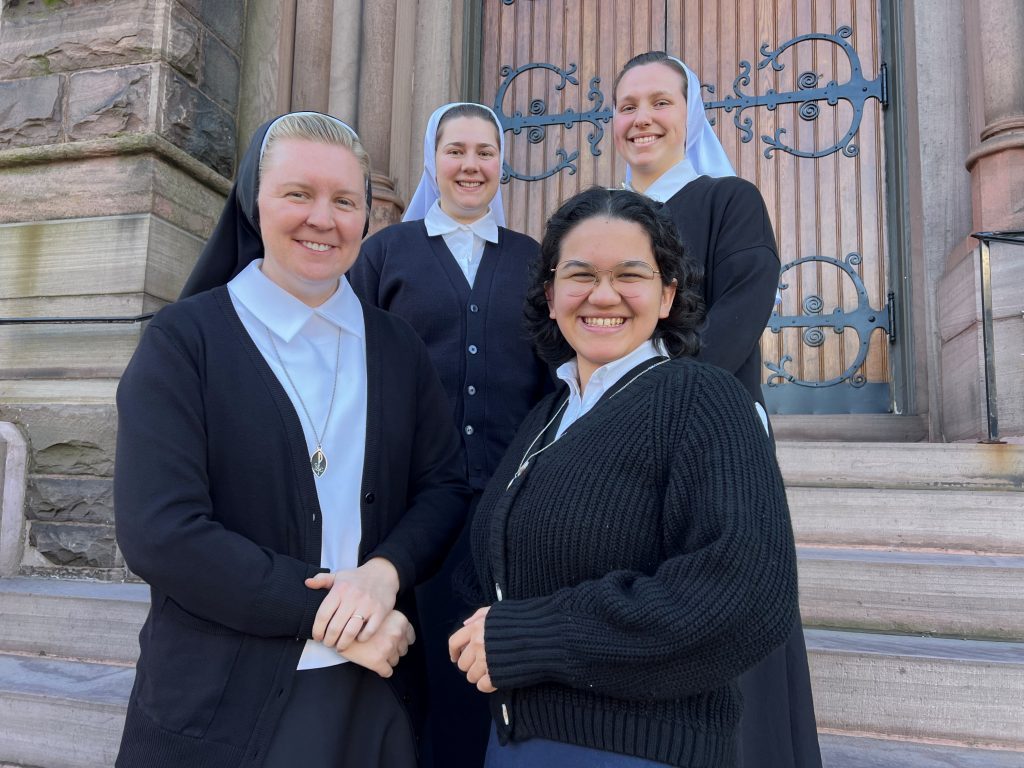
The three young women are now living at the Saint Nicholas Convent in Wilkes-Barre as they discern their vocations with the Sisters of Christian Charity.
Sister Jane Frances, 27, and Sister Philomena, 19, are novices, having advanced into a stage of formation in which they deepen their understanding of religious life. Miss Therese is a postulant – an earlier stage in which she and the congregation continue to discern whether she is called to become a Sister.
Their presence marks an important development for the Sisters of Christian Charity: the return of its formation program to Wilkes-Barre, where the Sisters first established their American motherhouse in the 19th century.
After prayer, discernment and consultation among congregational leadership, including Superior General Sister Mary Joseph Schultz, as well as Sister Maria Angeline Weiss, Formation Director, the Sisters decided to relocate the formation program from their motherhouse in Mendham, N.J., to a smaller, local convent.
The goal is to help young members prepare for the realities of religious life in the communities where they might eventually serve.
“Our motherhouse has about 80 sisters in it. It is a beautiful place to live and a beautiful place for formation,” Sister Maria Angeline explained. “In looking to the future – of how to best prepare young women to live connected to a parish, to live in a place where you’re doing the cooking and the grocery shopping and taking care of shared spaces – we thought, what if we mentored them through that by having the novitiate in a local community.”
The move, which took place Sept. 12, also brings the program back to a place deeply connected to congregation history.
Founded in Germany in 1849 by Mother Pauline von Mallinckrodt, the Sisters of Christian Charity came to Wilkes-Barre in the 1870s at the invitation of Father Peter Nagel, Pastor of Saint Nicholas Parish, at the time. Their first American motherhouse took root in the city before the congregation expanded and eventually divided its province in 1920.
For the three young women beginning their formation journey in Wilkes-Barre, each said there was an initial struggle to understand what God might be asking of them.
Miss Therese first encountered the Sisters of Christian Charity as a student at Allentown Central Catholic High School. Initially hesitant around religious Sisters, she began to see them differently after attending a Fiat Days retreat as a teenager.
One Sister repeatedly sat with her at meals, patiently reaching out even when Therese was reluctant to talk.
“She was the face of Christ,” Miss Therese said. “She just kept trying to reach out to me and I eventually warmed up to her because she was relentless in her love.”
That experience planted a seed. It would take several more years of prayer and discernment – and even a school pilgrimage to Italy – before Miss Therese felt ready to take a step toward religious life.
Sister Philomena also remembers being struck by the joy of the Sisters she encountered as a teenager.
She recalled an incredible moment during a Steubenville Youth Conference when a Eucharistic Procession stopped right in front of her.
“Out of 1,000 people, I kept asking the same question, why me? What is so special about me,” she recollected. “God calls us and we’re chosen. At the time, I was having a hard time believing it. But at that moment, it was very reassuring that this is what I want for you.”
Sister Jane Frances, meanwhile, initially set aside the possibility of a vocation, going to college and working for several years before returning to the Rosary and reconsidering the call she had first experienced in high school.
“I credit Mary with leading me back,” she said.
Their formation now provides time to deepen their relationship with Christ even more while learning the congregation’s history, spirituality and traditions. Their days include Mass, meditation, Scripture reading, Eucharistic Adoration, formation lessons and the practical responsibilities of maintaining a household. They take turns cooking, share chores and participate in the life of Saint Nicholas-Saint Mary Parish by being part of the choir.
The experience is already reaching beyond the convent walls.
Whether grocery shopping or walking along the Susquehanna River levee, the Sisters are regularly stopped by people who recognize their habits and ask whether they are religious Sisters.
The encounters are a reminder to all the young women that consecrated life can provide witness to God without any planning.
“To be a young Sister, it is an eye opener for people, especially young people who are still figuring out their own life and still figuring out their own relationship with Christ,” Sister Philomena said.
The emphasis on prayer and discernment also has a parallel in the Diocese of Scranton. In August, four seminarians began their formation journey at the reopened Saint Pius X Seminary in Scranton, entering a propaedeutic year dedicated to establishing a strong foundation in prayer, spiritual growth and discernment for men who are considering priestly formation.
Both experiences recognize the importance of learning to hear God’s voice amid the distractions and demands of daily life.
“In the novitiate, there is so much focus on prayer and silence,” Sister Maria Angeline said. Young Sisters must learn how to listen for God now so they can return to that relationship even amid the long days of future ministries in education, health care or service to those in need.
For Sister Jane Frances, the hope is not necessarily that everyone who encounters the Sisters will choose religious life. Instead, she hopes their presence encourages people to make room for prayer and discover God’s individual call.
“He has a plan for each one of us,” she said. “I want to help people listen to the Lord and grow in their own relationship (with Him).”