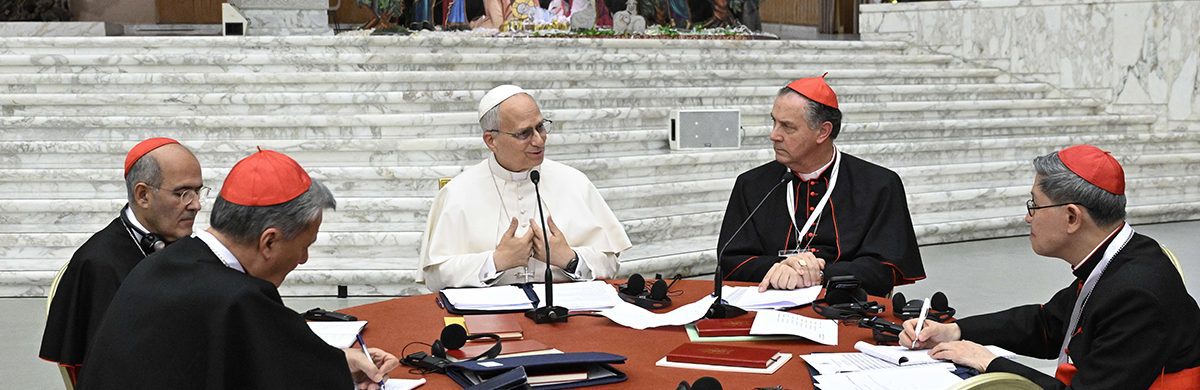
VATICAN CITY (OSV News) – With 170 red hats present in Vatican City, the extraordinary consistory of cardinals started at 3:30 p.m. Rome time with Veni Creator Spiritus sounding in the Synod Hall inside the Vatican City walls. They later moved to round tables in the Paul VI Audience Hall, where the cardinals held group discussions.
In opening remarks, Pope Leo XIV met the cardinals with one crucial message: “I am here to listen.”
“As we learned during the two Assemblies of the Synod of Bishops of 2023 and 2024, the synodal dynamic implies a listening par excellence,” the pope told the cardinals. “Every moment of this kind is an opportunity to deepen our shared appreciation for synodality.”
Calling the meeting “highly significant,” and voicing expectations that the gathering will be one of the defining moments of his papacy, the pope said. “This day and a half together will point the way for our path ahead. We must not arrive at a text, but continue a conversation that will help me in serving the mission of the entire Church,” he said.
Clearly answering a concern voiced during the general congregations before the May 2025 conclave that elected Pope Leo — that the cardinals didn’t know each other well — the pope told the cardinals that while they “are a very diverse group, enriched by a wide range of backgrounds,” they are still “called first to get to know one another and to dialogue, so that we may work together in serving the Church. I hope that we can grow in communion and thus offer a model of collegiality.”
Urging unity, one of the main themes of his pontificate, Pope Leo told the gathering that “While unity attracts, division scatters,” therefore “in order to be a truly missionary Church, one that is capable of witnessing to the attractive power of Christ’s love, we must first of all put into practice his commandment, the only one he gave us after washing his disciples’ feet: ‘Just as I have loved you, you also should love one another.'”
He said that due to time constraints, only two topics out of four proposed to cardinals prior to the gathering would be discussed during the meeting. The four options included “Evangelii Gaudium” and the mission of the church; “Praedicate Evangelium” and the service of the Holy See; synodality as an instrument of cooperation; and liturgy — the source and summit of the Christian life. Through a vote, the cardinals decided to focus on the missionary nature of the church, based on Pope Francis’s programmatic apostolic exhortation “Evangelii Gaudium,” and synodality, Matteo Bruni, director of the Holy See Press Office, confirmed Wednesday evening.
At the opening of the meeting, a meditation from Cardinal Timothy Radcliffe reminded the cardinals “of not leaving the successor of Peter alone as he faces the storms of the world,” Bruni said about the British Dominican cardinal’s meditation.
“Jesus commanded the disciples to get into the boat and go before him. Peter must not go into the storm alone,” Cardinal Radcliffe told the cardinals. “This is our first obedience, to be in the barque of Peter, with his successor, as he faces the storms of our times. We cannot remain on the beach saying, ‘Myself, I would not go sailing today.’ Or ‘I would choose a different boat.’ Jesus is alone on the mountain, but Peter must not be unaccompanied.”
Images and video from the extraordinary consistory shared with journalists by the press office brought to mind the images of the Synod on Synodality as cardinals moved to the Paul VI Audience Hall after the initial remarks of the pope and Cardinal Radcliffe, where they were divided into 20 groups. Nine tables were occupied by ordinary bishops of dioceses across the world and nuncios, while 11 were taken by curial officials and non-electors — specifically cardinals over 80. Each group had a president and secretary.
The pope was not present during the table discussions, Bruni said, except to offer brief closing comments.
To determine the topics to be discussed, “all groups gave their recommendations,” Bruni said during the evening briefing. “However, due to time constraints, only the secretaries of the first nine (groups), which include the cardinals of the local churches, were given three minutes to explain the work done within the groups and the reasons behind (their) choice … . The secretaries of the other 11 groups, however, only provided the titles of the chosen topics.”
“Among these 20 groups, there was no group that voted for another topic; that is, they were chosen by majority vote,” he confirmed.
Thanking the cardinals at the conclusion of the session on Jan. 7, Pope Leo “repeated the words of one of the secretaries, who mentioned how the path is as important as the conclusion,” Bruni told journalists.
“He mentioned the importance of the participation of everyone in terms of an experience of collegiality in the Church, the will, the desire, the sacrifice of the journey,” he said of the pope’s final remarks.
The pope said “the time is short, but it is important,” thanking some of the cardinals for traveling a long distance to reach Rome for the gathering,” Bruni said.
“Also for me, I feel the need to come to you. You have called the servant to this mission, and it is important that we discern together,” the pope told cardinals, according to Bruni, as they wrapped the first day of discussions.
Paraphrasing his own questions from his Epiphany’s Mass homily Jan. 6, Bruni said the pope asked the cardinals: “Is there life in our Church? Is there room for what is born? Do we proclaim a God that puts people back on a path?”
Referring to the topic chosen by the cardinals — the missionary zeal of “Evangeli Gaudium” — Pope Leo said, according to Bruni, “The joy of the gospel liberates. It makes people more attentive, but also more audacious. It suggests paths which are different from the ones that have already been walked upon. This is the experience of the novelty of the Church.”
“There may be doubt. There may be fear. Where shall we go?” Bruni said the pope asked. “But if we put our trust in the Lord and in his presence, we can do great things. It is not possible to separate one theme from another. The missionary church which looks beyond itself, that is the reason to proclaim the Gospel. And that is our mission.”