
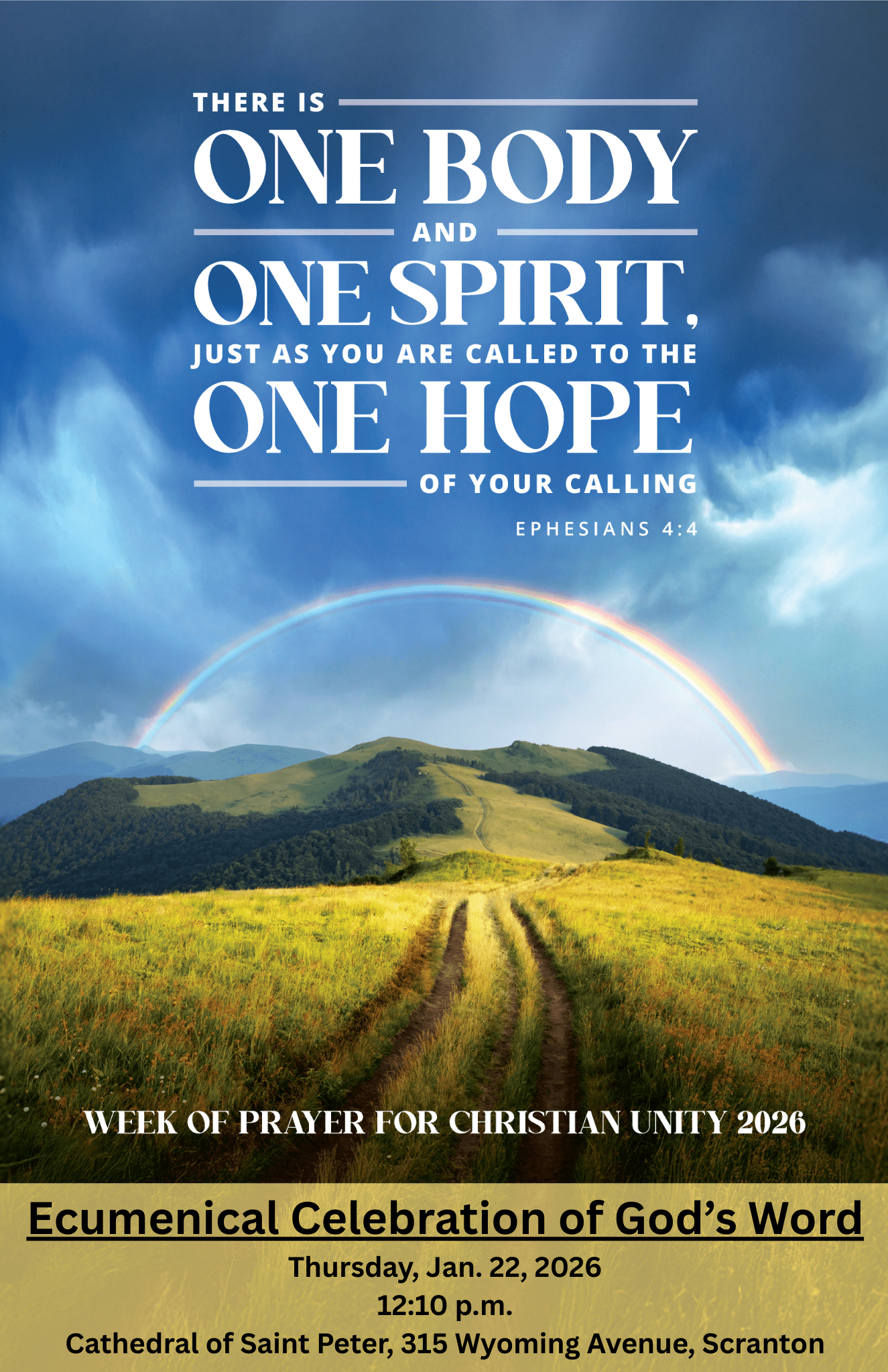
SCRANTON – The Diocese of Scranton will once again mark the Week of Prayer for Christian Unity with an Ecumenical Celebration of God’s Word, which will be held on Thursday, Jan. 22, 2026, at 12:10 p.m. at the Cathedral of Saint Peter in Scranton.
Christians of all denominations are warmly invited to attend this prayerful gathering, which reflects the Church’s ongoing commitment to unity among all followers of Jesus Christ.
The Most Rev. Joseph C. Bambera, Bishop of Scranton, will serve as leader of prayer for the traditional ecumenical prayer service. Bishop Bambera is currently serving his final year as Chairman of the U.S. Bishops’ Committee on Ecumenical and Interreligious Affairs.
The guest preacher for this year’s prayer service will be Rev. Dr. Nora Foust, Regional Conference Minister, Penn Central Conference, United Church of Christ.
The Ecumenical Prayer Service will be broadcast live at 12:10 p.m. on CTV: Catholic Television of the Diocese of Scranton. It will also be made available on the Diocese of Scranton website, YouTube channel, and across all Diocesan social media platforms.
ABOUT THE WEEK OF PRAYER OF CHRISTIAN UNITY
Observed worldwide each year from January 18-25, the Week of Prayer for Christian Unity encourages Christians to pray together and to renew their dedication to working toward greater understanding, reconciliation, and communion.
The Catholic Church has participated fully in this global observance since the Second Vatican Council, and in 2025, commemorated the 61st anniversary of the Decree on Ecumenism, which formally brought the Church into the modern ecumenical movement.
The 2026 theme, chosen by Christians in Armenia and drawn from Saint Paul’s Letter to the Ephesians, proclaims: “There is one body and one Spirit, just as you were called to the one hope of your calling” (Ephesians 4:4).
The theme emphasizes unity as both a gift and a calling – one rooted in the Holy Spirit and expressed through conversion of heart, shared hope, and love lived in community.
UNITY OF BELIEVERS
Unity is a divine mandate at the core of our Christian identity and is more than simply an ideal. It represents the essence of the Church’s calling – a call to reflect the harmonious oneness of our life in Christ amidst our diversity.
Throughout the Holy Scriptures, God’s call to unity resonates from the earliest times. Starting with the Old Testament, Abram’s plea to Lot highlights the divine desire for peace and harmony among the faithful: “Let there be no strife between you and me and between your herders and my herders; for we are kindred” (Genesis 13:8).
Abram’s call for harmony and mutual respect, despite their eventual parting of ways, emphasizes the importance of living peacefully.
This divine instruction continues in Leviticus 19:18, where God commands, “You shall not take vengeance or bear a grudge against any of your people, but you shall love your neighbor as yourself: I am the Lord.” Such commandments remind us that forgiveness and love are vital for maintaining unity within the community of faith.
The Psalms also celebrate the beauty of unity among God’s people.
They declare, “How very good and pleasant it is when kindred live together in unity! (Psalm 133:1). This imagery underscores the significance of unity in God’s design for His people.
In the New Testament, Jesus Christ elevates the concept of unity to a spiritual dimension, mirroring the profound relationship between Him and the Father. Unity among His followers is not merely the absence of conflict but a deep, spiritual bond reflecting the unity of the Holy Trinity.
Jesus’ prayer in John 17:21 calls for believers to be one as He and the Father are one, demonstrating that our unity is grounded in our relationship with Christ and our collective mission of sharing the Good News.