SCRANTON – Forty-eight years ago, a young Joseph Bambera walked through the doors of Saint Pius X Seminary in Dalton as a seminarian on his own journey toward the priesthood.
On Sunday, Aug. 23, 2026, he stood on the other side of that journey, now as Bishop of Scranton, welcoming a new generation of seminarians as the Diocese of Scranton re-established Saint Pius X Seminary in the former Cathedral Convent building in downtown Scranton.
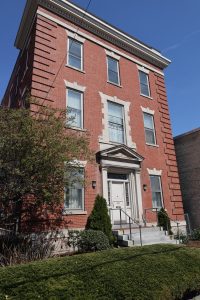
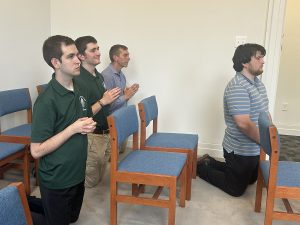
Four new seminarians have officially moved into the newly renovated building at 333 Wyoming Avenue, beginning the Propaedeutic Stage of their priestly formation and opening a new chapter in the history of a seminary that helped form generations of priests for the Diocese of Scranton.
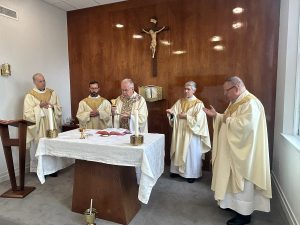
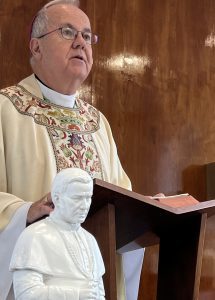
“As we re-establish the ministry of Saint Pius X Seminary, what an incredible gift this is,” Bishop Bambera said during his welcome at the Seminary’s first Mass, offering thanks to God for the blessing of faith, families and the many ways people are called to a life of service in Christ and His Church.
The four men beginning their formation at Saint Pius X this fall are Kenneth Francis of Nativity of Our Lord Parish, Duryea; Matthew Kelly of Saint Gregory Parish, Clarks Green; Zachariah Levin of Our Lady Queen of Peace Parish, Brodheadsville; and Stephen Chronowski of Saints Peter and Paul Parish, Plains.
For Father Alex Roche, Diocesan Secretary for Clergy Formation and Rector of Saint Pius X Seminary, the opening represented the culmination of months of planning, renovation and anticipation.
“We are excited because it’s going to give these men, as they start seminary, an opportunity to get to know the Diocese better,” Father Roche said. “It’s also going to give the people of the Diocese a chance to get to know our seminarians before they go elsewhere to continue their studies in theology.”
The decision to re-establish Saint Pius X Seminary locally grew out of new Vatican guidelines for the Program for Priestly Formation and Bishop Bambera’s desire to make the first stage of priestly formation more closely connected to the Diocese of Scranton and the people the seminarians may one day serve.
“I think this house is a sign of hope and growth,” Father Roche explained. “Our number of seminarians has increased in the country and in this Diocese. Just being able to house a part of formation here in the Diocese is a sign that there are wonderful things happening and that we’ve got a lot of great young men who are considering and discerning a call to serve the Diocese as priests.”
The building that will now serve as Saint Pius X Seminary was formerly home to the Cathedral Convent. Located directly across from the Diocesan Pastoral Center and just steps from the Cathedral of Saint Peter, the facility has undergone months of renovations to prepare it for its new mission.
The building includes individual bedrooms for seminarians, common areas designed to foster fraternity, a dining area and kitchen, and spaces for priests in residence. A chapel provides a place for Mass, Eucharistic Adoration and the Liturgy of the Hours.
The Propaedeutic stage is intentionally focused on preparation. Seminarians will develop habits of prayer, learn to live in community, deepen their understanding of the Catholic faith and participate in pastoral and service opportunities throughout the Diocese.
They also will take coursework at The University of Scranton while participating in retreats and other opportunities.
“As the year goes on, things are going to take shape, we’re going to discover things and we’re going to have new ideas and we’re going to find all the advantages of beginning formation here in the Diocese that maybe we didn’t even anticipate,” Father Roche added.
A NEW BEGINNING
The name Saint Pius X Seminary carries a special place in the history of the Diocese of Scranton.
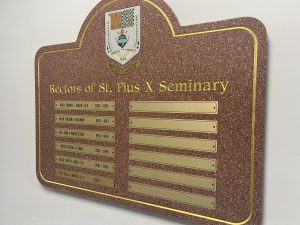
For more than four decades, from 1962 to 2004, the original Saint Pius X Seminary operated in Dalton, forming many men for priestly ministry.
As he celebrated the opening Mass for the new Seminary, Bishop Bambera wore two specific items to connect the past and present.
First, the Bishop wore the episcopal cross that belonged to Bishop William O’Hara, the first Bishop of Scranton.
“I thought it would be appropriate to wear it,” Bishop Bambera explained at the beginning of his homily.
He also pointed to the ring he was wearing – the ring he wore at his own episcopal ordination and one that had previously been given to Bishop Jerome Hannan, who established the first Saint Pius X Seminary.
“So, when people ask, you can tell people that I can be sentimental,” the Bishop joked.
The Bishop’s message to the four seminarians then turned more serious to the reality of what they were beginning.
Reflecting on his experience at World Youth Day in Denver in 1993, when he traveled with hundreds of young people from the Diocese to see Saint John Paul II, Bishop Bambera recalled words from the Pope that have remained with him for decades.
“Do not be ashamed of the Gospel. Be proud of the Gospel,” the Pope told young people.
Bishop Bambera said those words remain relevant for seminarians, priests and all Catholics today.
“We are challenged every day of our lives by a world that does not always appreciate, much less live out, the values of the Gospel for which Jesus gave his life,” he said.
The Bishop also focused on a question Jesus asked his disciples in the Gospel for the 21st Sunday in Ordinary Time: ‘Who do you say that I am?’
Bishop Bambera challenged the four seminarians to bring that question into their own lives in 2026.
“What about us? Who do you – who do we say that Jesus is he?” he asked. “Who is Jesus for you?”
It is easy, the Bishop noted, to proclaim faith in Jesus within the safety of a chapel.
The greater challenge comes outside those walls.
He offered hypothetical scenarios of being in a social setting, out to dinner, or standing beside someone whose life is falling apart because a loved one is suffering from cancer.
“How readily do we affirm Jesus?” he asked. “What do you say about Jesus then?”
He reminded the seminarians that even Peter, who boldly proclaimed Jesus as the Messiah, would later struggle and deny knowing him.
Sometimes, the Bishop said, believers struggle with their faith more than they might want to admit. But, he said, those moments do not have to be failures. He said that can become opportunities to encounter the mercy of Christ even more deeply.
“That is what I hope for you brothers, as you begin your priestly formation, that you will come to know Jesus more deeply than you do, that you affirm who Jesus is through thick-and-thin, and when you don’t, you will know where to turn, back to that same Jesus, who will forgive you and who will bring you closer to Himself through that struggle and through the honesty of your lives,” Bishop Bambera added.
BEGINNING JOURNEY TOGETHER
For the four men who will now call Saint Pius X Seminary home, they are excited about the journey that is beginning.
“For a long time, I’ve wanted to live in the city and meet more people,” Levin said. “I’ve wanted to serve others and finally I’ll begin to start doing pastoral work and I get to live right alongside all my brothers learning the same.”
Francis said being able to begin formation close to home offers an important witness to others.
“It’s a nice example for other people, to show them that the church is growing and there are young men willing to enter formation and hopefully one day become priests,” he said.
Kelly believes the small community will help the four seminarians develop the fraternity they will need as future priests.
“The whole goal is to eventually serve the people in unison with each other,” he said. “To truly be in unison with each other, we have to build friendships, and we have to build fraternity and this right here, is where it all begins and starts.”