

(OSV News) – The much-anticipated beatification of Venerable Fulton J. Sheen is set for Sept. 24 in St. Louis, marking a historic moment for the Catholic Church in the United States. Not only is Sheen the first television host to be formally recognized by the Church as “blessed,” but he also will become the first American-born bishop to be beatified.
For many of the nation’s bishops, however, Sheen’s beatification is about more than historical firsts. In interviews with OSV News, several bishops described a man whose influence as an evangelist and communicator flowed from a deeply rooted life of prayer and sacrifice — and whose example remains relevant to the Church’s mission today.
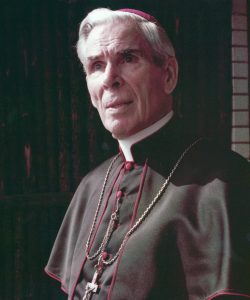
An auxiliary bishop of New York from 1951 to 1966, Sheen left an indelible mark on the Church in the United States and beyond. Yet when he arrived in New York, he was no stranger to the city. For two decades, while teaching at The Catholic University of America in Washington, he had traveled regularly to NBC studios to broadcast his popular weekly radio program. As an auxiliary bishop in New York, he also directed the Society for the Propagation of the Faith (one of The Pontifical Mission Societies), connecting American Catholics to the Church’s missionary work throughout the world.
For New York Archbishop Ronald A. Hicks, who said he is “filled with joy” at Sheen’s impending beatification, Sheen’s ministry offers a lesson the Church still needs today: evangelization must lead people into the mission of the Church.
“He was able to connect evangelization with mission,” Archbishop Hicks said. “We oftentimes focus only on his efforts to be on the radio or in front of television, and he did an extraordinary job at all of that. And at the same time, he used that platform to connect people to the mission of the Church, helping us to go deeper in our journey to know, love and serve Jesus.”
Sheen’s extraordinary public ministry, Archbishop Hicks stressed, flowed from the depth of his own Catholic life.
“I love his devotion to the Eucharist, to the Word, to the Rosary. I mean, it was all there — the Catholic life he embraced and he amplified and magnified.”
Sheen was “always making sure that we were never a self-referential Church, a self-serving Church, but a Church always on mission,” Archbishop Hicks said. Through his leadership of the Society for the Propagation of the Faith, Sheen devoted considerable energy to supporting young churches throughout the world.
But what inspires Archbishop Hicks most is Sheen’s willingness to serve wherever he was needed.
“Sheen always answered with a ‘Yes, send me where you need me, Lord,’ and I will go and I will respond and I will give it my best,” he said. “And his example inspires me.”
Rockville Centre Bishop John O. Barres finds in Sheen a similar connection between holiness and mission, calling him “our American St. Paul.” Citing Pope St. John Paul II’s insight that every saint is both deeply contemplative and deeply missionary, Bishop Barres said Sheen demonstrates how prayer and sacrifice bear fruit in evangelization.
“The more Catholics in the United States and everywhere are praying, sacrificing, carrying crosses on behalf of Catholic global worldwide mission in every continent,” he said, “the better we evangelize our families, our parishes, our secular networks and secular workplaces.”
Bishop Barres, who serves as chairman of the board of The Pontifical Mission Societies — the successor organization to the one Sheen directed — also was baptized by Sheen. He sees the beatification as an opportunity not only to remember Sheen’s accomplishments in supporting the missions, but “to move it forward in the 21st century.”
He points to Sheen’s gifts as a teacher and model for bishops, particularly his conviction “that the truth claims of the Catholic Church are liberating to all human beings because they are objectively true for all human beings.”
For Denver Archbishop James R. Golka, Sheen’s legacy as a teacher of the faith is equally compelling.
“When I picture him, one of the images that I have is of him as a bishop standing with his chalkboard teaching the whole world about Jesus and the Catholic faith,” Archbishop Golka said. “And for me that’s what we all ought to be doing. It’s kind of like a commission to do the same — not just teach our own flock, but the whole world.”
Sheen’s “clear, unambiguous teachings,” Archbishop Golka said, demonstrate how “truth leads to beauty and to wonder and to love.” In a culture increasingly marked by division and anxiety, he sees Sheen’s insistence on putting Christ at the center of everything as an enduring message.
“Our culture and world are divided and anxious, and we know the only remedy to that is Christ,” he said.
Bishop Steven J. Maekawa, O.P., of Fairbanks similarly sees Sheen’s ability to speak to ordinary human experience as central to his enduring appeal. Sheen could speak, Bishop Maekawa said, to “the regularity of the cross” in people’s lives and awaken within them a recognition of their deepest hunger.
“He’s trying to draw out that hunger and say that, you know, this is meant for you to have,” Bishop Maekawa said. “God wants you to have this.”
Oklahoma City Archbishop Paul S. Coakley, president of the U.S. Conference of Catholic Bishops, said Sheen’s example is especially relevant to the bishops’ priority of evangelization and inviting others into an encounter with Jesus Christ. Calling Sheen “one of the premier evangelists in our nation’s history,” Archbishop Coakley sees his example as “prophetic and profound.”
“He was, in a certain sense, all things to all people in his day,” Archbishop Coakley said. “I think that’s going to be his lasting legacy as an evangelist, really.”
Sheen’s witness will also continue to inspire future generations of priests, Bishop Barres believes. Through his life, intercession and writings on the priesthood, “Sheen’s going to be an instrument of a rich harvest of vocations for the priesthood,” he said.
Among a younger generation of clerics particularly inspired by Sheen is the soon-to-be-blessed’s own successor in Rochester, Bishop John S. Bonnici. Installed earlier this year, Bishop Bonnici has spoken with priests who served under Sheen during his brief tenure as bishop of Rochester from 1966 to 1969 and discovered another dimension of the famous television personality.
“The priests that I’ve spoken to speak of how his love for the poor always stood out, which is not what you necessarily would glean from his TV appearances,” Bishop Bonnici said.
Sheen was deeply concerned about Rochester’s housing problems and the beginnings of homelessness, Bishop Bonnici noted, and he was willing to challenge powerful interests on behalf of those in need.
One priest recalled to Bishop Bonnici how he was accompanying Sheen when a beggar with a reputation approached Sheen for money. As Sheen reached into his pocket, the priest warned him, “He’s taking you for a ride.” But Sheen stopped him. “I never want to make the mistake of turning someone away that just might be Jesus,” he said before giving the man his money.
Bishop Bonnici also admires Sheen’s humility in accepting his appointment to Rochester despite his international reputation and lack of experience leading a diocese.
“A man of his stature and popularity and fame still acknowledged that he, despite his age, needed a lot of learning,” Bishop Bonnici said. “So I think that’s inspirational and sobering.”
As Bishop Bonnici travels throughout the Rochester diocese, he has begun using Sheen’s crosier. When people recognize it from old photographs, he said, “they’re just drawn to it. They want to touch it. They want to hear about it.”
Several of the bishops also point to Sheen’s own prayer life — particularly his commitment to a daily Holy Hour for nearly six decades — as an inspiration to bishops and laity alike.
“Clearly you don’t do that unless there’s a huge love and personal hunger for God,” Bishop Maekawa said.
Bishop Bonnici observed that “a lot of young people today are grasping and appreciating” Sheen’s hallmark spiritual practice.
“What most young people today, I think, are seeking is a pause from the craziness of the technical world that they live in,” he said. “And I think that’s drawing them to prayer. So what better person than Sheen to not only nurture that in their lives, but also offer them guidance and insight on how to move forward?”
Archbishop Coakley sees Sheen’s continued relevance as multifaceted. He recalled that “one of my first ways of coming to reverence and recognize him was as a champion for life,” having prayed for decades a pro-life prayer attributed to Sheen.
For Archbishop Coakley, Sheen’s beatification is also “a source of pride” for the U.S. bishops “that the Church has recognized this man who is such a great evangelist, such a great figure in American Catholic Church history.”
But the significance goes beyond historical significance. For bishops who appreciate Sheen’s legacy as missionary, teacher and evangelist, attentive to the poor and grounded in prayer, his beatification offers a model of episcopal ministry rooted in personal holiness.
Sheen’s life also demonstrates that his greatest legacy was not his achievements or fame, but the way he made use of it all to point beyond himself — toward Christ, the Church and the needs of others. Sheen’s witness shows that evangelization flows from prayer, fidelity to Christ leads outward in mission, and ordained ministry must remain grounded in holiness.
That, Archbishop Coakley suggested, gives Sheen’s beatification significance for the entire U.S. episcopate.
“In a certain sense, Sheen’s beatification is evidence that the Church in the United States is coming of age and maturing in many ways,” he said. “The full flowering of our baptismal grace is a life of holiness, and to have some of our ecclesiastical figures, priests and bishops, who are being acknowledged and recognized by the Church for their holiness is, I think, a sign of great hope.”
Archbishop Coakley stressed that “we all have much to learn from him” and sees Sheen’s beatification as “a certain affirmation to the U.S. bishops.”
“To have one of our own beatified, the first member of this conference who’s ever been beatified,” he said, “it is a beautiful thing, isn’t it?”