ARLINGTON, Va. (OSV News) – At 9:37 a.m. on Sept. 11, 2001, American Airlines Flight 77 crashed into the Pentagon in Arlington killing 184 people — 125 people inside the Pentagon and 53 passengers and six crew members aboard the plane.

Twenty-five years later, the repaired facade of the Pentagon still looks a little brighter and the area outside that part of the building is now the National 9/11 Pentagon Memorial. There is no central statue. Instead, there are 184 stainless-steel benches, one for each person who lost their life there.

Each bench has the name and age of the victim with a shallow pool of water underneath. There are trees, gravel and dramatic lighting best seen at night.
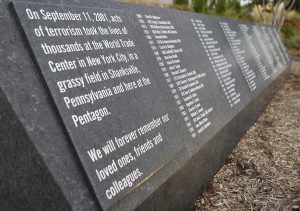
Names of victims of the Sept. 11, 2001, terrorist attacks are seen Aug. 18, 2011, on a display that is part of a memorial at the Pentagon in Arlington, Va., near Washington. Sept. 11, 2026, marks the 25th anniversary of the attacks that claimed the lives of nearly 3,000 people at the Pentagon and in New York City and Shanksville, Pa. (OSV News photo/Bob Roller)

Interestingly, each bench was placed according to where the victim was — those representing the Pentagon victims are oriented toward the building, while the plane victims are remembered with benches placed in the direction the plane approached the building.

That plane was one of four hijacked commercial airliners that attacked the U.S. that day, killing 2,977 people and injuring thousands more.

In New York, 2,753 people died in the Twin Towers collapse, brought down by two of the planes. Forty people died in Shanksville, Pennsylvania, when passengers and crew fought back against hijackers on the fourth airliner, forcing it to crash in a field near Shanksville.

Officials believe the fourth plane was headed for the U.S. Capitol or the White House.

Inside the Pentagon, a new chapel, built on the impact site of the attack, has a 9/11 etched glass memorial piece and is adjacent to a memorial area with a list of the Pentagon victims’ names etched in stone. Small pieces of paper and pencils are available for visitors to do a rubbing of the names. There is also a reflection room nearby.

Twenty-five years ago, Father Daniel Mode, an Arlington diocesan priest, was a U.S. Navy Reserve lieutenant serving reserve duty at the Pentagon as a staff officer for the chief of chaplains in the Navy Annex.

He would have been in that exact area of the Pentagon on 9/11, having frequent meetings there. Instead, he was at his parish, Queen of Apostles in Alexandria.

He heard about the attacks, and he stayed with the parish children waiting for their parents who worked in the Pentagon to pick them up. He celebrated an impromptu Mass. And then he received a phone call. There was a list of people who could’ve been in that part of the building and calls were being made to account for everyone.

“It quickly came home to me,” he told the Arlington Catholic Herald, the diocesan news outlet.

Much has changed in the past quarter-century — barricades around Washington memorials and government buildings; Transportation Security Administration enforcement at airports; and an underlying sense of “could it happen again” for many.

Steven Jarvis, who retired from the U.S. Air Force and now works in support of the Joint Chiefs of Staff, said the Pentagon “now has a chapel and the Eucharist is present 24/7 — a testament to how God can turn bad to good, in many ways.”

He said in the 1990s, Catholic Mass was celebrated in a big auditorium with the altar on a stage.

“After the plane hit, they made an indoor memorial and a chapel with a sacristy and the tabernacle,” he said. The Pentagon Memorial Chapel opened on the first anniversary of the 9/11 attacks.

“In the morning, I kneel down outside the door because I know the Lord is in there, and at the end of the day,” said Jarvis, a parishioner of St. Michael in Annandale. “The chapel is always open.”

Jarvis is volunteer coordinator for the Pentagon Catholic Community, working with “a dedicated and devout team” of Catholic volunteers, both military and civilian.

There are 175 members with an average of 25 to 35 people attending daily Mass. It peaks on first Fridays, and they move back to the auditorium for Ash Wednesday and holy days of obligation, he said.

“The chapel is multi-denomination,” Jarvis said, “but we are the big players because we are here every day.” Catholic Masses are celebrated at 11:30 a.m. on weekdays and confession is offered before and after Mass.

Two religious orders offer the daily Mass. Dominican priests are responsible for Tuesdays and Thursdays, and the Marian Fathers of the Immaculate Conception celebrate Mass on Mondays, Wednesdays and Fridays.

Dominican Father Vincent Ferrer Bagan, director of music for both the diocese and the Cathedral of St. Thomas More in Arlington, has been on the rotation for four years.

“It is quite moving,” he said. Coming from a rural town in Minnesota and having been in high school on 9/11, he said he never would have imagined he would be at the Pentagon someday. “It’s a privilege to interact with Catholics who serve in that building, many who are in parishes in our diocese,” he said.

“We always have each Mass offered with a pointed intention but having the chapel in that location is a good reminder for the priest and lay faithful … to remember to pray for those who lost their lives that day and all of the military personnel who have lost their lives all these years,” he said.

In the outside corridor near the chapel, Father Mode said a spot of black soot is still visible on the wall from the flames on 9/11. Perhaps it is a reminder of what was lost and what remains.
(OSV News) – The offering placed before the altar on Sept. 11, 2001, was unlike any ever seen at St. Peter’s Catholic Church in Manhattan’s Financial District: the lifeless body of 68-year-old Franciscan friar and New York City Fire Department Chaplain Father Mychal Judge.

He was killed when the 110 stories of the World Trade Center’s south tower collapsed at 9:59 a.m., blasting debris into the adjacent north tower lobby where Father Judge was stationed. At the moment, he reportedly was repeatedly praying, “Jesus, please end this right now! God, please end this!” He was shortly afterward carried from the apocalyptic site.

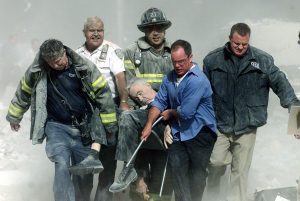
New York firefighters and rescue workers are seen Sept. 11, 2001, carrying Franciscan Father Mychal Judge, a chaplain with the New York Fire Department, who died while giving last rites to a firefighter following terrorist attacks that would soon bring down the twin towers of the World Trade Center. (OSV News photo/Shannon Stapleton, Reuters)

Some four blocks away, St. Peter’s own roof had been struck by landing gear from one of two hijacked jets smashed into both towers that morning. Father Judge’s journey there was captured in an instantly iconic photo seen worldwide — dust-covered, slumped in a chair and already shockingly pale as he was carried by five men.

Since he lost his life, Father Judge — a friar for 47 years; a priest for 40 — has been hailed as a hero, suggested for sainthood, and praised as a selfless friend not only to first responders, but also to the poor, sick and forgotten of the Big Apple’s sometimes tough streets.

Ahead of the 25th anniversary of the deadliest terrorist attack in recorded history, friends of Father Judge shared memories of his life and loss, and reflected on his legacy.

“People would often say about him, when you talk to him it was like you were the only person before him,” said Father Kevin Mullen, a Franciscan friar of the Province of Our Lady of Guadalupe and former president of Siena University in Loudonville, New York, where he currently teaches.

“He engaged you fully; he was not looking around for who he could talk to next. He was fully present to you,” Father Mullen told OSV News. “And that’s what made a difference to a lot of people about Mychal Judge — they could talk to him, bare their souls, share their good news, share their bad news. And he was going to be there for them.”

— ‘He was there. He was present’ —

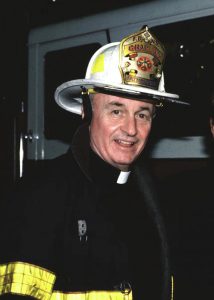
Franciscan Father Mychal Judge, a chaplain with the New York Fire Department, is pictured in an undated photo wearing his helmet and bunker coat. Father Judge died while giving last rites to a firefighter in the aftermath of the terrorist attacks that brought down the twin towers of the World Trade Center. This year marks the 10th anniversary of the attacks that claimed the lives of nearly 3,000 people in New York City and Shanksville, Pa., and at the Pentagon. (OSV News photo/courtesy Holy Name Province Franciscans)

On the morning of 9/11, Father Mullen, stationed in a parish approximately 15 miles from midtown Manhattan, was responsible for a funeral liturgy.

“I was aware before I started the funeral that the first tower had collapsed,” he recalled. “And when I finished the funeral, I was told the second tower had collapsed. So I knew things were getting worse.”

That afternoon, he heard a radio announcement reporting an injured fire chaplain at the World Trade Center.

“And my gut said, ‘That’s Mychal Judge,'” Father Mullen said. “He was right across the street from a fire station that responded immediately.” The church where Father Judge ministered and the friary where he lived, St. Francis of Assisi on West 31st Street, neighbored New York City Fire Department Engine 1/Ladder 24.

“And I had no doubt he was down there,” Father Mullen said, referring to the disaster area.

To confirm his suspicion, he called the regional head of his order.

“As soon as he answered the phone — he didn’t even say, ‘Hello, Kevin’ — he just said, ‘It was Mychal.’ And I said, ‘I thought so.’ That’s how I learned.”

Father Mullen said the already crushingly tragic day immediately became painfully personal. But nonetheless, he still found himself certain of one thing.

“I felt that if Mychal was given his choice of how he would go out of this world, that would have been his choice: to be with the firefighters, literally going with his boots on. He was there. He was present.”

— ‘He resided deeper in you than you understood’ —

The first introduction Michael Daly — journalist and author of “The Book of Mychal: The Surprising Life and Heroic Death of Father Mychal Judge” from St. Martin’s Griffin — had to the priest was the sound of his and others’ laughter.

And it was coming from, of all places, a hospital burn unit.

Accompanying Patrick “Paddy” Brown — an FDNY captain who later died on 9/11 — Daly was there in 1994 to visit FDNY Captain John Drennan, who had been critically burned battling an apartment fire.

“So I go in,” Daly recalled, “and there’s all these guys laughing because of something this priest said — and I’m thinking, ‘Who is this guy?'”

On 9/11, Daly, a Catholic, was at the scene of the attack for the New York Daily News when the north tower collapsed. He remembers running for his life as a massive cloud of debris — chokingly dense with pulverized concrete, glass, metal and the contents of countless offices — rolled like a tsunami through the surrounding streets.

He admits he was afterward “hazy about timing and hours and all that.”

But he does know the air had finally cleared when FDNY Deputy Fire Chief Peter Hayden told him Father Judge was dead.

“And my knees just went,” recalled Daly, overwhelmed with shock. “I didn’t expect that; I didn’t know Mychal had been down there. Someone had called over the radio for the fire chaplain earlier. But I didn’t hear any response. And then — he’s gone, you know?”

“I think he just …” Daly paused, searching for the right description. “He resided deeper in you than you understood.”

— ‘A genius priest’ —

Daly described Father Judge walking the streets of New York City in his brown Franciscan habit, greeting homeless people by their first names, praying with them and distributing neatly folded cash.

Daly also recalled Father Judge often worked 16-hour days ministering at blazes and rescues — counseling firemen, their families and victims — and that he gently tended AIDS patients in an era when medical staff would not make physical contact.

After Father Judge’s death, close friends and associates revealed he was gay — but by all accounts, maintained his vow of celibacy. The response of Kevin Shea, a firefighter at FDNY Engine 40/Ladder 35 in Manhattan’s Lincoln Square, apparently typified the reaction of other first responders. “He said,” Daly recalled, “Well, if you tell me Michael Judge was gay, I’ll tell you I just had my first gay friend.”

While not “out” in the fire department, Daly said Father Judge told Fire Commissioner Thomas Von Essen, who was struggling with his son’s gay identity.

“You know, he was a genius priest,” said Daly. “He just was.”

— ‘I sat with his body for about an hour’ —

Father Christopher Keenan, a friar of the Province of Our Lady of Guadalupe, entered the Franciscans more than 60 years ago at Father Judge’s urging and became a FDNY chaplain after his friend’s death. On 9/11, he was helping in the emergency room at St. Vincent’s Hospital.

About 2 miles from ground zero, St. Vincent’s staff were caring for the dust-caked and dazed people who had outrun the collapse of the towers.

“I was connecting with their families to come pick them up. And about 2 o’clock in the afternoon, it kind of stopped. I left at 5:30 to walk home from 12th to 31st Street,” Father Keenan recalled. “I had a shift of confessions at 6:00. I came out of the hospital, and there’s doctors and nurses and staff with stretchers — still waiting for all the people that never came.”

Father Keenan had been looking for Father Judge.

“So when I arrived at the firehouse across the street from St. Francis of Assisi Church, I asked the guys, had they heard from Mychal? And they said, ‘He died — and his body is in the back of the firehouse here.’ They had set up sheets and cordoned off a section, where his body was in a black bag. And so I sat with his body for about an hour.”

Father Judge had been moved to Engine 1/Ladder 24 after temporarily lying in front of St. Peter’s altar.

“Then the friars came from across the street. And the firefighters gathered that were there … and we friars sang the Blessing of St. Francis … and then an ambulance took him to the morgue.”

Father Keenan noted that six from the firehouse had also died.

— Victim 0001 —

Father Judge was later numbered victim DM (Disaster Manhattan) 0001-01 of 2,753 souls eventually tallied in New York City after the World Trade Towers crumpled into an infernal landscape of fiery and smoking rubble. Father Keenan himself would spend seven months assisting in that rubble with recovery efforts, afterward contracting several forms of cancer.

In Washington that day, 184 were killed when hijacked American Airlines Flight 77 crashed into the Pentagon. Another 40 aboard United Airlines Flight 93 died when a fourth hijacked plane crashed into a Pennsylvania field.

“The 25th anniversary is going to be a very solemn time,” Father Mullen said. “And I hope we have that consciousness still alive in our country — that this is very, very painful, especially for the families,” he shared.

“Because a lot of people have just taken this event for granted: ‘Well, that’s history — it happened, it’s over,’ he said. “But it’s never over for those families. Never, ever, over.”

(OSV News) – For seminarians navigating years of study and discipline in formation for the priesthood, Pope Leo XIV had a reminder Sept. 3: The key to preparing for priestly ministry is focusing on “your relationship with the One who called you.”

Pope Leo encouraged future priests to use their years in seminary to ground every aspect of their formation in a deep personal relationship with God.

“The heart of the seminary experience lies here: learning to be with the Master, the Lord Jesus,” the pope said in an audience with Italian seminarians in the Vatican’s Clementine Hall.

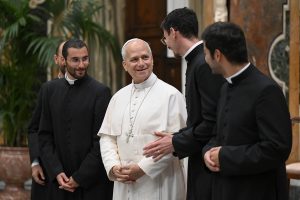
Pope Leo XIV smiles during a private audience with seminarians at the Vatican Sept. 3, 2026. Pope Leo shared his advice with the seminarians on how to best prepare for the vocation to the priesthood. (OSV News photo/Mario Tomassetti, Vatican Media)

“Every vocation is born from an intimate dialogue with God, cultivated in silence and prayer, which often occurs despite the sometimes deafening noise of the world,” the pope said.

The pope met with seminarians from two seminaries in southern Italy: the Pius XI Regional Seminary in Puglia and the Episcopal Seminary of Aversa in Campania.

“In a world so eager to celebrate self-realization, it is truly important to reiterate that none of you and none of us are here because we deserve it, but only because of a free choice made by God the Father, a sign and pledge of a gratuitous love that always anticipates us and never disappoints,” Pope Leo told the young men.

“There is no competition, no ranking, nor is it written anywhere that he chose the best: He chose those he wanted,” he added.

The pope underlined that the time spent in seminary is more necessary than ever today “in a world that is in a hurry.”

“Precisely because our times are fast-paced and noisy, we need a place and a season in life where we can learn to be present, to discern, and to allow ourselves to be formed without taking shortcuts,” he said. “The seminary is not a postponement of the mission, but rather a prerequisite for it.”

He encouraged them to remember that they are being prepared to be sent to communicate the newness of life in Christ to the world “to those families who are barely getting by, to young people in their 20s who pack their bags to look for work, to the elderly living alone, to the marginalized, and to those who have lost their sense of purpose.”

“The priest is sent to all people so that he may proclaim to all the beauty of faith in Jesus Christ, the good news of our salvation,” he said.

Pope Leo thanked the young men for their “yes” to God’s call, adding “your very presence in the seminary is a sign of hope for the entire Church.”

“As I look at each of you, I contemplate the wonder of God, who never tires of whispering to the hearts of young people the beauty of giving one’s life for him and for the Church,” the pope said.

(OSV News) – On Sept. 11, 2001 – the date of the worst terrorist attack in American history, when four hijacked jets became deadly weapons — there was no shortage of heroic first responders who confronted danger instead of avoiding it.

Many Catholic clergy and religious ministered among them – including priests, friars and sisters. Some of their stories are perhaps less well known – but the help and healing they also brought to those who experienced the devastating losses of 9/11 are worth remembrance as the 25th anniversary approaches.

“I remember like it was yesterday,” Father Brian Jordan told OSV News.

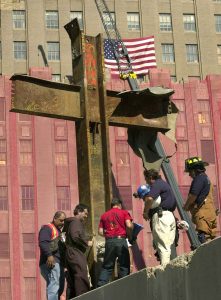
Franciscan Father Brian Jordan, standing with laborers and emergency workers Oct. 5, 2001, blesses a 17-foot-tall cross formed by steel beams and recovered from the rubble of the World Trade Center in New York brought down nearly a month earlier in the 9/11 terrorist attacks. (OSV News photo/Kathy Willens, Reuters)

A Franciscan friar of his order’s Province of Our Lady of Guadalupe, the priest is the current pastor of the Church of St. Francis of Assisi on West 31st Street in New York City.

That morning, Father Jordan was at New York Presbyterian Hospital. Hearing of the strike, he returned to the Franciscan friary on 31st Street — attached to St. Francis of Assisi Parish — where he lived, determined to go to the disaster site.

Uncertain what he might find — but expecting both victims and perpetrators — he retrieved holy water and a pair of brass knuckles. “I said, ‘I’ll bless them with one hand, and just in case there’s any bad guys, I’ll bless them with the other hand.”

Before he left, another friar had devastating news: Their fellow Franciscan, Father Mychal Judge, was dead. Still, Father Jordan knew what Father Judge would want him to do — go help.

After stopping at Manhattan’s St. Vincent’s Hospital — the only patients were those being treated for dust inhalation after the Twin Towers collapsed — Father Jordan headed to ground zero, encountering a police captain he knew.

“He gave me a mask; he gave me a pair of gloves. He said, ‘Father, put the mask on, put on the gloves and go to work.’ And so I went up and down for a couple blocks, and there were bodies and body parts. I just blessed them all.”

On Sept. 16, Father Jordan said his first Mass at ground zero; he would continue to have Mass there for nearly 10 months.

Then on Sept. 23, there was a surprise.

“A big burly construction worker from Local 731 comes up to me and says, ‘Hey, Father, you want to see God’s house?'”

“So we go into the ruins of 6 World Trade Center,” recalled Father Jordan. “I had like 25 fighters next to me, and the construction worker says, ‘What do you see there, Father, right in the middle?’ I said, ‘I can’t believe this … I see a cross.'”

Two intersecting steel beams had been sheared into a crucifix, as 6 WTC was struck by debris from the collapse of the North Tower.

The stunning artifact became known as the “Cross at Ground Zero” and eventually became part of the 9/11 Memorial & Museum collection.

It was excavated, placed on a concrete abutment, and blessed. On Oct. 7, a Mass was celebrated near it, at the corner of Vesey and West streets.

“It gave a boost of energy to people at the time,” explained Father Jordan, who wrote his own memoir — “The Ground Zero Cross” (Xlibris) — and was given the distinction of being its unofficial guardian.

On 9/11, Sister Margaret O’ Brien, a Sister of Charity working in the Sisters of Charity Health Care System, was in her office at the Bayley Seton Hospital on Staten Island, briefing a colleague just returned from vacation.

“Her secretary came in and said, ‘I just got a call. A plane went into the World Trade Center,'” Sister Margaret remembered. “We went down the hall to a window we could see from, and we realized, this is going to be bad.”

The sisters quickly prepared to go to St. Vincent’s Hospital “to set up the emergency and trauma response,” explained Sister Margaret. “And the doctors were there, the stretchers were there, all waiting at the entrance — but after a short while, nobody came.”

Sister Margaret worked the hotline in the sisters’ hospital command center, taking calls from people searching for loved ones.

“The telephone was really hard,” she reflected. “Because people would give you a name and you’d check your list, and you didn’t have them. … It was very, very emotional the whole time — and for the first couple of days, the phone just kept ringing.”

Nonetheless, she found a reason to be thankful.

“I remember being so grateful I had something to be part of, to help,” said Sister Margaret, now assistant to the president of the Sisters of Charity New York.

Trauma was a persistent feature of the sisters’ shifts — especially for one colleague who assisted first responders sent for care from recovery work at ground zero.

“Sometimes people would talk, but most of the time they just couldn’t,” Sister O’Brien explained. Her colleague “remembered one person — he was very quiet — and then he said, ‘I can take the arms and the legs. But when I turned over a stone and saw a face, just a head, flattened into the ground.'”

“He lost it,” said Sister O’Brien.

Father Stephen McGraw — at the time a priest in the Diocese of Arlington, Virginia, just outside of Washington — also saw unspeakable sights.

On the morning of 9/11, he had just concluded a school Mass — and was on his way to Arlington National Cemetery for a burial when he missed the appropriate exit.

“I remember about 9:35, I’m just sitting in this traffic, right in front of the Pentagon.”

He was distressed that he would now almost certainly be late for the burial.

“And then without warning, the plane came roaring right over the tops of our cars — very, very low,” Father McGraw said. “I can’t say which of my senses was most impacted — there was the vibration and roar of the plane, and a light pole was clipped and fell over on a taxi driver’s car just a few cars away.”

Looking to his right, he watched as American Airlines Flight 77 plowed into the Pentagon.

“I saw it crashing, disappearing, with a huge fireball billowing out from the building in the moment after the crash.”

Because his radio wasn’t on to hear what was happening in New York City, “I just assumed it was a terrible, tragic accident.”

Commuters came to a frozen stop, and Father McGraw leapt from his car — stole, anointing oils and prayer book in hand — vaulting the highway guardrail to the lawn of the Pentagon to reach the victims.

“Basically, my message to them was, ‘Jesus is with you.’ That’s what I kept saying to the several victims I attended,” said Father McGraw.

One victim who identified himself as Catholic — Juan Cruz, the civilian accounting division manager in the Office of the Administrative Assistant for the Secretary of the Army — was given the sacraments.

Another — Antoinette Sherman, an Army budget analyst, who later died — lay face down on the grass, severely burned on her back, a single shoe on one foot. Father McGraw gently removed it at her request.

“Then she just said, to perhaps whomever could hear her, ‘Tell my mother and father that I love them.’ And so I assured her that I would.”

Father McGraw — now a missionary priest and church pastor in the Diocese of Arlington’s BĆ”nica Mission in the Dominican Republic — doesn’t think his unplanned detour was a coincidence.

“I had a strong sense of divine providence,” he told OSV News. “I was meant to be there.”

The attacks killed 2,977 people and injured thousands more: 2,753 people died in the Twin Towers collapse, brought down by two hijacked commercial airliners; 184 people died when a third hijacked airliner flew into the Pentagon; and 40 people died in Shanksville, Pennsylvania, when passengers and crew fought back against hijackers on a fourth airliner, forcing it to crash in a field near Shanksville. Officials believe the fourth plane was headed for the U.S. Capitol or the White House.

The 25th anniversary of 9/11 will not only be a time of solemn remembrance — it also leaves some longing for the national unity Americans once demonstrated.

“We saw evil at its worst,” declared Father Jordan. “But we also saw goodness at its best. New York City came together. The country came together. The world came together.”

DearĀ Eric,

At the start of the 119th Congress, the American Dream and Promise Act (H.R. 1589) was reintroduced in the U.S. House of Representatives. This bill has passed in the House on a bipartisan basis on multiple occasions during previous congresses and has long enjoyed support from a wide cross-section of the American public. Up to this point, it has not passed in bothĀ the House and Senate, but it continues to have bipartisan support.

The bill would essentially provide a fair, just, and long-term legal solution for Dreamers (people brought to the United States as children who lack legal status but know only this country as their home) and those who have been lawfully relying on temporary protected status (TPS) or deferred enforced departure (DED) for several years. Under current law, there is no direct pathway to permanent legal status for these populations, including for people who have protection under Deferred Action for Childhood Arrivals (DACA). In many cases, even those with U.S.-citizen spouses and children do not have access to permanent status. This bill would fix that.

For both groups, eligibility to apply for permanent legal status under H.R. 1589 would be subject to several limitations (such as, for Dreamers, being physically present in the United States since at least January 1, 2021), while also requiring applicants to pay fees, present certain identifying information, and submit to background checks/security vetting.

In 2021, the most recent year this bill was passed by the House, Bishop Mario Dorsonville, chairman of the USCCB’s Committee on Migration at the time, submitted written testimony for a hearing on the American Dream and Promise Act. He stated: ā€œDreamers and TPS/DED holders are our neighbors, parishioners, and—most importantly—fellow children of God. We as a Church have long advocated for their legal protection and full inclusion in the life of our country.ā€ In that same testimony, Bishop Dorsonville quoted the late Pope Francis, who said, ā€œImmigrants, if they are helped to integrate, are a blessing, a source of enrichment and new gift that encourages a society to grow.ā€

The American Dream and Promise Act would provide such an opportunity for integration, recognizing the positive contributions to American communities already made each day by many Dreamers and longtime residents relying on TPS/DED. Through the procedural mechanism known as a ā€œdischarge petitionā€, the House could be required to vote on H.R. 1589 in the coming days.

Please join in expressing support for this bill with your congressional representative at this pivotal moment in time.

CONTACT YOUR REPRESENTATIVE TODAY

His Excellency, Bishop Joseph C. Bambera, announces the following appointments, as follows:

DEACONS:

Deacon William F. Behm, from diaconal ministry, Our Lady of Hope Parish, Wilkes-Barre, to Saint Nicholas-Saint Mary Parish, Wilkes-Barre, effective September 15, 2026.

Deacon Albert V. Giacometti, from diaconal ministry, Saint Teresa of Calcutta Parish, Scranton, to retirement, effective September 24, 2026.Ā 

Deacon Walter G. Janoski, from diaconal ministry, Corpus Christi Parish, West Pittston, to retirement, effective July 26, 2026.Ā 

Deacon Gerard P. Pernot, from diaconal ministry, Holy Family Parish, Luzerne, and Saint Ignatius Loyola Parish, Kingston, to Leave of Absence for personal reasons, effective August 11, 2026.Ā 

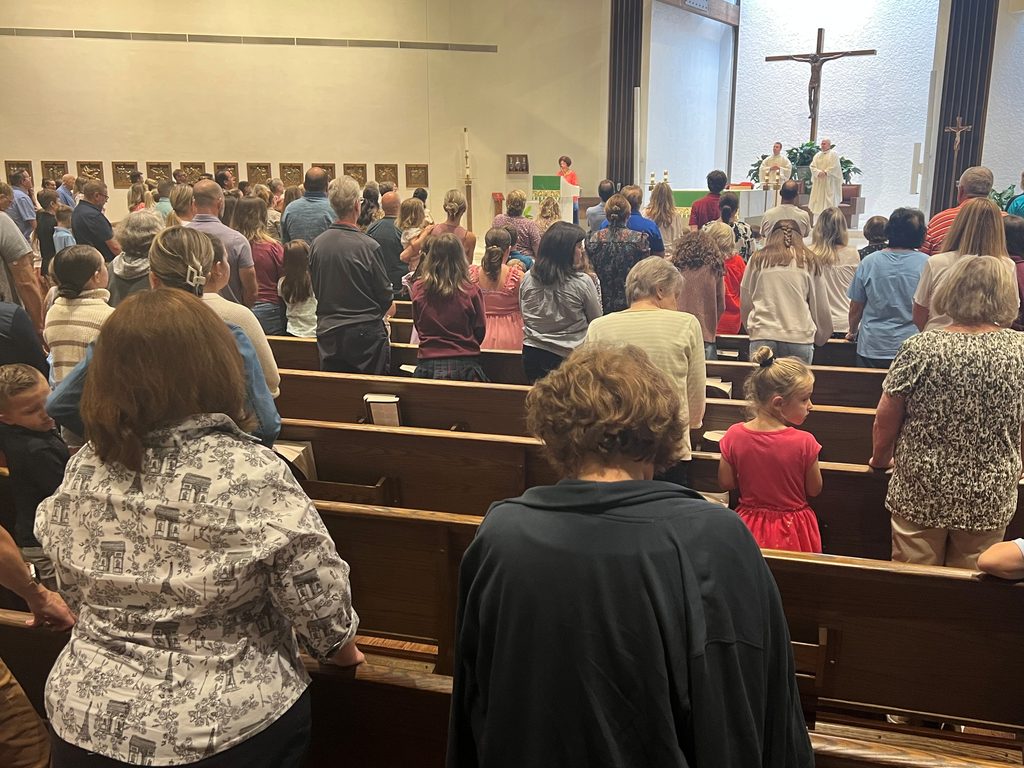
Students and families from Wyoming Area Catholic School attend Mass at Saint Maria Goretti Parish in Laflin, one day after a fire caused damage to their school building. (Photo/Eric Deabill)

LAFLIN – Just 24 hours after fire forced the evacuation of Wyoming Area Catholic School in Exeter, its students, families, teachers, staff, and administrators gathered at Saint Maria Goretti Parish – not simply to pray – but to express gratitude.

The school community came together Wednesday morning, Sept. 2, 2026, grateful that every student and adult made it safely outside the building.

ā€œThis is step one, to come together before God, to come together as a school community to give thanks to one another and to be thankful for our safety,ā€ Father Michael Drevitch, Pastor of Saint Maria Goretti Parish, said during his homily at the 11:00 a.m. Mass.

Throughout his homily, Father Drevitch returned to a theme he had shared with the students just two days earlier at their first school Mass of the year: Sometimes, God is found in the least expected places.

On Monday, he had encouraged students to recognize God’s presence not only in the Eucharist and the Word of God, but also through sports, academics, the arts, and other ordinary moments of school life.

ā€œThen yesterday,ā€ he said, ā€œwe came to recognize that God definitely presents himself in unexpected ways.ā€

Father Drevitch acknowledged the fire could be viewed as a disaster and a loss. Classrooms were damaged and books and supplies were lost.

But Father Drevitch urged the community to see something more.

ā€œYou can look at what happened yesterday as a disaster, as an emergency, as a loss,ā€ he said. ā€œOr you can look at it and recognize how God was present in our teachers and staff, how God was present in the first responders who literally put their lives at risk for our sake, and you can recognize how God was present in our children who stayed safe, brave, and listened to instructions and did what they were expected to do.ā€

Near the end of his homily, Father Drevitch, who teaches religion at Wyoming Area Catholic School, added a short example to emphasize how the situation had students reflecting God’s love.

ā€œAs students were dismissed, I saw some siblings come out, who sometimes would normally be fighting with one another, yesterday, they were holding hands and embracing one another. I saw it in a very beautiful way,ā€ he said.

For Wyoming Area Catholic Principal Eileen Rishcoff, the sight of so many families gathered at Mass made her emotional.

ā€œI am overwhelmed at the number of people that are here,ā€ she told families and students before Mass.

Rishcoff reminded them that a school is about far more than books, supplies and belongings that were left behind when students evacuated.

ā€œSometimes things happen,ā€ Rishcoff said. ā€œBut the most important thing is that we got out of the school safely.ā€

And they did so quickly.

Just after 10:00 a.m. Tuesday, Sept. 1, a teacher noticed that lights were flickering in the lower end of the school, near the younger grades.

When Amy Rosencrance, School Safety and Security Coordinator, went to investigate, she noticed smoke coming from the area.

ā€œWe quickly evacuated all of the kids from there and basically made sure that everyone got out of the building,ā€ Rosencrance said. ā€œAt that moment, as I was checking to make sure everyone was safe and all of the kids were out, there were flames.ā€

The fire alarm was pulled, and students immediately began evacuating.

Seventh grader Victoria Sabetta had just finished math class when the fire alarm sounded.

ā€œI was about to put my books away and all of a sudden we heard the fire alarm, so I dropped my books and I just went out,ā€ Sabetta said.

It wasn’t until Sabetta was outside that she first saw smoke.

ā€œIt wasn’t until we got outside and the police officers started coming,ā€ she added.

Ironically, the school had planned to conduct its first fire drill of the school year that same day. Instead, the students and staff found themselves responding to a real emergency.

ā€œIt was definitely well executed,ā€ Rosencrance said while thanking first responders for their quick response. ā€œI absolutely thank each and every one of them. Two police officers showed up immediately and we were inside the building together and they started to put out the fire. Within minutes, we had Exeter, West Pittson, Hughestown, Pittston city, Pittston Township, Kingston, every fire person was here. We had the Greater Pittston Ambulance and their response and how quickly they got here, I’m so thankful for that, because that really helped contain it and save this building.ā€

Students were transported to Wyoming Area High School, where they were reunited with their families.

The Pennsylvania State Police fire marshal is investigating the cause of the fire. School officials said there was considerable damage to at least two classrooms, with smoke and water damage affecting other portions of the building.

As school administrators face the work of beginning cleanup and restoration, students will be continuing their education at Saint Maria Goretti Parish in Laflin.

The parish has opened its religious education facilities, including classrooms and other spaces, to Wyoming Area Catholic School beginning Tuesday, Sept. 8, following Labor Day.

For Father Drevitch, the temporary relocation is itself an expression of what a parish is meant to be.

ā€œA parish isn’t just a group of people who go to church,ā€ he said. ā€œA parish is a community who helps people when they need something. A parish is God’s hands at work as we take care of our children, as we keep them safe and provide them an education.ā€

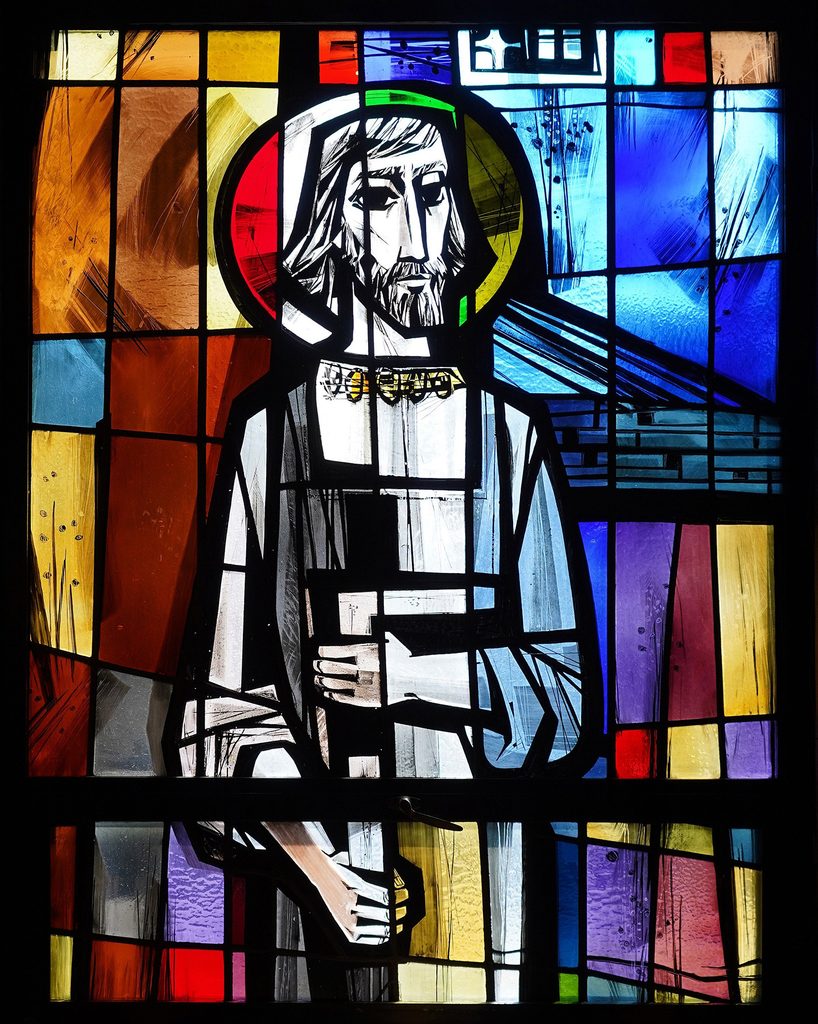
A depiction of St. Joseph holding a carpenter’s square is seen in a stained-glass window in the chapel of St. Joseph’s College in Patchogue, N.Y., in this 2020 photo. Work “anoints us” with dignity, Pope Francis once said in an address for the feast of St. Joseph the Worker. (CNS photo/Gregory A. Shemitz)

LAFLIN — The Congregation of the Oblates of Saint Joseph, located at 1880 Route 315, Laflin, is preparing for the annual Triduum and special Labor Day Mass honoring Saint Joseph the Worker in September.

A three-day preparation of Masses during the Labor Day weekend will be held Friday, Saturday and Sunday, Sept. 4-6, with liturgies celebrated at noon in the Saint Joseph Oblates chapel in Laflin.

Devotions to Saint Joseph will be offered after each Mass, especially for all workers and the unemployed. A blessing with the first-class relic of Saint Joseph Marello, founder of the Oblates religious order, will conclude the devotions.

A special Mass is planned for Labor Day morning, Monday, Sept. 7, at 11 a.m., honoring Saint Joseph as the Patron Saint of Workers. Bread will be blessed and distributed following the Mass to all faithful in attendance as a symbol of the ā€œfruit of our labor.ā€

Serving as celebrant and homilist for this year’s Labor Day Eucharistic celebration will be Saint Joseph Oblate Father Paul McDonnell, a member of the OSJ religious community in the Pittston area, who also serves as pastor of Divine Mercy Parish in the Minooka section of Scranton.

The Triduum devotions and Labor Day morning Mass will be broadcast live on JMJ Catholic Radio 104.5 FM.

For further information, contact the main office at (570) 654-7542 or email: osjseminary@comcast.net.


A three-day preparation of Masses during the Labor Day weekend will be held Friday, Saturday and Sunday, Sept. 4-6, with liturgies celebrated at noon in the Saint Joseph Oblates chapel in Laflin.
Devotions to Saint Joseph will be offered after each Mass, especially for all workers and the unemployed. A blessing with the first-class relic of Saint Joseph Marello, founder of the Oblates religious order, will conclude the devotions.
A special Mass is planned for Labor Day morning, Monday, Sept. 7, at 11 a.m., honoring Saint Joseph as the Patron Saint of Workers. Bread will be blessed and distributed following the Mass to all faithful in attendance as a symbol of the ā€œfruit of our labor.ā€
Serving as celebrant and homilist for this year’s Labor Day Eucharistic celebration will be Saint Joseph Oblate Father Paul McDonnell, a member of the OSJ religious community in the Pittston area, who also serves as pastor of Divine Mercy Parish in the Minooka section of Scranton.
The Triduum devotions and Labor Day morning Mass will be broadcast live on JMJ Catholic Radio 104.5 FM.
For further information, contact the main office at (570) 654-7542 or email: osjseminary@comcast.net.

ROME (OSV News) – The International Theological Commission published a new document Sept. 2 calling for ecological conversion due to “sin against creation and the Creator.”

The more than 29,000 word text, titled “Caring for Our Common Home: A Responsible and Fraternal Response to the Triune God,” was approved by a majority of members of the commission in a July vote and authorized for release by Cardinal VĆ­ctor Manuel FernĆ”ndez, prefect of the Dicastery for the Doctrine of the Faith, after being presented to Pope Leo XIV.

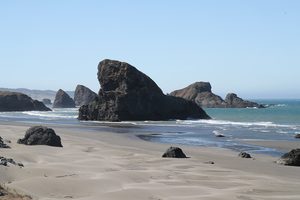
Waves roll in along the shoreline of the Pacific coast near Gold Beach, Ore., Aug 12, 2026. The International Theological Commission published a new document Sept. 2, 2026, calling for ecological conversion due to “sin against creation and the Creator.” (OSV News photo/Bob Roller)

More than a decade after the release of Pope Francis’ landmark encyclical “Laudato Si’,” the theological commission goes beyond Pope Francis’ use of the phrase “ecological sin” by proposing what it describes as more precise terminology: “sin against creation and the Creator.”

“As Pope Leo XIV emphasized, we believe it is appropriate to favor a formulation that simultaneously implies both the harm inflicted on nature and the failure to recognize, or even the rejection, of the Creator’s plan, which entails entrusting to human beings the stewardship and care of our common home,” the document says.

“We propose understanding this sin against our Common Home as a ‘sin against creation and against the Creator,’ insofar as it violates the meaning of creation intended by God the Creator.”

— Challenges of ‘ecological turning point’ —

The commission explained that by failing to care for “our Common Home” with sufficient wisdom and long-term vision, “we not only fail to respect God’s plan and mistreat creation, but we also harm our neighbors, especially the poorest and future generations.”

“Sin against creation,” it says, “therefore, concerns our relationship with God the Creator, with our neighbors, and with creation itself, distorting the three relationships that define us.”

Published only in Italian, the document is divided into three chapters, describing a “threefold transformation” in culture’s relationship to nature since the 16th century: the loss of the perception of nature as God’s creation; the emergence of an increasingly anthropocentric and predatory vision in the relationship between humanity and Creation; and the spread of an ecological crisis on a planetary level.

Msgr. Piero Coda, the secretary general of the International Theological Commission, said that the document’s “proposal to ‘understand sin against the environment in a similar way to how the notions of social sin and structures of sin have progressively consolidated’ is of particular importance.”

“This underscores the profound seriousness of the ‘ecological turning point’ that challenges our conscience today, calling for a conversion that — in order to be fully effective on the cultural, social, economic, and political levels — must first and foremost find expression on the spiritual and religious levels,” he wrote in a commentary on the document published by Vatican News.

— Creation reflects the Trinity —

The first chapter examines how all creation carries an imprint of the Trinity — Father, Son, and the Holy Spirit — arguing that since creation bears the Creator God’s imprint, ecological questions always have a religious dimension.

It quotes St. Hildegard of Bingen’s idea of creation as “a second Scripture,” as well as other Doctors of the Church — St. Augustine of Hippo, St. Bonaventure, and St. Thomas Aquinas. The commission also develops a dialogue with some scientific and philosophical views of the cosmos, examining how the Big Bang and quantum physics are compatible with faith.

The second chapter focuses on the human person’s place in the created world, using the creation narrative in Genesis to examine how humanity was given the original task of dominion, custody, and cultivation of the land, placing exploitation of the land, pollution, and biodiversity within the Genesis narrative of the fall of man.

Citing United Nations environmental reports, the document catalogs what it calls alarming levels of biodiversity loss, air and water pollution, and the environmental toll of armed conflict, noting that the poorest nations and communities suffer the worst consequences despite bearing the least responsibility for causing them.

The document rejects the two extremes of “predatory anthropocentrism,” or treating creation as mere property for exploitation, and radical biocentrism and “deep ecology” movements that strip humanity of its unique status within creation. Instead the theological commission puts forward the idea of “situated anthropocentrism” — an expression first used by Pope Francis which has been taken up by Pope Leo XIV that describes the human vocation as a “steward” and a “servant of creation.”

This twofold vocation finds its culmination in the Eucharist, which the document describes as an “ecological school” from which flows “a spirituality capable of supporting and encouraging the ecological conversion that we so urgently need to undertake as a human family.”

— Practical guidelines for ecological conversion —

The third chapter offers some practical guidelines and principles for “ecological conversion,” organized around different fundamental relationships of the person with God, with oneself, with creation, and with others, highlighting the importance of mindful consumption, balanced rhythms of work and rest with the Benedictine idea of “ora et labora,” respect for life, asceticism, reverence for creation, and listening to the cry of the Earth and the poor. It also surveys the contribution of other world religions to ideas of environmental stewardship.

“From the standpoint of the Christian faith, the doors are open to interreligious cooperation in the common task of respectfully caring for all Creation, in the service of the flourishing of life and communion with the Transcendent, who is at the origin and is the foundation of all life,” it says.

The document, written by a subcommission that met between 2022 and 2025, was published during the Church’s Season of Creation established by Pope Francis, which runs from the World Day of Prayer for the Care of Creation on Sept. 1 until Oct. 4, the feast of St. Francis of Assisi.

Pope Leo XIV celebrates Mass for the Care of Creation on the grounds of the Borgo Laudato Si’ ecology center in Castel Gandolfo, Italy, Sept. 1, 2026.(CNS photo/Vatican Media)

VATICAN CITY (CNS) – Pope Leo XIV began the five-week Season of Creation by calling on the faithful to step away from the frenzy of daily life to “hear the melodious voice of creation,” stressing that “it is not yet too late” to repair humanity’s relationship with the environment.

Celebrating Mass on the World Day of Prayer for the Care of Creation in the gardens of the papal villa and the Borgo Laudato Si’ ecology project in Castel Gandolfo, Sept. 1, the pope said contemplating creation and its Creator should lead people to recognize their responsibility for protecting it.

“Thus, as we become conscious of our shortcomings and failures, we can renew our commitment to restoring the relationships among all creatures according to the will of their Creator,” he said.

The theme chosen for the 2026 World Day of Prayer for the Care of Creation echoes the biblical call to “beat swords into plowshares” and connects armed conflict with environmental destruction.

In a June 2 statement, the Dicastery for Promoting Integral Human Development said that “the now widespread awareness of the impact of war on natural resources has not led to the creation of adequate institutions or to responsible decisions aimed at preventing conflicts and resolving disputes peacefully.”

In his homily during the Mass, Pope Leo said the call to transform weapons into instruments that sustain life remains urgent.

“What has been used for destruction can be redirected toward life, toward the care of the poor, the nourishment of the hungry, and the safeguarding of creation,” he said, quoting his message for the day.

Militaries account for about 5.5% of global greenhouse gas emissions and contribute to water pollution, soil contamination and waste generation, according to a joint study by the UK-based Scientists for Global Responsibility and the Conflict and Environment Observatory. The World Wide Fund for Nature estimated that the first three years of the Russia-Ukraine war alone generated the equivalent of about 230 million metric tons of carbon dioxide — a greenhouse gas that traps heat from sunlight, warming the planet.

Pope Leo also focused on access to clean water in his September prayer intention, released Sept. 1 by the Pope’s Worldwide Prayer Network.

Thanking God for the gift of water, the pope prayed for the “right of every brother and sister to drink without fear and without inequality.”

“Forgive us for turning it into a commodity, forgetting that it is a universal gift, a right without borders, meant for all your children,” he prayed. “We see with pain so many brothers and sisters who lack clean water, who walk for miles to find it, who become ill due to its scarcity.”

During the Mass, Pope Leo said passages from the Book of Wisdom and Psalm 18 encourage Christians to recognize God through the “beauty and power of creation.”

“All creation speaks to us of the greatness of its Creator, if only our eyes and hearts remain open to such a great mystery,” he said.

By looking with wonder at the birds of the air and the flowers of the field, the pope said, Christians can better understand the greatness of God’s love for humanity.

“If the Lord does not fail to bestow such splendid beauty upon plants and animals and provide for all their needs, how much more attentive will he be to the needs of his beloved sons and daughters,” he said.

The Season of Creation runs from Sept. 1 through Oct. 4, the feast of St. Francis of Assisi. The Catholic Church’s observance of the World Day of Prayer for the Care of Creation was established by Pope Francis in response to an initiative of Orthodox Ecumenical Patriarch Bartholomew of Constantinople. The Orthodox Church has observed Sept. 1 as a day of prayer for creation since 1989.

The 2026 season will conclude as the Church marks the 800th anniversary of the death of St. Francis of Assisi, who is the patron saint of ecology.

Pope Leo closed his homily by reciting portions of St. Francis’ Canticle of the Creatures:

“Praised be you, my Lord, with all your creatures, especially Sir Brother Sun… Praised be you, my Lord, through Sister Moon and the stars… Praised be you, my Lord, through Brother Wind… Praised be you, my Lord, through Sister Water… Praised be you, my Lord, through Brother Fire… Praised be you, my Lord, through our Sister Mother Earth, who sustains and governs us.”