ASSISI, Italy (OSV News) – For the first time in eight centuries, the mortal remains of St. Francis of Assisi are being exposed for an extended period of public veneration, drawing hundreds of thousands of pilgrims from around the world to pray before “the Little Poor Man of Assisi.”

The bones of the beloved saint were unveiled for public display Feb. 22 in the Lower Church of the Basilica of St. Francis of Assisi. Pilgrims waited in line outside of the Assisi basilica, taking in the panoramic views of the Umbrian countryside from the medieval hilltop town, for their chance to pray before the relics.
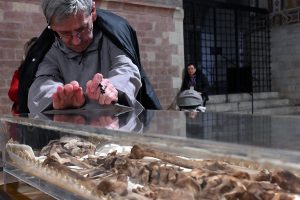
A monk prays during veneration of the remains of St. Francis during the first public display at the Basilica of St. Francis in Assisi, Italy, Feb. 22, 2026, to mark the 800th anniversary of the saint’s death. (OSV News photo/Alessia Giuliani, CPP)

The veneration runs through March 22 as part of the Catholic Church’s yearlong celebration of the 800th anniversary of St. Francis’ death in 1226.

Heather Martin, an American mother who has lived in Assisi for five years with her family, was among the first pilgrims to venerate the relics.

“St. Francis is by far the most important saint in my life. He’s shown up for me in so many ways and so many dark moments,” she told OSV News.

“This experience to be able to go and physically see his physical form has been utterly life-changing.”

Martin recalled a conversation she had with one of the Franciscan friars about the experience. “He felt like he was finally meeting a long-lost relative for the first time,” she said. “And I can’t agree with that more.”

Fabrizio Ballanti traveled from Ancona, Italy, as part of a care home run by the Focolare movement.

“We are a community for people with HIV and AIDS, and we all came together to live this experience,” Ballanti said.

Standing before the relics of St. Francis, he said, “I felt the presence of the Lord very strongly,” calling it “a truly powerful experience.”

For 21-year-old seminarian Gregory Maloney from the Archdiocese of St. Paul and Minneapolis, the moment was an opportunity to ask St. Francis for the gift of a deeper conversion “to grow in the virtue of poverty.”

He said that the long wait in line to view the relics gave him an opportunity to reflect on the life of St. Francis in prayer. “Here is the man who wanted to live poverty as Christ really said it in the Gospel,” Maloney said. “He wanted to give up his whole life, to give up all the things of the world to focus on the pearl of great price … the treasure of heaven.”

“And so that was a great encouragement for me then to say, ‘OK, what are the areas in my life I need to give to the Lord? I need to focus more on the things of heaven,” the seminarian added.

Franciscan friars opened the sarcophagus to exhume St. Francis’ remains Feb. 21, placing his bones on a specially prepared table in the crypt before carrying them in procession through the Lower Church while praying the Litany of the Saints.

Franciscans from across the world participated in a solemn vespers with the exposed relics beneath the basilica’s frescoed ceiling on the evening before the relics opened to the public.

Friar Ignacio Ceja Jimenez, a Franciscan friar from Mexico, called it a historic moment of fraternity for all branches of the Franciscan family “because we all recognize ourselves as children of St. Francis, heirs to his charism.”

“Seeing and praying before the body of St. Francis also means that we must commit ourselves to living what he lived,” he said.

“St. Francis reminds us that the Gospel can not only transform human beings, hearts, but that the Gospel can also transform the structures of our world and help us build a fraternal, peaceful world.”

Cardinal Ángel Fernández Artime, the pontifical delegate for the Papal Basilicas of Assisi, presided over both the vespers and the inaugural Mass Feb. 22.

The cardinal recalled St. Francis’ final hours on Oct. 3, 1226, in his homily for the Feb. 21 vespers.

“When St. Francis felt his death approaching, he asked a friar to read the Gospel to him. Not just any passage, but chapter 13 of John: ‘Before the feast of the Passover, Jesus, knowing that his hour had come … having loved his own who were in the world, he loved them to the end,'” Cardinal Artime said.

“His life had been this: a constant listening to the Word, a burning desire to conform himself to the poor and crucified Christ. Service and self-sacrificing love are the heart of Francis’s spirituality.”

Brother Jimmy Zammit of Toronto, now based in Rome as general definitor for the Franciscan order, shared his advice for Catholics unable to make the trip to Assisi who want to live out the special Jubilee Year of St. Francis in a particular way.

“If our heart becomes more Franciscan, we become makers of peace,” Brother Zammit said. “We seek out to help those who are less fortunate than we are to help the poor, but also to help those who are suffering because they’re feeling isolated and maybe even shunned in some way.”

Approximately 370,000 people from five continents have registered to venerate the relics, with Italians making up 80% of registrants. International registrations include 5,000 from the United States, 3,100 from Croatia, 2,000 from Slovakia and 1,500 each from Brazil and France. Some 400 volunteers from dozens of countries are giving of their time to make the monthlong historic event possible.

Entry to view St. Francis’ relics is free, but it requires advance registration at saintfrancisliveson.org. The exposition will close with Mass on March 22 in the Upper Church, to be presided over by Cardinal Matteo Maria Zuppi, archbishop of Bologna and president of the Italian Episcopal Conference.

“We are experiencing an event of extraordinary grace: For an entire month, in this holy land where St. Francis of Assisi lived and was buried, the exposition of his body is offered for the veneration of the faithful, on the eighth centenary of his death,” Cardinal Artime said.

“This body, fragile and poor, reminds us that the Gospel is also lived with the body, with real choices, with daily gestures. Francis did not love an idea of ??Christ: He loved Christ, poor and crucified, to the point of bearing his marks in his flesh.”
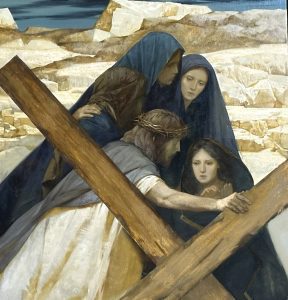

VATICAN CITY (OSV News) – St. Peter’s Basilica inaugurated a new Stations of the Cross Feb. 20, with paintings by a young Swiss artist who won the Vatican’s international art competition and said in an interview with OSV News that he was deeply moved by the experience of painting St. Veronica’s encounter with Christ.

The 14 stations, which were prayed in St. Peter’s Basilica for the first time on the first Friday of Lent, will be displayed temporarily until Easter as part of the many initiatives to mark the 400th anniversary of the basilica’s consecration.

The eighth Station of the Cross, painted by a young Swiss artist who won the Vatican’s international art competition, is displayed in St. Peter’s Basilica. The new Stations of the Cross series by Manuel Andreas Dürr, a 36-year-old artist and father of three, was inaugurated Feb. 20, 2026. (OSV News photo/Courtney Mares)

Manuel Andreas Dürr, a 36-year-old artist and father of three, was chosen after a commission of art historians, liturgists and Vatican representatives unanimously selected his proposal from among more than a thousand submissions from 80 countries in the art competition that the Vatican opened in December 2023.

“To paint Jesus is very, very difficult because he is not someone I am introducing; he is someone that billions of people already have an idea of and have a relationship with,” Dürr said ahead of the inauguration in St. Peter’s Basilica Feb. 20.

Dürr is not Catholic, but describes himself as theologically “quite close to Catholic faith.” He is a member of the Jahu community, a Christian group with roots in the Reformed Church that he said is “very ecumenical and influenced by different traditions.” He had previously painted Stations of the Cross for his local church in Switzerland in past years. Now his Via Crucis hangs in one of the world’s most visited religious sites.

The experience of visiting the Vatican, he said, was the first time he understood the universal dimension of the Catholic Church.

“One thing that came as a bit of a shock, in a sense, was when I came to Rome, I suddenly realized that really this is a global Church,” he said. “My own church at home feels very provincial when I come here and I see people from all ages, from all continents, and from all income classes, are gathering around shared expressions of faith.”

Dürr spent eight months completing the paintings after winning the contest, which carried a cash prize of 120,000 euros, or about $131,000.

He had not sought out the competition himself. “I actually wasn’t aware of the competition,” he said. “A friend of mine suggested that I partake in it. Of course, I never dreamed that it would actually happen, but somehow here we are, almost two years later. And I’m really, really humbled by having the honor to attempt such a thing.”

Among the 14 stations, Dürr said one particularly moved him. “To my surprise, maybe, a little bit, Veronica was the most special station for me,” he told OSV News.

“She holds up a cloth which then has an imprint of the image of Christ. And I found basically that’s what I’m attempting to do. I’m painting on cloth in a small way. … And for me, this kind of dignified, I think, what the painter is attempting to do which is … to provide a trace of something deeper to be experienced.”

The Crucifixion scene, he said, was both the first oil painting he began and the last he completed.

“This story has shaped Christian art and European culture … the world’s culture, like no other story has,” he said. “And how this cross, which was intended as a symbol of terror, instilling fear into the subjects of the Roman Empire, suddenly becomes something that we wear around our necks as a symbol of hope.”

Cardinal Mauro Gambetti, rector of St. Peter’s Basilica, presided over the inauguration at the Altar of the Chair in the basilica, where afterward the Way of the Cross was prayed with the new images for the first time.

Among those praying before the paintings that day was Hannah Kemper, a 27-year-old American who had no idea she was among the first to see the works on display. She had simply been visiting the basilica and felt drawn to pray the Stations of the Cross when she spotted them.

“How could you not feel close to our Lord like in this place?” she said, looking around the basilica. “My senses are so heightened to his glory and to contrast that to his suffering on the cross — it’s just so beautiful.”

(OSV News) – A Texas bishop and head of the U.S. Catholic bishops’ migration committee is sounding the alarm over the Trump administration’s plans to acquire massive warehouses all over the country, each capable of interning thousands of people, in the name of its sweeping — and at times deadly — crackdown on immigration.

“The thought of holding thousands of families in massive warehouses should challenge the conscience of every American,” said Bishop Brendan J. Cahill of Victoria, Texas, chairman of the U.S. Conference of Catholic Bishops’ Committee on Migration, in a Feb. 20 statement released by the USCCB. “Whatever their immigration status, these are human beings created in the image and likeness of God, and this is a moral inflection point for our country.”

A drone picture shows a warehouse purchased by the Department of Homeland Security, which is expected to be converted to an ICE detention facility in Social Circle, Ga., Feb. 18, 2026. On Feb. 20, 2026, Bishop Brendan J. Cahill, chair of the U.S. Catholic bishops’ Committee on Migration, condemned the Trump administration’s plan for acquiring eight mega-detention centers for mass detention of immigrants, including families, it wants to deport. (OSV News photo/Megan Varner, Reuters)

The New York Times, citing internal Department of Homeland Security documents it had obtained, reported Feb. 18 that the administration is seeking to purchase some 20 warehouses for the detentions, with the goal of 92,600 total beds. Immigration and Customs Enforcement, or ICE, called it a “necessary downstream requirement” for the planned tempo of its enforcement and arrest operations in 2026 after a “surge hiring effort” that added 12,000 officers.

All of the new facilities are set to open by Nov. 30, 2026, “ensuring the timely expansion of detention capacity,” ICE said.

So far, at least eight facilities — located in Georgia, Maryland, Pennsylvania and Texas — have already been acquired by the Trump administration.

The statement released by the USCCB drew particular attention to eight “mega centers” that would be each “capable of detaining 7,000 to 10,000 people.”

Warehouses are also being considered in Missouri, New Hampshire, New Jersey, North Carolina, Tennessee and Utah.

A majority of the people targeted by ICE for mass detention and eventual deportation are expected to be Catholics in six out of 10 cases, according to a 2025 joint Catholic-Evangelical report published by the USCCB and World Relief. It also found Christians make up 80% of those at risk of President Donald Trump’s mass deportation effort. The report also found nearly one in five Catholics (18%) in the U.S. are either vulnerable to deportation or live with someone who is.

In a Feb. 13 document, ICE detailed its “Detention Reengineering Initiative,” aiming to “meet the growing demand for bedspace and streamline the detention and removal process.”

Along with “eight large-scale detention centers,” the plan includes “16 processing sites” and “the acquisition of 10 existing ‘turnkey’ facilities” where ICE already operates.

The estimated cost for the ICE’s “new detention center model” will be $38.3 billion, to be funded by congressional allocations under the Trump administration’s “One Big Beautiful Bill Act.”

But the USCCB preface to Bishop Cahill’s statement noted, “Aside from the internment camps used to incarcerate Japanese Americans in the 1940s, such facilities have no precedent in American history.”

During World War II, the federal government at the order of President Franklin D. Roosevelt incarcerated more than 125,000 Japanese Americans to remotely located camps throughout the nation, claiming they posed a security threat following the Empire of Japan’s 1941 attack on Pearl Harbor.

Some 70,000 of those interned were U.S. citizens, with 1,600 of the people imprisoned dying during their incarceration. Interment also economically ruined families who lost property and businesses as a result.

The final camp was closed in 1946, and in 1988, a formal apology and reparations were issued under President Ronald Reagan. Only in 2022 was a full, accurate list of victim names made available thanks to the work of Duncan Williams, a scholar at the University of Southern California Dornsife.

In his statement, Bishop Cahill described the Trump administration’s ICE detention facility expansion plans as “deeply troubling.”

“The federal government does not have a positive track record when it comes to detaining large numbers of people, especially families, and the proposed scale of these facilities is difficult to comprehend,” he said.

A number of immigration advocates have deplored conditions at ICE detention centers, citing unsanitary conditions, lack of basic care, and instances of violence and death, as well as denial of pastoral visits and access to legal counsel.

Last year, 32 people died while in ICE detention — the largest number in over two decades, according to a Jan. 4 report by The Guardian. As of January, six people have died in ICE custody.

As of Feb. 7, 68,289 persons were in ICE detention, with 73.6% of detainees having no criminal conviction, according to Syracuse University’s Transactional Records Access Clearinghouse.

Bishop Cahill said that “the private prison industry is who stands to gain the most from this supercharging of immigration detention.”

He pointed to the USCCB’s special pastoral message on immigration, issued during the conference’s annual fall meeting in 2025.

“Last November, my brother bishops and I unequivocally opposed the indiscriminate mass deportation of people and raised concerns about existing conditions in detention centers,” he said. “We specifically highlighted a lack of access to pastoral care for detainees. On many occasions, we have also opposed the expansion of family detention, recognizing its harmful impacts on children in particular.”

Catholic social teaching on immigration seeks to balance three interrelated principles: the right of persons to migrate in order to sustain themselves and their families; the right of a country to regulate its borders and immigration; and a nation’s duty to conduct that regulation with justice and mercy.

The Church’s teaching, the bishops’ special message noted, “rests on the foundational concern for the human person, as created in the image and likeness of God (Genesis 1:27).”

The bishops’ condemnation of “indiscriminate mass deportation” also has a reference point in the Church’s magisterial teaching at the highest level. St. John Paul II’s 1993 encyclical “Veritatis Splendor” (“Splendor of Truth”) and 1995 encyclical “Evangelium Vitae” (“The Gospel of Life”) both quote the Second Vatican Council’s teaching in “Gaudium et Spes,” that condemns specifically “whatever is offensive to human dignity, such as subhuman living conditions, arbitrary imprisonment, deportation” among others. It calls them “a disgrace, and so long as they infect human civilization they contaminate those who inflict them more than those who suffer injustice, and they are a negation of the honor due to the Creator.”

Papal teaching in “Veritatis Splendor” reinforced the Council’s moral condemnations, stating these acts are examples of “intrinsic evil” incapable of being ordered to God or the good of the human person.

Bishop Cahill implored the Trump administration and Congress “to lead with right reason, abandon this misuse of taxpayer funds, and to instead pursue a more just approach to immigration enforcement that truly respects human dignity, the sanctity of families, and religious liberty.”

ROME (OSV News) – On Ash Wednesday, Pope Leo XIV encouraged Catholics to ask the Lord for “the gift of true conversion” at the start of the 40-day penitential season of Lent.

Speaking to English-speaking pilgrims at his Wednesday general audience in St. Peter’s Square Feb. 18, the pope encouraged people to approach Lent as a time of “conversion of heart” so that “we may better respond to his love for us and share that love with those around us.”

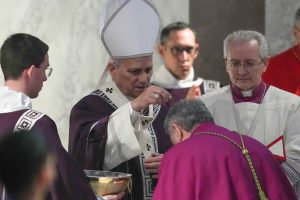
Pope Leo XIV sprinkles ashes during Ash Wednesday Mass at the Basilica of Santa Sabina in Rome Feb. 18, 2026. (CNS photo/Lola Gomez)

“At the beginning of Lent, I urge you to live this liturgical season with an intense spirit of prayer so that you may arrive, inwardly renewed, at the celebration of the great mystery of Christ’s Resurrection, the supreme revelation of God’s merciful love,” Pope Leo added in Italian at the close of the audience on a sunny winter day in Rome.

Before the audience, the pope greeted pilgrims from the popemobile, frequently stopping to bless babies as he made his way through the square.

Continuing his weekly catechesis on the documents of the Second Vatican Council, Pope Leo offered a reflection on “Lumen Gentium,” the Dogmatic Constitution on the Church, which he explained “presents the Church as both a sign and an instrument of this plan of salvation.”

He said the Church is a sign “because the Church community makes the unity established by Christ through his Cross and Resurrection visible to the world today” and an instrument as
“It is through the Church that God achieves the aim of bringing people to him and uniting them with one another.”

“As we journey through a world still marked by division, let us ask the Lord to continue to guide his Church in the mission of sanctification and reconciliation,” he said.

In his message for Lent this year, Pope Leo encouraged the faithful to embrace the “ancient ascetic practice” of fasting, as well as “refraining from words that offend and hurt our neighbor.”

Lent is a liturgical season of penance stretching from Ash Wednesday to Holy Thursday, during which Christians are encouraged to undertake voluntary acts of self-denial such as fasting and almsgiving, along with charitable and missionary works.

On Wednesday afternoon, Pope Leo will lead a solemn procession on Rome’s Aventine Hill from the Benedictine Basilica of Sant’Anselmo to the Dominican Basilica of Santa Sabina, retracing a papal procession route that dates back centuries.

The procession will culminate with the pope offering Ash Wednesday Mass at Santa Sabina, one of the oldest surviving Christian basilicas in Rome. Built in 422 A.D., the ancient church is the first stop in the Lenten Station Church pilgrimage, a tradition rooted in the early practice of the Bishop of Rome celebrating the liturgies of the church year at various churches throughout the city. By the latter half of the fifth century, a fairly fixed calendar had developed, with Mass held at different churches throughout Rome each day of the Lenten season.

The station church tradition has experienced something of an Anglophonic revival in recent decades, spearheaded by the Pontifical North American College, which has offered a 7 a.m. English-language Mass at the station churches each day of Lent in recent years.

On Feb. 18, hundreds of people, including many American college students and seminarians, attended an English-language Ash Wednesday Mass at Santa Sabina organized by the seminary.

Dear Brothers and Sisters in Christ,

More than ever before in recent memory, Lent meets us in a wounded world. The war in Ukraine continues to rage, the Middle East remains unsettled, innocent lives are being slaughtered in Nigeria, and the potential for conflict with Iran looms, to mention just a few areas around the globe that are steeped in pain and suffering.

In our own country, the immigration crisis continues to expose deep wounds within our society. While recognizing the duty of the government to protect the common good and maintain its borders, we must never forget that migrants and refugees are not strangers – but brothers and sisters, many of whom flee violence, poverty and persecution. Recent tragic incidents have reminded us how fragile human life is and how urgently we need solutions that safeguard communities while also honoring the God-given dignity of those seeking safety and hope.

Our Lenten experience begins in the midst of this sobering context.

In the liturgy of Ash Wednesday every year, we listen to the words of the prophet Joel, who sets the stage for our response to the Lord’s call to discipleship. He does so by challenging us to change our lives – not merely by performing religious gestures and practices – but by peering intensely into our hearts to ensure that our spirits are honest, pure and open to the transforming power and presence of God.

Saint Matthew, in that same liturgy, reinforces the words of the prophet as he calls us to pray, fast, and to give alms in support of the poor – not because such behavior will make us righteous – but because such acts for the true follower of Jesus are simply the consequence of faithful lives rooted in Jesus, who teaches us how best to live.

Yet, brothers and sisters, during these sacred days, it is not enough for us to simply focus on our own spiritual and moral well-being and growth to the exclusion of assuming any responsibility to care for our suffering world.

Lent does not allow us to look away!

It challenges us, in whatever situation and circumstance God has placed us, to move beyond indifference, to pray with honest hearts and to serve one another in ways that restore human dignity.

It beckons us to be people of healing, to listen before judging, to welcome before excluding, and to choose love when it’s easier to walk away.

While not one of us, on our own, can change the sad realities of the world in which we find ourselves, each one of us, through Baptism, can and must assume our place in building God’s kingdom of peace.

Lent then becomes a season of grace for personal conversion and a blessed opportunity to speak to our struggling world God’s words of love and peace.

In this same spirit of hope and promise, we will welcome catechumens into the ranks of the elect on the First Sunday of Lent. Their numbers in our own Diocese and throughout our country have increased significantly in recent years, serving as a powerful reminder of the presence of God moving among us and continually calling his people to life and salvation. When you meet them in your parishes, welcome them and let them know how proud you are of their willingness to say “yes” to Jesus’ call to discipleship.

As part of our Diocesan Lenten experience, for the fourth year, I will once again celebrate a Holy Hour before the Blessed Sacrament in each of our twelve deaneries throughout the weeks of Lent. I look forward to praying with many of you as we together we reflect upon how best to find God’s peace in these challenging times.

Finally, I encourage all of us to avail ourselves of the Lord’s mercy and healing in the Sacrament of Reconciliation.

In a message to the entire Church, Pope Leo XIV offered this perspective on our Lenten journey, “Let us ask for the grace of a Lent that leads us to greater attentiveness to God and to the least among us … Let us strive to make our communities places where the cry of those who suffer finds welcome, and listening opens paths towards liberation, making us ready and eager to contribute to building a civilization of love.”

Please know of my prayers for a fruitful observance of Lent.


Faithfully yours in Christ,

Most Reverend Joseph C. Bambera, D.D., J.C.L.
Bishop of Scranton


SCRANTON – Each Lent, the Church marks a powerful moment of grace for those preparing to enter full communion through the Order of Christian Initiation of Adults (OCIA) as it celebrates the Rite of Election and the Call to Continuing Conversion on the First Sunday of Lent.

During the Rite of Election, catechumens – those who have not yet been baptized – publicly declare their desire to receive the Sacraments of Initiation at the Easter Vigil. Their names are inscribed in their parish ‘Book of the Elect,’ and the Bishop, on behalf of the Church, formally affirms that they are chosen to receive Baptism, Confirmation, and the Eucharist.

At the same celebration, candidates – those already baptized in another Christian tradition who now seek full communion with the Catholic Church – participate in the Call to Continuing Conversion. They express their intention to complete their initiation through Confirmation and the Eucharist.

This year’s celebration will be broadcast live on CTV: Catholic Television on Sunday, Feb. 22, at 2:30 p.m., offering parishioners throughout the Diocese of Scranton the opportunity to witness these inspiring testimonies of faith.

A livestream will also be available on the Diocese of Scranton website, YouTube channel and across all social media platforms.

As we begin Lent, please pray for this year’s catechumens and candidates!

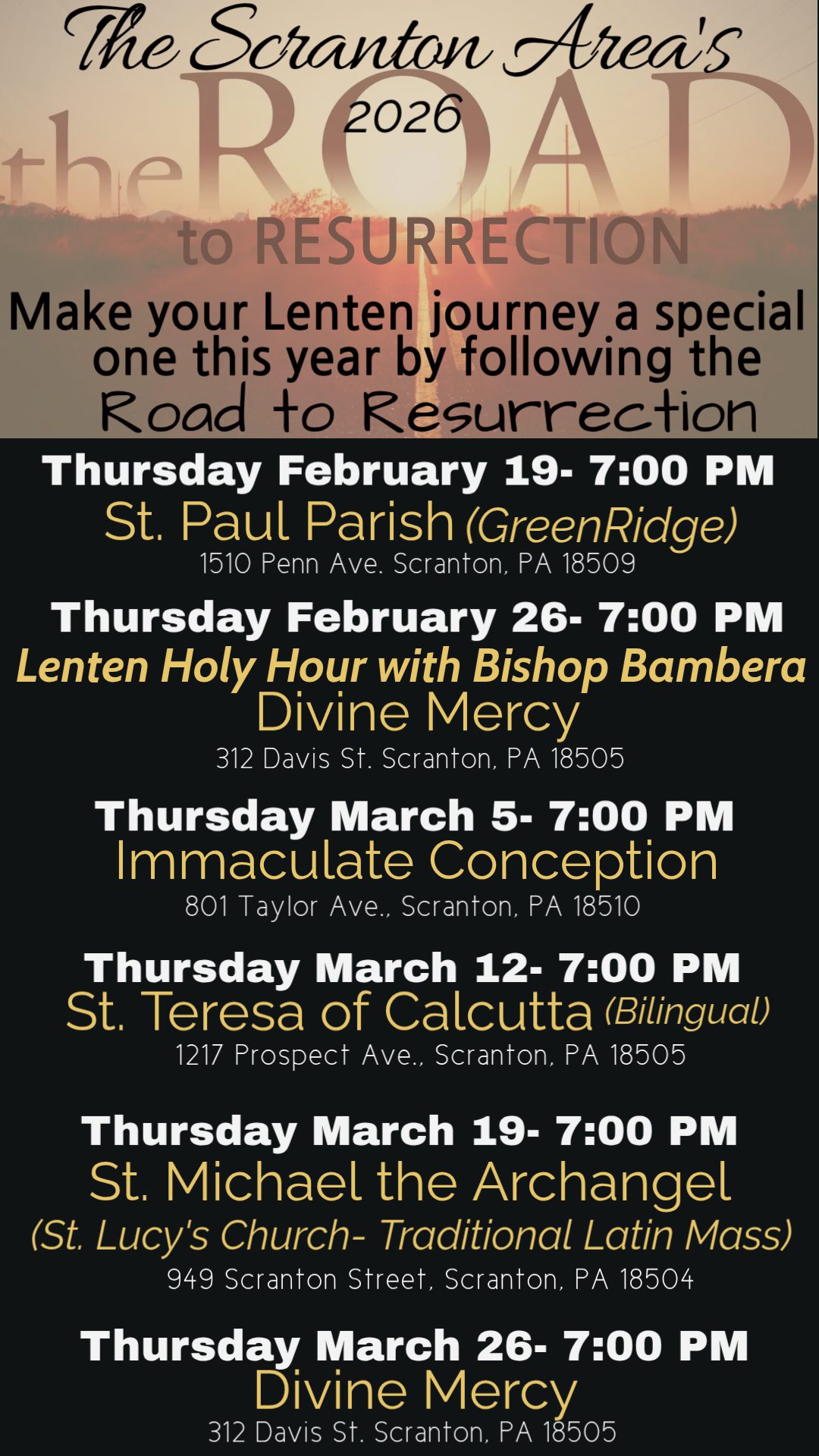
SCRANTON – Parishes throughout the Scranton Deanery will once again come together this Lent for their annual ‘Road to Resurrection’ series, a collaborative spiritual journey designed to help the faithful prepare their hearts for Easter.

The series will begin on Thursday, Feb. 19 at Saint Paul Parish in Green Ridge and conclude six weeks later on Thursday, March 26 at Divine Mercy Parish.

Rooted in the themes of conversion, sacrifice, and hope, the evenings invite parishioners to reflect more deeply on the journey from Calvary to the empty tomb – reminding us that every cross carried in faith leads toward the promise of new life.

All are welcome to attend any or all of the gatherings!

SCRANTON – During Lent, the Cathedral of Saint Peter offers several ways in which the faithful can deepen their relationship with Jesus and come to know Him in a more intimate way.

CTV: Catholic Television of the Diocese of Scranton will make many of these opportunities available to the faithful through television broadcasts and livestream opportunities.

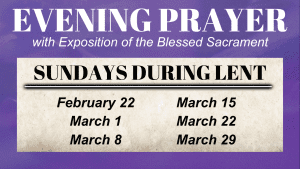
Every Sunday during Lent, the Cathedral will be hosting Adoration and Evening Prayer following the 5 p.m. Mass.

Evening Prayer is part of the Liturgy of the Hours, also known as the Divine Office. In the Liturgy of the Hours, the Church fulfills Jesus’ command to “pray always.”

Through this prayer, the people of God sanctify the day by continual praise of God and prayers of intercession for the needs of the world.

During Lent, CTV plans to broadcast both the Sunday 5 p.m. Mass live as well as the Sunday Evening Prayer that will begin directly thereafter (around 6:15 p.m.).

The first broadcast of the Sunday 5 p.m. Mass and Evening Prayer will take place on Sunday, Feb. 22, 2026.

STATIONS OF THE CROSS

Every Friday during Lent, the faithful are invited to enter more deeply into the mystery of Christ’s saving love by praying the Stations of the Cross following the 12:10 p.m. Mass at the Cathedral of Saint Peter.

Walking spiritually along the path to Calvary, we reflect on the moments of Jesus’ Passion – His condemnation, His falls, His encounter with His Blessed Mother, His crucifixion and death. In each station, we see not only the suffering of Christ, but the depth of God’s mercy poured out for the world.

The Stations remind us that the crosses we carry are united to His – and that no suffering is endured alone.

For those unable to attend in person, Catholic Television will broadcast the Stations of the Cross live each Friday, with rebroadcasts following the Daily Mass at 3:30 p.m. and 7:00 p.m., allowing the faithful to participate prayerfully from home.

Accompany our Lord to Calvary this Lent. Walk with Him, meditate upon His sacrifice, and discover in His Passion the hope and peace that lead to Easter joy.

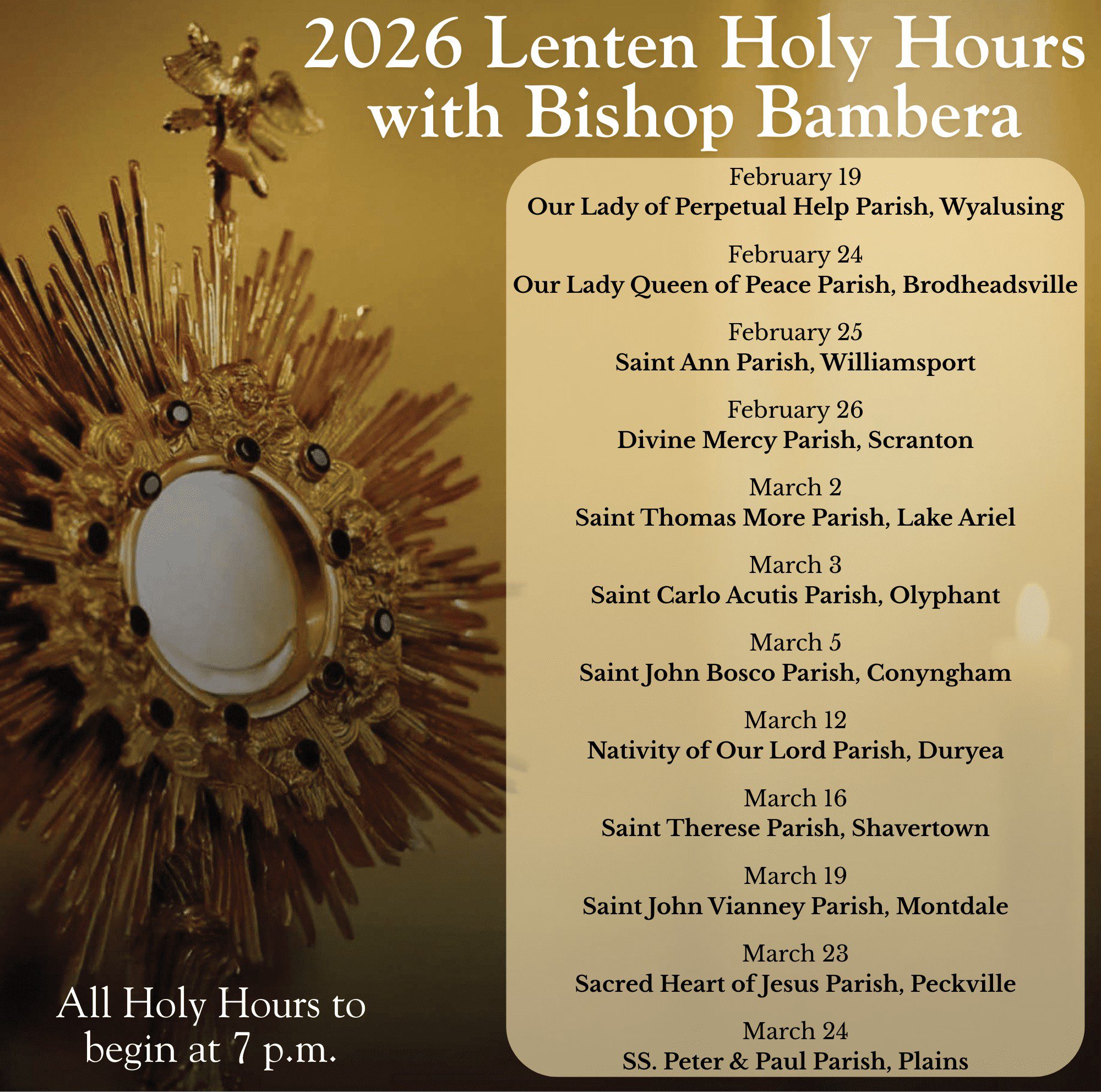
WYALUSING – As Lent unfolds across the Diocese of Scranton, the Most Rev. Joseph C. Bambera, Bishop of Scranton, will once again travel to each of our 12 deaneries to lead Lenten Holy Hours centered on this year’s theme: “Finding Peace in Challenging Times.”

The Holy Hours begin tonight at 7 p.m. at Our Lady of Perpetual Help Parish in Wyalusing, Bradford County.

In a world marked by uncertainty – and in lives often burdened with personal crosses – these evenings of Eucharistic Adoration, reflection, and sacred music offer a chance for the faithful to pause. Before the Blessed Sacrament, you will be invited to lay down your worries, seek clarity amid confusion, and rediscover the steady peace that only Christ can give.

All are welcome to attend any Holy Hour at 7 p.m., regardless of parish or deanery.

The full schedule is listed below.

Consider making time this Lent to step away from the rush of daily life, encounter the Lord in stillness, and find peace in the midst of life’s challenges.

SCRANTON – Some came in wheelchairs. Family members or caregivers assisted others. But they all approached the sanctuary with hands open, ready to receive a blessing.

On Wednesday, Feb. 11, 2026, dozens of faithful received the Sacrament of the Anointing of the Sick during the Diocese of Scranton’s annual World Day of the Sick Mass at the Cathedral of Saint Peter in Scranton.

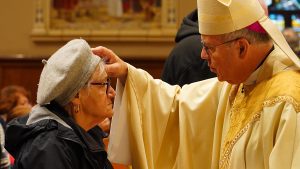
Bishop Joseph C. Bambera anoints the forehead of a woman during the World Day of the Sick Mass at the Cathedral of Saint Peter in Scranton Feb. 11, 2026. (Photo/Mike Melisky)

The Most Rev. Joseph C. Bambera, Bishop of Scranton, served as principal celebrant and homilist. He called the Mass a special and sacred moment for the Church.

“It’s beautiful to see so many of you gathered for this annual celebration,” Bishop Bambera his homily by saying.

Celebrated each year on the Feast of Our Lady of Lourdes, the World Day of the Sick invites Catholics to pray in a special way for those who are ill, elderly, or suffering, while also honoring caregivers and healthcare professionals who accompany them with compassion.

The World Day of the Sick was established in 1992 by Saint John Paul II as a moment of prayer and spiritual closeness for the entire Church.

For 2026, Pope Leo XIV chose the theme: “The Compassion of the Samaritan: Loving by Bearing the Pain of the Other.”

Reflecting on that theme, Bishop Bambera pointed to the familiar Gospel story of the Good Samaritan.

“Without even thinking about it, he makes a difference,” Bishop Bambera said of the Samaritan who stops to care for an injured stranger. “He makes the world more fraternal. He participates in building a community that we know as the Body of Christ.”

The Bishop reminded the faithful that love cannot remain an abstract idea.

“Love can’t just be spoken about,” he said. “It needs concrete gestures of closeness, through which we enter into the suffering of others – those who are ill, and especially those who experience poverty, isolation, grief, loss and loneliness.”

During his homily, the Bishop spoke about celebrating Christmas Mass each year at the Gino Merli Veterans Center in Scranton – a simple gathering in a community room.

“For all that is so obviously missing in that gathering, it is a sacred moment, because, like here, Jesus is present,” the Bishop remarked. “He’s present in the Eucharist, he’s present in the Scriptures that are proclaimed, but he is so very present in family members, volunteers, staff and most especially the residents that make their way to Christmas morning Mass.”

That same sacred presence filled the Cathedral as the faithful came forward for anointing.

The priests present traced the sign of the cross with holy oil on each person’s forehead and hands, praying for healing, strength, and peace.

“Today, Jesus invites us to experience His healing and His grace. Say yes to His invitation to come to Him with your burdens, to find consolation and peace,” Bishop Bambera ended by saying. “Trust, that in the midst of all that life seems to unload upon you, that Jesus will care for you and remember – through the wonderful sacrament of the Anointing of the Sick – every one of you will encounter the Lord, who promises to touch our hearts and give rest to our spirits.”

The Mass for the World Day of the Sick was broadcast live by CTV: Catholic Television of the Diocese of Scranton and livestream on Diocesan media platforms, allowing many who could not attend in person the opportunity to participate in prayer.