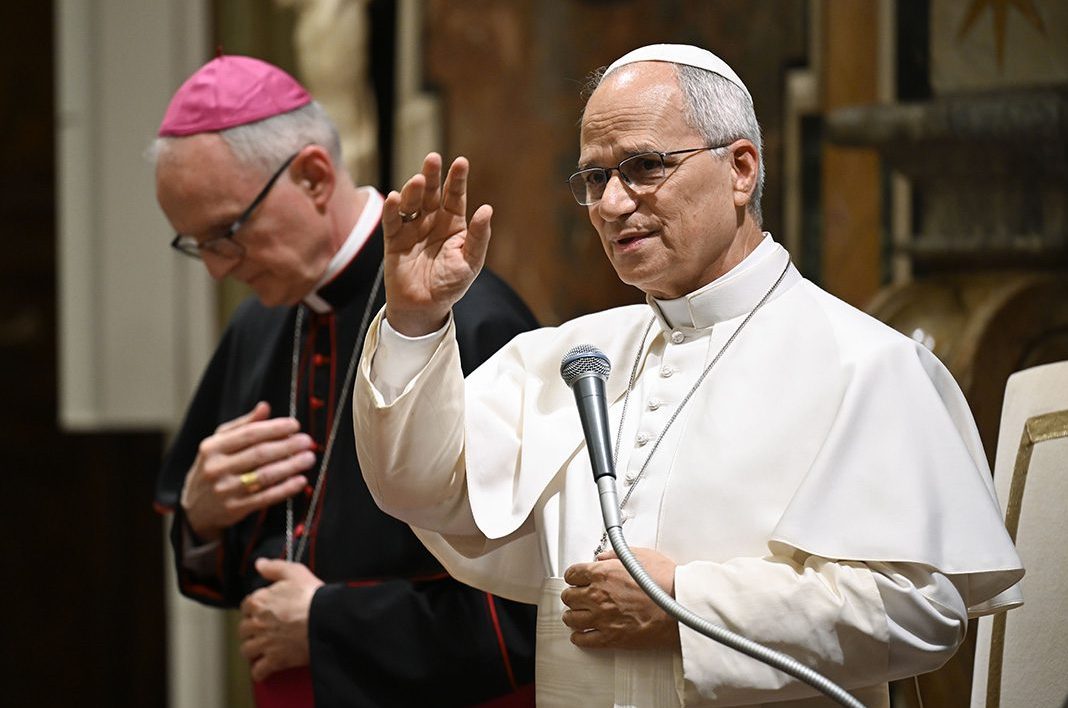
PHILADELPHIA (OSV News) – As the U.S. marks its 250th anniversary, Pope Leo XIV will be honored in the nation’s former capital of Philadelphia for his efforts to promote religious liberty as well as freedom of expression and conscience.

The National Constitution Center will bestow its Liberty Medal on Pope Leo July 3 during a public ceremony outside its location at Independence Mall in Philadelphia, part of Independence National Historical Park, home to several sites of historical significance in the nation’s founding.

Following the ratification of the Constitution, Philadelphia was the nation’s capital from 1790 until 1800, when that designation was transferred to Washington.

Established in 1988 to mark the bicentennial of the U.S. Constitution, and hosted by the center since 2006, the Liberty Medal honors both individuals and organizations “who strive to secure the blessings of liberty to people around the globe,” said the National Constitution Center in its press release.

The center — a private nonprofit that promotes constitutional education and civic debate — announced its decision March 16, noting that the ceremony will take place amid the Independence Week events set to commemorate the signing of the Declaration of Independence.

The pope is set to deliver live acceptance remarks from the Vatican, which will be livestreamed to in-person attendees and online at the center’s website.

Vince Stango, the center’s interim president and CEO, described Pope Leo as a “consistent advocate for religious liberty, freedom of conscience, and human dignity.”

“In formal Vatican statements and public addresses, His Holiness has affirmed that peace cannot exist without freedom of religion, freedom of thought, and freedom of expression, principles that closely align with constitutional protections guaranteed by the First Amendment,” Stango said in a statement.

In its release, the center also noted that since his May 2025 election, the pope “has made interfaith and ecumenical dialogue a defining priority of his pontificate, engaging leaders from Jewish, Muslim, Christian, and other religious communities to promote mutual respect and peaceful coexistence.”

“His outreach reflects a broader moral vision that frames religious liberty not as an abstract right, but as a lived expression of human dignity, particularly for marginalized communities, including religious minorities and those affected by conflict,” said the center.

“As the first American pope, Pope Leo XIV brings a distinctive perspective shaped by democratic ideals and a lifelong commitment to promoting interfaith dialogue,” it added.

Pope Leo is only the second religious leader to receive the award, preceded by 2015 recipient the 14th Dalai Lama of Tibet.

Other past recipients include Ukraine President Volodymyr Zelenskyy, U.S. Supreme Court Justice Ruth Bader Ginsburg, U.S. Senator John McCain, U.S. Representative John Lewis and human rights advocate Malala Yousafzai.

The Liberty Medal is typically accompanied by a prize sponsored by philanthropists Ira Lubert and Pamela Estadt, with contributions from corporations, foundations, and individuals.

In a statement to OSV News, the center confirmed that the medal “traditionally includes a $100,000 prize,” adding that “the Holy See has not yet indicated how it may be used.”

“Any decisions regarding the prize will be made by the Vatican, and we will share additional information when it becomes available,” the center told OSV News.

A statement in the center’s press release attributed to the Holy See Press Office said Pope Leo was “deeply grateful” for the award during “such a meaningful anniversary for the American people, as they are called to reflect on the 250 years of their history holding the Constitution of the United States and Liberty as hallmarks of their heritage for future generations.”

(OSV News) – Pope Leo XIV called for an immediate ceasefire in the Middle East and condemned the “atrocious violence” of the U.S.-Israeli-led war on Iran, which has spread across the region.

After praying the Angelus with pilgrims gathered in St. Peter’s Square March 15, the pope expressed his alarm about the deteriorating situation in Lebanon and called for “lasting solutions to the serious ongoing crisis for the common good of all Lebanese people.”

Pope Leo XIV speaks to those gathered to pray the Angelus in St. Peter’s Square at the Vatican March 15, 2026. (CNS photo/Vatican Media)

“In the name of the Christians of the Middle East and of all women and men of goodwill, I appeal to those responsible for this conflict: Cease fire! Let the paths of dialogue be reopened,” he said.

As the conflict enters its third week, Tehran accused the United States of launching attacks from the United Arab Emirates, further escalating tensions that have sent global oil prices into a volatile spiral.

According to a March 15 report by The Associated Press, President Donald Trump confirmed the U.S. “obliterated” military sites on Iran’s Kharg Island and warned that the country’s oil infrastructure could be the next target if interference with shipping in the Strait of Hormuz continues.

In response, Iran threatened to retaliate against U.S.-linked energy assets across the region, while Trump has called on international allies to deploy warships to secure the vital waterway, which carries one-fifth of the world’s oil supply.

Pope Leo’s appeal for peace, particularly in Lebanon, comes after the recent death of Lebanese Maronite Catholic priest Father Pierre al-Rahi, who was killed March 9 after sustaining wounds from Israeli tank fire on a house in Qlayaa, a village in southern Lebanon.

“Thousands of innocent people have been killed, and many others forced to abandon their homes,” the pope told the faithful. “I renew my prayerful closeness to all those who have lost their loved ones in the attacks, which have struck schools, hospitals and residential areas.”

Calling the escalating conflict in Lebanon “a matter of great concern,” the pope appealed for an end to the war and for those involved to return to the negotiating table for the sake of the people.

“Violence can never lead to the justice, stability, and peace that the people await,” Pope Leo said.

(OSV News) – Pope Leo XIV moved into his new apartments at the Vatican’s Apostolic Palace March 14, the Holy See Press Office announced that afternoon in Rome. Pope Leo’s new quarters include several rooms, among them the private study — where the pope appears at the window to lead the Angelus prayer in St. Peter’s Square every Sunday — a library and a small chapel. According to Italian media, the apartment also includes a home gym.

With Pope Leo’s return to the Apostolic Palace, his rooms will be different from those of Pope Benedict XVI, the last pope to live in that space. Instead of occupying the traditional papal living quarters, Italian media has reported that Pope Leo will live in a loft, or attic, above the “Third Loggia,” or top floor, of the building. Vatican media has reported that Pope Leo will live with his private secretaries, Msgr. Edgard Rimaycuna and Father Marco Billeri.

Pope Leo XIV leads the recitation of the Angelus prayer from the window of his studio in the Apostolic Palace at the Vatican Oct. 26, 2025. Pope Leo moved into his new residence at the Apostolic Palace March 14, 2026. (CNS photo/Vatican Media)

Pope Leo’s choice to live in the Apostolic Palace marks a change from his immediate predecessor and a return to more than 100 years of tradition. Pope Francis lived his entire pontificate in a suite in the Vatican guesthouse, formally known as the Domus Sanctae Marthae, preferring to be residing within a larger community.

Pope Leo’s move takes place after months renovation at the Apostolic Palace — and accompanying speculation — during which the Holy Father continued to live at his apartment at the Vatican’s Palazzo del Sant’Uffizio, where he had already been residing while serving as prefect of the Dicastery for Bishops.

In 1903, St. Pius X became the first pope to live in the apartments overlooking St. Peter’s Square. The apartments were completely remodeled by Pope Paul VI in 1964 and have undergone smaller modifications by each pope since, according to “Mondo Vaticano,” a Vatican-published mini-encyclopedia about Vatican buildings, offices and tradition.

On May 11, 2025, Pope Leo removed the seals that had been placed on the door of the papal apartment in the Apostolic Palace on April 21, following the death of Pope Francis.

In St. Peter’s Square on the evening of March 14, it was business as usual as tourists milled around taking in the sights — mostly unaware that a major shift in the life of the pope was happening nearby. A group of Romans who learned from OSV News that the pope was moving into the apostolic palace that day were very excited to hear the news.
And though Pope Leo’s bedroom — for reasons of security and privacy — won’t be as public as that of his predecessors, a small light in the palace was visible from the square — an indicator that the space officially is in use once again.

Vatican News, Catholic News Service and Paulina Guzik, OSV News international editor, contributed to this report.

ROME (OSV News) – Pope Leo XIV has highlighted how St. Joseph, who is never directly quoted in the Bible, is an example for Christians of the importance of “being present.”

In a speech March 12, one week before the Church celebrates the feast of St. Joseph, Pope Leo reflected on Jesus’ foster father’s exemplary role as a responsible guardian for the Holy Family.

Pope Leo XVI speaks March 12, 2026, in the Clementine Hall of the Apostolic Palace at the Vatican to participants in the “Cattedra dell’Accoglienza,” a cultural and educational event. Addressing the group one week before the March 19 feast of St. Joseph, Pope Leo reflected on Jesus’ foster father’s exemplary role as a responsible guardian for the Holy Family. (OSV News/Matteo Pernaselci, Vatican Media)

“This is exactly what Saint Joseph did in caring for the family entrusted to him by the Lord,” Pope Leo told participants in an Italian conference promoting a culture of solidarity and hospitality.

“In him we recognize that welcoming is not only presence, but also guardianship. Guardianship means being attentive to others, respecting their choices and caring for them.”

The pope noted that this posture of watchful care reflects the very nature of God, who Scripture presents as the tireless guardian of his people, echoing the words of Psalm 121, which describes the Lord as one who never slumbers in his watch over Israel.

“Joseph shows us that presence and guardianship are inseparable dimensions,” the pope said. “It is not possible to guard without being present, and one is not present without assuming responsibility for the other.”

Pope Leo turned to the Gospel of Luke, recalling the moment when Mary and Joseph lost the child Jesus and spent three anxious days searching for him before finding him in the Temple, saying this “teaches us that the presence of the other is not automatic, but the result of constant searching.”

“It has happened to each of us to lose someone or something we were very attached to. At that moment, we realized how precious that presence was,” he said.

The same dynamic, he explained, can play out in the interior life. “We take for granted the presence of Jesus in our existence, until unexpectedly it seems that He is no longer where we left Him. We feel a sense of loss.”

“In reality, it is not He who is lost, but we who have strayed. When this happens, we are called to seek him with confidence, with the courage to travel unexplored paths, looking at the world with new eyes, filled with hope. In this way, we will stop looking for a God who suits us and instead encounter Him where He dwells,” Pope Leo said.

The pope spoke in the Clementine Hall of the Apostolic Palace with participants in the “Cattedra dell’Accoglienza,” a cultural and educational event organized in collaboration with Rome’s Pontifical Lateran University and held in Sacrofano, a town north of Rome.

Pope Leo encouraged the participants in the conference “to continue to create environments capable of promoting goodness and fraternity in the Christian community and in society.”

“Cultivate the charism of welcome by listening to the Holy Spirit, whose fruit, as Saint Paul tells us, “is love, joy, peace, patience, kindness, goodness, faithfulness, gentleness, self-control” (Gal 5:22),” he said.

“May Mary Most Holy and Saint Joseph watch over you and intercede for you.”

DUSHORE — The Altar & Rosary Society of Immaculate Heart of Mary Parish invites all area faithful to participate in a special Lenten retreat, “A Day of Grace: In Honor of Our Lady,” on Saturday, March 14, to be hosted at the parish worship site of Saint Francis of Assisi Church in Mildred.

Offered as an opportunity for spiritual renewal during Lent, the day of prayer, reflection, and sacramental grace will be led by Capuchin Franciscan Father Pio Mandato and the Capuchin Sisters of Nazareth.

The mission retreat, commemorating the special Jubilee Year of Saint Francis, proclaimed by Pope Leo XIV to celebrate the 800th anniversary of the death of Saint Francis of Assisi, will focus on prayer and sacraments to align with the spirit and intentions of the Jubilee Year.

The retreat day opens at 8:30 a.m. with registration in Saint Francis church hall, followed by recitation of the Rosary, celebration of Mass, and guest presentation in the church. A light lunch will be provided in the hall.

The afternoon portion of the retreat will offer adoration of the Blessed Sacrament, Sacrament of Reconciliation, additional reflection, and benediction with the relic of Saint Padre Pio of Pietrelcina.

All faithful are welcome free of charge; a free-will offering will be accepted.

Pre-registration is requested for planning purposes. For reservations, call Karen at (570) 637-6607.


SCRANTON – The annual Saint Patrick’s Parade Day Mass will be celebrated at 10 a.m. on Saturday, March 14, at the Cathedral of Saint Peter in Scranton.

All are welcome to attend.

The liturgy is traditionally held in conjunction with the city of Scranton’s annual Saint Patrick’s Day Parade. Following the Mass, the Saint Patrick’s Parade is expected to take to the streets of the Electric City beginning at 11:45 a.m.

The Most Rev. Joseph C. Bambera, Bishop of Scranton, will serve as principal celebrant for the Mass. Various priests from the Diocese of Scranton are expected to concelebrate.

The Mass will be broadcast live on CTV: Catholic Television of the Diocese of Scranton due to the generosity of the Society of Irish Women.

It will also be livestream on the Diocese of Scranton YouTube channel and website. Links to view the Mass will also be shared on all of the Diocese of Scranton social media platforms.

The Mass will be rebroadcast several times the following week, including Tuesday, March 17 and Wednesday, March 18.

Among the other local organizations that participate in the annual Saint Patrick’s Parade Day Mass are the Ancient Order of Hibernians, Friendly Sons of Saint Patrick, Irish American Men’s Association, Irish Cultural Society, Ladies Ancient Order of Hibernians and the Saint Patrick’s Parade Association of Lackawanna County.

WASHINGTON (OSV News) – Sen. Josh Hawley, R-Mo., announced March 11 he has introduced legislation in the Senate that would ban mifepristone, a drug commonly, but not exclusively, used for first trimester abortion.

The Safeguarding Women from Chemical Abortion Act, if enacted, would revoke the Food and Drug Administration’s approval of the drug.

However, the path forward for the legislation was not clear, as President Donald Trump indicated as a candidate for president in 2024 he would veto a national abortion ban if one reached his desk. Abortion restrictions have failed to gain traction in Congress since the Supreme Court’s 2022 Dobbs v. Jackson Women’s Health Organization decision, which overturned its previous precedent that held abortion as a constitutional right.

Sen. Josh Hawley, R-Mo., speaks during a press conference on the U.S. Food and Drug Administration’s abortion drug policies on Capitol Hill in Washington Jan. 14, 2026. Sen. Hawley announced March 11 he has introduced legislation in the Senate that would ban mifepristone, a drug commonly, but not exclusively, used for first trimester abortion. (OSV News photo/Reuters, Nathan Howard)

“We’ve known for years that mifepristone is risky, but it’s really just in the last few years that we’ve learned this drug is inherently dangerous, and it’s inherently prone to abuse,” Hawley said in remarks at the Capitol March 11.

Proponents of the drug argue it is statistically safe for a woman to take, and attempts to restrict it are an attempt to ban abortion outright. In contrast, opponents argue there are significant risks to those who take it, particularly outside of medical settings, in addition to ending the life of an unborn child.

Hawley argued, “Only Congress can address this situation.”

“Only Congress can withdraw the FDA approval rendered way back in the Clinton administration for this drug that has proved to be inherently dangerous and inherently prone to abuse. Only Congress can act,” he argued.

FDA officials pledged mifepristone would undergo a safety review. However, the status and timeline of the FDA’s review is unclear.

Meanwhile, the Trump administration has asked multiple judges to pause state lawsuits seeking to roll back Biden administration-era eased restrictions on mifepristone, arguing those court cases would interfere with its review. In one such filing in Louisiana, the Justice Department said such reviews often take one year.

The FDA also recently approved a new generic form of the drug.

Mifepristone, the first of two drugs used in a medication-based abortion, was approved by the FDA in 2000, and gained the moniker “the abortion pill.” Medication abortions, sometimes called chemical abortions, account for the majority of abortions in the U.S., according to multiple studies.

Pro-life opponents of mifepristone have pushed the Trump administration to roll back eased restrictions on the drug implemented by the Biden administration. Over a year into Trump’s second term, the Trump administration has thus far left that regulation in place.

The Catholic Church teaches that all human life is sacred from conception to natural death and, as such, opposes direct abortion. Church leaders have called for restricting mifepristone’s use in abortion, while noting that the drug’s more recent usage in medical protocols for miscarriage care, where an unborn child has passed away of natural causes, would be a morally legitimate scenario.

ROME (OSV News) – The Vatican has published the final report of the synod study group examining women’s participation in the Church, which calls for expanded roles for women in Church governance and leadership in roles not including ordained ministry.

The 75-page document, published in English and Italian on March 10, discusses women’s leadership in the Church, but not the specific question of a possible female diaconate.

Participants pray in the Vatican’s Paul VI Audience Hall at the beginning of a working session of the assembly of the Synod of Bishops Oct. 10, 2023. The Vatican published the final report of the synod study group examining women’s participation in the Church March 10, 2026, and it calls for expanded roles for women in Church governance and leadership in roles not including ordained ministry. (CNS photo/Lola Gomez)

It is the third of 15 final reports expected from the study groups of the Synod on Synodality in the coming weeks. Cardinal Mario Grech, the secretary general of the Synod of Bishops, has characterized these reports as “working documents” which will be used to form proposals submitted to the pope for consideration.

— A ‘charismatic path’ for women

In the document, the study group calls for “new spaces” for women to exercise leadership in evangelization and administration in collaboration with ordained ministers.

“Alongside the sacramental path and distinct from it, there is also a charismatic path that can be fruitfully pursued to open new spaces of participation for the lay faithful, particularly for women,” it states. “It follows that even in the exercise of governance within a Diocese, opportunities of this kind may arise and should be employed.”

The report argues that laywomen possess distinct charisms from the Holy Spirit that demand recognition.

“Today laywomen have the right to affirm their participation in the mission of the Church not only on the basis of their equal human and Christian dignity but also on the basis of the charisms given by God,” it says.

“A new evangelization has become urgent,” it adds, “One that depends less exclusively on priestly resources and is enriched by the presence and contributions of women.”

— ‘New forms of exercising authority’

The synod study group calls for theology and canon law to “explore new forms of exercising authority grounded in the Sacrament of Baptism and distinct from those deriving from Holy Orders, so that adequate canonical forms may be found to make effective the participation of women in roles of leadership within the Church.”

“There is no reason or impediment that should prevent women from carrying out leadership roles in the Church,” the report states.

The document also recommends a “reformulation of the areas of competence of the ordained ministry,” suggesting that redefining those boundaries “could open the way to recognize new spaces of responsibility for women in the Church.”

— Female diaconate not addressed

Notably, the report does not address the specific question of a possible female diaconate, a controversial topic of debate within the Synod on Synodality. During the second session of the synod, Pope Francis reactivated a commission studying women’s access to the diaconate under Cardinal Giuseppe Petrocchi. That commission’s conclusions, published in December 2025, stopped short of recommending the female diaconate but approved by a wide margin a proposal to broaden women’s access to instituted ministries, like that of catechist.

— The Virgin Mary as a model

Drawing on Scripture and Church tradition, the report invokes both the Virgin Mary and St. Mary Magdalene as paradigms for female authority in the Church.

“Mary is the supreme model of the charismatic dimension. Though she does not belong to the hierarchical structure, she possesses within the Church a unique authority and spiritual fruitfulness,” it states.

The document also notes that Christ chose a woman, Mary Magdalene, to first announce the Resurrection, “The Apostles themselves received this proclamation from her.”

— Pope Leo’s appointments of women to Roman Curia

The report outlines appointments made by both Pope Francis and Pope Leo XIV as evidence that women can and already do lead at the highest levels of the Church.

It cites the Apostolic Constitution “Praedicate Evangelium,” which allows the possibility for a laywomen to head a Vatican dicastery, “depending on the power of governance and the specific competence and function of the Dicastery or Office in question.”

At the same time, the report states that women working in the Roman Curia have indicated “that certain attitudes marked by clericalism persist” in which “women, even in positions of responsibility, sometimes struggle to be involved and listened to on equal footing with male colleagues, particularly in interactions with ordained ministers.”

The study group highlighted Pope Leo XIV’s appointments of Trappistine Mother Martha Elizabeth Driscoll, and Sister Iuliana Sarosi, a member of the Congregation of the Mother of God, as consultors to the Dicastery for the Clergy and of Cristiana Perrella as president of the Pontifical Insigne Academy of Fine Arts and Letters of the Virtuosi al Pantheon.

The report also cited Pope Leo’s comments in an interview in July 30 in which he said that “the role of women in the Church has to continue to develop” and expressed his intention to continue “in the footsteps of Francis, including in appointing women to some leadership roles at different levels in the Church’s life.”

— Women in the Bible and Church history

The synod final report is organized in three parts. The first recounts the history of the study group and the second offers a “synthesis of the themes” emerging from the synodal process.

The third part is an extensive appendix containing six sections: female figures in the Old and New Testaments; significant women in Church history; contemporary testimonies of women in Church leadership; the Marian and Petrine principles; ecclesial authority; and the contributions of Pope Francis and Pope Leo XIV.

Among the examples of women highlighted by the document are St. Catherine of Siena, St. Joan of Arc, St. Elizabeth Ann Seton, Maria Montessori, and Servant of God Dorothy Day.

(OSV News) – Two Maronite bishops in the U.S. are calling for prayer, dialogue and solidarity after a Maronite priest was killed in Lebanon amid the U.S.-Israel war on Iran.

Father Pierre al-Rahi succumbed to injuries sustained March 9 when an Israeli artillery tank fired on a house in the southern Lebanon village of Qlayaa.

Lebanon and several other Middle East nations have come under attack since U.S.-Israel strikes on Iran, launched Feb. 28 and met with counterattacks by that nation, have plunged the region — as well as global relations and markets — into uncertainty.

A combination photo shows Bishops A. Elias Zaidan of the Maronite Eparchy of Our Lady of Lebanon of Los Angeles, chair of the U.S. Conference of Catholic Bishops’ Committee on International Justice and Peace, and Bishop Gregory J. Mansour of the Eparchy of St. Maron of Brooklyn, N.Y. Also pictured is Baltimore Archbishop William E. Lori. (OSV News photo/Bob Roller/Gregory A. Shemitz)

Father al-Rahi, also known by his French name Pierre el-Raï, had along with other priests refused Israeli orders to evacuate the Maronite village, located a few miles from the border with Israel and home to some 8,000.

When the strike took place, Father al-Rahi “didn’t wait” but “went to jump in right away” after hearing “one of the homes in his town was bombarded,” Bishop A. Elias Zaidan, who heads the St. Louis-based Maronite Eparchy of Our Lady of Lebanon of Los Angeles, told OSV News.

But, said Bishop Zaidan, the priest was injured in a second strike that took place “right away” after the first, and then “died in the hospital.”

In a message shared with OSV News, Maronite Bishop Gregory J. Mansour of the Eparchy of St. Maron of Brooklyn, New York, reflected on Father al-Rahi’s death by quoting John 15:13: “No greater love has any man than to give his life for his friends.”

“May God’s good servant, Father Pierre Al Rahi, rest in peace,” said Bishop Mansour. “May his patriarch, bishop, brother priests, parishioners and family be consoled by the Holy Spirit.”

Bishop Zaidan called the priest’s death a “sad story and unfortunate situation.”

With roots in Syria and Lebanon, the global Maronite Catholic Church — one of the 23 Eastern Catholic Churches that, along with the Roman Catholic Church, comprise the universal Catholic Church — mourns to see Lebanon ravaged again by war, said Bishop Zaidan.

“It’s definitely a sadness and a sorrow, because Lebanon is a spiritual home for Maronites, like the Vatican is for all Catholics,” he said. “And we feel that attachment.”

Yet in the midst of death, the hope of new life through Christ is present, said Bishop Zaidan.

“The blood of martyrs helps to build the Church in that way, and gives us the determination to keep going despite everything, and to witness to the love of Christ in that perspective,” he said.

Bishop Zaidan offered a message for the faithful following the priest’s death.

“I would say, as Pope Leo XIV has, enough violence; let’s dialogue, let’s talk,” he said.

In addition, “keep praying and praying and praying,” Bishop Zaidan urged.

And, he said, “stand in solidarity” with those suffering in the war by thinking about and reflecting on what they are experiencing.

“I think we go a long way from that perspective, because ‘whatever you have done to the least of my brothers and sisters, you’ve done it to me,'” said Bishop Zaidan, quoting Matthew 25:40. “This gesture of support that says, ‘We’re praying for you, we’re thinking about you, we’re feeling for you’ — I think this beautiful support can help our brothers and sisters.”

(OSV News) – Pope Leo XIV called for an end to the war in Iran and warned that the conflict could drag more countries in the Middle East into instability.

Speaking to pilgrims after praying the Angelus prayer March 8, the pope said that developing news from Iran and from across the Middle East has caused “deep dismay.”

“Amid episodes of violence and devastation, and the widespread climate of hatred and fear, there is also the concern that the conflict may widen and that other countries in the region, including Lebanon, may once again sink into instability,” he said.

People inspect the damage in the Lebanese town of Nabi Chit March 7, 2026, where the Israeli military carried out an airborne operation that dropped troops overnight. (OSV News photo/Mohammad Yassine, Reuters)

According to The Associated Press, Israeli forces struck an oil storage facility in Tehran, as well as targeted assaults in southern Lebanon against commanders of the Lebanese branch of Iran’s Revolutionary Guards.

Iran has continued striking U.S. allies in the Gulf, including Bahrain, where it fired missiles at a desalination plant. Iranian Foreign Minister Abbas Araghchi defended the attack, arguing that the “U.S. set this precedent” after it struck a desalination plant in Iran, AP reported.

The pope’s concern for Lebanon came as government officials confirmed that the conflict between Israel and Hezbollah militants resulted in the deaths of 394 people, including 83 children.

Since the start of the war Feb. 28, at least 1,230 people in Iran, about a dozen in Israel and six U.S. service members have been killed, AP said.

In his appeal, Pope Leo called on Catholics to pray so that “the roar of bombs may cease, that the weapons may fall silent, and that a space for dialogue may open in which the voice of the peoples can be heard.”

“I entrust this supplication to Mary, Queen of Peace,” the pope said. “May she intercede for those who suffer because of war and guide hearts along the paths of reconciliation and hope.”

Less than a day after the start of the war, the pope called for diplomacy to “regain its proper role” and that “the well-being of peoples, who yearn for peaceful existence founded on justice, be upheld.”

At his Angelus address March 1, several hours after the U.S. and Israel revealed that Iran’s supreme leader, 86-year-old Ayatollah Ali Khamenei, was killed, the pope expressed his concern, highlighting that “stability and peace are not achieved through mutual threats, nor through the use of weapons, which sow destruction, suffering, and death, but only through reasonable, sincere, and responsible dialogue.”

“Faced with the possibility of a tragedy of immense proportions, I make a heartfelt appeal to all the parties involved to assume the moral responsibility of halting the spiral of violence before it becomes an irreparable abyss,” the pope warned.