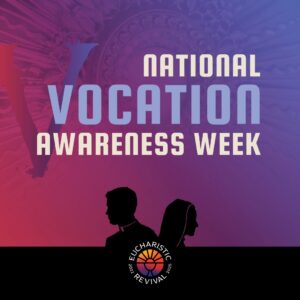
WASHINGTON – The Catholic Church in the United States will celebrate National Vocation Awareness Week, November 6-12, 2022.
Across the United States, dioceses, parishes, and Catholic organizations will host events to promote vocations to the ordained ministry and consecrated life. The faithful are encouraged during this week to renew their prayerful support for those currently discerning a vocation to the priesthood, diaconate, or consecrated life.
In his Message for the World Day of Prayer for Vocations, Pope Francis, reiterating his call for the Church to become increasingly synodal, compared the diversity of vocations in the Church to that of a beautiful mosaic. “As Christians, we do not only receive a vocation individually; we are also called together. We are like the tiles of a mosaic. Each is lovely by itself, but only when they are put together do they form a picture. Each of us shines like a star in the heart of God and in the firmament of the universe. At the same time, though, we are called to form constellations that can guide and light up the path of humanity, beginning with the places in which we live. This is the mystery of the Church: a celebration of differences, a sign, and instrument of all that humanity is called to be.”
Bishop James F. Checchio of Metuchen, chairman of the U.S. Conference of Catholic Bishops’ (USCCB) Committee on Clergy, Consecrated Life and Vocations emphasized that vocational discernment always takes place within a community. “Each year, the CCLV Committee commissions the Center for Applied Research in the Apostolate to conduct surveys of those recently ordained and religiously professed in the past year. These studies consistently show that vocations are the fruit of communal accompaniment. The family, healthy and holy friendships, youth group, campus ministry, and the broader parish and diocesan community form supportive environments in which vocations are first nurtured and grown.”
Observance of Vocation Awareness Week began in 1976 when the U.S. bishops designated the 28th Sunday of the year to call attention to the importance of upholding vocations and praying for those discerning a religious vocation and celebrating those who were in ordained ministry and consecrated life. In 1997, the celebration was moved to the Feast of the Baptism of the Lord and in 2014, the USCCB’s Committee on Clergy, Consecrated Life and Vocations moved the observance of National Vocation Awareness Week to November to influence youth and young adults by engaging Catholic schools and colleges.
Social
The National Religious Retirement Office (NRRO) announces that on Dec. 10-11, the Diocese of Scranton will hold the annual Retirement Fund for Religious collection in parishes throughout the diocese.
Last year, the parishioners in the diocese donated $68,433.29 to the collection. About the upcoming collection, NRRO Executive Director Sister Stephanie Still, a member of the Sisters of the Presentation of San Francisco, said, “The care of our aging religious presents an enormous financial responsibility. It is our privilege to care for those who gave a lifetime of tireless service, and I feel we are deeply blessed by all the U.S. Catholic donors who have steadfastly contributed to this fund.”
Historically, Catholic sisters, brothers, and religious order priests—known collectively as women and men religious—served for little to no pay. With rising health-care expenses, hundreds of U.S. religious communities face a large gap between the needs of their older members and the funds available to support their care. As a result, many now lack adequate retirement savings.
The 2021 appeal raised nearly $28.5 million, and the NRRO distributed funding to 271 U.S. religious communities. Donations also underwrite resources that help religious communities improve elder care and plan for long-term retirement needs.
About the National Religious Retirement Office:
The National Religious Retirement Office coordinates the annual national appeal for the Retirement Fund for Religious and distributes financial assistance for retirement needs to eligible religious institutes. To help address the deficit in retirement funding among U.S. religious orders, Catholic bishops of the United States initiated the Retirement Fund for Religious Collection in 1988.
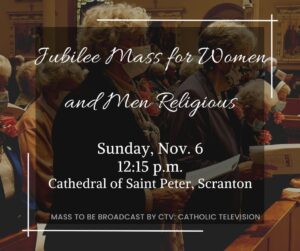
SCRANTON – Everyone is invited to attend a Jubilee Mass for Women and Men Religious who are celebrating milestone ordination anniversaries in 2022 on Sunday, Nov. 6, 2022, at the Cathedral of Saint Peter in Scranton.
The Mass will be celebrated at 12:15 p.m.
The Most Rev. Joseph C. Bambera, Bishop of Scranton, will serve as principal celebrant and homilist for the Jubilee Mass.
For those unable to attend in person, CTV: Catholic Television of the Diocese of Scranton will provide a live broadcast of the Jubilee Mass.
2 0 2 2 J U B I L A R I A N S
SISTERS, SERVANTS OF THE IMMACULATE HEART OF MARY (I.H.M.)
80 Years
Sister Marionette Coll, I.H.M.
75 Years
Sister M. Celesta Sinisi, I.H.M.
70 Years
Sister M. Francis Xavier Grieb, I.H.M.
Sister Maria Goretti Timperio, I.H.M.
Sister Geraldine Marie Dranginis, I.H.M.
60 Years
Sister Mary Pio Ferrario, I.H.M.
Sister Marie C. Moore, I.H.M.
Sister Katherine O’Neil, I.H.M.
Sister Elizabeth M. Pearson, I.H.M.
Sister Janet Rossiter, I.H.M.
Sister Frances E. Russell, I.H.M.
Sister M. Angelique Vannicola, I.H.M.
Sister Marie Estelle Gavel, I.H.M.
Sister Rose Marie Mozzachio, I.H.M.
50 Years
Sister Mary Ellen Coyne, I.H.M.
Sister Anne McDonald, I.H.M.
Sister Patricia Walsh, I.H.M.
25 Years
Sister Maryalice Jacquinot, I.H.M.
SISTERS OF MERCY OF THE AMERICAS (R.S.M.)
80 Years
Sister Miriam Rita Biter, R.S.M.
75 Years
Sister Aileen Mary Flynn, R.S.M.
Sister Maureen Harrison, R.S.M.
Sister Margaretta Phillips, R.S.M.
70 Years
Sister Maureen McCann, R.S. M.
60 Years
Sister Patricia Marie McCann, R.S.M.
Sister Ruth Neely, R.S.M.
Sister Carol Rittner, R.S.M.
SISTERS OF CHRISTIAN CHARITY (S.C.C.)
50 Years
Sister Teresa Ann Jacobs, S.C.C.
CONGREGATION OF THE PASSION (C.P.)
60 Years
Brother Andre Mathieu, C.P.
Father Michael Salvagna, C.P.
50 Years
Father Francis Landry, C.P.
Father Richard Burke, C.P.
Father John Michael Lee, C.P.
SOCIETY OF JESUS (S.J.)
60 Years
Reverend John J. Begley, S.J. in Priesthood
Reverend James D. Redington, S.J. in the Society
50 Years
Reverend Ronald H. McKinney, S.J. in the Society
Social
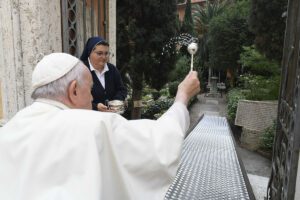
Pope Francis uses holy water to bless the tombs of those buried in the Vatican’s Teutonic Cemetery, a medieval cemetery now reserved mainly for German-speaking priests and members of religious orders, during a visit Nov. 2, 2022, the feast of All Souls. (CNS photo/Vatican Media)
VATICAN CITY (CNS) – As Christians await their death and the final judgment of God, the Gospel tells them what they must do to be welcomed into heaven: love others because God is love, Pope Francis said.
In life “we are in the waiting room of the world,” hoping to hear Jesus say, “Come, you who are blessed by my Father,” the pope said during a Mass in St. Peter’s Basilica Nov. 2, the feast of All Souls.
Pope Francis celebrated the Mass with special prayers for the nine cardinals and 148 archbishops and bishops from around the world who died between Oct. 30, 2021, and Oct. 17 this year, including 14 bishops from the United States and four from Canada.
After the Mass, the pope visited the Vatican’s Teutonic Cemetery, a medieval cemetery now reserved mainly for German-speaking priests and members of religious orders.
The Gospel reading at the Mass was St. Matthew’s description of the last judgment when those who fed the hungry, welcomed the stranger and visited the prisoner are welcomed into God’s kingdom, and those who neglected to care for others are sent into “the eternal fire.”
While praying for those who have died, he said, the feast day also is a call to “nurture our expectation of heaven” and question whether one’s strongest desires are for union with God or for earthly status and pleasures that will pass away.
“The best careers, the greatest achievements, the most prestigious titles and accolades, the accumulated riches and earthly gains — all will vanish in a moment,” the pope said.
But the Gospel of Matthew makes clear what will last, he said: love and care for others, especially the poor and those usually discarded by society.
And, he said, the Gospel also explains that God’s final judgment is not like a civil court where the judge or jury sifts through every piece of evidence and weighs them all carefully.
In the divine tribunal, the only thing that counts “is mercy toward the poor and discarded: ‘Whatever you did for one of these least brothers of mine, you did for me,'” the pope said. “The Most High is in the least, he who inhabits the heavens dwells among the most insignificant to the world.”
Jesus’ measure is “a love beyond our measures, and his standard of judgment is gratuitousness,” he said. “So, to prepare ourselves, we know what to do: love those who are on his priority list, those who can give us nothing back, those who do not attract us” and do so without expecting repayment.
Too often, Pope Francis said, instead of living the Gospel, people try to water down the words of Jesus.
“Let’s face it, we have gotten pretty good at compromising with the Gospel,” saying, “‘Feeding the hungry yes, but the issue of hunger is complex, and I certainly can’t solve it!'” or “‘Welcoming migrants yes, but it is a complicated issue, it concerns politics,'” the pope said. With little objections “we make life a compromise with the Gospel.”
“From simple disciples of the Master, we become teachers of complexity, who argue a lot and do little, who seek answers more in front of the computer than in front of the crucifix, on the internet rather than in the eyes of our brothers and sisters,” he said. Believers become experts “who comment, debate and expound theories, but do not know even one poor person by name, have not visited a sick person for months, have never fed or clothed someone (and) have never befriended someone in need.”
The Gospel teaches people how to live while awaiting death and God’s judgment — “loving because he is love,” Pope Francis said. God “waits for us among the poor and wounded of the world. And he is waiting to be caressed not with words but with deeds.”
Social
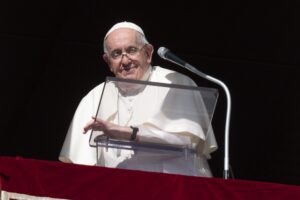
Pope Francis leads the recitation of the Angelus from a window of the Apostolic Palace at the Vatican Nov. 1, 2022, the feast of All Saints. (CNS photo/Vatican Media)
VATICAN CITY (CNS) – The saints were not “starched,” picture-perfect conformists, Pope Francis said; they were “countercultural and revolutionary.”
The multitude of men and women honored on the feast of All Saints lived according to the Eight Beatitudes, which made them decidedly out of place in the world, Pope Francis said Nov. 1 before reciting the Angelus prayer.
With thousands of people gathered in St. Peter’s Square, including runners who had participated in the 10k All Saints’ Day race, Pope Francis also encouraged people not only to visit the burial sites of their loved ones the following day, the feast of All Souls, but to go to Mass and pray for them as well.
Talking about saints and the day’s Gospel reading of the beatitudes, Pope Francis focused particularly on “Blessed are the peacemakers.”
Everyone says they want peace, he said, but often what they mean is they want “to be left in peace, to have no problems, just tranquility.”
But, if one reads the beatitudes in the Gospel, he said, they will see that Jesus does not say, “Blessed are those who are at peace,” but blessed are “those who make peace, the constructors, the peacemakers.”
“Indeed, peace must be built, and like any construction it requires effort, collaboration, patience,” he said. And it requires acts of justice and mercy.
While many people today try to convince everyone that only power and force can guarantee peace, the teaching of Jesus and the example of the saints show “peace is not achieved by conquering or defeating someone, it is never violent, it is never armed.”
To begin to sow peace, Pope Francis asked people to look at themselves and ask, “In the places where we live, study and work, do we bring tension, words that hurt, gossip that poisons, controversy that divides? Or do we open the path to peace: Do we forgive those who have offended us, care for those who are at the margins, redress some injustice by helping those who have less? This is building peace.”
At the end of his midday talk, the pope asked for prayers for his trip Nov. 3-6 to Bahrain so that his meetings with local Christians and with Muslim leaders would promote, “in the name of God, the cause of fraternity and peace, which our times so desperately and urgently need.”
And “please,” he said, “don’t forget martyred Ukraine; let us pray for peace, we pray that in Ukraine there would be peace.”
Social
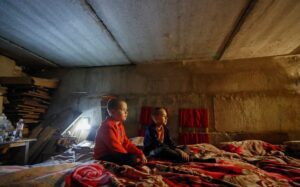
Children sit in a bomb shelter in Rubizhne, Ukraine, June 1, 2022, as the Ukraine-Russia war continues. During the month of November, Pope Francis is asking people to pray for children who are suffering because of poverty, war and exploitation. (CNS photo/Alexander Ermochenko, Reuters)
VATICAN CITY (CNS) – During the month of November, Pope Francis is asking people to pray for children who are suffering because of poverty, war and exploitation.
“Let us pray for children who are suffering, especially for those who are homeless, orphans and victims of war. May they be guaranteed access to education, and may they have the opportunity to experience family affection,” the pope said in a video released Oct. 31.
In the video message released by the Pope’s Worldwide Prayer Network, the pope explained his November prayer intention: “For children who suffer.”
“An abandoned child is our fault,” the pope said in the message.
“Each marginalized child, abandoned by his or her family, without schooling, without health care, is a cry! A cry that rises up to God and shames the system that we adults have built,” he insisted.
Pope Francis noted that there are millions of boys and girls around the world living “in conditions very similar to slavery.”
Yet, they are human beings with names and faces and an identity that God gave them, he said. And they have a right to an education and “to feel the love of a family so they know that God does not forget them.”
Social
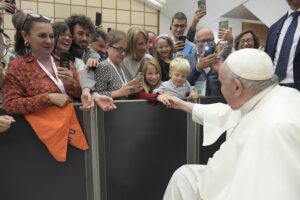
Pope Francis shakes hands with a child during an audience at the Vatican with members of the young adult section of Italy’s Catholic Action, Oct. 29, 2022. (CNS photo/Vatican Media)
VATICAN CITY (CNS) – The COVID-19 pandemic has weakened many parishes, but that community “in the midst of homes, in the midst of people,” is still an essential place for nourishing and sharing faith, Pope Francis told Italian young adults.
The parish is “the normal environment where we learned to hear the Gospel, to know the Lord Jesus, to serve with gratuitousness, to pray in community, to share projects and initiatives, to feel part of God’s holy people,” the pope told leaders of the young adult section of Italian Catholic Action, a parish-based program of faith building and social outreach.
Meeting thousands of young adults Oct. 29, Pope Francis said he knows that in most cities and towns the parish church is not the center of religious and social life like it was when he was growing up, but “for our journey of faith and growth, the parish experience was and is important, irreplaceable.”
With its mix of members, the pope said, the parish is the place to experience how “in the church we are all brothers and sisters through baptism; that we are all protagonists and responsible; that we have different gifts that are all for the good of the community; that life is vocation, following Jesus; and that faith is a gift to be given, a gift to witness.”
Part of that witness, he said, is to show concretely how faith leads to charity and a desire for justice.
In the neighborhood, town and region, “our motto is not ‘I don’t care,’ but ‘I care!'” the pope said.
The “disease of not caring” can be “more dangerous than a cancer,” he told the young people. “Human misery is not a fate that befalls some unfortunate people, but almost always the result of injustices that must be eradicated.”
Pope Francis urged the young people not to be frustrated or put off by the fact that in their parishes “the community dimension is a bit weak,” something “which has been aggravated by the pandemic.”
Learning to see each other as brothers and sisters, he said, does not begin with some parish meeting or activity, but with each person through prayer and, especially, through the Eucharist celebrated and shared in the parish.
“Fraternity in the church is founded on Christ, on his presence in us and among us,” the pope said. “Thanks to him we welcome each other, bear with each other — Christian love is built on bearing with each other — and forgive each other.”
Social
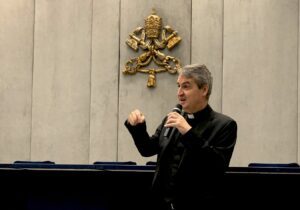
Oblate Father Andrew Small, secretary of the Pontifical Commission for the Protection of Minors, speaks to reporters in the Vatican press office Oct. 28, 2022, about the commission’s fall meeting. (CNS photo/Cindy Wooden)
VATICAN CITY (CNS) – With a renewed membership, the Pontifical Commission for the Protection of Minors met at the Vatican in late October and laid the groundwork for devising an annual report on child protection efforts by the Catholic Church globally.
Oblate Father Andrew Small, commission secretary, told reporters Oct. 28 that members also looked at the commission’s new relationship to the disciplinary section of the Dicastery for the Doctrine of the Faith and continued their efforts to promote greater transparency and fuller reporting to victims about the outcome of their cases.
“In our engagement with victim survivors, the acknowledgement of the wrong that was done to them is primary, being listened to, being believed,” Father Small said. “There’s nothing that takes the place of being believed and heard.”
But, he said, “seeing the wrongdoer continue to flourish at times or to appear without sanction is also very painful,” so victims are understandably confused or upset when they are not informed about actions taken by the church against an accused offender.
Because the commission is not involved in individual investigations and disciplinary procedures, Father Small said he could not comment on the case of Bishop Michel Santier of Créteil, France. When the Vatican announced in 2021 that the bishop was retiring, the bishop had said it was for health reasons. No one contradicted him publicly until mid-October when the Diocese of Créteil confirmed he had been credibly accused of sexual misconduct and disciplined by the Vatican.
The Vatican still needs to find a way to be more open while respecting local laws that protect the reputation of someone who is not guilty of a civil crime but may have violated church law, Father Small said.
If the church cannot figure that out, he said, not only will it be bad for the institutional church, “but it will be continually painful for the victims, who are the source and summit of the commission’s focus.”
When Pope Francis reorganized the Roman Curia, he linked the commission to the disciplinary section of the Dicastery for the Doctrine of the Faith. Father Small, writing in L’Osservatore Romano, the Vatican newspaper, said the move ensures the commission “would maintain its independence as an advisory body to the pope, with access to the bodies that exercise leadership within the church and with the mandate to oversee the adequacy of the church’s policies and procedures in the area of abuse prevention and safeguarding.”
So, Father Small wrote, the commission “will continue to be led by a president delegate, appointed by the pope and reporting directly to the pontiff. And decisions regarding the personnel, the members of the commission, as well as the proposals it produces, will remain independent of the dicastery. Pope Francis has been very clear that the independent voices of the members of the commission and those it serves should not be compromised.”
U.S. Cardinal Seán P. O’Malley of Boston has been president of the commission since its establishment in 2014.
During the commission’s meeting Oct. 27-29, it also announce the launch of a fund to help finance the establishment of “suitable centers where individuals who have experienced abuse, and their family members, can find acceptance and an attentive hearing, and be accompanied in a process of healing and justice, as indicated in the motu proprio ‘Vos Estis Lux Mundi.'”
Father Small told reporters that he believed 70 to 80 of the 114 bishops’ conferences in the world do not have stable, publicly accessible reporting mechanisms called for in Vos Estis, mainly because they do not have the resources. But with major funding from the Italian bishops’ conference and contributions from others, those listening and reporting posts will be established.
As for the annual report on the church’s child protection efforts worldwide, a report the pope asked the commission in April to develop, Father Small said commission members outlined a design for the report.
The first section, he said, would summarize reports bishops give to the commission while making their “ad limina” visits to the Vatican regarding their guidelines and implementation of Vos Estis.
For the second section, commission members will divide into teams to look at the church in specific geographical areas, focusing on giving a broader overview of child protection efforts in Africa, in Asia and Oceania, in Europe and in the Americas.
A third section will look at how dicasteries of the Roman Curia are including safeguarding in their activities; for example, how the Dicastery for Clergy promotes safeguarding awareness in seminaries, he said.
The final section will look at broader church efforts to protect children in the world by, for example, rescuing child soldiers, protecting migrant and refugee children, ensuring their safety in orphanages and foster care homes.
While Father Small said the commission should have something to give the pope in 2023, he does not expect to collect enough “actionable data” to begin doing a full annual report until 2024.
Social
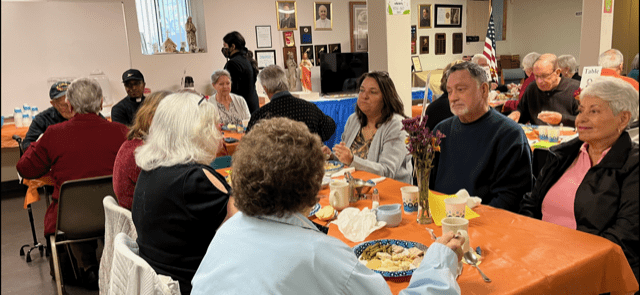
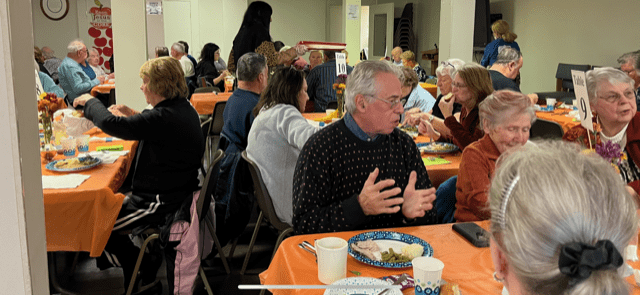
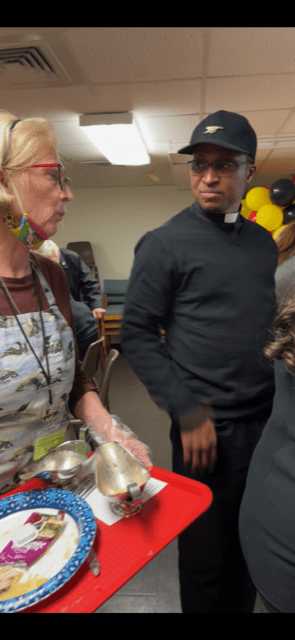
The final FREE Community Dinner of 2022 at St. Maximilian Kolbe Parish, Pocono Pines, was a huge success! The parish hall was warm and inviting – decorated in the colors of autumn – and friendly conversation filled the room. More than 86 guests enjoyed a delicious served meal of roast pork, mashed potatoes and gravy, green beans, a garden salad, dinner roll, and their choice of homemade dessert – pumpkin pie or apple cake. The dinner also provided hot and cold beverages including apple cider, a definite taste of the season!
Each year, the Social Concerns Committee of St. Max hosts three Free Community dinners. The dinners are gifts to the parish and community. Funding for the meals, and all their charitable works, comes from the proceeds of the committee’s three annual Lenten Buffets.
Committee members are supported in their efforts by their fellow parishioners including Confirmation students.
Father Paschal Mbagwu is Parish Administrator.
Social
As Catholics in a post-Roe world, we continue to respond to our call to build a culture of life that supports the dignity of every person at every stage. We call on our lawmakers to do the same. Encourage your members of Congress to pass legislation that advances the health, safety, and flourishing of women, children, and families. Passage of bills such as the Pregnant Workers Fairness Act and the PUMP for Nursing Mothers Act and support for the Child Tax Credit, paid family leave, pregnancy resource centers, child care and pre-kindergarten programs, housing, nutrition, maternal and child health, adoption, healthy relationships, environmental protections, inclusion of immigrant families in social programs, and the end of marriage penalties will help build an authentically life-affirming society.
We encourage you to add your own personal story about why more policies that support women, children, and families are needed.
You can read a recent USCCB letter calling for the passage of life-affirming policies that prioritize families here.


 As Catholics in a post-Roe world, we continue to respond to our call to build a culture of life that supports the dignity of every person at every stage. We call on our lawmakers to do the same. Encourage your members of Congress to pass legislation that advances the health, safety, and flourishing of women, children, and families. Passage of bills such as the Pregnant Workers Fairness Act and the PUMP for Nursing Mothers Act and support for the Child Tax Credit, paid family leave, pregnancy resource centers, child care and pre-kindergarten programs, housing, nutrition, maternal and child health, adoption, healthy relationships, environmental protections, inclusion of immigrant families in social programs, and the end of marriage penalties will help build an authentically life-affirming society.