(OSV News) – Two Maronite bishops in the U.S. are calling for prayer, dialogue and solidarity after a Maronite priest was killed in Lebanon amid the U.S.-Israel war on Iran.
Father Pierre al-Rahi succumbed to injuries sustained March 9 when an Israeli artillery tank fired on a house in the southern Lebanon village of Qlayaa.
Lebanon and several other Middle East nations have come under attack since U.S.-Israel strikes on Iran, launched Feb. 28 and met with counterattacks by that nation, have plunged the region — as well as global relations and markets — into uncertainty.
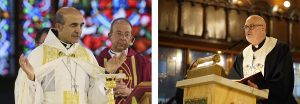
A combination photo shows Bishops A. Elias Zaidan of the Maronite Eparchy of Our Lady of Lebanon of Los Angeles, chair of the U.S. Conference of Catholic Bishops’ Committee on International Justice and Peace, and Bishop Gregory J. Mansour of the Eparchy of St. Maron of Brooklyn, N.Y. Also pictured is Baltimore Archbishop William E. Lori. (OSV News photo/Bob Roller/Gregory A. Shemitz)
Father al-Rahi, also known by his French name Pierre el-Raï, had along with other priests refused Israeli orders to evacuate the Maronite village, located a few miles from the border with Israel and home to some 8,000.
When the strike took place, Father al-Rahi “didn’t wait” but “went to jump in right away” after hearing “one of the homes in his town was bombarded,” Bishop A. Elias Zaidan, who heads the St. Louis-based Maronite Eparchy of Our Lady of Lebanon of Los Angeles, told OSV News.
But, said Bishop Zaidan, the priest was injured in a second strike that took place “right away” after the first, and then “died in the hospital.”
In a message shared with OSV News, Maronite Bishop Gregory J. Mansour of the Eparchy of St. Maron of Brooklyn, New York, reflected on Father al-Rahi’s death by quoting John 15:13: “No greater love has any man than to give his life for his friends.”
“May God’s good servant, Father Pierre Al Rahi, rest in peace,” said Bishop Mansour. “May his patriarch, bishop, brother priests, parishioners and family be consoled by the Holy Spirit.”
Bishop Zaidan called the priest’s death a “sad story and unfortunate situation.”
With roots in Syria and Lebanon, the global Maronite Catholic Church — one of the 23 Eastern Catholic Churches that, along with the Roman Catholic Church, comprise the universal Catholic Church — mourns to see Lebanon ravaged again by war, said Bishop Zaidan.
“It’s definitely a sadness and a sorrow, because Lebanon is a spiritual home for Maronites, like the Vatican is for all Catholics,” he said. “And we feel that attachment.”
Yet in the midst of death, the hope of new life through Christ is present, said Bishop Zaidan.
“The blood of martyrs helps to build the Church in that way, and gives us the determination to keep going despite everything, and to witness to the love of Christ in that perspective,” he said.
Bishop Zaidan offered a message for the faithful following the priest’s death.
“I would say, as Pope Leo XIV has, enough violence; let’s dialogue, let’s talk,” he said.
In addition, “keep praying and praying and praying,” Bishop Zaidan urged.
And, he said, “stand in solidarity” with those suffering in the war by thinking about and reflecting on what they are experiencing.
“I think we go a long way from that perspective, because ‘whatever you have done to the least of my brothers and sisters, you’ve done it to me,'” said Bishop Zaidan, quoting Matthew 25:40. “This gesture of support that says, ‘We’re praying for you, we’re thinking about you, we’re feeling for you’ — I think this beautiful support can help our brothers and sisters.”
Social
(OSV News) – Pope Leo XIV called for an end to the war in Iran and warned that the conflict could drag more countries in the Middle East into instability.
Speaking to pilgrims after praying the Angelus prayer March 8, the pope said that developing news from Iran and from across the Middle East has caused “deep dismay.”
“Amid episodes of violence and devastation, and the widespread climate of hatred and fear, there is also the concern that the conflict may widen and that other countries in the region, including Lebanon, may once again sink into instability,” he said.
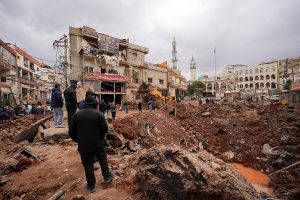
People inspect the damage in the Lebanese town of Nabi Chit March 7, 2026, where the Israeli military carried out an airborne operation that dropped troops overnight. (OSV News photo/Mohammad Yassine, Reuters)
According to The Associated Press, Israeli forces struck an oil storage facility in Tehran, as well as targeted assaults in southern Lebanon against commanders of the Lebanese branch of Iran’s Revolutionary Guards.
Iran has continued striking U.S. allies in the Gulf, including Bahrain, where it fired missiles at a desalination plant. Iranian Foreign Minister Abbas Araghchi defended the attack, arguing that the “U.S. set this precedent” after it struck a desalination plant in Iran, AP reported.
The pope’s concern for Lebanon came as government officials confirmed that the conflict between Israel and Hezbollah militants resulted in the deaths of 394 people, including 83 children.
Since the start of the war Feb. 28, at least 1,230 people in Iran, about a dozen in Israel and six U.S. service members have been killed, AP said.
In his appeal, Pope Leo called on Catholics to pray so that “the roar of bombs may cease, that the weapons may fall silent, and that a space for dialogue may open in which the voice of the peoples can be heard.”
“I entrust this supplication to Mary, Queen of Peace,” the pope said. “May she intercede for those who suffer because of war and guide hearts along the paths of reconciliation and hope.”
Less than a day after the start of the war, the pope called for diplomacy to “regain its proper role” and that “the well-being of peoples, who yearn for peaceful existence founded on justice, be upheld.”
At his Angelus address March 1, several hours after the U.S. and Israel revealed that Iran’s supreme leader, 86-year-old Ayatollah Ali Khamenei, was killed, the pope expressed his concern, highlighting that “stability and peace are not achieved through mutual threats, nor through the use of weapons, which sow destruction, suffering, and death, but only through reasonable, sincere, and responsible dialogue.”
“Faced with the possibility of a tragedy of immense proportions, I make a heartfelt appeal to all the parties involved to assume the moral responsibility of halting the spiral of violence before it becomes an irreparable abyss,” the pope warned.
Social
ROME (OSV News) – Pope Leo XIV has named Archbishop Gabriele Caccia as the Vatican’s ambassador to the United States, selecting a seasoned diplomat to serve as a crucial liaison between Rome and the pope’s home country.
The Vatican announced the appointment of the new apostolic nuncio March 7, naming Archbishop Caccia, 68, to succeed Cardinal Christophe Pierre, who turned 80 in January and had served in the post since 2016.
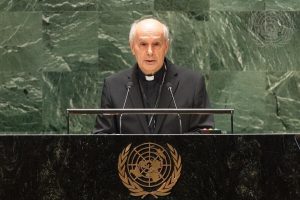
Archbishop Gabriele G. Caccia, the Holy See’s permanent observer to the United Nations, is pictured in a 2023 photo addressing the General Assembly at U.N. headquarters in New York City. Pope Leo XIV named Archbishop Caccia as the new papal nuncio to the United States March 7, 2026. He succeeds Cardinal Christophe Pierre, who turned 80 in January and had served in the post since 2016. (OSV News photo/Rick Bajornas, courtesy United Nations)
A nuncio is a Vatican diplomatic representative with the rank of ambassador. He acts as both the Holy See’s ambassador to the government and its representative to the Catholic Church in the host country, maintaining ties between local bishops and Rome.
Archbishop Caccia, a native of Milan, already has significant experience in the United States, having served as the permanent observer of the Holy See to the United Nations in New York since 2020.
As papal nuncio to the United States, Archbishop Caccia will play a key role in the selection process for U.S. bishop appointments and will serve as a point of contact between the bishops and clergy in the United States and the pope, in addition to carrying out the diplomatic tasks of a foreign ambassador serving in the United States.
Like his predecessor, Archbishop Caccia will serve as the pope’s key contact with President Donald Trump’s administration at a time when the administration’s immigration policies have been increasingly met by resistance by the U.S. bishops.
Archbishop Caccia in a March 7 statement said he was “honored and deeply humbled by the decision of the Holy Father to appoint me as Apostolic Nuncio to the Country and the Church where he himself was born and raised.”
“I receive this mission with both joy and a sense of trepidation, conscious of the great trust placed in me and of my own limitations, yet confident in His Holiness’s prayerful support and guidance,” the archbishop said.
During his years of service at the United Nations in New York, Archbishop Caccia said, he has experienced “warmth and openness” from the local Church, the government and the people of the United States. “I trust that their generosity and collaboration will assist me in carrying out this new mission at the service of communion and peace.”
Archbishop Caccia invoked “the blessings of Almighty God” on all, “especially in this year that marks the 250th anniversary of the birth of the United States of America.”
The president of the U.S. Conference of Catholic Bishops, Archbishop Paul S. Coakley of Oklahoma City, welcomed the appointment on behalf of his brother bishops.
“I wish to extend our warmest welcome and our prayerful support to him as he carries out his responsibilities across the United States, and we look forward to working with him,” the archbishop said in a statement.
Archbishop Coakley also expressed his “sincere and prayerful appreciation” to Cardinal Pierre, noting his “many opportunities to work with Cardinal Pierre over the years, particularly over the last four months through the U.S. Conference of Catholic Bishops,” since the Oklahoma prelate’s election in November as USCCB president.
“Thank you, Your Eminence, for your tireless service to the Church in the United States, and on behalf of my brother bishops, I offer our heartfelt prayers and best wishes in your retirement,” Archbishop Coakley said.
Archbishop Caccia is a career Vatican diplomat trained at the Pontifical Ecclesiastical Academy in Rome. He holds a doctorate in sacred theology and a licentiate in canon law from the Pontifical Gregorian University.
His previous diplomatic posts include serving as apostolic nuncio to the Philippines and Lebanon, and earlier as an attaché in Tanzania. He also worked as assessor for general affairs in the Secretariat of State under St. John Paul II in Rome.
Cardinal Pierre, who spent nearly five decades in Vatican diplomatic service, earned widespread respect among U.S. bishops for identifying episcopal candidates who embodied Pope Francis’ priorities while avoiding polarization. He was elevated to the College of Cardinals in 2023 and is expected to divide his retirement between his native France and Rome.
The United States and the Holy See have maintained formal diplomatic relations since 1984, when President Ronald Reagan and St. John Paul II established full ties. However, the relationship dates back to the U.S. founding, when Benjamin Franklin conveyed a message from George Washington to Pope Pius VI in 1788, affirming that the new republic’s commitment to religious liberty meant no government role in appointing bishops.
The U.S. maintained consular relations with the Papal States from 1797 and diplomatic relations from 1848 to 1867, though not at the ambassadorial level. Congress banned funding for Vatican relations in 1867, a move partly driven by anti-Catholic sentiment. For more than a century afterward, contact relied on personal envoys, including during World War II, until Reagan and John Paul II restored formal ties.
The current Rome-based U.S. ambassador to the Holy See is Ambassador Brian Burch, who presented his credentials to Pope Leo XIV in September.
Social
WASHINGTON (OSV News) – The U.S. bishops’ annual Catholic Relief Services Collection, which helps some of the poorest and most vulnerable people in need in the United States and worldwide, will be taken in most U.S. dioceses at Masses the weekend of March 14-15.
The collection benefits six agencies and offices affiliated with the Catholic Church, including CRS, the flagship international relief and development agency for the Catholic Church in the U.S.
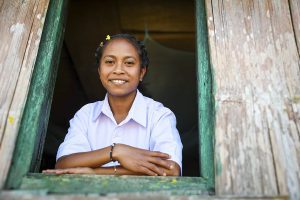
Adriana, 14, smiles for a pictured in Timor-Leste July 5, 2024. Catholic Relief Services supported nutrition and health initiatives for adolescent girls and young women across 21 communities in Timor-Leste. Good nutrition is the foundation for life and central to development and economic growth. (OSV News photo/Benny Manser, Catholic Relief Services)
“The Church in the United States was built on ministry among immigrants. We help all who are marginalized, including victims of war and disaster overseas. The Catholic Relief Services Collection combines all these kinds of assistance,” said Bishop Daniel H. Mueggenborg of Reno, Nevada, chair of the U.S. Conference of Catholic Bishops’ Committee on National Collections.
“Our Lord tells us to love our neighbors — those we know, those we don’t and those we think are very different from us. The Catholic Relief Services Collection is one way that we show that love. Today it is more vital than ever,” the bishop said in his March 2 statement.
The collection is also accepting online gifts at igivecatholic.org/story/USCCB-CRS.
Of nearly $13.5 million distributed from the collection in 2024, nearly $8 million went to CRS working in places affected by war and natural disaster, according to a USCCB news release.
The CRS Collection has become more critical in light of last year’s deep cuts to humanitarian aid by the U.S. federal government that have left a chasm for the Catholic Church and other international aid agencies to fill.
In July 2025, the U.S. Agency for International Development effectively ceased to exist, with 85% of its programs cut, as a result of the cost-cutting efforts of tech titan Elon Musk, then head of President Donald Trump’s Department of Government Efficiency. Musk bragged about “feeding USAID into the woodchipper,” but academic demographers have estimated the sudden loss of funding to groups carrying out humanitarian aid led to as many as 300,000 people dying within six months.
The Lancet, a peer-reviewed British medical journal published since 1823, estimated USAID assistance has saved more than 91 million lives, including that of 30 million children, over the past two decades. But it forecast that if USAID-funding levels were not restored, “a staggering number of avoidable deaths could occur by 2030”: 14.1 million people, with over 4.5 million being children younger than 5.
The other recipients of the CRS Collection are:
— The Catholic Legal Immigration Network Inc., or CLINIC: provides training and support to a network of more than 400 Catholic and community-based immigration law providers in 49 states.
— The USCCB Secretariat of Migration, formerly the Department of Migration and Refugee Services: assists dioceses in carrying out their ministries to newcomers, publishes educational resources, and promotes policies “that affirm the life and dignity of immigrants and refugees.”
— Two initiatives of the USCCB Secretariat of Cultural Diversity in the Church: pastoral ministries to migrant workers, travelers and seafarers through its Subcommittee on the Pastoral Care of Migrants, Refugees, and Travelers, and its Subcommittee on Asian and Pacific Island Affairs, which helps the Church address the unique pastoral needs across many boundaries of language and tradition.
— The USCCB Secretariat of Justice and Peace: engages in advocacy on behalf of the poor around the world and works with policymakers and government officials to end violent international conflicts through its international justice and peace program. Created in early August 2024, the secretariat serves a number of USCCB committees, including the Committee on International Justice and Peace.
— Holy Father’s Relief Fund: helps Pope Leo XIV rush aid to areas of the world in crisis.
Bishop Mueggenborg said, “Together, these agencies help victims of war and natural disaster, support sustainable economic development overseas, advocate for international peace and human rights, help refugees and immigrants in the United States to obtain legal support, offer pastoral support to a wide variety of people who migrate for work and build cross-cultural understanding.”
Social
This year Catholic Sisters Week is observed March 8-14, 2026, with the theme “Hope & Heart.” (OSV News illustration/courtesy Communicators for Women Religious)
(OSV News) – Catholic Sisters Week, an annual campaign to bring greater visibility to U.S. sisters, will again be focused on the theme of #LikeaCatholicSister, but instead of the action-oriented messages of last year, it will center on the stories of sisters’ work.
Catholic Sisters Week, now in its 13th iteration, is overseen by Communicators for Women Religious, an organization of sisters and laypeople who work in communications for sister congregations. It runs March 8-14 every year, starting on International Women’s Day.
The messages for this year’s observance fall under the theme of “Hope & Heart,” and include topics such as “Community & Connection” and “Prayer & Spirit.”
“Last year we focused on bold, action things like ‘Fighting for the Forgotten,'” said Mikaela VanMoorleghem, president of the CWR steering committee and director of communications for the Notre Dame Sisters in Omaha, Nebraska. “Instead, this year we’re inviting congregations to share the moments that reveal who Catholic sisters are.”
While those moments and stories will be collected on the Catholic Sisters Week website’s Padlet — a sort of shared digital bulletin board — one could also find stories by searching the #LikeaCatholicSister hashtag on social media. The Padlet itself can also be embedded on congregational websites, she said.
Before last year, Catholic Sisters Week focused on events being held by sisters to draw attention to their work and legacy; now it is centered on telling the stories of their work and legacy.
One event that is being held to commemorate the week, however, is a documentary screening held by the Louisville Ursulines:”In the Company of Change,” which is both a tribute to Sister Martha Buser and and exploration of the societal and ecclesial shifts that reshaped Catholic religious life in America over the past 75 years. The documentary is a follow-up to filmmaker Morgan Atkinson’s 1987 documentary on Sister Martha and the changes the sisters experienced after Vatican II, “A Change in Order.”
VanMoorleghem said the stories of Catholic sisters are so powerful and important, they need to be shared not just because they need to be preserved and remembered, but because the world needs them right now.
One example is a story by Notre Dame Sister Celeste Wobeter, who wrote about looking back on difficult times in her life and remembering “an emptiness, a fear of terrible consequences. Wondering what to do.”
But also trusting and hoping.
“Eventually a sense of peace and healing would seep into my life,” Sister Celeste wrote. “A sense of freedom and amazement that the situation was indeed a gift, unwanted, but a gift that strengthened my hope and trust in God and others. As I look back I see each struggle in life taught me something new. I began to be grateful for the struggle. (But I added, ‘Please, no more!’)”
VanMoorleghem said sisters and their work are a gift to the world — one part of the introductory video notes that sisters’ service “is love made visible” — that is more needed than ever.
“The goal is that we lift these voices up so they can inspire us to love more boldly, listen more closely, and carry hope forward,” she said. “We want to tell their stories and uplift their ministries and congregations, and invite the public to learn about these incredible women.”
Social
(OSV News) – Nine young adults have been selected as “perpetual pilgrims” to travel with the Eucharist along the East Coast this summer in the third National Eucharistic Pilgrimage. The pilgrims — five men and four women — will participate in the pilgrimage’s full route, which begins May 24 in Florida and reaches Maine before ending in Philadelphia July 5 for U.S. semiquincentennial celebrations.
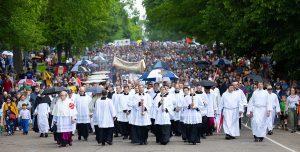
With an estimated 7,000 participants, the Source and Summit Eucharistic Procession makes its way along Summit Avenue in St. Paul, Minn., on its way from The St. Paul Seminary to the Cathedral of St. Paul in St. Paul May 27, 2024. The procession was part of the 2024 National Eucharistic Pilgrimage. (OSV News photo/Dave Hrbacek, The Catholic Spirit)
The pilgrims include Zachary Dotson, a parish employee in Indiana; Marcel Ferrer, a sophomore at Franciscan University in Steubenville, Ohio; John Paul Flynn, sophomore at The Catholic University of America in Washington; Eduardo Gutierrez, an accountant in Phoenix; Cheyenne Johnson, a missionary in New Jersey; Angelina Marconi, a college athletic trainer in Kentucky; Raymond Martinez II, a seminarian for the Diocese of San Angelo, Texas; Sharon Phillips, a high school youth minister in the Archdiocese of Seattle; and Mary Carmen Zakrajsek, a youth faith formation director in Indiana.
With four routes that met in Indianapolis, the 2024 pilgrimage included 30 pilgrims. Last year’s pilgrimage included eight. Johnson was among the 2025 perpetual pilgrims, and she is returning this year as the team lead. Last year’s pilgrimage also included a returning pilgrim who had traveled one of the 2024 routes to serve as team lead.
With the theme “One Nation Under God,” the 2026 National Eucharistic Pilgrimage route celebrates key Catholic landmarks and events in American Catholic history as part of the nation’s 250th anniversary. The pilgrimage’s route includes public events in 18 dioceses and archdioceses in 13 states and the District of Columbia.
Registration for public events such as Masses, Eucharistic processions, adoration and Holy Hours opens March 18 at eucharisticpilgrimage.org.
The pilgrimage will launch Memorial Day weekend with Mass at Our Lady of La Leche Shrine at Mission Nombre De Dios in St. Augustine, Florida, the site of the first Mass celebrated on American soil in 1565. It will also include commemorations of the Georgia Martyrs, five Franciscan missionaries who were killed for their faith in 1597, whose beatification is expected Oct. 31; the celebration of the feast of Corpus Christi in the Archdiocese of Washington and the Diocese of Arlington, Virginia; and stops in the Archdiocese of Baltimore, the nation’s first Catholic diocese.
The route is dedicated to St. Frances Xavier Cabrini, an Italian-American religious sister who cared for the immigrants and poor in New York during the turn of the 20th century.
The National Eucharistic Congress nonprofit organizes the pilgrimage, which first took place in 2024 ahead of the 10th National Eucharistic Congress in Indianapolis as part of the National Eucharistic Revival, and which returned last summer with a route from Indianapolis to Los Angeles.
This year’s pilgrimage will take place in solidarity with the U.S. bishops’ call to consecrate the United States to the Sacred Heart of Jesus. It also aims to broadly involve the Church in the U.S. through a campaign to offer 250,000 Holy Hours “for the renewal and blessing of America,” according to its website.
Dioceses and archdioceses with stops along the route are St. Augustine; Savannah, Georgia; Charleston, South Carolina; Charlotte, North Carolina; Richmond, Virginia; Arlington, Virginia; Washington; Baltimore; Wilmington, Delaware; Camden, New Jersey; Paterson, New Jersey; Springfield, Massachusetts; Manchester, New Hampshire; Portland, Maine; Boston; Fall River, Massachusetts; Providence, Rhode Island; and Philadelphia.
Social
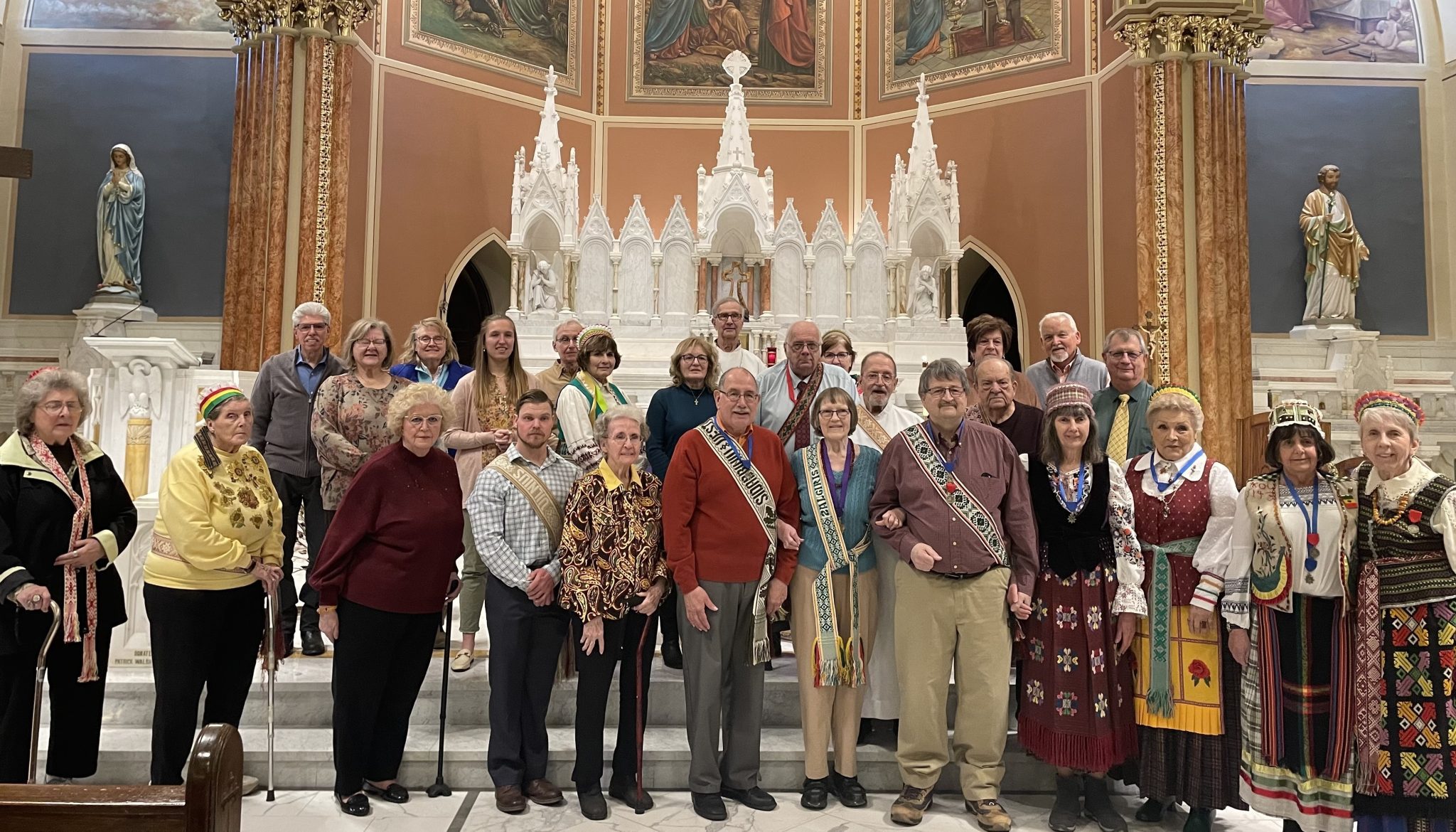
Knights of Lithuania Council 143, Pittston, celebrated the feast of St. Casimir with a Mass held on Sunday, March 1st at St. John the Evangelist Church in Pittston. Third and Fourth degrees were also conferred at the Mass held by Reverend Joseph Elston. A luncheon and Amber District meeting in the Monsignor Bendik Center followed the service.
Pictured are Council members and Amber District members.
Front row, from left to right Evelyn Parra, Marilyn Fitzgerald, Judy Stodolny, Rob Kiska, Eileen Kelly, Tom Miller – Supreme Ritual Chair and Amber District Secretary, Barbara Miller-Amber District President, Dennis Palladino – 4 th Degree recipient, Janet Palladino – 4 th Degree recipient, Yvonne Branas – 4 th Degree recipient, Mary Claire Voveris and June Supey.
Second row, from left to right, Les Distin, Donna Albright, Anne Marie Distin, Lainey Mentrikoski, Joe Francik, Mary Portelli, Elaine Elko, Bill Sodnik, Tom Wierbowski – Amber District Vice President, Sylvia Waxmonsky, Tom Vaxmonsky, Don Waxmonsky, Irene Kovaleski, John Kovaleski, and Larry Domalakes. – Amber District Treasurer. Absent from photo was Beverly Harnen.
Social
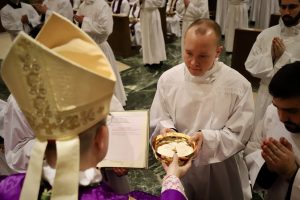
VATICAN CITY – On Sunday, March 1, 2026, seminarian Jacob P. Mutchler from St. Matthew Parish, East Stroudsburg, was one of 33 seminarians who received the Ministry of Acolyte in the Chapel of the Immaculate Conception at the Pontifical North American College, Vatican City State.
Seminarian Jacob P. Mutchler from Saint Matthew Parish, East Stroudsburg, receives the Ministry of Acolyte on March 1, 2026, at the Pontifical North American College. (Photo/Pontifical North American College)
His Excellency, Archbishop Samuele Sangalli, Adjunct Secretary of the Dicastery for Evangelization, conferred the Ministry of Acolyte.
In the rite of the Institution of Acolyte, Archbishop Sangalli placed the paten, which contains the hosts for the celebration of Mass, in the hands of each candidate. He then said, “Take this vessel with bread for the celebration of the Eucharist. Make your life worthy of your service at the table of the Lord and of His Church.”
The seminarians, currently in their second year of formation at the College, have two additional years of theological studies before being ordained to the priesthood in their home dioceses.
The Pontifical North American College serves as the American seminary in Rome.
Founded in 1859 by Blessed Pius IX, the College has formed over 5,000 priests in the heart of the Church for service in dioceses around the United States and Australia.
The College strengthens the bonds between Rome and local Churches worldwide, and it allows its students a first-hand encounter of the Church’s rich religious and cultural heritage.
Social
ROME (OSV News) – Catholic sisters from around the world are inviting people to join a livestreamed prayer for peace March 6 amid ongoing violence related to the U.S. and Israel-Iran war.
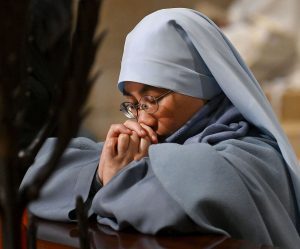
A religious sister prays as Cardinal Pierbattista Pizzaballa, Latin patriarch of Jerusalem, said Mass in the Basilica of the Annunciation at the inauguration of the Jubilee Year in the Holy Land on Dec. 29, 2024, in Nazareth, Israel. Catholic sisters from across the world are inviting people to join them in a livestreamed prayer for peace on March 6, 2026, amid the ongoing violence of the U.S. and Israel-Iran war. (OSV News/Debbie Hill)
The International Union of Superiors General, which represents more than half a million religious sisters from more than 1,900 congregations worldwide, is calling for prayer, fasting and action for peace.
The sisters will host a livestreamed moment of prayer March 6, at 9:30 a.m. Eastern Standard Time (3:30 p.m. Rome time), open to people of every faith and all people of goodwill. The online prayer event, livestreamed at youtube.com/@UISGRome, will bring together religious communities from every continent.
“As consecrated women religious, present in the most fragile contexts of society and close to those who suffer, we cannot remain silent in the face of a spiral of destruction that undermines human dignity and jeopardizes the future of new generations,” Sister Roxanne Schares, a member of the School Sisters of Notre Dame and executive secretary of the union of superiors general said in an announcement about the event.
The organization noted that Catholic sisters “living alongside refugees, the wounded, and devastated families daily bear witness that peace is not an abstraction, but a fundamental human need denied to millions.”
“We entrust to our loving, compassionate God the victims of all conflicts and war, implore the gift of courage for us to become artisans of peace, and reaffirm our commitment to walk together beyond borders with all our sisters and brothers so the world may truly become a home for all,” Schares said.
Social
ROME (OSV News) – A Synod on Synodality study group has recommended the creation of a new “Pontifical Commission for Digital Culture and New Technologies” in the first of 15 synod study group reports expected in the coming weeks.
The Vatican published the first two final reports from its Synod on Synodality study groups on March 3.
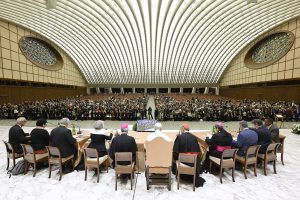
Pope Leo XIV, with regional representatives of synod teams, listens to and answers questions from participants in the Jubilee of Synodal Teams and Participatory Bodies in the Vatican audience hall Oct. 24, 2025. The final reports for two Synod on Synodality study groups, on formation for the priesthood and on navigating the Church’s presence in digital spaces, were released on March 3, 2026. (CNS photo/Vatican Media)
The first report contains recommendations on navigating the Church’s presence in digital spaces, including a proposal for a Vatican office or commission to monitor emerging theological, pastoral and canonical questions; prepare guidelines and training strategies for bishops, priests, religious and laypeople; and support bishops’ conferences in integrating digital mission into their pastoral plans.
The second report focuses on guidelines for the formation of future priests and includes a call for more women to play a role in aiding the formation of seminarians for the priesthood. The report also lists 26 real world examples of “best practices” from seminaries around the world.
In one of the examples, the report points to how almost all seminaries in France now include at least one woman on their seminary council with voting rights, after a 2021 directive from the country’s bishops. In one French seminary, a married couple, a marriage counselor and her retired husband, married 39 years with six children, lives in the seminary as an integral part of its formation team alongside six priests.
Pope Leo XIV directed that the study group reports be made public, according to the General Secretariat of the Synod, “in order to share with the entire People of God the fruit of the reflection and discernment undertaken, thereby giving concrete expression to one of the essential characteristics of the synodal Church: transparency and accountability.”
Cardinal Mario Grech, the secretary general of the Synod of Bishops, noted the final reports “are to be understood as working documents, a point of departure rather than arrival,” but said they “already contain valuable indications … from which local Churches and various ecclesial realities may draw inspiration from this very moment.”
The General Secretariat of the Synod will publish 13 more study group final reports, according to its website, with the next batch expected March 10.
The study groups were established by Pope Francis following the first session of the Synod on Synodality in October 2023. Twelve groups were originally formed to examine issues raised at that assembly, including women’s participation in the Church, the role of papal nuncios and the liturgy in a synodal perspective.
The groups, composed of cardinals, bishops, priests and lay experts from both inside and outside the Vatican, had originally been asked to submit their conclusions by June 2025. After the death of Pope Francis and the election of Pope Leo XIV last year, the new pope extended the deadline, requesting final reports be delivered “insofar as possible” by Dec. 31, 2025.
The proposals drawn from all of the final reports will be submitted to Pope Leo XIV, who will evaluate and may approve them, the secretariat said.
The 26-page final report from the study group on the Church’s mission in the digital environment provided recommendations both at the diocesan level and for the bishops’ conferences and Roman Curia to better serve the needs of people online.
The report reflected on feedback gathered from Catholics throughout the global synod process, citing clergy who said they felt “ill-equipped to navigate digital spaces.”
The report called on appropriate Vatican bodies to study potential canonical adaptations to accommodate what it termed “supraterritorial digital realities,” acknowledging that online ministry often goes beyond traditional geographic diocesan boundaries. The group noted that “much more consultation and discernment remains to be done regarding jurisdictional issues.”
Additional Vatican-level proposals included developing guidelines on digital risks such as polarization and manipulation, fostering international networks of those engaged in digital mission, and creating a Church-wide digital resource hub.
The group’s recommendations emphasized that digital spaces represent genuine terrain for evangelization. Local churches, it said, should affirm digital culture as “a real space for mission, where true human relationships occur.” The report also cautioned that “mainstream digital platforms are not neutral but have algorithms that may hinder the spread of positive messages.”
The second report, a 24-page document, provided guidelines and recommendations for how seminarians are formed, including closer immersion in parish life, the inclusion of women in the process of formation, and greater lay involvement in decisions about priestly candidates.
Rather than issuing a wholesale revision of the 2016 Ratio Fundamentalis Institutionis Sacerdotalis, a document from the Congregation for the Clergy on priestly formation, which the synod secretariat said the group judged as “still valid in its fundamental principles,” the study group produced a guiding document for its implementation in a “missionary synodal key.”
Among its key guidelines, the report called for priestly formation to be immersed in the life of the Christian community, with the possibility of alternating traditional seminary residence with periods living in parish communities or other ecclesial environments, particularly during later stages of formation. The document specified this should not prolong the overall formation period.
The report called on seminaries to include “well-prepared and competent women as co-responsible at all levels of formation, also within the formation team, in order to benefit from their indispensable contribution to vocational discernment and to the accompaniment of candidates to the priesthood.”
Responsibility for the formation of future priests, the document said, “cannot remain limited to the Bishop and those directly given the task of formation, but requires the contribution of the entire People of God.” It called for bishops to promote listening and interaction among people of different vocations in drafting national formation plans, and said the People of God should be “truly listened to” before the conferral of Holy Orders.
The document includes 26 real-world best practice examples from seminaries around the world. Among those highlighted: a program in eight U.S. dioceses focused on healing wounds caused by the excessive use of technology and family breakdown, centered on an eight-day silent retreat and a small-group chastity program; and a Nigerian seminary that requires seminarians to perform all maintenance work and cleaning of their seminary building to “experience the dignity of human labor.”
The report also outlined a three-year action plan under the supervision of the Dicastery for the Clergy, in which each episcopal conference could establish a working group to oversee implementation of synodal elements in its seminaries. Comprehensive reports would be submitted to the dicastery at the end of the three-year period, which would compile a summary report for the pope.
With the submission of their final reports, both study groups have concluded their mandates and are considered dissolved. The General Secretariat of the Synod and the competent Vatican dicasteries will now work to translate the findings into proposals to be submitted to the pope.