SCRANTON – Catholic Social Services of the Diocese of Scranton is inviting residents to experience the national “People of Hope Museum” when the traveling exhibit visits Nay Aug Park in Scranton on Wednesday, June 10, 2026.

The free interactive museum experience will be open from 10:00 a.m. to 4:00 p.m. in front of the Everhart Museum and will feature immersive exhibits, storytelling opportunities and reflections focused on poverty, compassion, and community service.

The People of Hope Museum is displayed in this undated photo. The traveling museum, produced by Catholic Charities USA and made possible by a Lilly Endowment grant, features 42 videos of Catholic Charities staff and volunteers from agencies around the country sharing moving first-person accounts of what it means to serve someone in need in their darkest moment. (OSV News photo/courtesy Catholic Charities USA)

Presented by Catholic Charities USA, the museum recently began traveling the country in a 53-foot semi-tractor trailer, inviting visitors to step into the lives of others through learning about their stories.

Local organizers say the Scranton stop promises to be both meaningful and family-friendly – especially as schools across the region will just be beginning summer vacation.

“This is a wonderful opportunity for families, parishioners, students and our entire community to begin the summer with an experience that is both inspiring and eye-opening,” Joe Mahoney, CEO of Catholic Social Services of the Diocese of Scranton, said. “The People of Hope Museum reminds us that every person has dignity, every story matters, and every one of us has the ability to make a difference in the life of a neighbor.”

Visitors to the museum will encounter video testimonies from people serving vulnerable populations in communities across the nation, hear stories of individuals whose lives have been transformed through acts of kindness, and participate in an interactive poverty simulation designed to foster empathy and understanding.

The traveling exhibit also includes an audio learning library featuring reflections and insights from nationally known voices discussing poverty, social isolation, and community engagement. Guests will additionally have the opportunity to record and share their own stories of hope and service as part of the museum’s ongoing national initiative.

“As Catholics, we are called not only to recognize Christ in those who are struggling, but also to respond with compassion and action,” Mahoney added. “This exhibit will help people see the very real challenges many families face every day while also highlighting the incredible hope that comes when communities come together in service.”

The People of Hope Museum is made possible through a $5 million grant from Lilly Endowment Inc. as part of its National Storytelling Initiative on Christian Faith and Life. Organizers say the traveling exhibit seeks to inspire greater volunteerism, empathy, and involvement within local communities.

While the museum experience is intended for those ages 14 and older because some content addresses themes of poverty and past trauma, organizers emphasize that the June 10 event offers activities and attractions for visitors of all ages.

In addition to the free museum tour, attendees will also receive free admission to both the Everhart Museum and the Brooks Mine during event hours.

“We want this day to be something the entire community can enjoy,” Mahoney said. “Whether someone comes to experience the museum, explore the Everhart Museum, visit the Brooks Mine or simply spend time together at Nay Aug Park, we hope people leave feeling inspired and hopeful.”

Because the museum trailer will necessitate the closing of the main entrance to Nay Aug Park for the safety of visitors, people are encouraged to enter Nay Aug Park using the entrance near the Blackwatch Cafe and follow Nay Aug Road to the parking area adjacent to the event site.

The People of Hope Museum began its national tour earlier this year in New York City. It will arrive in Scranton after making a stop in the Diocese of Greensburg, which is located near Pittsburgh. In all, the traveling museum is expected to visit more than 150 communities nationwide over the next three years.

SCRANTON – In just a few months, the former Cathedral Convent building in downtown Scranton will welcome its first seminarians as the new Saint Pius X Seminary officially begins its mission of forming future priests for the Diocese of Scranton.

Located in the 300-block of Wyoming Avenue, directly across from the Diocesan Pastoral Center and steps away from the Cathedral of Saint Peter, the new seminary will house men beginning the “propaedeutic” stage of priestly formation – a preparatory year focused heavily on prayer, fraternity, human formation, and spiritual growth.

Renovations are underway to the Cathedral Convent building in Scranton, which will soon be the Saint Pius X Seminary. The updates include new carpet, light fixtures and paint.

The Most Rev. Joseph C. Bambera, Bishop of Scranton, recently announced several key appointments for the seminary. Father Alex J. Roche, S.T.L., will serve as Rector of Saint Pius X Seminary beginning June 1, 2026. On the same date, Father Mark J. DeCelles has been appointed to begin serving as Academic Dean; and Father Brian Van Fossen, V.F., has been appointed as Head Spiritual Director.

For Father Roche, the work underway is about much more than preparing a building for occupancy. It is about laying the groundwork for the future priests of the Diocese of Scranton.

“We’re starting something new. We’re beginning something,” Father Roche said. “Throughout the Diocese, I think there should be a lot of excitement for this new initiative that can benefit us in a lot of ways.”

While the first stage of priestly formation – the “propaedeutic” stage may sound unfamiliar – Father Roche said its purpose is simple.

“It is a time of preparation,” he explained. “It is seen as a time of formation in which a man learns to pray, he learns to live in community, he learns some of the basics of our faith by reading the Bible, the Catechism, the documents of the Second Vatican Council and great spiritual works.”

The Diocese of Scranton previously utilized seminaries outside the Diocese for this initial stage of formation. Establishing the program locally, however, creates new opportunities for seminarians to grow more deeply connected to the Church they may one day serve.

“It gives us an opportunity to get to know our seminarians a little better,” Father Roche said. “It gives them an opportunity to get to know the Diocese and its people and priests a little better – and can serve as a great foundation for the rest of their time in formation, and God willing, their time as a priest.”

The former convent building itself is ideally suited for that mission.

The first floor includes a dining area, kitchen, small library, and space for priests in residence. Upstairs are shared areas designed to foster fraternity among seminarians, along with a chapel where daily Mass, Eucharistic Adoration and the Liturgy of the Hours will be celebrated. The building contains 13 rooms for seminarians.

“It is a nice space,” Father Roche noted. “It’s a space that we look forward to transforming and making our own. We’re all going to spend a lot of time there – a lot of time in prayer, a lot of time together.”

Right now, crews are repainting rooms, replacing carpeting, updating light fixtures, and making other improvements in preparation for the seminary’s opening in August.

Once operational, seminarians will begin each day together in prayer and Mass while learning the rhythms of community life and priestly formation. Seminarians will also take coursework at The University of Scranton, while also participating in retreats, service opportunities and other events that arise.

“There will be opportunities for them to go out and serve the poor,” Father Roche added. “We’ll have entire days really dedicated to prayer. We’ll also have opportunities for community and fun together.”

The year will also intentionally help seminarians navigate real-world challenges facing young adults today, including dependence on technology and social media.

“Part of what will happen during the propaedeutic is periods of media fasting – opportunities to really examine prayerfully how we use our cell phones and media,” Father Roche emphasized. “What we want to develop are healthy ways to use those things that aren’t getting in the way of spiritual development or ministry.”

The establishment of Saint Pius X Seminary comes at a moment of renewed momentum for vocations across the Diocese of Scranton, which could have 17 seminarians in formation by this fall – the highest number in several years.

“We’re watching incredible vocation work happening around the Diocese,” Father emphasized. “There is excitement now. We hope this really is a way to carry that excitement forward and make sure the momentum keeps going.”

For Father Roche, personally, the transition to full-time seminary leadership also comes with sacrifice. After serving four years as pastor of Saint Maria Goretti Parish in Laflin, he acknowledges it is difficult stepping away from parish ministry.

“Leaving a parish is just as difficult as it is for parishioners saying goodbye to a priest,” he admitted.

Still, he believes the mission ahead is worth it.

“I think it’s a sign of growth and excitement for the whole Diocese,” he ended saying. “When young men see formation happening right here in their own Diocese, it becomes more tangible, more accessible and more real.”

LAFLIN – In a world filled with constant noise, stress and distraction, young adults from across the Diocese of Scranton are discovering something increasingly rare each month: silence, peace, and the living presence of Christ.

On Thursday, May 7, the Diocese of Scranton Vocations Office hosted its latest Young Adult XLT Eucharistic Adoration at Saint Maria Goretti Parish in Laflin. The evening included Eucharistic Adoration, praise and worship music led by Joel Kankiewicz, the Sacrament of Reconciliation and fellowship afterward.

The Diocese of Scranton Vocations Office offers monthly Eucharistic Adoration like this opportunity at Saint Maria Goretti Parish in Laflin May 7. (Photo/Dan Piazza)

The monthly gatherings are centered on praying for vocations to the priesthood and religious life, while also encouraging the faithful to reflect on God’s call in their own lives.

“The primary mission is to bring primarily young adults to Eucharistic Adoration to pray about what the Lord might be calling them to do with their lives,” Kyra Krzywicki, Vocations Program Coordinator, explained. “But we have people of all ages and parishes coming to pray.”

The Diocese of Scranton is currently experiencing renewed hope for vocations. By this fall, the Diocese could have as many as 17 seminarians in formation – the highest number in well over a decade – while work continues toward the creation of Saint Pius X Seminary in Scranton.

“One of the recent findings that has been conducted through research has been that a lot of people entering seminary and religious life have come into it having a foundation from Eucharistic Adoration,” Krzywicki added. “Come and find a peaceful oasis where you can just rest in God and maybe find your vocation along the way.”

For many participants, Eucharistic Adoration offers an opportunity to step away from the pressures of daily life and spend quiet time with Christ.

“It is finals week. I go to King’s College and it’s very stressful,” Stephanie Kucharski of Nativity of Our Lord Parish in Duryea, said. “This has helped me to calm down, really take a deep breath and focus on God before the rest of my finals.”

Nicholas Maille said the evenings also remind young Catholics that they are not alone in living their faith.

“When we can come together – not just to pray – but to hang out and catch up and enjoy fellowship with one another, it’s just a really important reminder that when we’re out in the world, we’re not alone and we have other brothers and sisters to rely on,” he said.

Even if you have never participated in Eucharistic Adoration before, Krzywicki is hopeful you will consider attending future events.

“Even if you’ve never been to Adoration before and don’t know what to expect, the Lord will come to meet you there in that confusion or nervousness,” she emphasized.

Upcoming Adoration Opportunities

Sunday, May 24
Eucharistic Adoration following the
6 p.m. Mass at Saint Matthew Parish, East Stroudsburg

Wednesday, May 27
Eucharistic Adoration at 6:30 p.m. at Christ the King Parish, Archbald

Thursday, June 4
Young Adult XLT Eucharistic Adoration at 7 p.m. at St. Maria Goretti Parish, Laflin

WILKES-BARRE – Young Catholics throughout the Diocese of Scranton have been receiving the Sacrament of Confirmation this spring, publicly affirming the faith first given to them at Baptism and embracing a deeper life in the Church through the gifts of the Holy Spirit.

While the Most Rev. Joseph C. Bambera, Bishop of Scranton, is the ordinary minister of Confirmation, the Diocese follows a three-year rotation that allows the Bishop to visit every parish over time. In years when the Bishop is unable to celebrate the sacrament with a parish, pastors are granted permission to confirm students, with many liturgies taking place on Pentecost weekend if not before.

Bishop Joseph C. Bambera anoints the forehead of Madeline Martin of Exaltation of the Holy Cross Parish with Sacred Chrism during a Confirmation Mass on April 23, 2026. (Photo/Dan Piazza)

One of the Diocese’s earlier regional Confirmation celebrations took place April 23 at Saint Robert Bellarmine Parish in Wilkes-Barre, where students from four Luzerne County parishes gathered to receive the sacrament.

Candidates from Exaltation of the Holy Cross Parish, Hanover Township, Saint John the Baptist Parish, Larksville, and All Saints Parish, Plymouth, joined the host parish for the special liturgy celebrated by Bishop Bambera.

Among those confirmed was Joaquin Gabriel “Francis” Galdos Nunez of Exaltation of the Holy Cross Parish, who chose his Confirmation name in honor of a saint cherished by his family.

“I’m very happy,” Nunez said after Mass. “I’m following my parents’ religion and helping other people out.”

Nunez admitted he felt nervous when approaching the Bishop during the Rite of Confirmation but afterward described feeling “happy and satisfied.”

Luke Borino of Saint John the Baptist Parish said receiving the sacrament filled him with joy and hope for the future.

“Tonight was a great night. I feel like the future is very bright for all of us,” he said.

Reflecting on the moment of Confirmation, Borino added, “It actually made me feel a lot of joy. I couldn’t stop smiling.”

Father Gerald Gurka, pastor of All Saints and Saint John the Baptist Parishes, said Confirmation marks an important turning point in the lives of young Catholics.

“They take the commitment that their moms and dads and godparents wanted for them when they were baptized and they take ownership of that and they ask God’s spirit, through Confirmation, to strengthen that commitment for the rest of their lives.”

Father Gurka said the seven gifts of the Holy Spirit remain especially important for young people navigating today’s world.

“As young people, they realize you need courage more than ever in a confusing world,” he added. “You need wisdom to be informed, and you need understanding to make right judgments.”

At the end of the liturgy, Father Gurka said he noticed something unique in the expressions of the newly confirmed students.

“There was something different about their faces,” he said. “There was a sense, in a nonverbal way, that they had a greater connection to God. It was a very beautiful moment that I think shined right through the ending of the Mass.”

SCRANTON – Families whose lives have been touched by adoption gathered at the Cathedral of Saint Peter on Mother’s Day to celebrate the Diocese of Scranton’s annual Adoption Mass, celebrating the gift of life, the love of mothers, and the joy of families formed through adoption.

The 10:00 a.m. Mass on May 10, 2026, was celebrated by the Most Rev. Joseph C. Bambera, Bishop of Scranton, who reflected in his homily on the selfless and sacrificial love that lies at the heart of motherhood and adoption alike.

Wesley and Michelle Jones, along with their daughter Jailynn Ryan, participate in the Mother’s Day Adoption Mass at the Cathedral of Saint Peter in Scranton on May 10, 2026. (Photo/Mike Melisky)

Focusing on the Gospel of Saint John, Bishop Bambera reminded the faithful that Jesus promised His disciples they would never be abandoned.

“I will not leave you orphans,” Jesus says in the Gospel passage proclaimed during the liturgy. The Bishop said that promise of hope is lived out through the love people share with one another – especially within families.

“As Christians, we exist for a purpose: to proclaim the Good News of Jesus,” Bishop Bambera stated. “We exist to proclaim love, not war and division … We exist to nurture respect for all of creation … We exist to love, to forgive and to work for peace.”

On a day dedicated to honoring mothers, the Bishop reflected on the profound witness offered by birth mothers, adoptive mothers, foster mothers, grandmothers, and all mother figures.

“We honor mothers because our first encounter with love comes from our mother,” Bishop Bambera said. “That love is hardly a sentimental love – but rather, a sacred love – a selfless, sacrificial, forgiving love that mirrors the very love of Jesus Himself.”

The annual liturgy, coordinated in partnership with Saint Joseph’s Center, brought together adoptive families from throughout the Diocese of Scranton. The Mass featured joyful music from the Cathedral choir and the sound of young children filled the pews.

“Adoption is really a beautiful choice for a mother, or for parents, who acknowledge that they’re unable to provide the care that their child needs,” Sister Maryalice Jacquinot, I.H.M., President/CEO of Saint Joseph’s Center, said. “It really is an act of love and a great gift.

Sister Maryalice noted that Saint Joseph’s Center has participated in adoption ministry for more than a century and continues to witness the blessings that come through the process.

“Sometimes people think of adoption only in the negative connotation,” she added. “But we have to think of the sacrifice that is given out of love and the gift of life that enables that child to live and create a family and to be part of that family forever.”

Among those attending the Mass was Jennifer Daniels, a parishioner of Saint Jude Parish in Mountain Top, who attended with her husband and son. Daniels explained that after being unable to have children, the couple turned to adoption through Saint Joseph’s Center.

“We always wanted to adopt a child,” Daniels said. “Everyone at Saint Joseph’s Center has become like family to us. It is not their job of what they do – it is their passion.”

Daniels added that returning each year to the Mother’s Day Mass is incredibly special.

“To come back and to celebrate what God has given us and see all the people who made it possible for us to have our family, is very meaningful,” she added.

Michelle Jones of Taylor, who participated in the offertory procession alongside her husband, Wesley, and daughter, Jailynn, described adoption as an immeasurable blessing for her family.

“It’s really hard to put it into words,” Jones said. “It is something that give us so much joy – being able to share our love and being able to give someone so much love that might not have had it otherwise.”

Jones said the Mass also serves as an important reminder that many families share similar experiences and journeys.

“Just to be able to have a network of other people that have also went through the adoption process or have given their children up for adoption, it really puts into perspective how many families are willing to go above and beyond for that,” she added.

PECKVILLE – In churches throughout the Diocese of Scranton this spring, young girls wearing white dresses and young boys donning suits and ties have stepped forward for the first time to receive the Body and Blood of Christ in the Eucharist – a moment of joy and excitement for parish communities and families alike.

At Sacred Heart of Jesus Parish in Peckville, that joy filled the church in a special way on Saturday, May 2, 2026, as 56 children received their First Holy Communion – one of the parish’s largest classes in recent memory.

“It is one of the happiest days of the year,” Father Andrew Kurovsky, pastor, said. “This milestone will probably go down as one of the more important days in their life – receiving Christ in the Eucharist. Hopefully, what they take away from here is the fact that not only have they received Him, but they’re called to be more Christ-like in the world because He is part of them and their lives.”

At the start of Mass, the children processed into the church as proud parents, grandparents, godparents, and friends all looked on – gathering to witness the special milestone.

For the children themselves, the excitement was written across their faces.

“It was really cool,” Brooke Bacchiocchi said with a smile. “It was the first time that I received Jesus and I love Him.”

Her sibling, Collin, admitted to feeling “happy, scared and nervous,” especially while helping bring up the gifts during Mass.

Reflecting on the importance of the day, Collin stated he is most happy that he’ll be able to receive Holy Communion regularly when attending Mass with his parents.

“Now I can go up with my mom and dad,” he explained.

Second-grader Chase McDermott described why Jesus is important to him simply and beautifully.

“Because He died on the cross for us so that we can have a good life and He took our sins away from us,” McDermott said.

Parish faith formation leaders and catechists worked with the students for months to help them understand the importance of the Eucharist – recognizing not simply “what” is being received, but “who.”

“They are developing what we hope to be a lifelong relationship with Jesus Christ,” Gayle Castellani, Pastoral Associate, explained. “Our teachers are phenomenal. We do lesson plans, we have hands-on activities, we do a retreat for them. We want them to be excited and prepared.”

Castellani, who has been involved in the parish for more than 25 years, said it was beautiful to see the church full of parents, grandparents and godparents – who really are critical to the faith formation process.

“We can’t thank the parents enough,” Castellani added. “Parents are the first educators in the faith. They then entrust their children to us here.”

Father Kurovsky echoed that sentiment, noting that the work of forming young Catholics begins long before children walk up to receive Holy Communion for the first time.

“Hopefully what we do here, the parents follow up on at home,” he said.

SCRANTON – Food, faith, and fellowship came together on the weekend of May 2-3 as Saint Teresa of Calcutta Parish in South Scranton hosted its first-ever Cinco de Mayo Food Festival.

The weekend event drew a steady crowd who came to enjoy a wide variety of authentic Latin American dishes while supporting the parish community. From tacos and empanadas to chicharrónes and elotes, the festival highlighted the rich culinary traditions of the parish’s Hispanic members.

Parishioners place orders at a stand set up for the first-ever Cinco de Mayo Food Festival at Saint Teresa of Calcutta Parish in South Scranton.

“We’re selling all different kinds of foods,” parishioner Emily Lopez said. “It’s fun too. We get to see people from our church and interact with them. It’s really fun.”

The festival was more than just a fundraiser – it was a celebration of culture and connection.

“It has been nice to see parish members taste some of the foods that they haven’t tasted yet,” parishioner Daisy Klem said. “As a Hispanic person myself, I’ve been trying new foods that I haven’t tried before from other countries, so it has been great.”

Klem noted the strong sense of unity throughout the weekend, with parishioners of all ages pitching in.

“Every single person in our community is working out there – the youth group, adults – everybody is just here and helping and enjoying ourselves and making new friends. It’s great,” she added.

Given the outstanding turnout, Father Jonathan Kuhar, pastor of Saint Teresa of Calcutta Parish, said the food festival is likely to become an annual event.

“This is a wonderful opportunity for the people of our community to gather together in love and fellowship, and to have a nice fundraiser,” Father Kuhar said. “While it’s our first annual food festival for Cinco de Mayo, I expect it will become an annual tradition because it’s been a wonderful event.”

The festival also highlighted the diversity within the parish itself, with foods representing cultures from across Latin America, including Mexican, Ecuadorian, Colombian, and Dominican traditions.

“There is a real enthusiasm for the faith,” Father Kuhar added. “They bring a vibrancy and an enthusiasm that is really reinvigorating for our parish and for our diocese.”

For those volunteering, the weekend offered a meaningful way to share heritage while building new relationships.

“It’s important to combine our religion with our culture,” Lopez explained. “Just so that more generations know more about it and we get connected to our ancestry.”

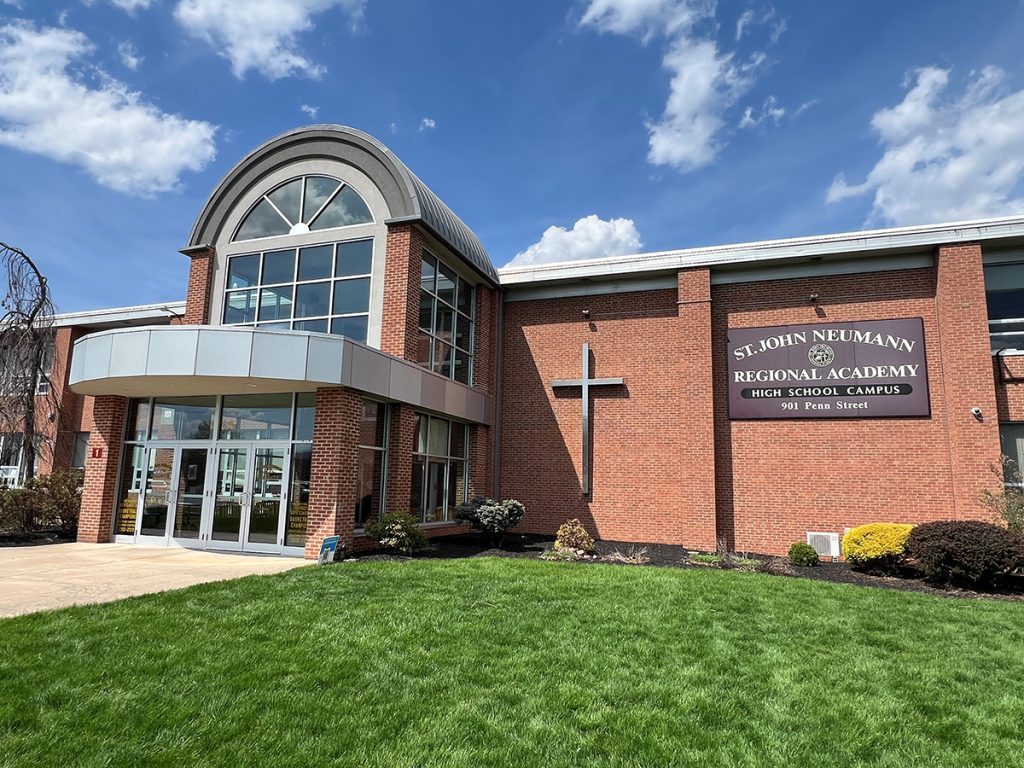
WILLIAMSPORT – As the current school year begins to wind down, administrators at Saint John Neumann Jr./Sr. High School are preparing for an exciting change next year.

Beginning in the 2026-2027 academic year, the Williamsport-based school will transition to an innovative four-day school week – an approach school leaders believe will expand opportunities for students while also strengthening academic success, personal growth, and faith formation.

Chris Miller, science teacher at Saint John Neumann Jr./Sr. High School, teaches a lesson on April 16, 2026. (Photo/Eric Deabill)

Under the new model, students in grades 6 through 12 will attend classes Monday through Thursday, with extended school days to ensure they exceed instructional requirements set by the Commonwealth of Pennsylvania.

Fridays, although not required attendance days, will be anything but idle. Fridays are now being reimagined as a time for enrichment.

“We are going to be moving to a four-day innovative learning model, with the fifth day being reserved for extension activities and different opportunities for our students,” principal Alisia McNamee said. “Fridays are going to be fantastic.”

YEARS IN THE MAKING

The decision to change the traditional 5-day school week follows several years of careful research, planning, and consultation.

Drawing from data received from the Strategic Growth Plan for the Diocese of Scranton Catholic School System which was completed last year, school administrators examined ways to enhance the experience of students while remaining rooted in academic excellence.

“We had the opportunity to go visit a school that has already implemented this model and used that as a blueprint,” McNamee explained, referring to Bishop McCort High School, which is in Johnstown. “We spent a lot of time talking with them, visiting them, and just doing our homework to see how we could implement that here at Saint John Neumann.”

Administrators also gathered feedback from students, families, and faculty – who overwhelmingly supported the change.

By shifting from measuring instructional time in days to hours, the school will not only meet but still exceed the 990 hours required annually at the secondary level.

NOT JUST A DAY OFF

While the idea of a four-day week may initially sound like a reduction, Diocesan leaders are quick to emphasize the new innovative learning model provides much more flexibility.

“Students will be able to take advantage of using Fridays to either get extra tutoring or explore things beyond the curriculum that we right now wouldn’t have the opportunity to do,” Kristen Donohue, Superintendent of Catholic Schools, said.

Students will still have the option to come to Saint John Neumann Jr./Sr. High School on Fridays. In addition to having the opportunity for one-on-one academic support, Donohue also sees the opportunity for college visits, internships, field trips, and guest speakers. Partnerships with local businesses, universities and healthcare providers are also being explored, opening doors to real-world experiences.

“I think this model will attract students,” Donohue added. “It really is a game changer for our students and our families.”

FACULTY & STUDENTS EMBRACE POSSIBILITIES

Faculty members are already embracing the shift, seeing it as a chance to rethink how learning happens both inside and outside the classroom.

“We’re no longer just disseminators of information,” Dr. Chad Greevey, Assistant Principal/Curriculum Director, said. “We’re the ones who are helping facilitate the learning with students, helping to direct them in a way that they might not have thought about before, and opening up those doors and pathways.”

That flexibility is also resonating with students.

“I’m excited,” junior Maverick Dunkleberger said. “There are many different opportunities for us to succeed in other things, not just school, but internships and other experiences.”

Dunkleberger, who hopes to study mechanical engineering, sees the potential for hands-on learning on Fridays that connects directly to his future goals.

“I would like to get an internship with Textron to just learn more,” he explained.

Sophomore Haylee Meixel echoed that enthusiasm, especially as she begins to think about college.

“I think there are a lot of opportunities,” she said. “Being in National Honor Society, I can come in on Friday and tutor kids or use those days off to work.”

For Monica Frasca, a sophomore who commutes 50 minutes each way from Mifflinburg to school, the change offers both practical and personal benefits.

“Sometimes not coming in on Fridays would be great for gas and not having to sit in a car for two hours,” she said. “I would love to get to spend that time with my siblings at home.”

STRENGTHENING FAITH AND SERVICE

Beyond academics, the new schedule also opens the door for deeper engagement with faith and service – hallmarks of Catholic education.

Father Glenn McCreary, pastor of nearby Saint Boniface Parish, sees new possibilities for student involvement.

“We could use servers on Friday which is actually our most robust daily Mass,” he said. “We also have a lot of activities and programs going on. Kids could sort food that is going to the food pantry, or they could help with mailings as they go out.”

These possible Friday experiences, Father McCreary noted, would allow students to live out their faith in tangible ways while strengthening their connection to the Church.

While school leaders acknowledge there may be challenges in implementing the new learning model, the overall outlook is one of excitement.

“We are just brimming with excitement,” McNamee said. “We know there will be some hiccups along the way … but what we’re doing will be a game changer.”

Prospective students and families are welcome to learn more about the new innovative learning model by taking a tour of Saint John Neumann Jr./Sr. High School any weekday. You can contact the school directly at 570-323-9953. Additional information on Saint John Neumann Jr./Sr. High School is also available at sjnra.org.

EXETER – Students at Wyoming Area Catholic School recently stepped away from their normal routines to learn a lesson that may shape their digital decisions for years to come.

On Wednesday, April 29, 2026, a representative from the Pennsylvania Attorney General’s Office led several interactive presentations to help students better understand the opportunities – and dangers – of the digital world.

Dana Neely, Education & Outreach Specialist with the Pennsylvania Office of Attorney General, held a presentation called “IRL – Being Smart in the Digital World” for students at Wyoming Area Catholic School in Exeter on April 29, 2026. (Photo/Eric Deabill)

Dana Neely, a former teacher, held three different age-appropriate sessions to help students think critically about their digital footprint and the lasting impact of what they post online.

“The moment you post something, you’ve already lost control of it,” Neely told students in grades 5-8, noting that even deleted content can remain accessible or be shared through screenshots.

Students were quick to name the platforms they use – ranging from YouTube and TikTok to Snapchat and online gaming chats – and openly discussed both the benefits and risks of social media.

While the students recognized the value of social media for connection and entertainment, they also identified concerns such as cyberbullying, scams, and negative effects on mental health.

Using real-life examples, Neely emphasized that online behavior could have serious consequences, from damaged reputations to legal trouble. He encouraged students to take responsibility not only for what they share, but also how they respond to others – especially in situations involving bullying or threats.

For fifth-grade student Chloe Kelly, the message was clear.

“I thought that it was important to be careful with the internet because if you say one thing, it can ruin your entire reputation,” she said, adding that her parents help guide her online activity.

Seventh-grader Hannah Beekman said the presentation reinforced the importance of thinking before posting.

“I learned that it could be a very bad thing, what you post, so make sure you double check on what you post,” she said. “I do think about it and double check what I’m posting, and I make sure all the things I have are private for my friends and family.”

The presentation went beyond warnings, focusing also on forming habits rooted in character and good judgement – values that align closely with the mission of Catholic education.

Students were encouraged to pause and ask themselves key questions before posting things online: Is this a positive or accurate reflection of the person I am? Would I say this on TV or in front of my family? Could it be easily misunderstood? Am I posting out of anger?

As the presentations ended, Neely left the students with a simple but powerful reminder.

“It’s all about making good choices,” he said, “and helping your friends make good choices too.”

A graphic depicts the 2026 route of the National Eucharistic Pilgrimage, which begins May 24 in St. Augustine, Fla., and ends in Philadelphia July 5. (OSV News graphic/National Eucharistic Congress)

(OSV News) – Before the Declaration of Independence was boldly signed in 1776, before pilgrims feasted at what became popularly regarded as the “First Thanksgiving” in 1621, there was St. Augustine, Florida.

The coastal Florida city was founded in 1565 by Spanish Catholic explorer Pedro Menéndez de Avilés, is celebrated as the longest continually inhabited European-founded city in the U.S., and is home to the United States’ oldest continuously operating parish, the Cathedral Basilica of St. Augustine.

A file photo shows the historic chapel of the Shrine of Our Lady of La Leche at Mission Nombre de Dios in St. Augustine, Fla., with the statue of the nursing and watchful mother of Jesus. (OSV News photo/St. Augustine Catholic)

It is also the May 24 starting point for the 2026 National Eucharistic Pilgrimage, themed “One Nation Under God” in honor of America’s 250th year.

The pilgrimage begins on the historic grounds of America’s oldest Marian shrine: the National Shrine of Our Lady of La Leche at Mission Nombre de Dios, which Bishop Erik T. Pohlmeier of St. Augustine has described as “the oldest site of continuous Catholic presence in the United States.”

With its founding, St. Augustine became the site of an early Mass in what is now the United States, celebrated in 1565 to commemorate the landing of a Spanish explorer, his crew and Catholic clergy.

“As we focus this year on the Declaration of Independence and the 250th anniversary of that, St. Augustine helps us begin not with politics, but with worship,” said Jason Shanks, National Eucharistic Congress president. “And I think that’s critically important.”

Both the shrine and the mission, its caretakers say, “stand as living witnesses” not just to the founding of St. Augustine, but also to the practice of the Mass in the United States. The site roots its history in the landing of Spanish Admiral Pedro Menéndez de Avilés. In 1565, his crew sighted land on Aug. 28, the feast of St. Augustine, and Menéndez came ashore Sept. 8. The admiral claimed the land for Spain, “establishing the settlement that would become the first permanent European settlement in what is now the continental United States,” according to the shrine’s website.

Soon after landfall, the expedition’s chaplain, Father Francisco López de Mendoza Grajales, celebrated a Mass of thanksgiving.

The shrine and mission grounds, known as “The Sacred Acre,” still yield discoveries, said the shrine’s rector, Father Timothy Lindenfelser.

“We’re constantly doing archaeological excavations. Most recently, we found the foundations of the Franciscan church that was on the property. That was found with burials of Indigenous people around it, and then the kitchen that was connected to it,” he said. “Every time we do a renovation or do archaeological digs, we’re always finding new things.”

The mission and shrine’s website describes Father Francisco’s Mass as the “first Catholic Mass of Thanksgiving in what is now the United States, establishing the first parish and planting the roots of the Catholic faith in the New World.”

However, “we do not claim to be the first Catholic Mass in what is today the United States,” said Father Lindenfelser. “The first that’s documented would have been in Pensacola in 1559. The Spanish established a settlement there, so we know there were priests and Mass was celebrated. But the settlement didn’t last.”

Kathleen Bagg, the Diocese of St. Augustine’s communications director, elaborated, telling OSV News, “What makes St. Augustine historically significant is that the Sept. 8, 1565, Mass of Thanksgiving was connected to the founding of the first permanent European settlement in what is now the continental United States, and to a Catholic community whose presence has continued into the present day.”

“The phrase ‘first Catholic Mass of Thanksgiving in what is now the United States’ is intended as a historical distinction connected to the founding of St. Augustine, rather than a claim that no earlier Masses had ever been celebrated elsewhere in territories that later became part of the United States,” she said.

If the wording seems intentionally careful, it is because there is some historical wrestling over the location of the first Mass celebrated in what would become the United States of America.

“There are a whole series of Spanish expeditions into Florida and elsewhere in the Southeast, long before Pensacola was established in 1559,” said J. Michael Francis, a history professor and chair of Florida studies at the University of South Florida.

He noted expeditions led by Juan Ponce de León — the first of which made landfall in 1513, probably south of Cape Canaveral — as well as subsequent expeditions, and the settlement of San Miguel de Guadalupe.

“It hasn’t been located archaeologically,” Francis told OSV News, “but it was likely somewhere in present-day South Carolina in 1526. That settlement lasted for less than one year — but assuredly there were many Masses said at San Miguel. Then you have the 1539 Hernando de Soto expedition, and there were likely dozens — if not hundreds — of Masses said between 1539 and 1543 during the course of that expedition.

“So,” he emphasized, “this is where it gets really tricky.”

The 1565 Mass at St. Augustine, held on the feast of the Nativity of Mary, “is often attributed to an account written by the priest” — Father Francisco López de Mendoza Grajales — “who allegedly said that Mass. But he never says that in his account. What he says is that on Sept. 8, 1565 — when Menéndez, the founder of St. Augustine, comes ashore — they greet him singing the ‘Te Deum laudamus,'” a hymn of rejoicing.

Father López, Francis continued, “said Menéndez — and all of the others with him — approached him on their knees, and they kissed the cross. … But he never specifically says, ‘I said Mass.’ He says there were ‘other ceremonies.’ There’s another account — that has been attributed to Pedro Menéndez de Avilés’ brother-in-law — in which he says that on that day, Menéndez ordered that a solemn Mass be said.

“So what often happens with these kind of stories is that different sources get conflated,” Francis stressed.

Bagg pointed out what she described as another “important historical nuance.”

“While St. Augustine remained continuously inhabited as a city, Catholic parish life was interrupted during the British period (1763–1784), when Spanish clergy departed and public Catholic worship ceased until the arrival of the Minorcans and Father Pedro Camps in 1777,” she told OSV News. “Even with that interruption in sacramental life, the broader Catholic presence associated with the founding of St. Augustine and Mission Nombre de Dios remains foundational in American Catholic history.”

Ultimately, the St. Augustine site remains a place of witness. When the tourist trolleys stop at the National Shrine of Our Lady of La Leche at Mission Nombre de Dios, Father Lindenfelser says visitors often find themselves deeply affected.

“Many people have come back to the faith,” he said. “Some people have for the very first time heard the message of the Gospel, just because they were sitting there — and one of the chaplains or one of the staff, we come up and talk to them,” Father Lindenfelser said.

“So, it’s still today a great place of evangelization,” he added, “by just being present to those who come.”