

DRUMS – After 17 years of marriage, Phil and Sue Milazzo both began to realize something was missing. Between work, family life and children, both started to realize that they were unhappy.

“It was a culmination of little things that built up,” Phil Milazzo said.

That unhappiness led to Phil’s poor choice of becoming emotionally and physically involved with another woman. It seemed like the couple, who married on Long Island at the age of 19, was headed for separation and divorce.

“It was very shocking for me when I heard that there was someone else,” Sue Milazzo said. “I ran in circles trying to find something to help us, to try and turn things around, trying to make some sense of what was happening and try to work on our marriage. I had no help at all. No matter where I went, people were helping me get divorced, no one was helping me stay married!”

That is when the Milazzo’s discovered Retrouvaille.

Retrouvaille (pronounced Retro-vi) is a marriage program for couples facing challenges in their relationship. The program is peer-facilitated by other couples that have gone through difficult times in their own marriages. Retrouvaille is Christian-based, and Catholic in origin, but welcomes couples of all faiths as well as non-religious couples.

“It is basically for people who are suffering a crisis in their marriage, whether they are in the middle of the crisis or they may even be separated or divorced,” Phil said.

The Retrouvaille program is broken down into three phases.

The first phase involves a weekend retreat where three presenting couples share the breakdown of their own personal marriage stories and teach tools they have learned to improve communication.

The second phase of the program includes six follow-up sessions which help the couples in healing and rebuilding a new foundation based on love, respect and communication.

The third phase consists of ongoing monthly small group meetings, called CORE (Continuing Our Retrouvaille Experience), to keep marriages on track.

Overall, the Retrouvaille experience is focused on improving a couple’s communication through the sharing of feelings.

“Feelings are a large part of the program because feelings cannot be judged as right or wrong,” Phil said.

While several couples attend a weekend retreat at the same time, there is no large group sharing in Retrouvaille, which puts many people at ease.

Privacy is also a priority.

“There is no group sharing unless you want to,” Phil added. “No one is ever forced to say anything about their relationship. You can go through the entire weekend and not even say why you were there!”

Sue Milazzo is very blunt about the impact Retrouvaille has had on her marriage.

“We would not be sitting here today together if it wasn’t for Retrouvaille,” she admitted.

The program left such an impact on the couple that they have now spent more than three decades presenting it to other couples in need of assistance.

“We’ve been gifted to see people get back together after being divorced,” Sue said.

After moving to Luzerne County several years ago, Phil and Sue Milazzo are now working to bring the Retrouvaille program back to the Diocese of Scranton in coordination with the Diocesan Office for Parish Life.

A Retrouvaille Weekend has been scheduled for Aug. 19-21 at the Townplace Suites in Moosic. In addition to explaining the program and looking for couples that might benefit, Phil and Sue are also in need of help to get everything off the ground.

“We need people to do prayer letters, people to do hosting, people to just get supplies and get set-up for the weekend,” Sue said.

Over the last 37 years, the Milazzo’s have presented a total of 94 Retrouvaille weekend retreats. With an average of 20 couples attending each one, they’ve already helped roughly 2,000 people improve their marriages. They want to keep going.

“We’ve heard the phrase that it’s the best kept secret in the Catholic Church and I don’t know why that is!” Phil joked.

To learn more about attending the Retrouvaille weekend in August, or to learn more about helping to bring this weekend to life, please contact: Phil & Sue Milazzo, philmilazzo2@gmail.com or call (631) 338-5413. Additional information is also available by contacting Jen Housel, Director for Community and Family Development in the Diocesan Office for Parish Life, jhousel@dioceseofscranton.org, (570) 207-2213, x1104.
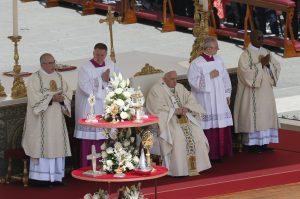

Pope Francis celebrates Mass for the canonization of 10 new saints in St. Peter’s Square at the Vatican May 15, 2022. Five of the new saints are from Italy, three from France, one from India and one from the Netherlands. (CNS photo/Paul Haring)

VATICAN CITY (CNS) – The lives of the saints prove that holiness is not an unreachable goal accomplished by a select few but comes from acknowledging and sharing God’s love, Pope Francis said.

“Our Christian lives begin not with doctrine and good works, but with the amazement born of realizing that we are loved, prior to any response on our part,” the pope said in his homily during the canonization Mass in which he declared 10 men and women as saints of the Catholic Church.

“At times, by overemphasizing our efforts to do good works, we have created an ideal of holiness excessively based on ourselves, our personal heroics, our capacity for renunciation, our readiness for self-sacrifice in achieving a reward. In this way, we have turned holiness into an unattainable goal,” he said.

An estimated 45,000 pilgrims from around the world gathered in St. Peter’s Square at the beginning of the canonization Mass, and tens of thousands more arrived in time for the recitation of the “Regina Coeli” prayer afterward, the Vatican said.

Carmelite Father Michael Driscoll, who lives in Boca Raton, Florida, was among the pilgrims who arrived early for the canonization Mass, which he said he has “been waiting for for 18 years” since his miraculous healing from advanced, metastatic melanoma. He had prayed for St. Titus Brandsma’s intercession, and his healing was accepted as the miracle needed for the Dutch Carmelite’s canonization.

Father Driscoll told Catholic News Service May 13 he was “very anxious and thrilled” for the canonization of St. Brandsma, who died in 1942 at the Dachau concentration camp after he “used his talents as a teacher, as a publicist and as a writer” to fight Nazi ideology.

“He fought with his mouth in the pulpit, he fought with his pen and typewriter way before the internet came along. He used all that was available at that time and rallied Holland,” Father Driscoll told CNS.

In his homily, the pope reflected on the Sunday Gospel reading from St. John in which Jesus calls on his disciples to love one another “as I have loved you.”

Christ’s call, he said, should be “the core of our own faith,” a faith that recognizes that “our abilities and our merits are not the central thing, but rather the unconditional, free and unmerited love of God.”

“Being disciples of Jesus and advancing on the path of holiness means first and foremost letting ourselves be transfigured by the power of God’s love. Let us never forget the primacy of God over self, of the Spirit over the flesh, of grace over works,” the pope said.

Jesus’ call to love one another, he continued, is not solely a call to imitate his love for humanity, but a reminder that Christians “are able to love only because he has loved us, because he pours into our hearts his own Spirit, the Spirit of holiness, love that heals and transforms.”

To live one’s life according to that love, the pope said Christians must be willing to serve others, which clears one’s soul from “the poison of greed and competitiveness” and fights “the cancer of indifference and the woodworm of self-referentiality.”

Giving one’s life, he said, is “more than simply offering something of ours to others,” but rather it is a way of “surmounting our selfishness in order to make our lives a gift.”

Pope Francis said that the 10 new saints exemplified the Christian call “to serve the Gospel and our brothers and sisters, to offer our lives without expecting anything in return, or any worldly glory.”

“They discovered an incomparable joy, and they became brilliant reflections of the Lord of history,” the pope said. “May we strive to do the same, for each of us is called to holiness, to a form of holiness all our own.”

The new saints are:

– Devasahayam Pillai, an Indian layman born in 1712 and martyred in 1752.

– César de Bus, the French founder of the Fathers of Christian Doctrine, who was born in 1544 and died in 1607.

– Luigi Maria Palazzolo, Italian founder of the Congregation of the Sisters of the Poor, who lived 1827-1886.

– Giustino Maria Russolillo, Italian founder of the Society of Divine Vocations for men and the Vocationist Sisters, 1891-1955.

– Charles de Foucauld, French priest and hermit, born in 1858 and killed in 1916.

– Anna Maria Rubatto, Italian founder of the order now known as the Capuchin Sisters of Mother Rubatto, who lived 1844-1904.

– Maria Domenica Mantovani, co-founder and first superior general of the Little Sisters of the Holy Family, born in 1862 and died in 1934.

– Titus Brandsma, Dutch priest and journalist, who was born in 1881 and martyred in 1942.

– Carolina Santocanale, Italian founder of the Congregation of the Capuchin Sisters of the Immaculate of Lourdes, who lived 1852-1923.

– Marie Rivier, French founder of the Sisters of the Presentation of Mary. She was born in 1768 and died in 1838.

The U.S. Capitol is seen in Washington in this undated photo. The Women’s Health Protection Act failed to reach the votes needed in the Senate May 11, 2022, to cut off debate on the bill and proceed to a vote on the measure itself. All Republicans and Sen. Joe Manchin, D-W.Va., opposed the bill. (CNS photo/Tyler Orsburn)

SCRANTON (May 12, 2022) – The Most Reverend Joseph C. Bambera, Bishop of Scranton, issued the following statement on the U.S. Senate vote taken May 11, 2022, on the Women’s Health Protection Act, which failed with a final vote of 49-51:


“Today, I express my deep disappointment in the U.S. Senate’s attempt to advance the cause of a proposed law that would threaten the lives of countless unborn children. Senator Pat Toomey (R-Pa.) voted against the measure and Senator Bob Casey (D-Pa.) voted for the legislation.  

“It is particularly distressing that Senator Casey chose to support the most radical, pro-abortion bill ever before Congress. I urge him in the strongest possible terms to take efforts to protect the rights of the unborn. 

“The deceptively titled ‘Women’s Health Protection Act,’ (S.4132) would impose abortion on demand nationwide at any stage of pregnancy through federal statute and eliminate pro-life laws at every level of government – including parental notification of scheduled abortions for young women under the age of 18, informed consent, and health and safety protections specific to abortion facilities. 

“If adopted, the legislation would compel all Americans to support abortions performed domestically and internationally with their tax dollars. It would also likely force health care providers and professionals to perform, assist in, and/or refer for abortion against their deeply held religious beliefs and rights of conscience. Finally, it would force employers and insurers to cover or pay for abortions and abortifacient drugs in violation of their deeply held religious beliefs and rights of conscience. 

“Today, I reaffirm the stance that all human life deserves respect, protection, and dignity from conception to natural death. In addition to defending the rights of the unborn, that means providing for the needs of the poor, the elderly, the disabled, and the most vulnerable of our brothers and sisters.

“I invite all of the faithful of the Diocese of Scranton to join Catholics around the country in fasting and praying the Rosary on Friday, May 13, the Memorial of Our Lady of Fatima.”

The Most Reverend Joseph C. Bambera, Bishop of Scranton, served as principal celebrant and homilist for the annual Mother’s Day Adoption Mass at the Cathedral of Saint Peter on May 8. (Photos/Eric Deabill)

SCRANTON – The beauty and importance of adoption once again became the focal point of the Diocese of Scranton’s annual Mother’s Day Mass – thanks to dozens of families who attended the liturgy with their adopted children.

The Mass, celebrated May 8 at the Cathedral of Saint Peter, brought together dozens of families and their adopted children.

Many, like Karen Trently of Throop, were joyful in discussing their adoption stories following Mass.

“It will almost be nine years in July that we got the call about Addison. My husband and I tried about ten years to get pregnant and unfortunately it didn’t happen for us,” Trently explained.

That is when the couple decided to adopt.

“The day that we got the call about Addison was one of the happiest days of our lives. Every day with her is a blessing and she really completed our family,” she added.

The Trently family makes it an annual tradition to attend the Mother’s Day Adoption Mass at the Cathedral.

“She didn’t grow inside me but she grew in our hearts,” Trently said. “She knows about her adoption and we thank her mother for being so brave and putting her up for adoption.”

This was the first year Dan and Sarah Wilson attended the Mother’s Day Adoption Mass. The Milford couple has an eight-year-old son, Luke, and recently adopted their two-year-old son, Jude.

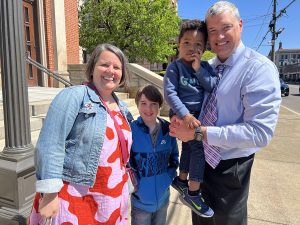
Dan and Sarah Wilson, along with their children, Luke, 8, and Jude, 2, attended the Mother’s Day Adoption Mass for the first time. Jude recently joined the Wilson family through the adoption process.

“We knew our family wasn’t complete with Luke and we knew that he needed to have a sibling so we went through the adoption process and adopted Jude. He is from Atlanta, Georgia. We have a completely open adoption with his birth family and it is the most happy and joyous relationship in our life and our family is complete,” Sarah Wilson said.

“He is an absolute miracle. Our lives are so much richer, I don’t know how we existed without him,” Dan Wilson added. “Luke is amazing as well but Jude really completes our whole family.”

When asked to describe his thoughts on having a brother, Luke responded it was “probably the happiest time of my life.”

The Most Reverend Joseph C. Bambera, Bishop of Scranton, was principal celebrant and homilist for the Mother’s Day Adoption Mass. During the liturgy, the bishop not only acknowledged adoptive and foster mothers, but all mothers, grandmothers and godmothers.

“For all of the commercialization and hype that can cause us at times to lose touch with the heart of its real meaning, doesn’t this day cause us to reflect upon the essence of the gospel message for the Fourth Sunday of Easter, Good Shepherd Sunday?” the bishop asked. “Selfless love, forgiveness, unconditional acceptance and hope are all qualities that a mother seeks to impact to her child whom she knows and loves so well.”
Mothers, the bishop added, remind us that we are all given the power and responsibility to become vehicles for God’s presence in the world.

“May we especially give thanks for those women who have nurtured and cared for us, their children, and have taught us that it is possible to love as Jesus, the Good Shepherd,” Bishop Bambera noted.

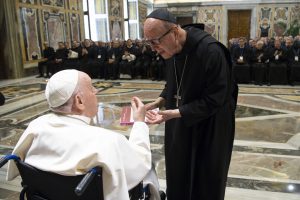
Pope Francis talks with Abbot Gregory Polan, leader of the confederation of Benedictine monasteries, during an audience with students and professors of Rome’s Pontifical Institute of Liturgy at St. Anselm, at the Vatican May 7, 2022. The pope said that the celebration of the liturgy and the study of it should lead to greater unity in the church, not division and squabbles. (CNS photo/Vatican Media)

VATICAN CITY (CNS) – The study and celebration of the liturgy should lead to a sense of awe before God, a commitment to mission and a growing unity within the church, not tensions and squabbles, Pope Francis said.

“When liturgical life is a bit of a banner of division, there is the odor of the devil, the deceiver. It is not possible to worship God and at the same time make the liturgy a battlefield,” the pope said May 7 during a meeting with students and professors from the Pontifical Institute of Liturgy at St. Anselm in Rome.

The papal audience marked the conclusion of a celebration of the 60th anniversary of the Benedictine-run institute, which was founded after the Second Vatican Council and its reform of the liturgy.

Pope Francis said the institute responded to “the growing need of the people of God to live and participate more intensely in the liturgical life of the church” by understanding it and experiencing “its mystery with an ever-new sense of wonder.”

“One does not possess the liturgy,” he said. Rather, the liturgy is lived and celebrated.

However, the pope said, people must be aware of “the temptation of liturgical formalism: to focus on forms, formalities rather than reality, as we see today in those movements that try to go backwards and deny the Second Vatican Council. Then the celebration is recitation, it is something without life, without joy.”

The teaching of every church council has taken time to be accepted fully, he said, and it is no different with Vatican II, especially with its reform of the liturgy.

He told the students and professors that he remembers as a youngster how people were so upset — “they rent their garments” — by reforms that began even before the council, such as Pope XII ruling that drinking water did not violate the required fast before Mass or allowing people to fulfill their Sunday Mass obligation by attending a Saturday evening Mass or the restoration of the Easter vigil on Saturday night.

“All of these things scandalized closed-minded people,” he said, and “it still happens today. Indeed, those with closed mindsets use liturgical patterns to defend their own point of view. Using the liturgy: this is the drama we are experiencing in ecclesial groups that are distancing themselves from the church, questioning the council (and) the authority of the bishops” even as they claim “to preserve tradition.”

Celebrating the liturgy must increase communion within the church and unity with others, he said, because “the liturgical life opens us to each other, to those closest and furthest from the church, in our common belonging to Christ.”

“Giving glory to God in the liturgy finds its counterpart in love of neighbor, in the commitment to live as brothers and sisters in daily life, in the community in which I find myself, with its merits and its limitations,” Pope Francis said.

And, he said, every Mass or liturgy ends with sending members of the congregation out on mission.

“What we live and celebrate leads us to go out to meet others, to meet the world around us, to meet the joys and needs of so many people who perhaps live without knowing the gift of God,” he said. “A genuine liturgical life, especially the Eucharist, always impels us to charity, which is above all openness and attention to others.”

VATICAN CITY (CNS) – Pope Francis said he wants LGBT Catholics to know that God is a father who “does not disown any of his children.”

The pope’s comment was among the short answers to three questions posed in a letter by Jesuit Father James Martin, editor at large of America magazine and a driving force behind its new website, outreach.faith, which provides news and resources for LGBT Catholics, their families and the people who minister with them.

Pope Francis’ letter, in Spanish, is dated May 8; it was posted on Outreach the next day. And Vatican Media also published a translation in Italian.

Father Martin asked the pope, “What do you say to an LGBT Catholic who has experienced rejection from the church?”

“I would have them recognize it not as the ‘rejection of the church,’ but instead ‘of people in the church,'” the pope responded.

“The church is mother and calls together all of her children,” he continued. “Take for example the parable of those invited to the feast: ‘the just, the sinners, the rich and the poor, etc.'”

A church that is “selective,” or makes some pretext about who is “pure,” he said, “is not the Holy Mother Church, but rather a sect.”

Asked what the most important thing LGBT people should know about God, Pope Francis responded, “God is Father and he does not disown any of his children. And ‘the style’ of God is ‘closeness, mercy and tenderness.’ Along this path you will find God.”

Father Martin also asked the pope what he would like LGBT people to know about the church, to which the pope responded that they should read the Acts of the Apostles. “There they will find the image of the living church.”

This is a portrait of Pauline Jaricot. In 1822, the young and rich French woman founded the Society for the Propagation of the Faith. (CNS photo/courtesy Pontifical Mission Societies in the United States)

WASHINGTON (CNS) – In 1822, a young and rich French woman, Pauline Jaricot, founded the Society for the Propagation of the Faith.

In 2022, this international association that coordinates assistance for Catholic missionary priests, brothers, and nuns in mission areas, is still going strong and renewed attention has been given to its founder, who will be beatified May 22.

Born in Lyon, France, in 1799, Jaricot was the youngest of seven children. At age 17, while recuperating from a serious fall, her mother died. Jaricot then led a life of intense prayer, and on Christmas 1816, took a vow of perpetual virginity.

Jaricot first founded an association for pious servant girls, the Repairers of the Sacred Heart of Jesus Christ. While her brother, Phileas, was studying to be a missionary priest, she felt an urge to help the missionary cause. So, in 1822, with the help of workers at the family’s silk factory, she established the Society for the Propagation of the Faith.

She encouraged each participant to invite 10 other people to pray and make contributions which was dubbed the “circle of 10.”

“Pauline had a vision of two lamps. One lamp was empty and the other lamp was full and filling up the other lamp,” said Monica Yehle, chief of staff for the Pontifical Mission Societies in the United States. “She saw the empty lamp as France after the revolution.” She wanted to rebuild the strength of the church in France just a few decades after the French Revolution.

“She wanted to do something, right? So she sent to the circles of 10 a sous — equivalent to a penny — for the work of the church,” Yehle said.

In 1826, while fostering the growth of the society supporting missionary work, Jaricot  also founded the Association of the Living Rosary. Instead of organizing by tens, she assembled groups of 15 — one for each decades of three “mysteries” of the rosary at that time. By 1832, Pope Gregory XVI gave canonical status to the latter organization.

In 1835, Jaricot became severely ill again, and while heading toward a pilgrimage in Italy, she was healed. She attributed the cure to St. Philomena.

In 1845, she set out to practice Christian social reform by buying a blast furnace plant, with workers and their families living in an adjacent building, with a school and chapel nearby. She left the management to people who defrauded her and left her virtually penniless. She declared bankruptcy but preached forgiveness to those who had bilked her. Jaricot died destitute in 1862.

But what she started bore many fruits.

The United States, which got all of $6 from the society in its first contribution, now accounts for 25% of all donations to its current work. By 1908, the church in the United States had grown so vigorous that it was decided that it was no longer missionary territory.

The last U.S. diocese still receiving funds from the society is the Diocese of Fairbanks, Alaska — and this is the final year of society contributions, according to Father Kieran Harrington, director of the Pontifical Mission Societies of the United States.

In May 3, 1922, a century after its founding, Pope Pius XI declared the Society for the Propagation of the Faith “pontifical.” There are three international groups with the “pontifical” designation: the Missionary Childhood Association, the Society of St. Peter Apostle, and the Missionary Union. The first two were also founded in France and raise funds for the church.

Since 1935, Jaricot’s remains are in St. Nizier Church in Lyon.

On Feb. 25, 1963, a century after her death, St. John XXIII declared Jaricot venerable.

In 1995, during the worst of the Rwandan Hutu-Tutsi civil war, a parish church in Rwanda gave $81 to the World Mission Sunday collection, which is held on the next-to-last Sunday in October.

In November 1997 — the 175th anniversary of the Society for the Propagation of the Faith, during a Mass in conjunction with the U.S. bishops’ annual fall meeting, Auxiliary Bishop John J. McCormack of New York praised the work of Jaricot, saying her work is still in need today.

“We know that God, in a way known to him, helps those to be saved who, through no fault of their own, do not hear the Gospel and see it lived,” Bishop McCormack said. “But will God help us if we neglect to do all that we can to make it possible for them to hear and to see the truth, the truth who is Jesus Christ?”

Then there is the matter of the miracle.

Mayline Tran had been in painful agony for two years. But her intercession with Jaricot resulted in what she describes as a miraculous recovery in 2012. Her doctor, stunned by the reversal of her condition, was dumbstruck to learn she was going to middle school. The girl’s brain waves, a jumble in the wake of the accident that nearly killed her, were once again normal.

The file was presented he case to the archbishop of Lyon in late 2017. On May 26, 2020, Pope Francis authorized the Congregation for the Causes of Saints to promulgate a decree recognizing a miracle attributed to Jaricot’s intercession.

The May 22 beatification will be in Lyon, with Filipino Cardinal Luis Antonio Tagle presiding on the pope’s behalf.

To learn more about Pauline Jaricot, the documentary “Heart of a Missionary: The Story of Pauline Jaricot” can be seen at https://blessedpauline.org/

An “EWTN Live” episode about Pauline Jaricot –that starts at about the 8-minite mark — can be seen at https://www.youtube.com/watch?v=8yZOoLU-dUU

The story of the miracle linked to her intercession can be found at https://3415701.fs1.hubspotusercontent-na1.net/hubfs/3415701/The-true-story-of-a-miracle.pdf

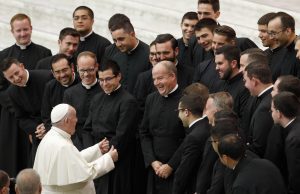
Pope Francis greets seminarians and the rector from the Pontifical North American College during his general audience in the Paul VI hall at the Vatican in this Sept. 29, 2021. In his message for the World Day of Prayer for Vocations, the pope said that priests and laity should work together to evangelize. (CNS photo/Paul Haring)

VATICAN CITY (CNS) – The Christian vocation is for all members of the church to work together and show that one human family united in love is not a utopia but is the reason God created humanity, Pope Francis said.

“When we speak of ‘vocation,’ then, it is not just about choosing this or that way of life, devoting one’s life to a certain ministry or being attracted by the charism of a religious family, movement or ecclesial community,” he wrote in his message for the 2022 World Day of Prayer for Vocations.

“It is about making God’s dream come true, the great vision of fraternity that Jesus cherished when he prayed to the Father ‘that they may all be one,'” he wrote.

The day of prayer will be observed May 8 at the Vatican and in many dioceses around the world.

The message, released at the Vatican May 5, was dedicated to the theme, “Called to build the human family,” and it looked at the meaning of “vocation” within the context of a synodal church, that is, “a church that listens to God and to the world.”

In his message, the pope wrote, “We know that the church exists to evangelize, to go forth and to sow the seed of the Gospel in history. This mission can only be carried out if all areas of pastoral activity work together and, even more importantly, involve all the Lord’s disciples.”

“We must beware of the mentality that would separate priests and laity, considering the former as protagonists and the latter as executors,” he said, and instead “together carry forward the Christian mission as the one people of God, laity and pastors.”

All members of the church are called: to be protagonists together in the church’s mission as “an evangelizing community”; to be guardians of one another and of creation; and to build a fraternal world, he wrote.

“In a word, we are called to become a single family in the marvelous common home of creation, in the reconciled diversity of its elements,” the pope wrote.

Everything is rooted in welcoming and responding to God’s loving gaze, he wrote. “Our lives change when we welcome this gaze. Everything becomes a vocational dialogue between ourselves and the Lord, but also between ourselves and others.”

This dialogue allows each Christian to become “ever more who we are,” meaning, for those ordained in the priesthood, to become ever more “instruments of Christ’s grace and mercy,” for consecrated men and women to become ever more “the praise of God and the prophecy of a new humanity,” and for married couples “to be mutual gift and givers and teachers of life.”

Christians receive a vocation as individuals and “we are also called together” like “the tiles of a mosaic,” he wrote. “Each is lovely in itself, but only when they are put together do they form a picture.”

“This is the mystery of the church: a celebration of differences, a sign and instrument of all that humanity is called to be,” he wrote.

For that to happen, Pope Francis said, “the church must become increasingly synodal: capable of walking together, united in harmonious diversity, where everyone can actively participate and where everyone has something to contribute.”

Therefore, with each vocation striving to make “God’s dream” of human fraternity come true, each vocation “contributes to a common objective: to celebrate among men and women that harmony of manifold gifts that can only be brought about by the Holy Spirit.”

The pope urged priests, consecrated men and women, and the lay faithful, “let us journey and work together in bearing witness to the truth that one great human family united in love is no utopian vision, but the very purpose for which God created us.”

Abortion demonstrators are seen outside the U.S. Supreme Court in Washington May 3, 2022, after the leak of a draft majority opinion written by Justice Samuel Alito preparing for a majority of the court to overturn the landmark Roe v. Wade abortion rights decision later this year. (CNS photo/Elizabeth Frantz, Reuters)

WASHINGTON (CNS) – Although many pro-life groups immediately reacted positively to the news that the majority of Supreme Court justices seem set to overturn the court’s Roe v. Wade decision, some tempered their reaction with a continued call for more advocacy while others kept a wait-and-see approach until the court issues its opinion in the weeks ahead.

Some Catholic bishops likewise kept their response in check, but acknowledged the work done on the grassroots level by pro-life activists.

For example, hours after the draft of the court’s opinion was published by Politico May 2, San Francisco Archbishop Salvatore J. Cordileone tweeted: “Tonight I am thinking of all the years of hard work by pro-life people of all faiths and none. Years and years of patient advocacy, help for unwed moms, political engagement and more.”

The next day, the Archdiocese of St. Paul and Minneapolis released a statement that Archbishop Bernard Hebda will comment when the Supreme Court releases its official statement. “No matter the court’s decision, the Catholic Church will continue to work toward building a culture of life and supporting women and their children,” the statement said.

Archbishop William E. Lori of Baltimore, chairman of the U.S. Conference of Catholic Bishops’ Committee on Pro-Life Activities, said in a May 4 statement that the leaked opinion draft “reminds us of the urgent need for prayer and action at this pivotal moment in our country.”

“As we await the court’s decision, we urge everyone to intensify their prayer and fasting that the final decision of the court will bring about the reversal of Roe and Casey,” he said, referring to the court’s 1992 decision that affirmed Roe.

“We hope and pray for a change in our laws and stand ready to help all pregnant women in need in each of our communities,” he added.

National Right to Life, an advocacy group that has long fought against abortion, similarly said it “agrees with the statement of Mississippi Attorney General Lynn Fitch, who said, ‘We will let the Supreme Court speak for itself and wait for the Court’s official opinion.'”

Other groups were not so cautious. Texas Right to Life said it was encouraging news that “Roe soon may be gone. Yet new attacks on life will emerge.”

In its May 2 statement, the group called its supporters to further action saying: “Already, abortion advocates are calling on Congress to ban states from passing pro-life laws.”

“If and when the court overturns Roe, the pro-life movement must defeat attacks such as these and build a culture that values preborn children and pregnant mothers.”

Kristan Hawkins, president of Students for Life of America, likened the potential overturning of Roe v. Wade as the beginning for the antiabortion movement.

The previous day, her group sent a letter to all the Republican members of Congress urging them to back a nationwide “heartbeat bill,” banning abortions at six weeks of pregnancy. Hawkins, and nine other antiabortion leaders, emphasized that the 15-week ban at stake in the Dobbs v. Jackson Women’s Health Organization case before the court did not go far enough.

“If we are not focusing on limiting early abortions, we are not really addressing the violence of abortion at all,” Hawkins wrote in the letter.

After the court’s draft decision was leaked, she told The Washington Post: “We are on the precipice of a whole new America.”

One thing many groups said they were not happy with was that the opinion was leaked to a news outlet.

Dennis Poust, executive director of the New York State Catholic Conference, said the leak was a breach of trust and “an attack on the integrity of the Judicial Branch of government.”

“When our highest court cannot operate free of political interference or intimidation, it serves as a stark example that nothing is sacred anymore. While we fervently pray for legal protections of unborn children, we will not dignify the goals of the leaker by commenting on the contents of the draft document.”

The California Catholic Conference said in a May 3 statement that the leak of the opinion draft “triggered the governor and California legislative leadership to announce its intent to create a California constitutional amendment to protect the right to abortion. This will destroy lives, families and significantly limit the ability of the Catholic Church in California to protect the unborn.”

The conference said this was moment for the church and California Catholics to “engage with their communities, actively and publicly oppose this amendment.”

Right to Life Michigan expressed “cautious optimism” about the leaked draft and said its mission won’t change if Roe is overturned.

“We’d have a complete abortion ban in our state, but there are a lot of different moving parts with different groups and with a governor who is trying to invalidate this law. Our focus would be on those efforts and making sure we are fighting against them and have as many people on our side fighting against them as well,” Anna Visser, director of communications and education for Right to Life Michigan, told Detroit Catholic.

She warned pro-life advocates not to celebrate too early, considering the official opinion hasn’t been released and the final version might not reflect the views of Justice Samuel Alito, who authored the draft opinion.

She also noted that the work of pro-life advocacy goes beyond abortion.

“As a pro-life organization, we have to protect the vulnerable, the elderly, the disabled, the unborn,” she said, adding that the focus is “on the marginalized and those discriminated against.”

Abortion demonstrators in Washington are seen outside the U.S. Supreme Court May 3, 2022, after the leak of a draft majority opinion written by Justice Samuel Alito preparing for a majority of the court to overturn the landmark Roe v. Wade abortion rights decision later this year. (CNS photo/Evelyn Hockstein, Reuters)

WASHINGTON (CNS) – The Supreme Court appears set to overturn its Roe v. Wade decision, which legalized abortion for nearly 50 years, according to a leaked initial draft of a court opinion obtained by Politico and published online the evening of May 2.

Just minutes after the leak was published, reactions were fast and furious on social media, and barricades were erected around the Supreme Court. Many people gathered at the court in protest and some, including students from The Catholic University of America, were there to pray the rosary.

The draft opinion, written by Justice Samuel Alito, said Roe “was egregiously wrong from the start” and that “Roe and Casey must be overruled.” Casey v. Planned Parenthood is the 1992 decision that affirmed Roe.

Alito’s opinion said the court’s 1973 Roe decision had exceptionally weak reasoning “and the decision has had damaging consequences. And far from bringing about a national settlement of the abortion issue, Roe and Casey have enflamed debate and deepened division,” he wrote.

He also said abortion policies should be determined on the state level.

Politico’s report says Alito’s opinion is supported by Justices Clarence Thomas, Neil Gorsuch, Brett Kavanaugh and Amy Coney Barrett and that Justices Stephen Breyer, Sonia Sotomayor and Elena Kagan were working on dissents. It was not clear how Chief Justice John Roberts planned to vote.

The 98-page draft, which includes a 31-page appendix of historical state abortion laws, is an opinion in Dobbs v. Jackson Women’s Health Organization – a case about Mississippi’s ban on abortions after 15 weeks of pregnancy with the potential to also overturn Roe.

The fact that the opinion was leaked also caused significant reaction, because this is unprecedented in the court’s recent history, especially with such a big case.

A May 3 statement by the Supreme Court verified that the draft opinion reported on “is authentic” but that it “does not represent a decision by the Court or the final position of any member on the issues in the case.”

Roberts, in his own statement, emphasized the significance of the leaked document, which he said was a “singular and egregious breach of that trust that is an affront to the Court and the community of public servants who work here.”

He also said that if this action was “intended to undermine the integrity of our operations, it will not succeed. The work of the Court will not be affected in any way.” He said he has directed the Marshal of the Court to launch an investigation into the source of the leak.

Politico acknowledged that “deliberations on controversial cases have in the past been fluid. Justices can and sometimes do change their votes as draft opinions circulate and major decisions can be subject to multiple drafts and vote-trading, sometimes until just days before a decision is unveiled.”

“The court’s holding will not be final until it is published, likely in the next two months,” it added.

But that does not stop the firestorm of speculation and discussion.

A tweet from scotusblog, which reports on the Supreme Court, said: “It’s impossible to overstate the earthquake this will cause inside the Court, in terms of the destruction of trust among the Justices and staff. This leak is the gravest, most unforgivable sin.”

Pro-life groups praised the court’s potential decision but some also questioned the motivation behind the leak and wondered if the court was being manipulated by this action.

A May 2 tweet by Jeanne Mancini, president of the March for Life Education and Defense Fund, said her organization would “not be providing comment on an official decision of #scotus possible leak until a decision is officially announced.”

“We also believe that given the leak the court should issue a ruling as soon as possible. This leak was meant to corrupt the process. It is heartbreaking that some abortion advocates will stoop to any level to intimidate the court no matter what the consequences,” she added.

“This leak is an act of desperation from rabid abortion supporters,” said Kristan Hawkins, president, Students for Life, in an email to Catholic News Service. She noted that although she didn’t know if rumors about ending Roe were accurate she stressed that “ending Roe is the right decision.”

Marjorie Dannenfelser, president of the Susan B. Anthony List, also expressed some skepticism but also praise for the potential decision.

“If the draft opinion made public tonight is the final opinion of the court, we wholeheartedly applaud the decision,” she said in a statement adding: “If Roe is indeed overturned, our job will be to build consensus for the strongest protections possible for unborn children and women in every legislature.”

Those on the other side of the issue were similarly taken aback by the leak but also by the potential impact of the decision if it ultimately echoes the draft opinion.

American Civil Liberties Union tweeted: “If the Supreme Court does indeed issue a majority opinion along the lines of the leaked draft authored by Justice Alito, the shift in the tectonic plates of abortion rights will be as significant as any opinion the Court has ever issued.”

And Planned Parenthood said in a May 2 tweet: “Let’s be clear: This is a draft opinion. It’s outrageous, it’s unprecedented, but it is not final.”

During oral arguments in this case last December, a majority of the justices indicate that they would uphold Mississippi’s abortion ban after 15 weeks of pregnancy, which was struck down by a federal District Court in Mississippi in 2018 and upheld a year later by the New Orleans-based U.S. Court of Appeals for the 5th Circuit.

A 15-week ban is not a “dramatic departure from viability,” Roberts said.

The point of viability — when a fetus is said to be able to survive on its own — was key to the discussion because the Supreme Court has consistently ruled that states cannot restrict abortion before 24 weeks or when a fetus is said to be able to survive on its own.

In the draft opinion, Alito said Roe’s viability distinction “makes no sense.”

If this draft is adopted by the court, it means a ruling in favor of the Mississippi abortion ban. If it goes further to overturn Roe, there would be stricter limits to abortion in parts of the U.S., particularly the South and Midwest, with several states set to immediately impose broad abortion bans.