SCRANTON – In less than one week an expected 1.5 million young Catholics will descend on the capital city of Portugal for World Youth Day 2023. Among them will be 21 pilgrims from the Diocese of Scranton.
World Youth Day 2023 is scheduled to take place in Lisbon, Aug. 1-6, and the motto for this year’s event is a passage from Luke’s Gospel: “Mary arose and went with haste.”
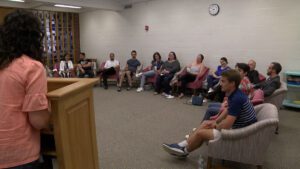
Diocesan pilgrims who will be attending World Youth Day 2023 gathered for a retreat on June 11 at the Diocesan Pastoral Center in Scranton.
As a part of their trip, those young people and chaperones in the Diocese of Scranton delegation will also visit the Shrine of Our Lady of Fatima.
“Our Diocesan delegation will visit the site of the apparitions and the miracle of Fatima. We’re also going to visit the Shrine of the Eucharistic Miracle of Santarem which is exciting and then we’re going to dive into the experiences of World Youth Day themselves,” Shannon Kowalski, Diocesan Director of Service and Mission, said.
Only six of the pilgrims from the Diocese of Scranton have attended World Youth Day before.
“It is certainly exciting for me because this will be my first time attending World Youth Day,” seminarian Jacob Mutchler said. “I’m very much interested and excited to visit Fatima. I think that it is going to be a very powerful experience. I think we can expect a very powerful experience having people from all parts of the world coming together to share their faith and worship the Lord and really grow in their relationship with Him.”
Maggie Guarnieri of Pittston, a parishioner of Saint Maria Goretti Parish in Laflin, will be traveling with her two sisters.
“The fact that we all get to do this together is going to bring us even closer than we already are so I’m really excited for that,” Guarnieri explained. “I’m very excited to be incredibly present along the way and almost unplug from reality and be fully immersed in this experience.”
Pope Francis is expected to have nine events with young people, including hearing their confessions and eating lunch with them. He will arrive in Lisbon Aug. 2 where he will be welcomed by Marcelo Rebelo de Sousa, president of Portugal and pray vespers with local bishops, priests, religious, seminarians and pastoral workers.
The highlight of the trip will come Aug. 6 when the pope will end his trip to Portugal by celebrating the closing Mass for World Youth Day along the Portuguese coast.
“I’m really excited to gather with so many young people from around the world and also just to see Pope Francis. I think he has such a calling for young people to get involved in the church,” Tommy Flynn, Director of Youth and Family Ministry at Saint John the Evangelist and Saint Joseph Marello Parishes in Pittston, stated.
Pope Francis has called World Youth Day an antidote against indifference, isolation and lethargy.
“This is a great opportunity for young people around the world to see that there are young people in the church and they’re not the church of the future but they’re the church of today,” Flynn added.
At 23, Flynn says he will be excited to take the energy and excitement he experiences and bring it back home.
“Even if we don’t experience Mass in the same language, it is still a Mass to everyone and we know the special things that happen during Mass,” Flynn said. “I’m just really excited to get to know some of the other pilgrims from across the diocese, across the world and deepen my faith a little bit.”
Kowalski, who has been planning the pilgrimage for several years, echoes those sentiments.
“There is just no other experience like it. There is no way you can go to World Youth Day and not come back a changed person. There are literally millions of people from all over the world – United States, Europe, Asia, Africa – all coming together for the same reason,” Kowalski explained. “They want to have an experience of faith rooted in the Catholic experience, to pray with our Holy Father, Pope Francis, to learn more about our faith and to take advantage of the Sacraments.”
Following their experiences at World Youth Day 2023, many of the Diocese of Scranton pilgrims will also visit Barcelona, Spain, to visit the Basilica de la Sagrada Familia before returning home to the United States.
Social
VATICAN CITY (CNS) – Young people today must be open to love and let themselves be led and accompanied by God in the face of life’s challenges, Pope Francis said.
In the second edition of the “Popecast,” produced by Vatican Media in Italian and released July 25, the pope responded to the stories of young people recorded ahead of World Youth Day in Lisbon, Portugal, scheduled for Aug. 1-6.
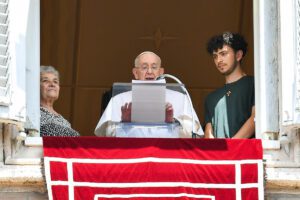
Pope Francis addresses visitors in St. Peter’s Square alongside a young person and his grandmother before praying the Angelus July 23, 2023. On World Day for Grandparents and the Elderly, the pope stressed the need for young people and the elderly to interact with each other. (CNS photo/Vatican Media)
The first episode of the Vatican Media’s podcast with Pope Francis was released in March, in which he looked back on the first 10 years of his pontificate.
The Dicastery for the Laity, Family and Life also released a podcast series meant to talk about how its work concretely impacts the lives of people in the church. Its first episode released July 23 focuses on grandparents and the elderly.
Meanwhile, the Popecast’s latest episode focused on marginalized youth, and one person the pope heard from was Giona — Jonah in Italian — a transgender, homosexual and disabled Catholic who described how his faith helped him accept his identity and body despite his disability.
“The Lord always walks with us, even if we are sinners he comes toward us to help us,” the pope said after hearing Giona’s story. “The Lord loves us as we are. This is God’s crazy love.”
Like the prophet Jonah, “people are often stubborn,” he said, “and that stubbornness closes us” to God’s love. Yet the pope urged Giona to “not surrender” and recalled that “God always caresses us” and “walks with us,” even if it is sometimes difficult to feel.
The pope then listened to two young men share how they resorted to crime and violence in response to their troubled backgrounds. Both had experienced run-ins with the law and were now involved with the Kayros Association, a Catholic organization supporting young people in need near Milan.
People make progress in life “with successes and mistakes,” the pope said, and “many times society is cruel to us because one mistake characterizes us for our whole life.”
“You were not alone on your journeys, not even when you made terrible mistakes; the Lord was there, ready to take you by the hand, ready to lift you up ” Pope Francis said. “It was he who created the circumstances in history to lift you both up.”
The pope also told them to not be afraid to dream, calling dreams “seeds of hope, seeds of progress, of strength, to go forward.”
“God is present in every stage of life,” Pope Francis said after hearing the experience of Arianna, a healthcare worker who suffers from bipolar disorder.
She described living on a “seesaw” between having suicidal thoughts and feelings of extreme joy. The pope noted that life’s ups and downs can become a “labyrinth” with no way out, the pope said.
“Always look ahead and don’t lose sight of the horizon, because the horizon is what leads you forward,” he said. “God is the horizon and God is with you accompanying you.”
Pope Francis urged Arianna not to lose a sense of “the adventure of life” or “fall into the labyrinths of our consciousness, which don’t save us in the end.” He also asked that she continue pursuing medical treatment for any psychological conditions she may have.
Valeria, who will accompany a group of young people traveling to World Youth Day, shared that the young people she knows want the church as an institution to be coherent with the message of the Gospel, and that she sees the synod on synodality as a key step toward that result.
“The church is church when it walks, the contrary is a religious sect closed within itself,” the pope said in response. “Each time the church has closed itself it has ended poorly, it has ended up being infertile.”
Pope Francis stressed the need for fostering “unity among diversity” in the church, which he said is achieved by living coherently with the Gospel. “Each person lives life differently, in their own way, but if it is coherent with the Gospel it’s okay.”
“Many times in the church there are fights among little groups, one against the other, but on the morning of Pentecost everyone spoke differently but understood each other in unity,” he said. When a difference becomes akin to a political party, “it kills unity.”
Speaking to Giuseppe, who said he spends most of his time playing video games, the pope said his virtual relationships to other gamers and content creators are “sterile.” Pope Francis warned him against “becoming bored with yourself” and living his life “without poetry,” before encouraging him to “open a window” and look toward a horizon in life to pursue.
Turning to all young people, Pope Francis urged them to attend World Youth Day, responding to those who may not feel like going by saying “it is worth it to take the risk.”
“In life, who doesn’t take risks doesn’t move forward,” he said.
The pope also responded to an audio message from 9-year-old Alessandro asking if there would ever be a “World Children’s Day.”
“It would be nice,” the pope said, “and we can ask grandparents to organize it. I will think about it and see how to do it.”
“Say hello to your grandparents for me,” Pope Francis told him.
Social
WASHINGTON (OSV News) – When Pope Francis arrives in Lisbon for World Youth Day 2023, there will be plenty of pilgrims from the U.S. ready to greet him – close to 29,000.
The U.S. Conference of Catholic Bishops announced July 24 that more than 28,600 individuals, most between the ages of 18 and 25, and over 60 U.S bishops will be on hand for the Aug. 1-6 gathering. While registration numbers have not yet been finalized (and in fact are rising, said the bishops’ conference), the U.S. is set to have one of the five largest delegations at WYD.
The logo for World Youth Day 2023 depicts a cross, rosary and a profile of Mary in the colors of the Portuguese flag. It was presented at the Vatican Oct. 16, 2020. The Vatican announced Pope Francis will be in Portugal Aug. 2-6 and would go to the Shrine of Our Lady of Fatima Aug. 5. (CNS photo/courtesy Fundação JMJ Lisboa 2023)
“Our country is very much looking forward to this pilgrimage,” said Bishop Robert E. Barron of Winona-Rochester, Minnesota, chairman of the U.S. Conference of Catholic Bishops’ Committee on Laity, Marriage, Family Life and Youth, which oversees the U.S. involvement in WYD. Bishop Barron, along with 60 other U.S. bishops, will be accompanying young people to Lisbon.
In a statement, Bishop Barron described WYD as “a wonderful occasion for young adults to have a significant encounter with Jesus Christ in the company of the universal Church.”
The event is “also a moment when the Holy Father and the Church’s leadership get an opportunity to listen to the young people present, teach and form them in the Gospel, and ultimately send them towards their vocation and mission in the world,” he said.
U.S. pilgrims will stay in parishes, campuses, homes and hotels around Lisbon during the WYD week, taking part in prayer, liturgies, daily catechesis, concerts, presentations, dialogue, service and networking with young adults from around the world.
More than 35 U.S. bishops will lead daily catechetical “Rise Up!” sessions.
U.S. pilgrims will gather Aug. 2 for an outdoor evening gathering organized by the USCCB in Lisbon’s Parque da Quinta das Conchas. Music and testimony by young adults will be followed by a keynote address from Bishop Barron, who will then lead a Holy Hour with Bishop Edward J. Burns of Dallas as part of the USCCB’s National Eucharistic Revival initiative.
Pope Francis will join the WYD pilgrims Aug. 3 for a welcome ceremony in the city center. He will preside at a Way of the Cross Aug. 4 and a prayer vigil Aug. 5, and then celebrate the WYD closing Mass Aug. 6, with an anticipated crowd of 1 million or more.
The USCCB’s Committee on Laity, Marriage, Family Life and Youth recently collaborated with WYD organizers in Lisbon and U.S.-based Oregon Catholic Press on the English version of the official WYD hymn, “Feel the Rush in the Air,” which was released earlier this month.
Inaugurated by St. John Paul II in 1986, WYD officially takes place every year as a “Global Celebration of Young People,” which is now celebrated on Christ the King Sunday. In addition, a major international event is held every 2 – 4 years in a different location around the world.
Past WYDs have taken place in Buenos Aires, Argentina (1987); Santiago de Compostela, Spain (1989); Czestochowa, Poland (1991); Denver (1993); Manila, Philippines (1995); Paris (1997); Rome (2000); Toronto (2002); Cologne, Germany (2005); Sydney (2008); Madrid (2011); Rio de Janeiro (2013); Krakow, Poland (2016); and Panama City (2019).
Social
A federal judge July 25 blocked the Biden administration’s rule permitting immigration authorities to deny asylum to migrants who arrive at the U.S.-Mexico border without first applying online or seeking asylum protections in a different country.
U.S. District Judge Jon Tigar of the Northern District of California blocked the rule, which President Joe Biden’s administration implemented in May, following the expiration of a Trump-era policy restricting migration during the COVID-19 pandemic.
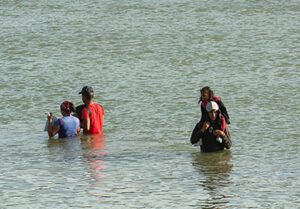
Asylum-seeking migrants walk in the Rio Grande river between the floating fence and the river bank as they look for an opening on a concertina wire fence to land on the U.S. soil in Eagle Pass, Texas, July 24, 2023. (OSV News photo/Go Nakamura, Reuters)
“The Rule – which has been in effect for two months – cannot remain in place,” Tigar wrote in his order. The order does not go into effect for two weeks, giving the Biden administration time to appeal.
Catholic immigration groups and the U.S. bishops have objected to the asylum ban, arguing it violates existing U.S. immigration law, and exposes those who may otherwise be eligible for asylum to additional danger.
Dylan Corbett, executive director of Hope Border Institute, told OSV News July 26 that the court “has made the right decision here – there is no legal basis for the Biden administration’s asylum ban.”
“It needlessly puts asylum seekers in danger and it outsources the challenges of immigration to countries less equipped to address them,” Corbett said. “Effective management of the border doesn’t need to come at the cost of the rights and dignity of asylum seekers and vulnerable migrants. The administration should pivot now by taking strong action to fully restore asylum at the border and make the moral argument to the country and Congress that we need immigration reform.”
White House Press Secretary Karine Jean-Pierre said during a July 25 briefing that “nothing has changed.”
“There is a stay (on the judge’s order), which means that our border enforcement plan remains in full effect,” she said. “The Department of Justice will appeal the decision and seek to extend the stay.”
Jean-Pierre said “our border enforcement plan works” and consists of “deterrence, diplomacy, and enforcement.”
“We have seen that plan working,” she said. “Unlawful border crossings have come down to the lowest that we have seen in the past two years.”
But Anna Marie Gallagher, executive director of the Catholic Legal Immigration Network, Inc., said in a statement that CLINIC welcomes “the decision by Judge Tigar, who indicated the asylum ban is arbitrary and capricious, and was issued without adequate opportunity for public comment.”
“As we have said before, the right to seek asylum through a full and fair process, with dignity and respect, is a bedrock rule of international and domestic law,” Gallagher said. “Any barriers to asylum that undermine the principles of U.S. law and Catholic social teaching with respect to migration, and fail to uphold due process, are contrary to the values we hold dear as a compassionate and just society.”
Social
(OSV News) – A recent analysis shows 25% of 40-year-olds in the U.S. have never been married – a record high – and may indicate “the closing of the American heart,” according to W. Bradford Wilcox, a sociologist at the University of Virginia and director of the National Marriage Project.
“More and more Americans are headed toward a kinless future, without either a spouse or children of their own,” Wilcox told OSV News. “This particular statistic … is just one more manifestation of the fact that fewer adults are putting a ring on it.”
A person is seen in a file photo reading a book alone while sitting along the Rock Creek Trail in Washington. A recent analysis shows the share of 40-year-olds in the U.S. who have never married has reached 25% — a record high — and flags a ministry need the church often struggles to meet. (OSV News phoro/Tom Brenner, Reuters)
The Pew Research Center published the statistic and related demographic analysis June 28 after examining 2021 U.S. Census Bureau data. Pew disaggregated the data by sex, race and education. It showed that more men (28%) than women (22%) had never married by 40; that more Blacks (46%) than Hispanics (27%), whites (20%) or Asians (17%) had never married by 40; and that more people with a high school education or less (33%) had never married by 40, contrasted to people with some college (26%) or a bachelor’s degree or higher (18%).
Cohabitation alone doesn’t explain the rise. According to Pew, most never married 40-to-44-year-olds in 2022 reported not living with a romantic partner — only 22% of them reported cohabitating.
In 1900, 16% of 40-year-olds had never been married, and over the century that share declined to 6% in 1980, when it began to rise again, reaching a milestone 20% in 2010 before jumping to 25% in 2021.
The statistics matter because of the relationship between marriage and happiness, Wilcox said. “In general, folks who are married are about twice as likely to be very happy with their lives compared to their unmarried peers,” he said. “Married folks tend to be more financially secure, less lonely (and) report more meaningful lives.”
The rising number of never-married 40-year-olds reflects the cultural emphasis on delaying or forgoing marriage in one’s 20s to focus instead on education, work or recreation, Wilcox said. However, he added, “I think it’s very unwise for 20-somethings to be kind of indifferent towards their family future,” which is the subject of his forthcoming book, “Get Married,” anticipated from HarperCollins in February 2024.
“Marriage and family are just enormously important for Americans today,” he said, “and yet there’s a kind of cultural ignorance out there about the value of marriage, vis-à-vis the other kinds of goals that tend to get more attention — goals like money, a good job, having enough time on the weekends or the evenings to do what you want to do. To have that freedom for fun things, but not recognizing that for most of us, having a spouse, having children, having eventually grandchildren, end up being a lot more important than the size of our bank account or the prestige or stimulation of our job.”
While the Pew analysis shows what Wilcox called a “crisis in marriage” is most salient for working class, poor and some minority Americans, Wilcox’s research also shows that it is also noteworthy among secular and progressive Americans, he said. Contributing to the crisis is the failure of young men to launch successfully into careers that make them attractive for marriage, and people adopting “a more individualistic view of life, who want to keep their options open,” he said.
“These trends are also concentrated among young adults who are not involved in religious communities and adults who are more progressive in their cultural orientation,” he said. “There’s both a class story that we can think about, as well as a cultural story that is playing out among young women, young men today.”
Religious adults are more likely to be dating and marrying, Wilcox said. And while that’s good news, he’s also seeing a rising number of adults, including Catholics, who are single and yet wish to be married.
“Because of the demographic trends and cultural trends unfolding in the country at large, we can expect, at least for the next decade or so,” he said, “that there are going to be a lot of young adults today, including in the church, who won’t find a spouse and who won’t have children.”
A June 2023 survey about marriage expectations among Millennials and Zoomers (Generation Z) who are in a relationship but not married found that “while the majority are hoping to tie the knot someday, many aren’t in a rush to do it.”
Commissioned by The Thriving Center Of Psychology, a mental health platform, the survey found that two in five of the young adults surveyed think marriage is an outdated tradition, but 83% expect to get married someday. However, 85% do not think marriage is necessary to have a fulfilled and committed relationship, and 73% feel it is “too expensive” to get married in the current economy.
Additionally, 17% are not planning to wed, with 72% in this group saying “they just aren’t interested in it.”
The U.S. Census Bureau data – and the underlying situation – flags a ministry need for singles the church often struggles to meet, said Anastasia Northrop, director of the National Catholic Singles Conference. Singles can feel ignored by typical parish ministries, especially if they no longer fit in the “young adult” category, she said.
Among single Catholics, Northrop, 46, sees men and women who are interested in marriage but haven’t found a spouse, and others who aren’t interested in marriage. She said key reasons Catholics aren’t marrying include making a career core to one’s identity, which also can make motherhood appear unfulfilling for women; a desire for one’s own comfort and protection from a broken heart; the availability of sexual intimacy outside of marriage; pervasive individualism; commodification of the person through the perception of endless or unrealistic choices for partners, exacerbated by dating apps; and the idea that relationships shouldn’t require sacrifice or struggle.
Northrop, who is single, founded the National Catholic Singles Conference in 2005 to help single Catholics receive faith formation, socialize and seek holiness in their state of life. This year’s conference, the National Conference for Single Catholics, is Aug. 25-27 in Plymouth, Michigan, and online.
The upshot to the rising number of never-married 40-year-olds may mean that for the 40-year-old single, “there’s other people in the same boat” and “there’s hope you can actually find somebody,” she said.
“The key is that we need to maybe shift our expectations about who we’re looking for (and) make sure we have the right items on our checklist, and our checklist shouldn’t be too long,” she said. “If we look at it as far as encountering a person like, who is this unique individual made in the image and likeness of God – this unrepeatable person – instead of saying, ‘Alright, I’m going to talk to this person for five minutes and, oh well, I don’t feel a lot of fireworks, so I’ll move on.'”
Meanwhile, the church needs to do a better job at helping singles of different ages feel like they belong in parish life, whether or not they want to marry, Northrop said. She recommends single Catholics not wait for their parish or diocese to provide single-focused events, but instead work to build community and share their gifts.
“We are all called to love. We’re made with the vocation to love. We are all called to holiness,” she said. “I always encourage people that are single to work on yourself and your own healing and growth, and becoming who you were created to be.”
In San Diego, Nancy Wesseln has created what she considers an ideal Catholic singles group, in part by not creating a singles group. Instead, her ministry — which is supported by three parishes but draws hundreds of Catholics from across the region — curates hospitality focused social, formation and worship activities for different age groups, where single, widowed, married or divorced Catholics can find community.
“We need to know that there’s others that believe what we believe, in our society that we live in now,” said Wesseln, 62, who is single. San Diego Catholic Adult Community’s online calendar includes opportunities for hiking, bonfires, beach walks and service activities, as well as “Holy Hour and dinner” and “Theology Uncorked.” Each event indicates participants’ age range, with some overlapping events. All events prioritize socializing.
Some friendships formed through the San Diego Catholic Adult Community have resulted in marriage, and Wesseln thinks in-person events are better than dating apps. She hopes in the future to add speed dating to the event mix. “I really believe our young people don’t even know how to date,” she said.
Wesseln’s approach with the San Diego Catholic Adult Community tracks with Wilcox’s recommendations for how religious and cultural institutions can address the rising share of singles – both by creating opportunities for marriage-minded singles to find a spouse, and to integrate all singles into community.
For Catholics, “we have to be more intentional about creating intergenerational and small-group activities that integrate Catholic families or Catholic singles,” Wilcox said, “so that people who are single, often through no deliberate choice of their own, can be incorporated into the other forms of community and in the church.”
Social
VATICAN CITY (CNS) – The Gospel calls Christians to bring the elderly to the center of their lives and away from the margins of families, politics and financial markets that banish them as “unprofitable waste” in society, Pope Francis said.
“Let it not happen that by pursuing the myths of efficiency and performance at full speed we become unable to slow down to accompany those who struggle to keep up,” he said in his homily at a Mass for World Day for Grandparents and the Elderly in St. Peter’s Basilica July 23.
“Please, let us mingle and grow together,” he said.
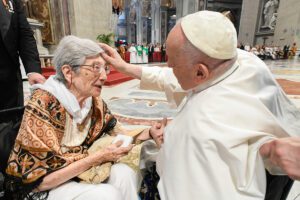
Pope Francis greets 100-year-old Lucilla Macelli before celebrating Mass in St. Peter’s Basilica at the Vatican, marking World Day for Grandparents and the Elderly July 23, 2023. (CNS photo/Vatican Media)
Elderly persons in wheelchairs were seated in the front row before the altar and alongside Pope Francis. Several grandparents with young children in tow were scattered among the estimated 6,000 people in attendance in the basilica.
“We need a new alliance between young people and the elderly,” Pope Francis told them in his homily, “so that the sap of those who have a long experience of life behind them will nourish the shoots of hope of those who are growing.”
“In this fruitful exchange we can learn the beauty of life, build a fraternal society and in the church we can allow for encounter and dialogue between tradition and the newness of the Spirit,” he said.
Cardinal Kevin J. Farrell, prefect of the Dicastery for the Laity, Family and Life – which organizes the world day – was the main celebrant at the altar. The theme for this year’s celebration was “His mercy is from age to age,” taken from St. Luke’s Gospel.
In his homily, the pope related the elderly’s role in society to the three parables Jesus tells in the day’s Gospel reading from St. Matthew.
In the first parable, the devil plants weeds among a wheat crop while the householder is asleep, but rather than tell his slaves to pull them up he allows them to grow until harvest for fear of uprooting the wheat with it.
“The good and the bad are intertwined to the point of appearing inseparable,” Pope Francis said. But, “Christians, enlivened by hope in God, are not pessimists, but neither are they naive people who live in a fairy-tale world, who pretend not to see evil and say ‘all is well.'”
“No, Christians are realists: they know there is wheat and weeds in the world,” he said.
The pope noted the common temptation to create a “pure” society and church that risks making people “impatient, intransigent, even violent toward those who have fallen into error.”
“In that way, together with the weeds we pull up the good wheat and block people from moving forward, from growing and changing,” he said. Instead, by “beating the temptation to divide the wheat from the weeds, we are called to understand the best ways and moments to act.”
The elderly, who have “already come a long way in life,” he said, are examples of embracing life’s beauty as well as its challenges.
“Old age is a blessed time also for this reason: it is the season to be reconciled, to look with tenderness at the light that has advanced despite the shadows, in the faithful hope that the good wheat sowed by God will prevail over the weeds with which the devil has wished to infest our hearts,” said the pope.
He also recalled the parable of the tiny mustard seed that grows into a large bush where birds make nests among its branches.
“At the beginning we are a small seed, then we are nourished by hopes, we fulfill projects and dreams, the most beautiful of which is becoming like that tree, which doesn’t live for itself but makes shade for who wants it and offers space for who wants to build a nest,” said Pope Francis.
He said that grandparents and grandchildren “grow together” like the tree and the birds that settle in its branches, where they “learn the warmth of home and experience the tenderness of an embrace.”
Urging the elderly and young people to engage with one another, the pope turned to the parable of the yeast in which a whole batch of bread is leavened by a small measure of yeast. He encouraged the young and elderly to “mix with one another” and to “come out from yourself to join with others.”
Such intergenerational interaction, he said, “defeats individualism and selfishness, and helps us generate a more humane and fraternal world.”
After Mass, five elderly people in St. Peter’s Basilica symbolically handed over a pilgrim’s cross to five young people traveling to World Youth Day in Lisbon, Portugal, which is scheduled for Aug. 1-6. The gesture represents the elderly’s commitment to “pray for the departing youth and accompany them with their blessing,” the Dicastery for the Laity, Family and Life said in a statement.
Shortly after, Pope Francis appeared at the window of the papal studio overlooking St. Peter’s Square with a young person who was going to attend World Youth Day and his grandmother on either side of him. The pope noted the significance of a day dedicated to celebrating the elderly right before World Youth Day begins.
“May the closeness of these two days be an invitation to promote an new alliance between generations of which there is so much need; so that the future may be constructed together, in the sharing of experiences and reciprocal care between young people and the elderly,” he said after praying the Angelus.
Noting the strong heat waves in many countries and recent flooding in South Korea, Pope Francis called on governments to act concretely to reduce polluting emissions, and he asked the estimated 20,000 people in St. Peter’s Square not to forget the ongoing migration crisis in northern Africa.
Social
WASHINGTON (OSV News) – A new survey indicates belief in spiritual entities continues to decline in the U.S. — and evangelization leaders say the data is a call for Catholics to examine their own witness to their faith.
Poll results released by Gallup July 21 show that 74% of U.S. residents believe in God, 69% in angels, 59% in hell and 58% in the devil.
A file photo shows a sparse congregation during Mass at St. Anthony’s Catholic Church in North Beach, Md. A new survey indicates belief in spiritual entities continues to decline in the U.S.; the data is a call for Catholics to examine their own witness to their faith, evangelization leaders told OSV News. (OSV News photo/CNS file, Bob Roller)
The responses point to a new low in spiritual beliefs among U.S. residents, consistent with trends seen by Gallup – which has conducted the survey for the past two decades – and Pew Research Center.
The data also aligns with other indicators of waning religious interest in the U.S. Religious book sales were down 6% in 2022, while Christian and gospel music combined took just 1.7% of the total U.S. music market share in 2022, according to a year-end report from data company Luminate.
“I’m not surprised that belief in spiritual realities is dropping,” Bishop Andrew H. Cozzens of Crookston, Minnesota, said in an email to OSV News.
Bishop Cozzens, who is spearheading the U.S. bishops’ National Eucharistic Revival, said he has observed “a loss of the sense of the transcendence in the world” that often translates into a denial of the real presence of Jesus Christ in the Eucharist.
“People don’t understand that the whole world is a sacrament, which points to the reality of God,” he said. “We are living in an increasingly materialistic culture that tends to deny spiritual realities, and for that reason people cannot understand that everything that exists points to a deeper, invisible, spiritual reality.”
When that spiritual reality fails to translate into acts of everyday virtue and charity, a disconnect occurs, said Father Steve Grunow, CEO of Word on Fire Catholic Ministries, in an email to OSV News.
“If our witness to the God in Christ is not accompanied by an evident way of life that demonstrates that we are actually Christ-like, we should not be surprised if people do not take our beliefs and practices seriously,” he said.
Compared with results from Gallup’s first poll of this kind in 2001, the latest Gallup data — collected from 1,011 adults representing current U.S. demographics — shows belief in God and heaven has tumbled 16 points. Belief in hell is down 12 points, with belief in the devil and angels falling 10 points each.
Gallup found that declining belief in God was matched by nearly equal increases in uncertainty and nonbelief. Nonbelief has outstripped uncertainty with regard to heaven, hell, angels and the devil.
Just over half of U.S. residents (51%) believe in all five spiritual entities, with 11% stating they do not believe in any of them. Seven percent are unsure about all of them, while 31% replied they believe in some of the entities but not others.
Gallup noted that rephrasing its question regarding belief in God produced “slightly different results,” with 81% in last year’s survey affirming their belief when they were not offered the option to say they were unsure.
Belief in all five entities trended higher among frequent churchgoers, Protestants, nondenominational Christians and Republicans, said researchers.
The current poll also showed Protestants as more likely than Catholics to believe in all five spiritual entities, although “broad majorities” of Catholics continue to believe in each. Differences between the two groups were more likely to involve belief in heaven, hell and the devil.
Income, age and education levels correlated with belief in all five spiritual realities, said Gallup. Those with annual household incomes under $40,000, those over 55 and adults without a college degree were most likely to profess belief, and women were more likely than men to believe in all of the concepts, except for the devil.
But Father Grunow said that “well-known and referenced” cultural factors do not alone account for the downturn in religious belief.
“People will only discover why belief in God matters if they are invited to encounter the God in whom we have faith,” he said. “Extending this invitation is the responsibility of all the baptized, and it cannot be delegated to institutions, or just presumed to have happened through the vapors of ethnicity.”
His own pastoral experience sheds light on some glaring gaps in missionary discipleship, he said — and “the usual suspects” for disaffiliation, such as “secularism, abuse scandals, the role of women (and) science versus faith” were not in evidence.
“I lived in one of the most secular cities in one of the most secularized states in this country, and … the most prevalent answer I received to the questions of why (the unaffiliated) did not believe in God or attend church services … was ‘because Christians are mean,'” he said. “Consider the results of the Gallup poll in relation to that insight and let it sink in.”
In addition, “you have to look at the anthropology of the human being” to evangelize, Marlon De La Torre, senior director of evangelization for the Diocese of Columbus, told OSV News. “You have to identify with that human being, understand what they’re going through.”
Presenting the Gospel as missionary disciples means “we can’t throw a tool or program at other human beings,” he said. “We have to throw another human being at them.”
“The heart leads to the heart,” he said, referencing the approach of St. Francis De Sales.
De La Torre also stressed the need for Catholics to be formed in their faith in order to share it effectively with others. “Tell me why you believe,” he said. “And not in theology terms. I’m not asking for Aquinas. I’m asking you to be real.”
Reversing the trends identified by the poll will be difficult in the short term, but “if we invite more and more people to an encounter with the living Jesus Christ, this will have a profound effect,” said Bishop Cozzens.
“When people encounter the truth of a reality they cannot see, but they can sense with their souls, then they are open to the truth of the spiritual world in which we live,” he said. “In fact, we live in a spiritual world where there is a great struggle happening. … Angels, demons, heaven, hell are profoundly real realities that affect us all. When people meet Jesus, they come to see this.”
Social
VATICAN CITY (CNS) – Pope Francis’ special envoy went to Washington to explore what the Vatican’s role could be in bringing about an end of hostilities in Ukraine, said the president of the U.S. bishops’ conference.
Discussing Cardinal Matteo Zuppi’s July 17-19 trip to the U.S. capital, Archbishop Timothy P. Broglio of Military Services said the cardinal talked about humanitarian responses and avenues toward ending hostilities in Ukraine in his July 18 meeting with U.S. President Joe Biden.
Cardinal Matteo Zuppi, on a peace mission to Moscow on Pope Francis’ behalf, speaks with Russian Orthodox Patriarch Kirill of Moscow at the patriarch’s residence at the Danilov monastery in Moscow June 29, 2023. (CNS photo/Courtesy of the Russian Orthodox Church, Department for External Church Relations)
In an interview with Vatican News published July 20, Archbishop Broglio stressed that the purpose of Cardinal Zuppi’s meeting was “certainly not mediation, but an opportunity to see what the Holy See could do to help in an eventual end of hostilities in Ukraine,” yet he noted that “at the present time that seems somewhat unrealistic.”
“The church is concentrating on what we do best, which of course is humanitarian assistance, so that was the primary focus of Cardinal Zuppi’s intervention,” he said.
The cardinal and the president met for more than an hour at the White House, which Archbishop Broglio said “gives an indication of how much importance the president of the United States attributed to the gesture on the part of Pope Francis to send the cardinal to the United States.”
While in the United States, the cardinal also met with Archbishop Broglio, members of the U.S. Helsinki Commission and the Senate Prayer Breakfast.
Cardinal Zuppi, archbishop of Bologna and president of the Italian bishops’ conference, hand-delivered a letter from Pope Francis to President Biden during their meeting, the Vatican said in a July 19 statement.
A July 18 White House readout said the two “discussed the Holy See’s efforts providing humanitarian aid to address the widespread suffering caused by Russia’s continuing aggression in Ukraine, as well as the Vatican’s advocacy for the return of forcibly deported Ukrainian children.”
President Biden also “shared his wishes for Pope Francis’ continued ministry and global leadership and welcomed the recent nomination of a U.S. archbishop as cardinal,” the statement said, referring to Chicago-born Cardinal-designate Robert Prevost, prefect of the Dicastery for Bishops.
Archbishop Broglio told Vatican News that U.S. Catholics have shown a “tremendous” response to the war by sending humanitarian assistance to Ukraine and organizing prayer initiatives throughout the country.
He also said he was “concerned” about U.S. cluster bombs being sent to Ukraine which he said are “indiscriminate in the victims” they create, noting that “any escalation (of the war) is going to be dangerous.”
“There’s always a danger in war that the innocent will be injured or will be harmed or can even lose their lives (on) the peripheries of a military action, and that certainly should always be avoided,” he said.
Cluster bombs refer to munitions that release smaller explosives across a wide area while in the air, making them less precise in their targeting. The Pentagon confirmed that U.S.-provided cluster bombs arrived in Ukraine July 13 and they have since been used in combat.
Archbishop Broglio expressed his gratitude for Pope Francis doing everything he can to “echo the message of peace, which is really the message of our Savior.”
“I’m very grateful for this gesture,” he said.
Social
SCRANTON – Born and raised just one street over from the Basilica of the National Shrine of Saint Ann, Kathy Dennebaum feels a deep connection to the annual Solemn Novena. She makes it a priority to attend services each year.
“I’ve had three major intentions that I’ve brought to the Novena and all three of them came to fruition so I’m a firm believer,” she explained.
Each year, an estimated 8,000 to 12,000 people attend the Novena each day.
“This has been a very sacred place since I was a little kid. My grandmother and grandfather had nine children that came here and were all members of this parish until they died,” Dennebaum added. “I just like to come and listen to the priests when they speak. A lot of times it’s very meaningful.”
The West Scranton native, who has been married to her husband Mark for 45 years, now bring their own grandson to experience the peace that comes from the prayerful place.
“I think it goes back to the fact that we grew up here and we’d like to have him be part of what we were part of when we were young,” Mark Dennebaum said.
This year marks the 99th year for the annual Novena that began Monday. The Novena concludes July 26, the Feast of Saint Ann.
“We never miss it, my whole family of eight sisters and brothers,” Patricia DeNapoli, a parishioner of Saints Anthony and Rocco Parish in Dunmore, said. “No matter what I ask, somehow, someway, it gets answered. You have to believe. If you don’t have faith there is nothing else!”
Very Rev. Richard W. Burke, C.P., rector of Saint Ann’s Shrine Basilica, said the annual Novena remains popular because Saint Ann is such a powerful intercessor.
“Every week we get letters and calls and have conversations with people who had their prayers answered one way or another through the intercession of Saint Ann,” Father Richard said.
With the centennial anniversary of the Solemn Novena quickly approaching, Father Richard believes its importance and relevance is just as important as when it started in 1924.
“Just think about all the major issues that we have to pray about. We can influence them through the gift of our prayers that God gives to us, we can influence the events of the world,” Father Richard stated. “The end of the hostility in Ukraine is a prayer that is on everybody’s mind. When they send in their petitions to put at the Altar of Saint Ann, nine out of ten of them have peace in Ukraine on those petitions.”
Social
VATICAN CITY (CNS) – Cardinal Matteo Zuppi hand-delivered a letter from Pope Francis to U.S. President Joe Biden as part of his three-day papal mission to help promote humanitarian efforts and open avenues of peace in Ukraine.
The pope had sent the cardinal, who is archbishop of Bologna and president of the Italian bishops’ conference, to Washington July 17-19 for meetings with top church and government leaders, including members of the U.S. Helsinki Commission and the Senate Prayer Breakfast.
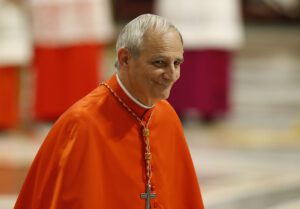
Cardinal Matteo Zuppi of Bologna, Italy, smiles as he arrives for a consistory led by Pope Francis for the creation of new cardinals in St. Peter’s Basilica at the Vatican Oct. 5, 2019. (CNS photo/Paul Haring)
Cardinal Zuppi and other members of a Vatican delegation went to the White House July 18 “where they were received by President Joseph R. Biden, to whom Cardinal Zuppi delivered a letter from the Holy Father, emphasizing the pope’s sorrow for the suffering caused by the war,” said a Vatican communique published July 19.
“The meeting, which began shortly after 5 p.m. and lasted over an hour, took place in an atmosphere of great cordiality and mutual listening,” it said.
During the conversation, assurance was made of there being a “full willingness to support humanitarian initiatives, especially for children and those who are most fragile, both to respond to this urgency and to foster paths of peace,” the Vatican said.
Early July 19, the Vatican delegation attended the Senate Prayer Breakfast, which is held Wednesday mornings in the U.S. Capitol for senators to meet, talk and pray together.
During this gathering, the Vatican said, “Cardinal Zuppi had the opportunity to brief the participants on the meetings he had over the various stages of his peace mission. During the meeting, appreciation was expressed for the Holy See’s efforts and the responsibility of each individual to strive for peace was emphasized.”
He also traveled to Russia and Ukraine in recent months to meet with church and government officials on the pope’s behalf.
Cardinal Zuppi arrived in Washington the evening of July 17 and had a meeting with USCCB President Archbishop Timothy P. Broglio of Military Services at the apostolic nunciature.
“Some reflections were exchanged on the war in Ukraine and the Holy See’s initiatives in support of victims and peace” during that meeting, the Vatican said.
The next morning the Vatican delegation went to the Rayburn House Office Building and met with some members of the Commission on Security and Cooperation in Europe, also known as the Helsinki Commission. This independent U.S. government commission seeks to promote human rights, military security and economic cooperation in 57 countries in Europe, Eurasia and North America.
The Vatican delegation, which included Cardinal-designate Christophe Pierre, apostolic nuncio to the United States, and Msgr. Séamus P. Horgan, charge d’affaires at the apostolic nunciature, presented to the commission “the nature and conduct of the mission entrusted to it by the pope, reflecting together on ways in which it could be made more effective.”
According to Cardinal-designate Pierre, the top priority for Cardinal Zuppi in his meeting with President Biden was the repatriation of children forcibly deported from Ukraine to Russia.
The overall objective of that closed-door meeting, he told the Italian daily, La Repubblica, was “to contribute to peace and more precisely to cover the humanitarian aspects, in particular concerning children. The discussion revolved around this.”
When asked if this meant that the immediate goal was facilitating the reunification of Ukrainian children with their families, the cardinal-designate said, “Yes, that is the cardinal’s, and obviously the pope’s, more specific goal, also because it is a more concrete issue.”
“Obviously, however, the idea is to think about peace, in the complicated context that exists,” he said in the interview with the newspaper, published in Italian July 19.
“The cardinal is very realistic, we try to do what is possible,” Cardinal-designate Pierre said.
In general, Cardinal Zuppi’s mission was “to listen and be listened to. To report on what has already happened in order to see how one can proceed,” the papal nuncio said.
“This is a first step. We are realists, we know perfectly well that this is not easy. But the pope wants to contribute to (bringing) attention to a situation that will in any case have to reach an outcome,” Cardinal-designate Pierre said.
Meanwhile, the White House said in a statement July 18 that President Biden shared with Cardinal Zuppi “his wishes for Pope Francis’ continued ministry and global leadership and welcomed the recent nomination of a U.S. archbishop as cardinal,” referring to Chicago-born Cardinal-designate Robert F. Prevost, prefect of the Dicastery for Bishops.
The U.S. president and Cardinal Zuppi “also discussed the Holy See’s efforts providing humanitarian aid to address the widespread suffering caused by Russia’s continuing aggression in Ukraine, as well as the Vatican’s advocacy for the return of forcibly deported Ukrainian children,” the White House statement said.
Pope Francis had sent Cardinal Zuppi to Washington as part of his ongoing humanitarian efforts to help Ukraine.
The July 17-19 visit is “in the context of the mission intended to promote peace in Ukraine and aims to exchange ideas and opinions on the current tragic situation and to support humanitarian initiatives to alleviate the suffering of the most affected and fragile people, especially children,” the Vatican said in a communique July 17.
The cardinal visited Bucha and Kyiv in early June and met with Ukrainian officials including President Volodymyr Zelenskyy. In Moscow in late June, he met with Russian Orthodox Patriarch Kirill of Moscow; Yury Ushakov, a Kremlin foreign policy adviser and former ambassador to the United States; and Maria Lvova-Belova, Russia’s commissioner for children’s rights, accused by the International Criminal Court of aiding the abduction and deportation of Ukrainian children to Russia.
Cardinal Zuppi had told reporters at a book presentation in Rome July 4 that the Vatican was working on a “mechanism” to help Ukrainian children that have been taken into Russia, Vatican News reported.
“The children should be able to return to Ukraine,” he said. “The first step is verifying the children and then seeing how to return them, starting with the most fragile.”
“There is no peace plan (or) mediation,” he said, “there is a great aspiration that the violence ends, that human lives can be saved starting with the defense of the youngest.”
The cardinal said July 2 that Pope Francis’ concern is to “create all opportunities to see, to listen and encourage everything that can lead toward a resolution to the conflict.”
“Of course there are small openings, we must look for them,” he said. “It is precisely in the darkness that the light of peace must be sought while knowing no one has a magic wand.”