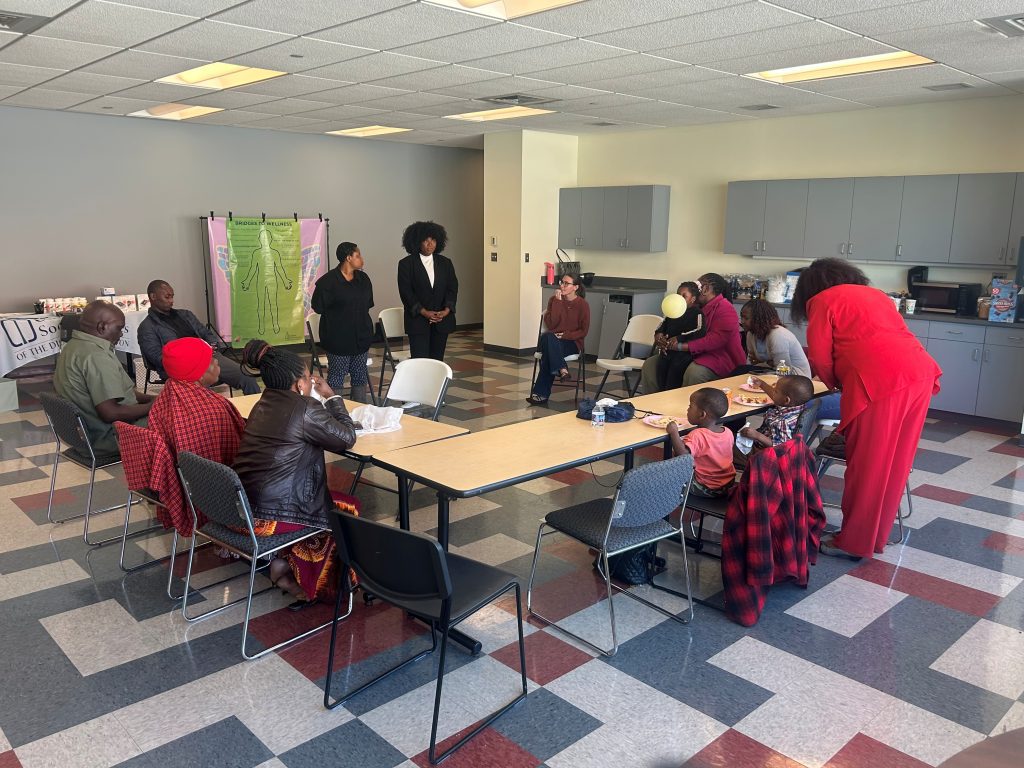
Catholic Social Services’ Bridges to Wellness Program held a community health fair for the Congolese community in Scranton on Oct. 31, 2026. (Photo/Dan Piazza)
SCRANTON – A simple greeting, offering the opportunity to ask questions and creating a welcoming place for people to gather can make a meaningful difference for someone navigating life in a new community and country.
Those opportunities are at the heart of ‘Bridges to Wellness,’ a new program of Catholic Social Services of the Diocese of Scranton that collaborates with immigrant and refugee communities across northeastern Pennsylvania.
Through wellness education, peer support, community gatherings and creative activities, the program seeks to help people build connections, find resources and develop healthy ways to support their overall well-being.
Over the past year, the Bridges to Wellness Program has hosted activities for Afghan, Congolese, Haitian, Hispanic/Latino, Nepali/Bhutanese and Ukrainian communities.
Its most recent event was a community health fair for the Congolese community which was held on Oct. 31, 2026, at the Scranton Enterprise Center. Participants had the opportunity to ask health-related questions, receive basic wellness guidance and learn about health habits with the assistance of students from Geisinger Commonwealth School of Medicine.
“One of the things that we recognize through our community outreach and conversations with Congolese families is that access to healthcare is challenging,” Ruth Cuinica, Bridges to Wellness Program Supervisor, said.
Language differences, limited availability of health care resources, transportation challenges, financial difficulties and simply navigating the health care system can all create obstacles, Cuinica explained.
The Bridges to Wellness Program aims to bring resources and opportunities into familiar community settings, helping participants feel comfortable asking questions and seeking assistance.
Prisca Poly, a Congolese community peer, said the health fair was organized to encourage people to take care of themselves.
“The event today is to encourage everybody that our health matters,” she said.
Poly also emphasized the importance of everyday gestures of welcome, like a smile or warm greeting, as being particularly important for people adjusting to unfamiliar surroundings.
“A simple good morning, how are you, how can I help you, is really helpful,” Poly said.
While the Bridges to Wellness Program collaborates with individual communities, its approach is centered on connection, shared learning and the strengths people bring.
“We welcome everyone,” Cuinica said. “When we welcome them and support their well-being, the whole community is healthier and stronger.”
Ushu Mukelo, President of the Congolese Community of Scranton, said events such as the health fair are extremely important.
“It gives them an opportunity where they can talk about their health and get some basic guidance,” Mukelo said.
For those interested in learning more about Bridges to Wellness, volunteering, partnering with the program or supporting its activities, contact Ruth Cuinica through Catholic Social Services at (570) 207-2283, ext. 2125, or by email at RCuinica@cssdioceseofscranton.org.
Social
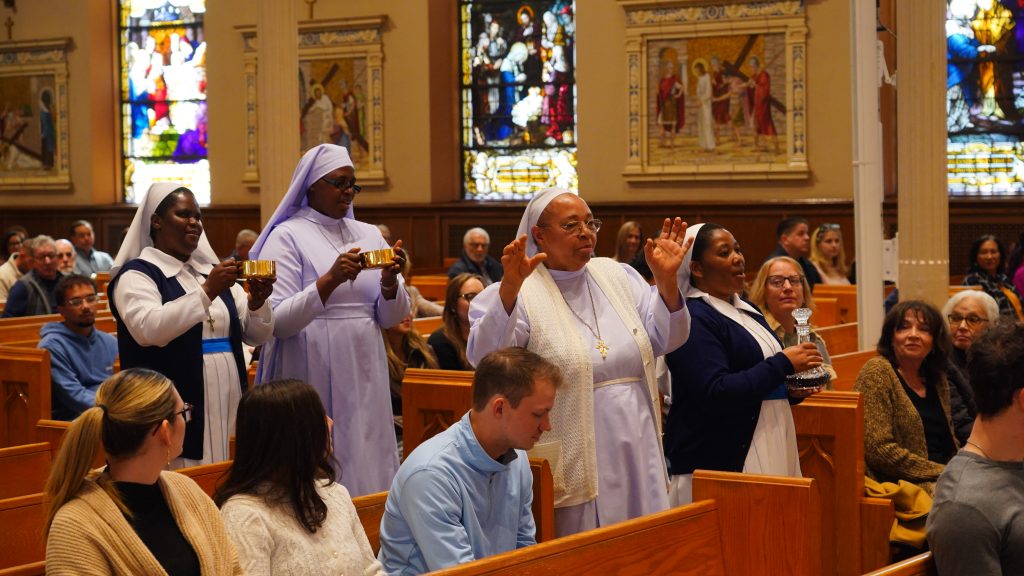
Four religious sisters joyfully danced down the aisle of the Cathedral of Saint Peter during the Preparation of the Gifts on Oct. 18, 2026, during a Pontifical Mass for World Mission Sunday. (Photo/Mike Melisky)
SCRANTON – Four religious sisters danced down the center aisle of the Cathedral of Saint Peter on Oct. 18 to the sound of drums and an international choir, carrying the gifts of bread and wine to the altar in a joyful procession that brought the sights and sounds of the universal Church to Scranton.
The special procession was part of the Diocese of Scranton’s annual celebration of World Mission Sunday.
Dancing to the song, “Yamba, Yamba, Yamba, Yahweh,” which originated in the Democratic Republic of the Congo, the words translate to “Thank you, thank you, thank you, Lord.”
The Most Rev. Joseph C. Bambera, Bishop of Scranton, served as principal celebrant of the 12:15 p.m. Pontifical Mass, greeting the four sisters just outside the sanctuary of the Cathedral at the start of the Liturgy of the Eucharist.
This year marks the 100th anniversary of World Mission Sunday, which was established in 1926 to unite Catholics in prayer and support for missionary work around the world.
Father Sudhir Toppo, Administrator of Most Holy Trinity Parish in Susquehanna, and a native of India, served as homilist for the Mass.
In his homily, Father Toppo reminded those gathered that mission extends beyond priests and religious traveling to distant lands.
“Mission is the love we share, the faith we live and the relationship we build with God’s people,” he said.
Father Toppo shared a story of a community in his home country that had limited material resources but had a great love in their hearts.
“Their faith was alive. Their families prayed together. They welcomed others with warmth and generosity. Even when life was difficult, they continued to trust in God,” he said.
He encouraged Catholics to recognize their shared responsibility to proclaim the Gospel, build unity, and support communities in need.
“All of us are called to be missionary disciples,” Father Toppo added. “We cannot proclaim the love of Christ if we live in hatred, discrimination or division … Let us be united in Christ, united in His mission. Let us not allow our differences to divide us. For when we are one in Christ, our lives become a mission of hope for the world.”
Bishop Bambera also acknowledged the important contributions of roughly 25 international priests and religious serving the Diocese of Scranton, noting that the Church’s missionary story has come full circle.
“We are fortunate enough to be able to keep the faith alive and flourishing in our country and in our diocese in particular because of them,” Bishop Bambera noted.
Shannon Ruiz, Diocesan Director of Pontifical Mission Societies, said the annual World Mission Sunday celebration should remind all Catholics that they belong to one global family.
The collection on World Mission Sunday helps to support seminary education, health care, orphanages, and other needs in mission territories around the globe.
“We may be separated by distance, but we’re united by one mission,” Ruiz said.
Social
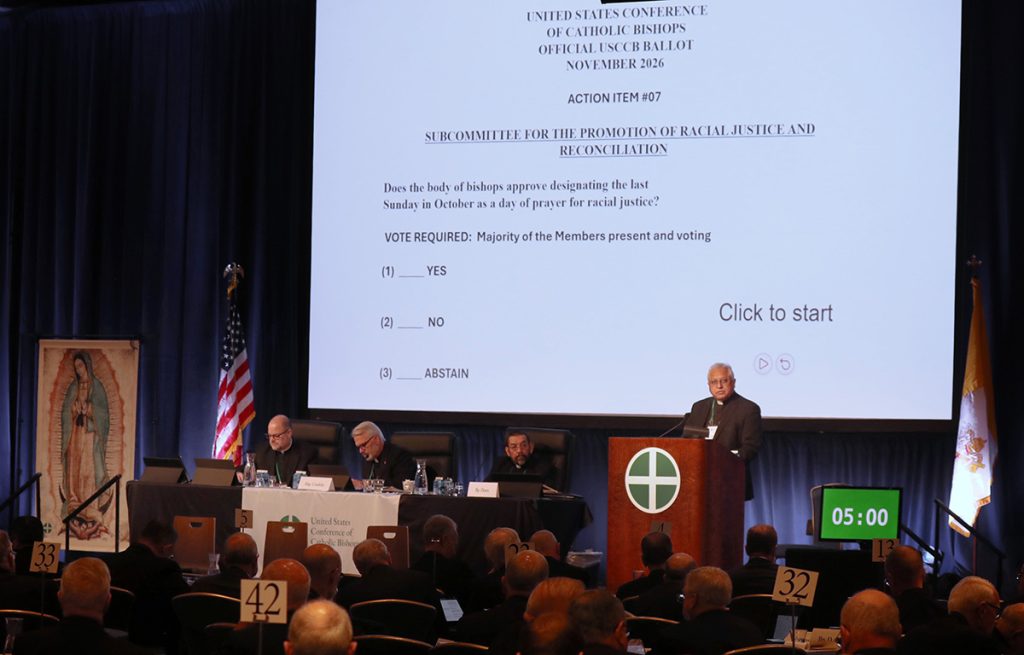
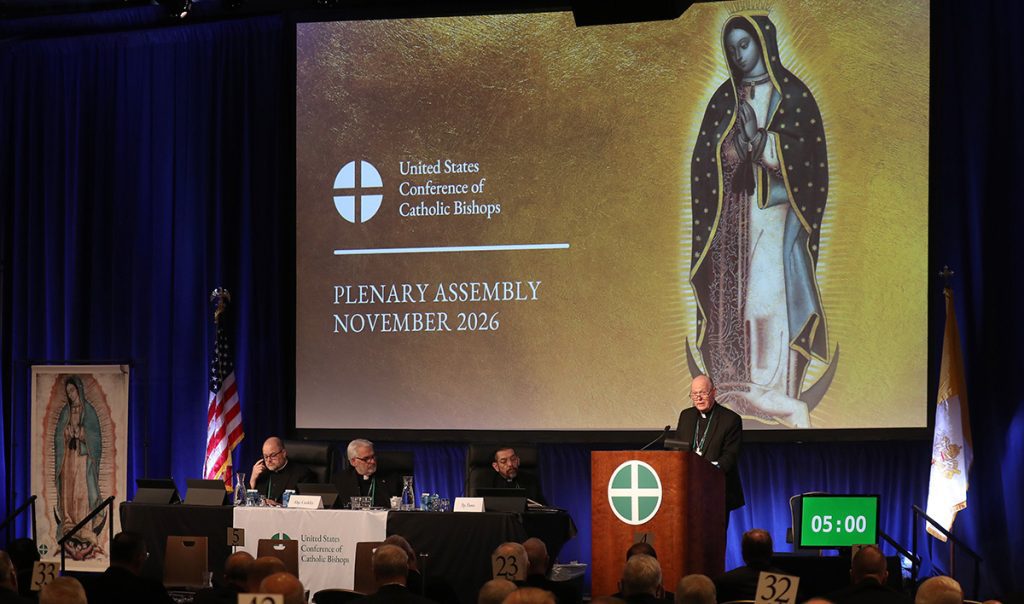
Bishop Daniel E. Garcia of Austin, Texas, speaks during a Nov. 18, 2026, session of the fall general assembly of the U.S. Conference of Catholic Bishops in Baltimore. (OSV News photo/Bob Roller)
BALTIMORE (OSV News) – The nation’s Catholic bishops have approved a motion to designate the last Sunday in October as a day of prayer for racial justice.
The decision was determined by a vote Nov. 18 amid the U.S. Conference of Catholic Bishops’ annual fall plenary, held Nov. 16-19 in Baltimore.
A total of 180 bishops voted in favor of the observance, with 15 voting against and seven abstaining.
Bishop Daniel E. Garcia of Austin, Texas, chairman of the USCCB’s Subcommittee for the Promotion of Racial Justice and Reconciliation, presented the action item for consideration, saying the establishment of such a day “creates sacred space for reflection, repentance and the conversion of hearts, fostering deeper reconciliation within the body of Christ and across our communities.”
The subcommittee, first launched in 2017 as the Ad Hoc Committee Against Racism, was approved as a permanent entity under its new name by the USCCB’s administrative committee in September 2025 as a permanent entity. Bishop Garcia was named its inaugural chairman in November 2025.
Speaking to OSV News ahead of the vote, Bishop Garcia — who previously shared his own childhood experiences of racism — said that day of prayer for racial justice was “an opportunity for the Church at large to draw some recognition to an aspect of racism that in some ways we’ve not wanted to talk about, and that’s the whole aspect of racism in the Church.”
That aspect is not confined to the past, he said, but manifests itself “in the present day, age and climate.”
“We see the divisiveness and the polarization,” which at times manifest themselves along the lines of “color or ethnicity,” he said.
He also pointed to intensified fears of discrimination experienced under the Trump administration’s crackdown on immigration, which has seen widespread allegations of racial profiling in immigration enforcement operations.
Ending racism, Bishop Garcia said, “first and foremost” begins with prayer: “Asking God to heal our hearts of the wounds of the past, and to help us as we try to work through this complex situation that we encounter today, both civilly but also in the Church,” he said.
In his plenary address, Bishop Garcia cited a recently released study by the Center for Applied Research in the Apostolate, which found that 60% of adult Catholics in the U.S. believe racism exists within their local community, with about 4 in 10 (39%) saying they have experienced racial discrimination generally.
That figure was higher among Black Catholics (66%), Hispanic Catholics (54%) and Asian Catholics (54%).
Citing CARA’s data, Bishop Garcia said in his address that “26% of Black respondents indicated that they have personally experienced racial discrimination within their parishes or Catholic schools.”
He also noted that only 48% of the study’s participants said they were familiar with the USCCB’s 2018 pastoral letter against racism, “Open Wide Our Hearts: The Enduring Call to Love.”
“These findings underscore the continued need for initiatives that promote racial justice, inclusion, and reconciliation within the Church and broader society,” said Bishop Garcia.
Bishop Garcia also noted that the timing of the day of prayer for racial justice — coordinated in consultation with the bishops’ Committee on Divine Worship — “would coincide with either the 30th or 31st Sunday of Ordinary Time.”
“The readings are very fitting for this designation,” he said, adding that “placing this observance at the end of October would provide a meaningful transition into November, a month that recognizes both Black Catholic history and Native American heritage.”
As a result, the day of prayer would “serve as a bridge between related observances,” creating increased pastoral opportunities for addressing racism, while incorporating “reflection on racial justice and reconciliation more fully into the liturgical life of the Church.”
Speaking to OSV News prior to the vote, Bishop Garcia said that “racism is not something we’re born with.”
“It’s learned behavior,” he explained.
But “that man, that woman who is different from me — who has a different skin color, who speaks a different language — they are also a daughter and a son of God,” Bishop Garcia told OSV News. “And if I claim to be Catholic and Christian, then I have to start there.”
Through prayer, the Lord can heal those wounded by racism, while — as the psalmist pleads in Psalm 51 — creating “a clean heart” that honors and respects others, he said.
“Whether you’re a person that’s maybe been the subject of discrimination, or one who has discriminated against someone, there’s always an ability to change,” said Bishop Garcia. “There’s conversion in every one of us. God doesn’t give up on us.”
And for that reason, he added, “Pray to God for the grace to be more open-hearted to the person who is different, or who is a stranger in my midst.”
Social
The words “AI Artificial Intelligence” and a keyboard are shown in this illustration created Oct. 19, 2026. (OSV News photo/Dado Ruvic, Reuters)
BALTIMORE (OSV News) — Humans must remain in control of artificial intelligence — and the clock is ticking for exerting that oversight to safeguard human dignity and the common good, said Bishop Oscar Cantú of San Jose, California, who heads the U.S. Catholic bishops’ AI task force.
The bishop — whose diocese is home to Silicon Valley — reflected on the task force’s work in an interview with OSV News and in a presentation during the U.S. Conference of Catholic Bishops’ annual fall plenary assembly, which is taking place Nov. 16-19 in Baltimore.
Bishop Cantú’s call for human-centered development and governance of AI echoes that of Pope Leo XIV in his encyclical “Magnifica Humanitas.”
The bishop’s message also comes amid a recent slew of high-profile technology disruptions that saw a rare nationwide ground stop at U.S. airports and a global Microsoft outage, as well as online snarls for several banks and Apple products.
While not thought to be directly related to AI, the disturbances nonetheless highlighted modern dependence on digital connectivity.
Bishop Cantú’s Nov. 18 plenary update on the work of the task force was also offered just hours ahead of the highly anticipated initial public offering of Anthropic, the frontier AI firm whose co-founder joined Pope Leo for the May release of his encyclical on the technology.
— Bishops’ AI task force —
Shortly after the encyclical’s publication, Bishop Cantú was named chair of the newly formed USCCB task force on AI, with the group focused on implementing Pope Leo’s vision to keep the technology firmly rooted in human dignity and the principles of Catholic social teaching.
Last month, the USCCB announced the full list of the committee’s eight episcopal members, who include Cardinal Blase J. Cupich of Chicago, and its three lay consultants: theologian and ethicist Charles Camosy of The Catholic University of America, philosopher Meghan Sullivan of the University of Notre Dame, and Kim Daniels, director of Georgetown University’s Initiative on Catholic Social Thought and Public Life.
— ‘Time is of the essence’ —
Speaking to OSV News the day prior to his USCCB presentation, Bishop Cantú said the mid-November whirlwind of flight and online service disruptions within the span of a few days “set us on edge and make us wonder what’s happening,” adding he hoped for “some calmer waters” ahead.
At the same time, he added, “time is of the essence with regard to this technology.”
“I wouldn’t say the technologists have warned us, but they’ve mentioned their timeline,” he told OSV News. “They expect this technology to be at full speed within six months to a year. And so we need to raise our voice. We need to educate ourselves quickly, calmly and raise our voice in the public square in this debate.”
— Threats to human dignity, truth, work —
In his Nov. 18 address at the USCCB plenary, Bishop Cantú — quoting extensively from “Magnifica Humanitas” throughout his presentation — said one of the greatest threats posed by AI is a diminished view of the human person.
“The Church’s contribution is to insist that every human being possesses inherent dignity that no algorithm can measure and no market can price,” something Pope Leo’s encyclical warns against, said Bishop Cantú. “God formed mankind with his own hands and continues to breathe life into humanity; that breath cannot be replaced by an algorithm.”
Truth is another potential casualty of AI, and a key pastoral concern, Bishop Cantú told his fellow bishops.
“Unfortunately, AI allows bad actors to produce convincing falsehoods,” such as generated images and disinformation, he said.
As a result, Bishop Cantú said in his address, bishops “should recognize that in the coming years there will be an unprecedented pressure on the public’s ability to distinguish truth from falsehood.”
The Church “must become a school of discernment in the digital age,” with its institutions as “places where people learn to verify, to slow down, and to reason together.”
Protecting children and vulnerable persons from harmful impacts of AI is also crucial, Bishop Cantú said.
With AI set to become “a permanent companion” for many young people, posing risks to their capability for critical thinking, “friendship, prayer, and genuine human encounter,” he said.
In his address, Bishop Cantú called on Catholic educators to “help us develop guidelines for children and young people regarding the prudent use of artificial intelligence.”
The impact of AI on labor markets, which tech leaders continue to debate, has “many Catholics” concerned about their own jobs and the future of “meaningful work” for their children, he said.
AI’s impact on modern warfare, particularly with respect to autonomous weapons, is “one of the most urgent themes” of Pope Leo’s encyclical on the technology, said Bishop Cantú.
“The Church must insist that moral responsibility in conflict cannot be delegated to an algorithm,” he said.
— Dialogue, formation and guardrails for AI —
At the same time, said Bishop Cantú, the USCCB’s AI task force has found “genuine openness to dialogue among major technology companies.”
“Most have expressed interest in ongoing conversation with the Church,” he reported. “Many recognize the deep moral and ethical questions at stake.”
With a majority of AI frontier labs based in the U.S., that openness “represents a significant opportunity for the Church, particularly here in the United States,” he said, adding, “the Church possesses something that Silicon Valley cannot engineer: over two thousand years of wisdom on the human person, truth, and the common good.”
Bishop Cantú said the USCCB AI task force will focus on providing bishops with “updates and formation opportunities” for prelates and diocesan leaders, with webinars for bishops set to begin after the new year.
The task force is positioned to “become a clearinghouse for best practices” in developing AI literacy in educational institutions and catechetical programs, he said.
The group will also partner closely with the USCCB’s government relations team to advocate for “clear guardrails on the development and use of AI, including transparency, accountability, and human oversight,” said the bishop in his address.
Continued and expanding engagement with society at all levels on the issue of AI will continue, he said.
— ‘Renewed confidence’ in humanity —
Highlighting Pope Leo’s reflections on AI, Bishop Cantú urged the Church to “articulate with renewed confidence what it means to be human in the time of artificial intelligence.”
“Brothers, at a moment when society is asking what machines can do, we must remind the world who the human person is,” he concluded. “‘Magnifica Humanitas’ calls us not to fear the future, but to help shape it, with humanity at the center.”
Social
Bishop Brendan J. Cahill of Victoria, Texas, speaks during a Nov. 18, 2026, session of the fall general assembly of the U.S. Conference of Catholic Bishops in Baltimore. (OSV News photo/Bob Roller)
BALTIMORE (OSV News) – A year after the U.S. Conference of Catholic Bishops approved a special pastoral message on immigration, “much of what we addressed at that time continues to be relevant today,” Bishop Brendan J. Cahill of Joliet, Illinois, chair of the USCCB’s Committee on Migration, said Nov. 18 at their fall plenary assembly in Baltimore.
The November 2025 statement expressed the bishops’ opposition to the “indiscriminate mass deportation of people.”
While it did not name President Donald Trump, it objected to some of the policies implemented by his administration, which also included a reduction in protection from immigration enforcement actions at houses of worship and other sensitive locations, and expressed concern about access to sacraments for those detained by U.S. Immigration and Customs Enforcement.
In remarks at the assembly, Bishop Cahill expressed particular concern about the impact on children and family separation.
“The reduced protections and support for noncitizen children, especially the decreased availability of legal services within this population, is a scandal,” he said.
Bishop Cahill also stressed the conference’s position that clergy should be able to provide pastoral care to those in detention centers. The Archdiocese of St. Louis recently filed a lawsuit against the federal government over a policy it said prohibits priests from distributing Communion to and hearing confessions of ICE detainees.
“Please note that our staff at the conference are eager to assist with addressing any issues that arise for dioceses attempting to provide pastoral care to those in immigrant detention,” he said.
The assembly came just weeks after midterm elections in which Democrats won a landslide victory, projected to win a more than 80-seat majority in the U.S. House. In the U.S. Senate, Democrats will hold 56 seats, after Democrat Mary Peltola defeated Sen. Dan Sullivan, R-Alaska.
After the election and subsequent mixed signals from Trump on his willingness to work with the new Congress on the issue, debate emerged over the viability of immigration reform after the new Congress begins in January. Leaders of the USCCB indicated they would continue to advocate for what they called humane and just immigration reform.
In Vice President JD Vance’s book “Communion: Finding My Way Back to Faith,” released in June, he acknowledged the USCCB’s November 2025 statement was “widely viewed as a critique of our administration’s immigration policies,” but argued that the bishops’ message was “admirably measured. Or almost too measured,” casting it as vague.
In response to a question at a Nov. 17 press conference about whether the message was effectively ignored by the Trump administration, Archbishop Paul S. Coakley of Oklahoma City, president of the USCCB, said, “We did have one bit of success working with the Trump administration, subsequent to my visit with him at the end of January regarding R1 visas. So that was something that we counted as a partial win.”
“There’s a lot more work to be done,” he added.
Many immigrant religious workers — such as Catholic priests and nuns — legally enter the country on R-1 non-immigrant religious worker visas. During his address to the assembly, Bishop Cahill also pointed to a policy slightly reducing wait times for religious worker visas.
Asked about the new political landscape during an interview with OSV News, Bishop Cahill said, “I do think there is a sense that the people of America would want better treatment of human beings,” adding that it is a good “starting point.”
Social
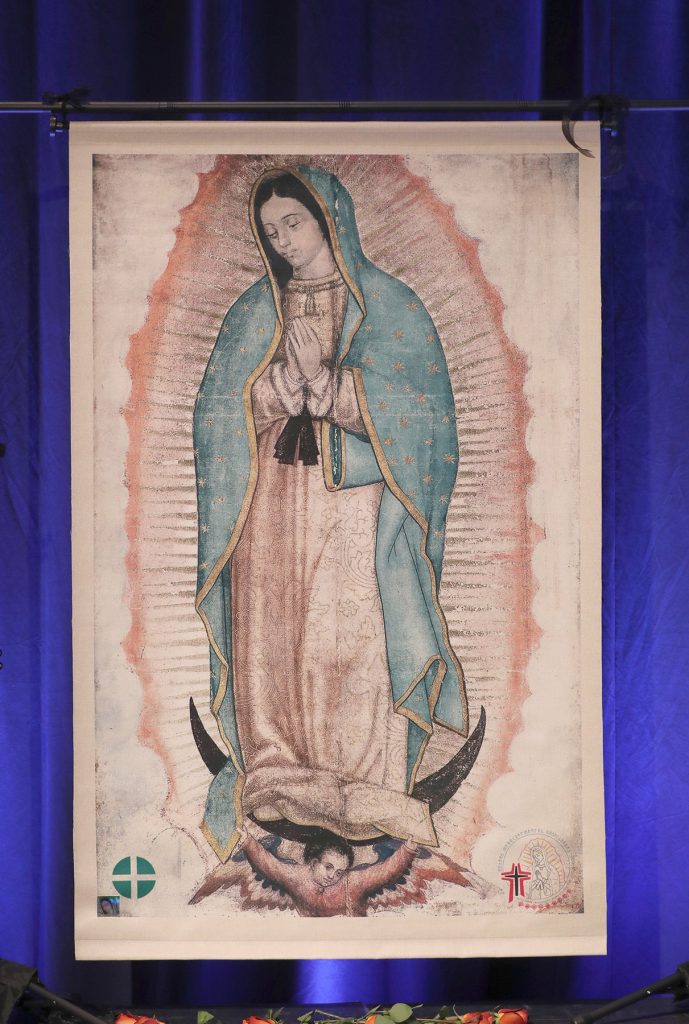
A replica of the original tilma, or cloak, bearing the image of Our Lady of Guadalupea, is displayed following a Nov. 17, 2026, session of the fall general assembly of the U.S. Conference of Catholic Bishops in Baltimore. (OSV News photo/Bob Roller)
(OSV News) – On the first public day of their fall plenary assembly, the U.S. bishops heard a presentation on how the U.S. Church is participating in the Intercontinental Guadalupan Novena to commemorate the 500th anniversary of the apparitions of Our Lady of Guadalupe, which will take place in 2031.
On Nov. 17, Bishop Daniel E. Flores of Brownsville, Texas, who is vice president of the U.S. Conference of Catholic Bishops, explained the Guadalupan event of 1531 and its account in Nahuatl, known as Nican Mopohua, before he addressed the historical context of the Spanish conquest, the Virgin’s encounter with St. Juan Diego and the meaning of certain symbols on the tilma, or cloak, which has Our Lady’s image miraculously imprinted on it.
Four years ago, the Mexican Episcopal Conference began a “Novena of Years” in anticipation of the quincentennial of the Guadalupe apparitions on Tepeyac Hill, inviting all dioceses throughout the Americas to join them for the remaining five years leading to the quincentennial. At their spring plenary session, the U.S. bishops discussed a multiyear plan of pastoral activity in sync with the intercontinental novena.
Bishop Flores said the message of Guadalupe reflects God’s tenderness and mercy, which embraces the humble and vulnerable in a special way, acknowledges their sufferings and calls them to fulfill a mission, just as Our Lady did with Juan Diego.
“This is why she can be, and in some ways, she must be, at the same time, patroness of evangelization, defender of the unborn child, protectress of the immigrant, consolation of the mother weeping for her children in a blood-soaked land, and also why she is also patroness of the elderly and the infirm,” he said.
Bishop Flores emphasized that the apparitions and the evangelizing momentum that accompanied them helped counteract the brutality of the Spanish conquest and strengthen the work of the mendicant orders. Furthermore, he compared the brutality of the conquest to contemporary forms of dehumanization and highlighted that the message of Guadalupe remains a call to evangelization.
“As we enter a new world where dehumanization proposes itself in ever new ways, we must embrace the urgency of our own evangelizing efforts,” said Bishop Flores. “We can do this because we have with us the woman clothed with the sun and her child, sent to take from us all our stony hearts and give us hearts of flesh.”.
Bishop Óscar Cantú of San José, California, chairman of the USCCB’s Subcommittee on Hispanic/Latino Affairs, highlighted the “enthusiasm across the United States” generated by the “One Tilma, One Heart” initiative, through which, he noted, the replicas of the tilma have been distributed to 85 dioceses, while another 50 will receive them soon.
These images have been touched with the original tilma, which remains on display today at the Basilica of Our Lady of Guadalupe in Mexico City, making the replicas third-class relics.
“Our goal is that all 196 dioceses and eparchies receive their tilma by the end of the year,” said Bishop Cantú. He explained how parishes and dioceses are progressing through the three phases of the process, noting that “several dioceses have already scheduled the enthronement of Our Lady of Guadalupe in their cathedral early in December, while others plan to do so soon after the New Year.”
The bishop noted that following their enthronement, the tilma replicas will go on pilgrimage to parishes, schools and other locations chosen by each diocese, accompanied by bilingual resources designed to strengthen catechesis and devotion to Our Lady of Guadalupe.
The bishop also announced two webinars (in English and Spanish), which will take place on Dec. 10 and 11 at 1 p.m., with the aim of providing participants with guidance on the Intercontinental Guadalupe Novena, answering questions about the “One Tilma, One Heart” initiative and highlighting the available resources.
Bishop Robert J. Brennan of Brooklyn, New York, chairman of the USCCB’s Committee on Cultural Diversity in the Churchopened and closed the presentation. He reminded those present that Bishop Flores and Bishop Cantú traveled to Mexico in late August/early September at the invitation of Bishop Ramón Castro of Cuernavaca, president of the Mexican Episcopal Conference, to participate in a fraternal gathering of the episcopal conferences of North America.
In an interview following the gathering, Bishop Flores told OSV News Sept. 7 about the fruits of these meetings and how the Church in the United States is preparing for the celebration of the 500th anniversary of the Guadalupe event.
“One of the fruits already taking shape is the cooperation — which we had already begun — on how to use these moments leading up to the anniversary of the Guadalupe apparitions as opportunities for evangelization and also as times to welcome our people with the simple message and the profound encounter of how God’s grace is at work,” said Bishop Flores.
He also recalled that during her apparitions, Mary asked that “a little house” be built — a place to encounter her and Christ — which is why countries are called to create spaces that foster encounters with God and with his people.
The USCCB has launched a webpage — https://www.usccb.org/intercontinental-guadalupan-novena — with various pastoral and liturgical resources to assist dioceses, parishes, and the faithful in preparing for the Intercontinental Guadalupe Novena.
Among these resources are formation materials, guidelines for organizing celebrations, pilgrimages, and community activities, as well as a timeline for preparation leading up to 2031, when the 500th anniversary of the apparitions of Our Lady of Guadalupe will be commemorated.
In a video posted on the website, Bishop Flores said that “as we prepare to celebrate in each of our dioceses and in our parishes the 500th anniversary of the apparition that we can renew our sense of the newness of Christ in our lives and that can give us a sense of being participants in sharing this message with each other and with our neighbors and with those in our community.”
Social
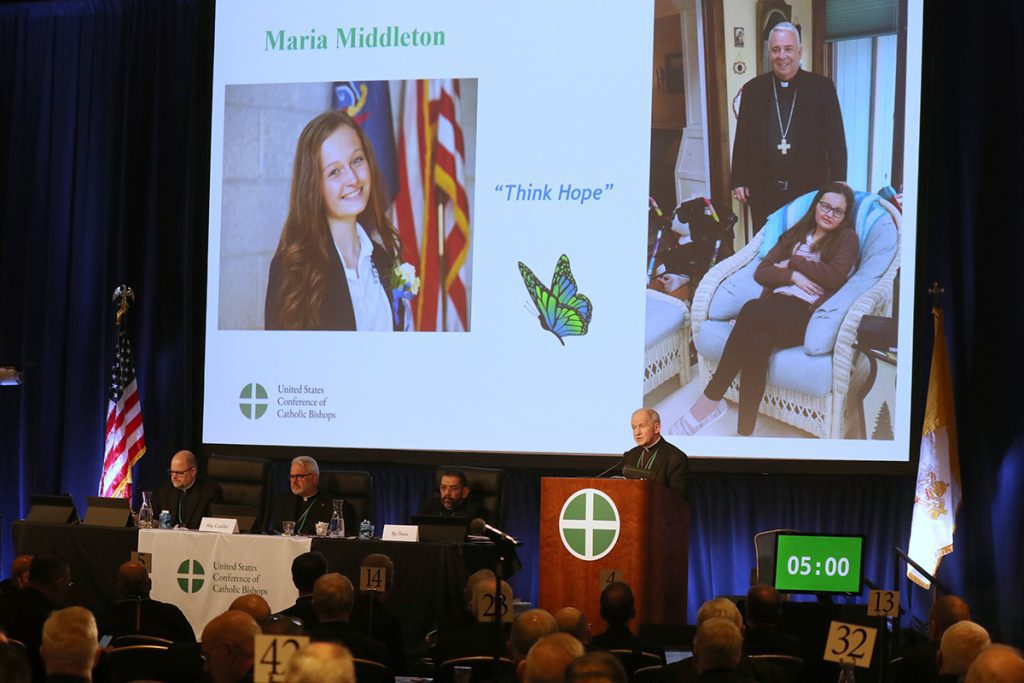
Bishop Thomas J. Paprocki of Springfield, Ill., speaks during a Nov. 17, 2026, session of the fall general assembly of the U.S. Conference of Catholic Bishops in Baltimore. Bishop Paprocki was addressing the bishops prior to their vote to support on the of beatification and canonization for Maria Middleton, a laywoman of the Archdiocese of Philadelphia. (OSV News photo/Bob Roller)
BALTIMORE: (OSV News) – Meeting in Baltimore for their annual fall plenary assembly, the members of the U.S. Conference of Catholic Bishops Nov. 17 offered overwhelming support for a canonization cause for a Pennsylvania teenager who died from terminal brain-stem cancer. Her cause is expected to be opened soon.
Bishop Thomas J. Paprocki of Springfield, Illinois, as chair of the U.S. bishops’ Committee on Canonical Affairs and Church Governance, presented to the body of bishops, detailing the heroic suffering and faith of Maria Middleton, who died in 2020 at age 18.
Born in 2002, Maria Middleton’s family guided and gave witness to the importance of a relationship with God. She expressed early in her short life a love for the Marian and Eucharistic devotion, attending Eucharistic adoration starting at age 3 with her mother.
Dedicated to parish life, she served as a cantor and altar server, participated in youth activities and helped organize opportunities to serve the poor. During her final days, Middleton wrote to Archbishop Nelson J. Pérez of Philadelphia advocating for churches to be reopened during the temporary closures initiated by the COVID-19 pandemic. In response, Archbishop Pérez brought Middleton holy Communion at her home to strengthen her in her journey to eternal life.
As a student at Villa Joseph Marie High School, in a northeast suburb of Philadelphia, Middleton continued her commitment to Christian service. She also participated in numerous outreach efforts for the elderly and underprivileged, serving as a student leader in the school’s charitable outreach.
Middleton co-founded and led the school’s annual Hope-A-Thon, a fundraiser which initially aided children with cancer and neurological issues. Today, the benefit provides scholarships at her former high school and helps support Think Hope, a nonprofit foundation established by Maria’s parents, Susan and Brian Middleton, to fund community outreach programs, including education, elder care and street ministry.
During her sophomore year in high school, Middleton was diagnosed with an inoperable and terminal brain tumor. Given only nine to 12 months to live, she responded to pain and suffering with remarkable faith, courage and trust in God’s providence. Her journal entries show how she believed that rather than giving in to despair, she offered her illness for others, believing it could bring people closer to God.
Throughout her illness, Middleton accepted what suffering brought. She did not see it as a punishment but as a means for growing closer to God, if her suffering was embraced without bitterness. Since her death, Middleton has been remembered for her compelling witness, particularly to young people.
Middleton died in the presence of family and friends, inducing hospital staff who have spoken of her joyful spirit, total surrender to God’s will, and faithful perseverance. Her final written words in her journal expressed the message that had guided her: “think hope,” a phrase engraved on her grave marker in Doylestown, Pennsylvania.
“Maria offers a modern-day witness to all Catholics about the redemptive power of suffering,” Bishop Paprocki stated in his presentation. “The statistics concerning depression, anxiety, loneliness and suicide among young people speak of the urgent need to lift up examples of young holy men and women, who can be witnesses to the power of faith, hope and love.”
In addition to Middleton’s cause, the assembly also was initially to be consulted on the canonization cause of Thomas Vander Woude, a layman from the Diocese of Arlington, Virginia, who offered his life to save his son’s in 2008. Vander Woude died to save the life of his youngest son, Joseph, who has Down syndrome, after the latter fell into a septic tank on the family’s farm in rural Virginia.
Vander Woude’s cause, however, did not appear on the bishops’ final agenda for the week. OSV News confirmed that Bishop Michael F. Burbidge of Arlington, in whose diocese Vander Woude’s cause is proceeding, was not able to present the cause in person due to an unforeseen conflict.
The Diocese of Arlington told OSV News that Bishop Burbidge soon would consult bishops in the Baltimore ecclesiastical province on Vander Woude’s cause, and expects to present on Vander Woude at the bishops’ spring assembly in 2027. The Tom Vander Woude Guild, the organization currently pursuing the cause, told OSV News that the cause is expected to be formally opened in 2027.
Social
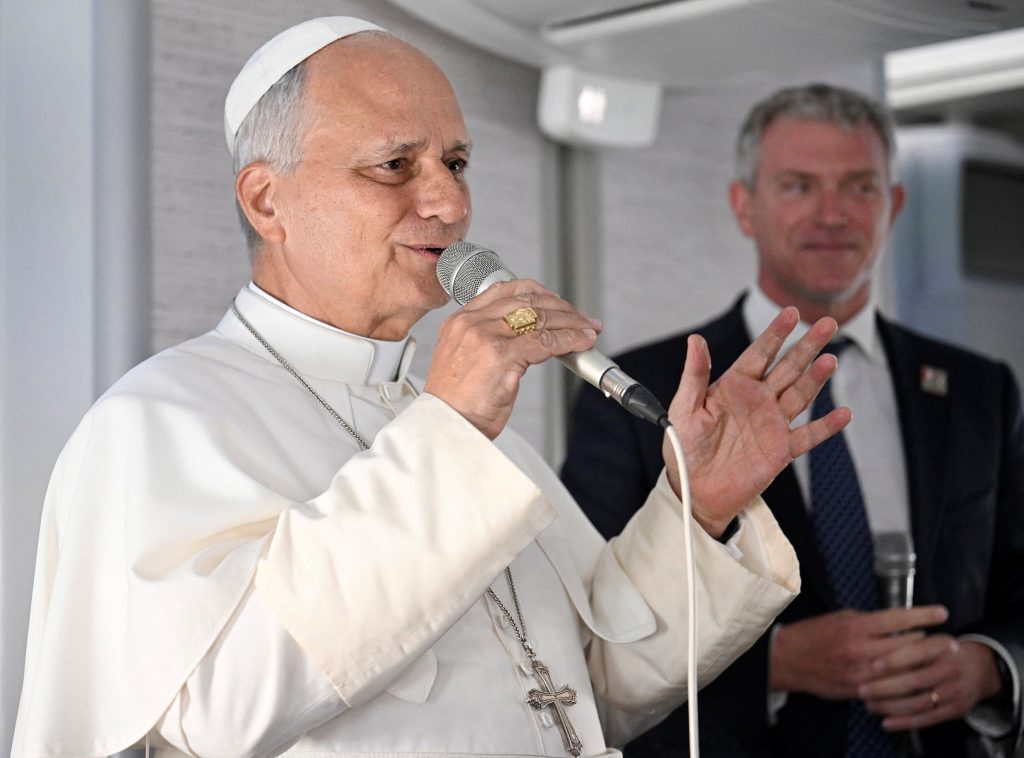
Pope Leo XIV talks to journalists during a press conference on the flight from Lima, Peru, to Rome, Nov. 16, 2026. (OSV News photo/Daniel Dal Zennaro, Reuters)
ABOARD THE PAPAL PLANE (OSV News) — Pope Leo XIV said he believes ordaining married men to the priesthood would cause division in the Church during an in-flight press conference on his return flight from Peru Nov. 16 that included discussion of Pope Francis’ Latin Mass restrictions and revealed more details about how his lung cancer was diagnosed.
During the roughly 45-minute press conference at the start of the 12.5-hour flight from Lima’s Callao Air Base, Peru, Pope Leo said one of the top priorities of his pontificate is to promote unity in the Church and that he believes the power of prayer aided his recovery from his “rather significant” October surgery.
The pope also spoke about how being an American, or as he described it, “a gringo,” has shaped who he is today, as he wrapped up his 12-day apostolic journey to Uruguay, Argentina, and Peru, the latter of which firmly claims him as “a Peruvian pope.”
— Ordaining married men to the priesthood? —
Asked about the proposal made at the 2019 Synod of Bishops on the Amazon to ordain older married men of proven virtue, or “viri probati,” due to a lack of vocations in the region, Pope Leo responded that, in his experience, there are more Augustinian vocations in Peru today than when he first arrived as a missionary in 1985, noting that more vocations means Peruvian priests could potentially serve these missionary areas in the Amazon in the future.
Pope Leo added that he believes the proposed solution of ordaining married men to the priesthood is “not the only solution” and which would “in certain areas of the Church … cause division because there is not a universal, if you will, acceptance of that concept.”
“One of my priorities is first, to promote unity and communion among us as members of the Church,” Pope Leo underlined.
“It may be in the future that some things will change, however, for right now, what I believe an important part of my ministry of the Church is to heal, bring people together,” he added, noting that the “the pope doesn’t change Church doctrine” and that everyone needs to continue to listen to the Holy Spirit.
“I suppose that’s enough right now because the whole question about married men as clergy is complicated. There are others who have other proposals, as we know, but all these things are going to take time, and we will go with that as the Lord moves us,” he said.
— No changes to ‘Traditionis Custodes’ right now —
A journalist from the French newspaper “Le Figaro” asked the pope if he would consider making “Traditionis Custodes” more flexible — to which Pope Leo responded “not right now.”
“Traditionis Custodes” is the name of a 2021 motu proprio by Pope Francis that restricted the practice of the preconciliar form of the Mass, commonly called the traditional Latin, or Tridentine, Mass, predating the 1962-1965 Second Vatican Council.
Pope Leo responded, “‘Traditionis Custodes’ is the decision of Pope Francis, and we will continue to follow that. ‘Traditionis Custodes’ includes possibilities of dispensation, or of allowing the Tridentine Mass” — also called Vetus Ordo, Latin for old order — “to be celebrated.”
“Again for the unity of the Church, the vast majority of Catholics around the world, we celebrate the rite of Vatican II, Paul VI, and we will continue to do that. And there is an avenue available for those who wish to apply for the dispensation,” he said.
In response to another part of the same question, Pope Leo said he had “no comment” on the selection of future cardinals, adding: “there’s still enough of them there.”
He also confirmed that the topic of “spiritual abuse” is being studied at the Vatican, but that there is not an immediate document that will be published yet.
– Pope Leo: Not at 100% after surgery, doing ‘quite well,’ stamina a gift from God –
During the rigorous Nov. 6-17 trip that brought the pope to mountains, rainforests, deserts, rural communities, and metropolitan cities on a total of 14 flights, Pope Leo did not show visible signs of fatigue, something the pope joked “surprised” others.
“As everyone knows, it has been a little over a month since my surgery — a rather significant one,” he said.
“With a certain determination of my own, and with the help of the doctors — who showed that it was indeed possible — I’ve managed,” he added. “I wouldn’t say I’m at 100%, but I am doing quite well. As for the stamina — well, that is one of the gifts the Lord has granted me.”
When discussing his recovery, Pope Leo said he firmly believes “in the power of prayer,” noting that he had “received messages from literally all over the world.”
“With a certain determination of my own, and with the help of the doctors — who showed that it was indeed possible — I’ve managed,” he said.
The pope also revealed more details about when he was first diagnosed with cancer, as well acknowledged publicly for the first time his brother Louis is currently battling cancer. Pope Leo’s older brother, Louis Prevost, said Oct. 13 in an interview with Newsmax he is being treated for multiple myeloma, a type of blood cancer.
Pope Leo said that the initial news of his own illness came as “a surprise,” discovered during one of the pope’s routine annual check-ups. A biopsy then confirmed it was a tumor. The pope asked for it to be taken care of right away, noting that he was determined to make the trip to South America.
“The tumor was completely contained; it was limited to that area. No further treatment is required, though as a precaution, I will need to undergo annual check-ups — just staying vigilant, as is standard,” Pope Leo said.
As Pope Leo told OSV News on his outbound flight to South America, his message for others is the importance of getting regular check-ups, taking care of one’s health, and not to be afraid when facing a diagnosis.
He added that his brother is “facing a much more complicated situation,” but “we are nevertheless facing it with great trust in the Lord.”
— A self-described ‘gringo’ who calls things as they are —
During Pope Leo’s nearly weeklong visit to Peru — a country where he spent decades as a missionary and later a bishop — the pope was met with many crowds enthusiastically chanting “the pope is Peruvian” and “the pope’s heart is in Chiclayo,” the diocese he led as bishop from 2015 to 2023. Pope Leo, likewise, spoke extensively about how his experience in Peru had shaped him, prompting a question on the papal plane from a Mexican journalist about how his life in the United States also contributed to his formation.
“In many ways. I am a ‘gringo’ — a North American,” Pope Leo responded to the question in perfect Spanish.
“When I talk about things, I am generally direct. I call things as they are,” he said. “With regard to my health, for example. I speak openly about what I’m going through; that might not be typical in many other countries or cultures.”
Part of being an American, he added, is “my deep faith in democracy.” Describing his way of living out his faith as being “transformed” by his time in Peru, Pope Leo noted that he was also shaped by the culture of growing up in an American family that practiced the faith.
The pope declined to comment on the possibility of a future papal trip to the United States or to the shrine of Our Lady of Guadalupe in Mexico, saying that his travels in 2027 are still being planned.
— A historic visit to Uruguay, Argentina, and Peru —
Reflecting back on the trip, Pope Leo said the Church in secular Uruguay is an example of how “a small community can accomplish great things.” He said that he hoped he had sown new seeds of hope in unity in Argentina, saying, “Differences of opinion will always exist, but that does not mean we must resort to hatred or use such violent language — to the point where, even within families, we become unable to talk to one another or find common ground.”
He said that he could not say why his predecessor did not visit Argentina, joking, “I cannot read Francis’s mind, even though I was a close collaborator. I only knew him in his later years — maybe a bit more.”
“As for why — well, I’ll leave that to the mystery of eternal life! We can ask him ourselves then.”
Pope Leo said that the affection shown to him by the Peruvian people with their enthusiasm, faith, and devotion “is truly a gift from God — a gift shared not only with me, but with the entire world, which has borne witness to what we have experienced.”
The pope said he thinks the trip could be titled “Magnífica Humanitas,” a reference to the title of his first encyclical which means “Magnificent Humanity,” because it was a true experience of meeting people and recognizing the gifts of different cultures.
“It is an apostolic journey focused primarily on sharing the faith — sharing the Gospel message among various peoples who have had diverse experiences, often marked by suffering and pain, yet who always celebrate their faith in God,” he said.
Social
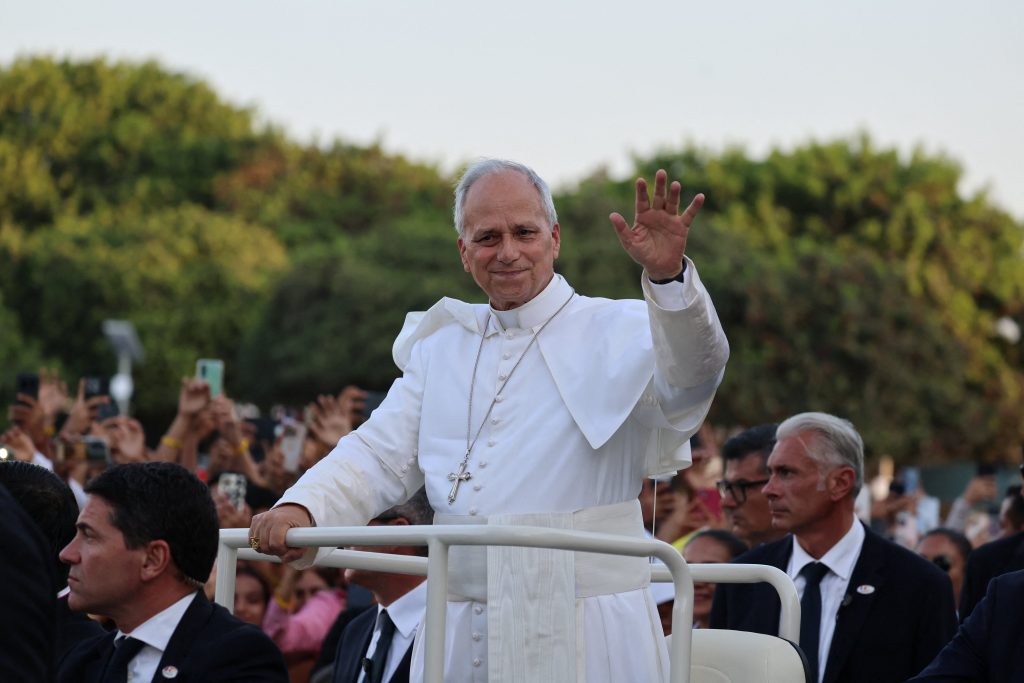
Pope Leo XIV waves as he arrives to address students and members of the university community at Santo Toribio de Mogrovejo Catholic University during his return to Chiclayo, where he served as bishop from 2015 to 2023, as part of his 12-day trip to South America, in Chiclayo, Peru, Nov. 13, 2026. (OSV News photo/Yara Nardi, Reuters)
(OSV News) – “Dear brothers and sisters, my journey is coming to an end, but the mission continues,” Pope Leo XIV said in the concluding homily of his apostolic visit to three South American nations, capping a 12-day tour that blended homecoming, history and a call to unite hearts in the love of God.
The pope — who served for about two decades in Peru as an Augustinian missionary and later as bishop of Chiclayo — celebrated Mass Nov. 16 at Las Palmas Air Base in Lima, drawing some 1.5 million for the liturgy, with thousands more lining the pope’s route to the site.
Crowds waved, clapped and chanted as Pope Leo — standing in the white Chevy Colorado truck customized as his popemobile for the journey — greeted them in a nearly 20-minute circuit of the air base, flanked front and back by security vehicles.
At least one American flag was seen among the numerous banners, posters, rosaries and relics lifted as Pope Leo passed, as a choir, accompanied by traditional Peruvian instruments, sang “León, Hermano del Camino” by Jamie Montoya Ayala, the official hymn of the papal visit to Peru. The hymn’s chorus described the pope as a “brother on the journey” and a “sower of fraternity.”
In his homily, Pope Leo — who holds both U.S. and Peruvian citizenship — underscored that bond, saying, “I will always carry you with me. Yes, the Peruvian people are my people, too!”
Amid the joyful exuberance of the crowds, with many fanning themselves in the heat, Pope Leo looked thoughtful during the entrance procession.
His head was bent at points as he made his way to the altar, which was surrounded by sacred images beloved to Peruvians: Our Lady of Copacabana, the Lord of the Miracles (“El Señor de los Milagros”), and Peruvian saints, including a statue of St. Turibius of Mogrovejo.
The Spanish missionary bishop — who evangelized Peru during the 16th century, and in whose honor the Nov. 16 Mass was celebrated — has served as a model for Pope Leo. Despite more than four centuries separating them, the two share a defining experience: arriving in Peru as missionaries and becoming one with the people they served.
Two days earlier, Pope Leo had traveled to the shrine of the saint (known locally as San Toribio) in Zaña, about an hour north of Chiclayo, where the former Robert Prevost served as bishop from 2015 to 2023. The visit marked the conclusion of the jubilee year for the 300th anniversary of the saint’s canonization.
“Three hundred years after the canonization of St. Turibius of Mogrovejo, the second archbishop of Lima, we give thanks, as Peruvians, for the gift of the Christian faith that his apostolic witness has been deeply rooted in our people,” said Pope Leo in his homily at the Nov. 16 Mass.
He noted that “the missionary mandate was lived out by the first disciples and by countless Christians throughout history,” adding, “That is why we are gathered here today for this celebration: We have been baptized; we have become disciples of Jesus Christ; and, day after day, we are learning to follow all that he commanded us to do.”
Pope Leo highlighted how St. Turibius had “received a special invitation from Jesus,” one that “took him by surprise.”
Forsaking a “promising career in law,” St. Turibius “crossed this country on foot, covering hundreds and hundreds of kilometers, conscious that he was following Jesus himself as he set out to meet the Indigenous peoples,” said Pope Leo.
The future saint “sought to be present in these communities, even as he was still learning their language and coming to understand their beliefs, all with the aim of discerning the quiet work of the Holy Spirit,” the pope said.
St. Turibius, marked by his “tireless dedication to pastoral visits,” was enriched by his encounters with those he evangelized, said Pope Leo.
He recounted that St. Turibius, giving generously and sacrificially to the impoverished, would weep and exclaim, “O poor man, you make me rich! O man with no clothes, you clothe me! O hungry man, you feed me!”
The Spanish missionary would also advocate for the Indigenous, collecting “observations, complaints and petitions concerning the Indigenous population, addressed to the king, with the aim of putting an end to injustices,” said Pope Leo.
The saint’s example “invites us to sanctify our relationships within the Church” and “calls us to recognize ourselves as living members of one Body,” Pope Leo stressed.
“He opened his heart to ecclesial communion and experienced the Church as a missionary communion; namely a communion that comes from her being the true dwelling place of the Trinity,” Pope Leo reflected, adding, “For this reason, the Church values differences, sensitivities, and diverse perspectives within the unity of the faith.”
That unity “is manifested and strengthened in the Eucharist, the sacrament of unity, which was the center of St. Turibius’ life,” said Pope Leo.
The pope pointed to the sacrifice of the Mass as the place of meeting for Christ’s faithful in every age, saying, “Whenever we celebrate the Eucharist, remember his promise: ‘And remember, I am with you always, to the end of the age,'” drawing from Matthew 28:20.
The Spanish missionary also “anticipated” synodality “through the councils and synods he held, in which he knew how to listen, engage in dialogue, welcome the inspirations of the Spirit and put communal discernment into practice, even including the poor in the search for truth,” the pope observed.
Alluding to imagery he invoked in his encyclical, “Magnifica Humanitas,” Pope Leo described St. Turibius as “an architect of the civilization of love, standing against the builders of Babel in his own time.”
The pope also pointed to later Peruvian saints, including St. Rose of Lima, St. Martin de Porres and St. Francis Solano, as fellow “protagonists of this civilization.”
“As we look to them, let us gratefully rediscover the gift of being the Church of Jesus Christ,” said Pope Leo.
Papal Mass volunteer Evelyn Leon, a 45-year-old resident of Lima, told OSV News that she was “very happy and excited” to be on hand for the liturgy.
“My heart is really swelling with a lot of emotion, because we as Peruvians have a very, very fervent faith in God, in the Church,” she said. “And the arrival of the pope has increased faith in all of us Peruvians.”
Another Mass volunteer — wearing the purple penitential robe of a Lord of the Miracles devotee — noted that the papal visit had followed October’s monthlong celebration of the uniquely Peruvian devotion.
Leon said that the purpose of Pope Leo’s visit is unity.
“As you can see, we are a people united, despite the problems we have,” she said. “We have the faith that our country will get ahead.”
Leon said the pope’s departure after his brief but intense homecoming brought both tears and smiles.
“We feel a little sad, but happy,” she said. “It’s like his arrival has been many days for us. And I think he might feel sad, too, because he has to leave.”
At the conclusion of the Mass — shortly before his 14-hour return journey back to Rome — Pope Leo expressed his “gratitude to the Lord for the abundant gifts and graces he has poured out upon us during these days we have shared together.”
“I have felt at home, and you have reminded me that the Church truly is a family,” he told the people of Peru. “It was here that you taught me how to be a bishop, and this time I learned a little more about serving as the Successor of Peter.”
Saying that he will carry with him the warmth of families, the smiles of children, the joy of young people and “tenderness of the grandparents who never missed our events,” the pope said that his apostolic visit renewed his conviction “that the mission must be brought to the ends of the earth.”
“I came to proclaim Christ to you, and I leave with the witness of the faith and devotion that I always admired in you,” Pope Leo added. “Dear brothers and sisters, renewed by the joy of our time together, though separated by distance, let us continue to pray together to Jesus, the way, the truth and the life.”
Social
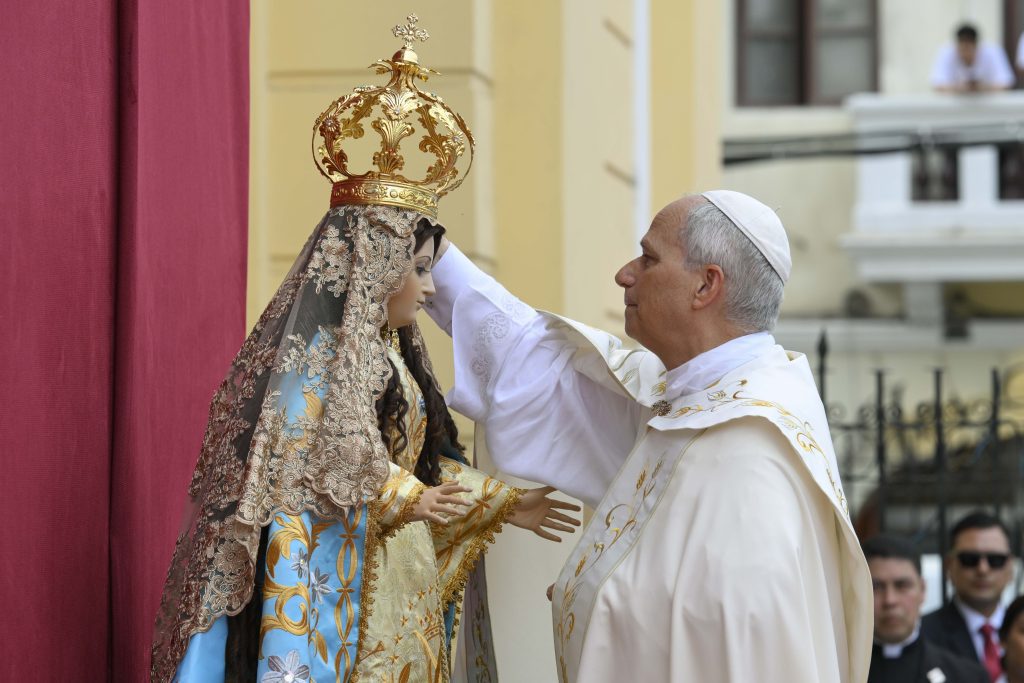
Pope Leo XIV places a crown on a statue of Mary as he presides over the rite of the coronation of the Immaculate Virgin outside the Cathedral of St. Mary in Chiclayo, Peru, Nov. 14, 2026, during his Nov. 6-17 apostolic journey to Uruguay, Argentina and Peru. (OSV News photo/Simone Risoluti, Vatican Media)
LIMA, Peru (OSV News) – At a coronation ceremony at the cathedral of Chiclayo, Pope Leo XIV crowned a statue of the Virgin Mary and entrusted the city he once served as bishop to her maternal protection.
In his homily on Nov. 14 at the Cathedral of St. Mary, the pope expressed his gratitude “for the years the Lord granted us to walk together” and for returning to his former diocese as the Successor of Peter.
“This gesture is particularly significant, for the crown I will place upon our Lady’s head is intended to symbolize the tribute of gratitude and filial love offered to her by the pope, together with you and the whole Church, as we acknowledge her as the loving Mother and Patroness of Chiclayo, exalted by God as Queen of heaven and earth,” the pope said in his homily Nov. 14.
— Mary holds a particular significance for Chiclayo and northern Peru —
As he entered the cathedral’s side entrance, the pope was greeted by hundreds inside. Accompanied by Bishop Edinson Farfán Córdova of Chiclayo, Pope Leo made his way to the sacristy as the people he once served greeted him with chants of “El papa es Chiclayano” (“The pope is Chiclayan”).
Donning white and gold-embroidered vestments, the pope processed toward the cathedral’s front entrance where thousands packed the main square for the ceremony. Near Pope Leo stood a statue of Mary, draped in ornate blue and gold, and a small pillar in front bore the large gold crown he would later place on her head.
As he placed the crown, the choir broke into song, chanting the “Magnificat” as Pope Leo remained in quiet prayer before the statue of Mary. After the ceremony, Pope Leo re-entered the cathedral to greet the crowds.
Mary holds a particular significance for Chiclayo and the entire region in northern Peru. In October, regional governor Jorge Pérez Flores announced that he would submit a formal proposal to declare the Immaculate Conception as the patron saint of the Lambayeque region.
According to an Oct. 23 statement by the Lambayeque regional government, the proposal, which was backed by the Diocese of Chiclayo, would allow the region to “adopt the same devotion shared internationally with countries like the United States, solidifying a milestone of profound spiritual significance for the Lambayeque community.”
In his homily before the rite of coronation, the pope noted the first reading’s reference to a people who walked in darkness, which “seems to envelop us completely,” especially in today’s world where so many are “threatened by the uncertainty of widespread violence and by the unspeakable suffering that continues to afflict so many of our brothers and sisters.”
In the face of this suffering, he continued, “a defenseless child is God’s answer to a humanity plunged into darkness, yet longing for unity and reconciliation.”
— Pope Leo points to Mary as part of the Catholic identity of Chiclayo —
Pope Leo said it is because of her “yes” in response to the angel’s annunciation that Catholics invoke Mary as the “cause of our joy,” and that through her obedience, God “makes all things new, rescues us from the tragedy of sin and reveals to us the eternal destiny to which every man and woman is called.”
Addressing Catholics in Chiclayo, the pope reminded them that the devotion to Mary “is part of the Christian roots that shape your identity and strengthen your faith.”
“Trusting in her intercession and protection, I invite you to keep walking forward together, as one family of God,” the pope said. “A family that longs for a world marked by love and compassion, forgiveness and the pursuit of justice. A family confident that Mary Most Holy always shows us the sure path that leads to Jesus, who is the source of abundant life and truth, and who continually offers us new opportunities.”
Expressing his “filial affection to Mary,” Pope Leo said it was at her side that he “learned to be the shepherd of Chiclayo” and it was through her that he learned “to meet its people and to be attentive to their needs, as you did at the Wedding Feast of Cana.”
“To your Immaculate Heart I entrust today my life and my ministry as Successor of Peter,” the pope said. “I also ask you to watch over and protect the People of God making their pilgrim way in these lands and to guide them always to your Son, Jesus Christ.”
Pope Leo concluded his homily with a prayer to Mary, who “humbly obeyed the will of the Father and gave us an example of simplicity.”
“We beg you to continue walking with us, and to obtain for us from your Son, Jesus Christ, through your maternal heart, the gift of listening attentively to the Holy Spirit, so that, with the help of his grace, we may be ready to follow him faithfully, to be builders of peace and reconciliation, and servants of the Kingdom of God and of our brothers and sisters,” the pope prayed.
After the ceremony, the pope was escorted to Chiclayo Air Base and transported by helicopter to Santa Cruz de Succhabamba, where he will celebrate Mass. After the Mass, Pope Leo will return to Chiclayo, where he will preside over a prayer meeting to close the Jubilee Year of St. Turibius of Mogrovejo.