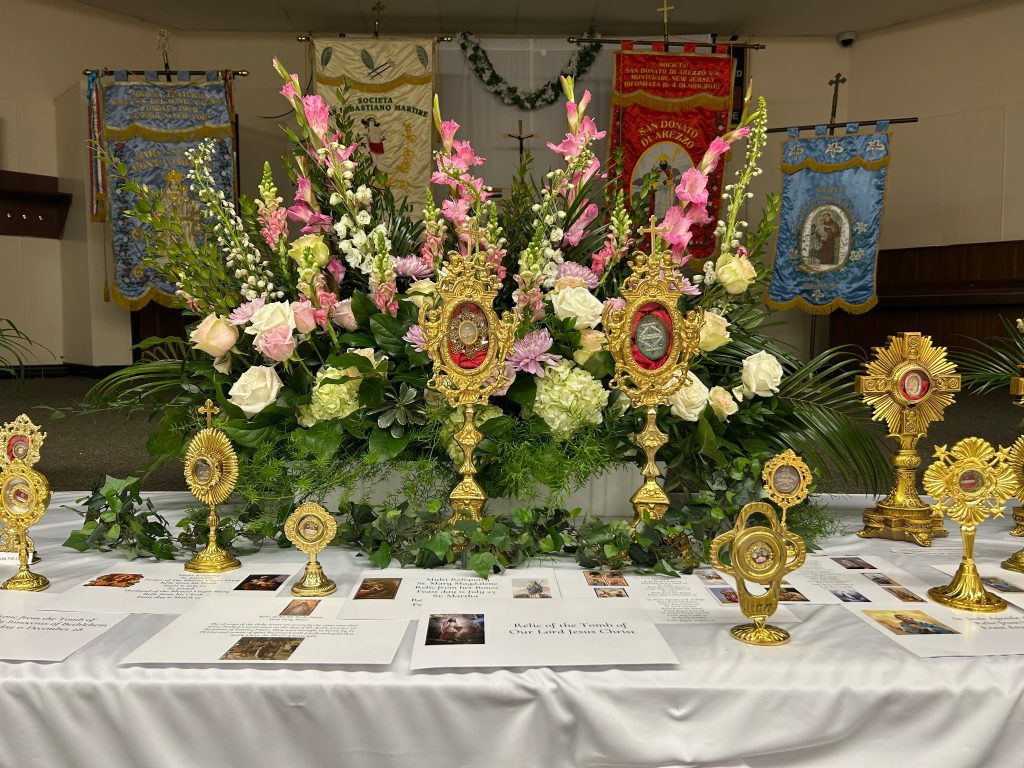
More than 600 major relics of saints and blesseds of the Catholic Church will be on display at the National Centre for Padre Pio in Berks County from Nov. 5 – 8, 2026.
BARTO, Pa. – The National Centre for Padre Pio will host a special Holy Relics Exposition Nov. 5 – 8, 2026, inviting visitors to venerate over 600 major relics of saints and blesseds of the Catholic Church.
Held in celebration of All Saints’ Week and the Feast of the Holy Relics, the four-day exposition offers an extraordinary, potentially once-in-a-lifetime opportunity for prayer and reflection before relics of many of the most important and influential figures in the history of Catholicism.
The exposition is a special part of the Centre’s Year of Saint Pio, which began June 16, 2026, and culminates June 16, 2027, with the 25th anniversary of Padre Pio’s canonization.
Through special events, Masses, and devotions, the Centre is inviting pilgrims to deepen their faith and draw closer to Christ through the life and intercession of Saint Pio.
The collection includes authenticated relics associated with Jesus and the Holy Family, some dating to biblical times, as well as relics of the apostles and evangelists.
Among the featured relics are the blood of Padre Pio, the hair of Pope Saint John Paul II, linen from the deathbed of Saint Carlo Acutis, and the hair scarf of Saint Frances Xavier Cabrini.
The veneration of relics is a longstanding tradition within the Catholic Church, honoring the saints whose lives bear witness to the transforming power of God’s grace. Relics offer a tangible connection to these holy men and women, whose bodies were temples of the Holy Spirit.
Through veneration, the faithful honor God’s work in the saints, seek their intercession, and find encouragement to follow their example of faith, love, and perseverance. This exposition invites pilgrims to encounter that tradition personally and deepen their relationship with Christ.
“Each of these 600 relics tells the story of someone who said yes to God. The saints show us that redemption and holiness are possible for every one of us. This exhibition is a unique opportunity to encounter saints whom we’ve read about our entire lives,” said National Centre for Padre Pio Executive Director Deacon Jim Friend. “I encourage you to join us to learn more about them, ask for their intercession, and leave inspired to deepen your relationship with Christ.”
As pilgrims prepare to celebrate Padre Pio’s canonization anniversary, the exposition invites them to reflect on the communion of saints and the call to holiness in their own lives. Individuals, families, and parish communities are welcome to make these days an occasion for spiritual renewal.
Exposition Hours will be as follows: Thursday, Nov. 5 – Saturday, Nov. 7 from 9:00 a.m. until 4:30 p.m.
Exposition Hours on Sunday, Nov. 8 will be from 11:00 a.m. until 4:00 p.m.
The National Centre for Padre Pio is located in Berks County at 111 Barto Road, Barto, PA 19504.
For additional information, visit www.padrepio.org or call (610) 845-3000.
Social
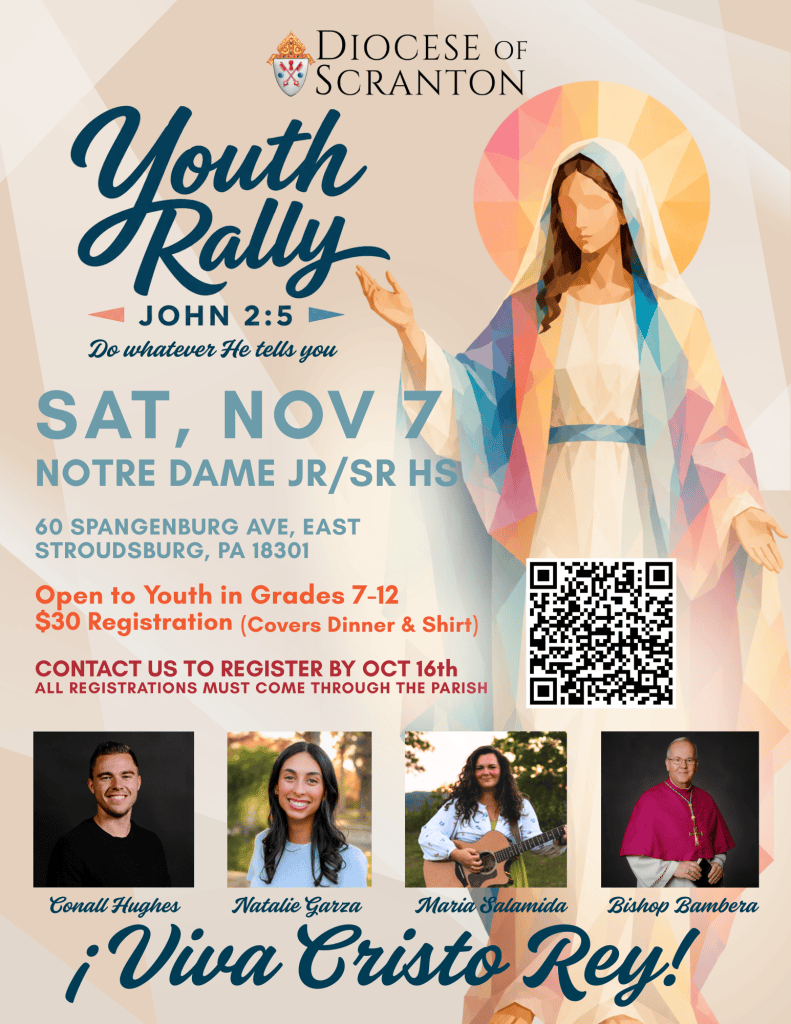
EAST STROUDSBURG – More than 300 young people in grades 7-12 have registered for the fourth annual Diocesan Youth Rally, which will take place on Saturday, Nov. 7, 2026, at Notre Dame Jr./Sr. High School in East Stroudsburg.
The theme for this year’s Youth Rally is “Do Whatever He Tells You.”
The participants – which come from 17 parishes throughout the Diocese of Scranton – will participate in ice breakers, small group talks, Adoration, Mass and more.
Participants will be invited to dive deep into prayer. When the wine runs dry in our own lives — whether that is when prayer becomes difficult, when our circumstances seem to overwhelm us, or when we deeply need God to meet us wherever we find ourselves — we can look to Mary to point us back to her Son by her instruction to “Do whatever He tells you.”
This day will focus on who God is, how to listen to His Voice, and how we as the Young Church can more fully align our wills to the will of God. It will be a day for students to deepen their faith, make new friends, and experience fun and fellowship.
The 2026 Diocesan Youth Rally will begin at 11:30 a.m. and run through 8:00 p.m.
Check-in will open at 11:00 a.m.
Youth will hear from several engaging speakers and musicians. The speakers for this year’s Youth Rally are Conall Hughes, evangelist and Director of Advancement for Damascus Summer Camps, and Natalie Garza, evangelist and teacher who has spoken at several youth conferences in the United States. Conall and Natalie plan to speak about the importance of cultivating a personal relationship with Christ, why it is important to “Do whatever He tells you”, and how to cultivate a deep prayer life.
Music will be led by Maria Salamida, from Franciscan University, and her Steubenville Worship Band!
Social
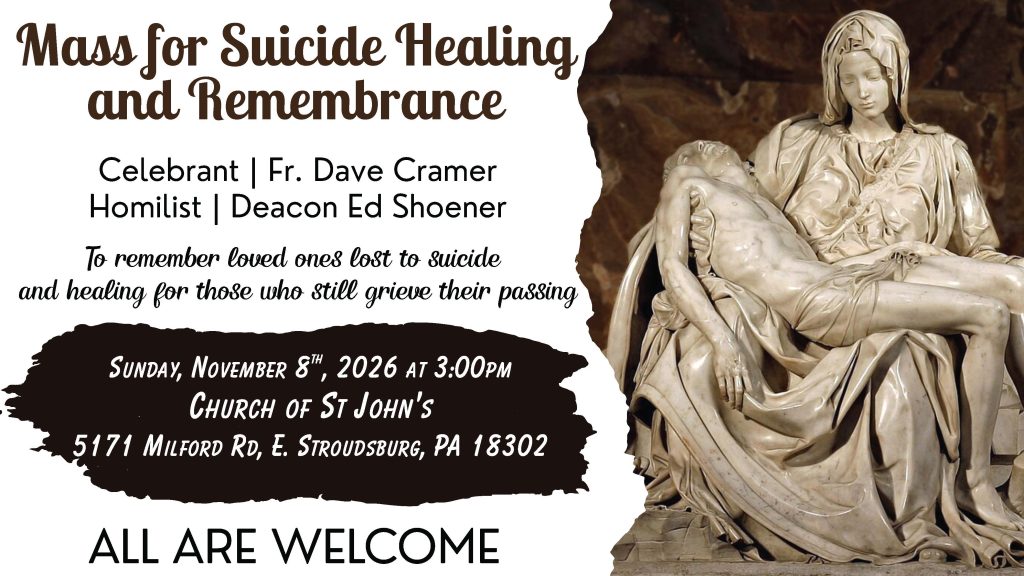
EAST STROUDSBURG – The Northeast Pennsylvania Mental Health Ministry team will hold a Mass for Suicide Healing and Remembrance on Sunday, Nov. 8, 2026, at 3:00 p.m. at the Church of Saint John, located at 5171 Milford Road, East Stroudsburg.
The Mass will serve to remember loved ones lost to suicide, and to promote healing for those who grieve their passing.
Rev. Dave Cramer, Pastor of the Church of Saint John, will be the celebrant for the Mass. Deacon Ed Shoener, President of the International Association of Catholic Mental Health Ministers and Deacon at the Cathedral of Saint Peter and Immaculate Conception Parishes in Scranton, will serve as homilist.
All are welcome to attend.
Social
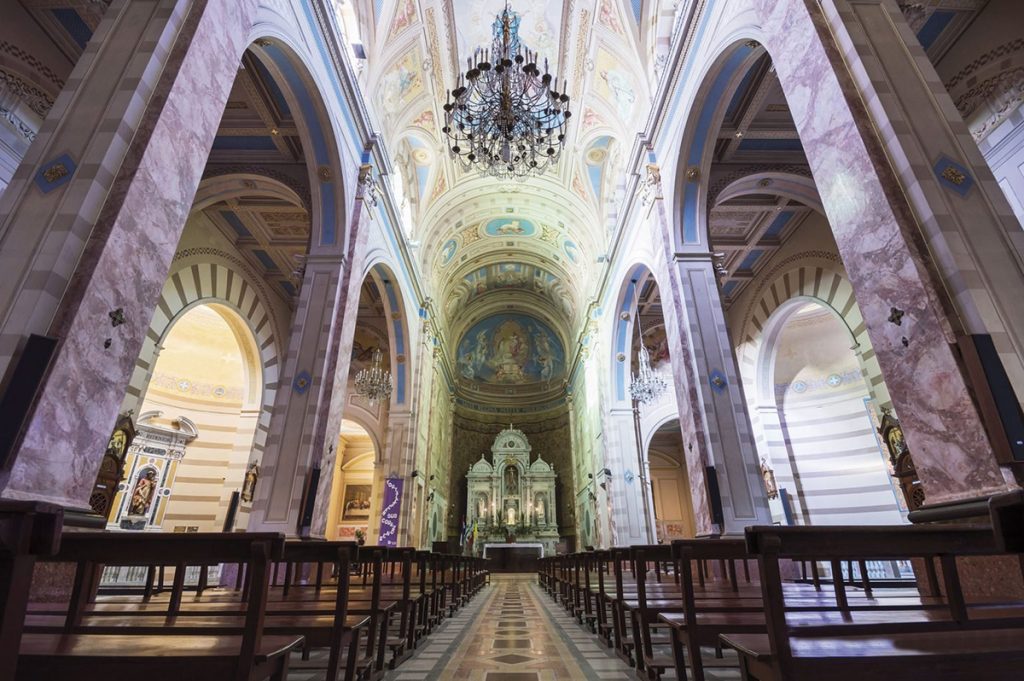
The interior of the National Shrine of Our Lady of the Thirty-Three in Florida, Uruguay, where thousands of pilgrims gather each year to honor the country’s patroness, is seen in an undated photograph. Pope Leo XIV is scheduled to celebrate Mass at the shrine on Nov. 8, 2026, the feast day of the Virgin of the Thirty-Three, during his Nov. 6-8 visit to Uruguay. (OSV News photo/courtesy National Shrine of Our Lady of the Thirty-Three)
(OSV News) – Flying to South America a little over three weeks after his surgery for lung cancer, Pope Leo XIV is going “personally enthusiastic about this trip” with “the ordinary medical assistance” in force, Vatican communicators confirmed during a Nov. 3 briefing in the Vatican Press Office.
The Nov. 6-17 trip will be the first papal visit to Latin America of Pope Leo’s pontificate. Over 12 days, he will celebrate nine public Masses, visit seven cathedrals and preside over two stadium prayer vigils.
Matteo Bruni, Holy See Press Office director, said “about 36 speeches” of the pope will be delivered during the journey.
Maria Monstserrat Alvarado, who assumed her position as prefect of the Dicastery for Communication Nov. 1, told journalists that “he’s going to give you a lot of improvised texts to work with” – something she noted is a “beautiful thing” as “he wants to share his heart and we want to help him do that.”
The pope, she said, will be “giving away his heart in a language that is true to him,” like he did in Spain. “You will see that again, but in a totally different way, because he knows these streets.”
Pope Leo first arrived in Peru in 1985 and the missionary work shaped his vision for the universal Church. There he was appointed bishop and there he experienced challenges and joys of shepherding his flock.
— Pope Leo fit to undertake the trip without special equipment needed —
Speaking to journalists for the first time in a press conference after assuming her role as the first laywoman prefect of the Vatican dicastery, Alvarado said the pope is “excited” before his longest trip of the pontificate so far, and “confirmed this trip with no changes,” adding that he’s “grateful” for the prayers and medical concern.
“When he hears those messages of concern, questions about the doctors, all he hears is the way that people love and have hope for what this journey will bring,” Alvarado said.
During the press briefing Nov. 3, journalists repeatedly asked about the health challenges of changing altitudes and helicopter flights into the Andes region for the pope roughly a month after removing part of his lung during the Oct. 13 surgery.
Bruni confirmed that “there’s no particular accommodation or particular equipment which is being used” medically wise and that “the pope was pretty clear” in his Oct. 26 statement that “the plan is as it is” and no changes to the initial schedule are planned due to his recent hospital stay.
The nature of the surgery, Bruni said, is that it “does not create a permanent condition,” adding that Pope Francis was missing part of a lung and was traveling without disruptions.
“Were any special medical arrangements needed for those journeys? Take our trip to the Holy Land, for example: We packed a week’s worth of events into just three days. It is a condition that allows one to go about life without needing any particular precautions,” Bruni said.
“Should anything change, I will be sure to let you know, but as things stand — based on what the doctors have told us — no therapy is required, and he is clinically fit to undertake this trip,” the press director said.
Alvarado meanwhile mentioned the Nov. 2 Campo Verano Cemetery All Souls’ Mass: “I don’t know if you all watched yesterday’s Mass. His stamina is fantastic,” she pointed out.
“The way that he’s singing is incredible. And you can only sing if your lungs are really strong,” Alvarado said, adding the pope “was past the days of recovery that were required, the 14 days to be able to test him.”
His doctors, she said, “are very confident and he’ll have plenty of medical care on board should something happen. But we don’t see that in his prognosis, the way that he’s acting.”
The journey to Latin America begins Nov. 6 with a flight of more than 14 hours and 6,900 miles from Rome to Montevideo, Uruguay. The return flight from Lima, Peru, to Rome covers 6,700 miles. In between, the pope will travel to a new destination nearly every day, including a 2,200-mile flight from Buenos Aires to Lima and a military helicopter flight Nov. 14 to the Andes mountain town of Santa Cruz de Succhabamba, Peru.
By comparison, Pope Leo traveled 11,000 miles over 11 days during his trip to Algeria, Cameroon, Angola and Equatorial Guinea earlier this year. The trip culminates with a return to Chiclayo, Peru, where he served as bishop from 2015 to 2023.
— Pope Leo coming home with a message of peace —
Asked about the objectives of the trip, Alvarado said there are “two really important parts of what he wants this trip to be.”
First is the homecoming of a pope with Peruvian citizenship to Latin America. “He feels that very deeply,” she pointed out, as “this is a place that gave him his ministry and inspired who he is as a pastor.”
She said the continent taught the pope “the way that he views encounter and the … diverse needs of the Church” and “opened his eyes in a way that’s new and different.”
Reaching for her phone, Alvarado read the second objective and what she said the pope asked her to share with journalists — to help “share his message of peace and encounter with the world” — something she pointed out “is expressed in Latin America through its diverse people and cultures.”
She said the pope hopes “that everyone will be able to see the importance of encounter, for healing and for peace, and why dialogue is so important and the elements of the trip really bring about.”
Pope Leo will start his journey in Uruguay — the most secularized country in Latin America, where his journey will bring him before a small Marian image that Uruguay’s determined secularization could never entirely separate from the country’s national identity — the Virgin of the Thirty-Three.
In Argentina, where he arrives Nov. 8, he will meet a challenge of stepping into the land of the Argentine pontiff, Pope Francis, who never visited his homeland as pope, and a country that Archbishop Jorge Ignacio García Cuerva of Buenos Aires recently described as “a wounded Argentina, a divided Argentina.”
In Peru, he will visit Lima, Chiclayo, Santa Cruz de Succhabamba and Cusco in the Andes and Amazonian Pucallpa, skipping Chulucanas and Trujillo where he served as missionary.
Bruni said while the trip’s program includes “some elements of the pope’s personal history,” it is also “an opportunity to reach those places that normally are not reached,” giving the pope an opportunity to be “following the footsteps of those missionaries who wanted to reach places where Christ had not been taken before” showcasing a “sense of gratitude towards their huge work, the huge work that was done in the beginning of Christianity in Latin America.”
“You’re seeing this balance between Prevost and Pope Leo XIV,” in the trip’s schedule, Alvarado said, referencing the pope’s given last name.
“He belongs to the world. And as much as his heart is in certain places in Peru, he also has to perform the pastoral duties of gathering himself with the individuals who lead these countries and have invited him to these countries,” she said, adding that “there’s a real balance there in terms of where he would love to go … as well as the duties he must perform as the Holy Father.”
— Alvarado’s first trip in the official papal entourage —
Asked about her own emotions prior to the first official trip with the pope, she said “it is an incredible honor and privilege to to be seated as part of his entourage.”
“It’s incredibly emotional to think about a journey that is going to tell us so much about his heart,” she said.
Pointing to one of the earlier questions about Uruguay — the most secularized country on the apostolic trip itinerary, Alvarado said: “Why not? Everyone needs to hear the message of Jesus Christ, and that is part of who Pope Leo is.”
She said the pontiff “understands that he’s not only going to talk to countries and representatives there, he’s going to meet people and meet hearts and hopefully inspire them to look again for the places where the Church was big and now is small” and “reconsider.”
“That’s very much a part of where my heart is and why I said yes to this job.”
Social
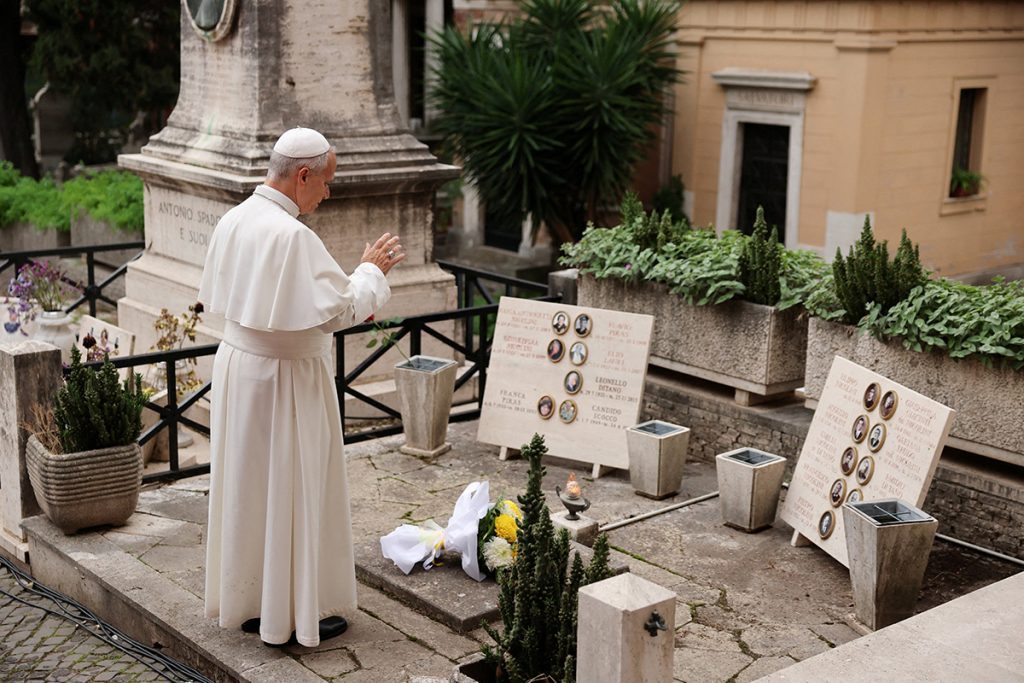
Pope Leo XIV prays at a grave before celebrating Mass for the feast of All Souls at Campo Verano Cemetery in Rome Nov. 2, 2026. Worshippers gathered amid the tombs of the historic cemetery to pray for the dead during the annual liturgy. (OSV News photoYara Nardi, Reuters)
(OSV News) – Surrounded by the tombs and monuments of Rome’s largest cemetery, Pope Leo XIV offered All Souls’ Day Mass Nov. 2, saying prayer for the dead helps lead our loved ones toward full communion with the Lord.
“Dear brothers and sisters, our faith in Christ tells us that our bond with the faithful departed is not severed, but transformed,” Pope Leo said at the Mass in the Campo Verano Cemetery, which covers more than 200 acres.
“Through our prayers for the dead, we accompany our loved ones toward full communion with the Lord — that communion which we truly already taste here, in the Sacrament of the Eucharist,” he said. “Inspired by this faith full of hope, we continue our earthly journey, awaiting the day when He will wipe away every tear, when ‘there will be no more death or mourning or crying or pain, for the old order of things has passed away’ (Rev 21:4).”
On All Souls’ Day, or the Commemoration of the Faithful Departed, the universal church prays for the souls of all those in purgatory. On that day and throughout the entire month of November is customary for Catholics to go to pray in a cemetery and to ask for Masses to be said in remembrance of those who have died.
In his homily in the cemetery, Pope Leo reflected on how “the Beatitudes are the path to a full and fulfilled life, both now and for eternity.”
“Among the eight Beatitudes in the Gospel of Matthew, there is one that touches us in a special way today: ‘Blessed are those who mourn, for they will be comforted’ (Mt 5:4),” the pope said. “At this moment, we wish to pray for all those who have recently lost a loved one; in particular, for those from whom a loved one has been torn away by the senseless violence of war.”
He added, “May the tears of so many mothers, so many children, and so many elderly people touch the consciences of those who have the power to silence the weapons.”
Cardinal Baldassare Reina, the vicar general of Rome, and the parish priest of the nearby Basilica of St. Lawrence Outside the Walls, were among those who concelebrated the outdoor Mass with the pope as the sun began to set on the overcast day in Rome.
On Nov. 5, the day before leaving for South America, Pope Leo will celebrate a morning Mass in St. Peter’s Basilica for the cardinals and bishops who have died during the past year.
Social
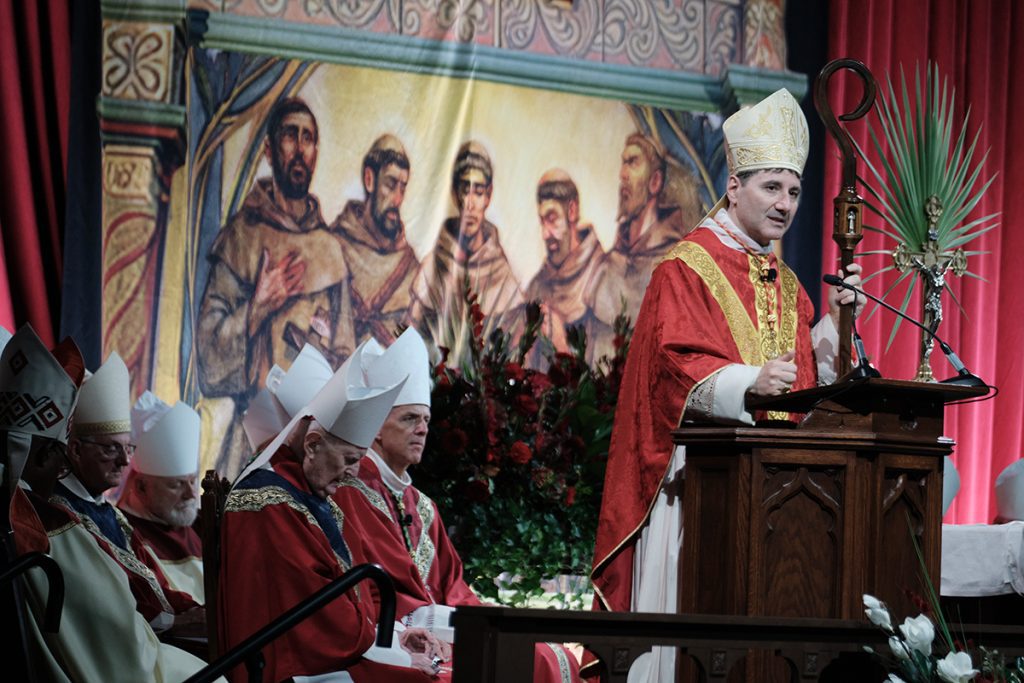
Cardinal Frank Leo of Toronto, papal delegate and principal celebrant, delivers the homily during the beatification Mass for the five Georgia Martyrs Oct. 31, 2026, at the Savannah Convention Center on Hutchinson Island in Savannah, Ga. The martyred Spanish Franciscan missionaries, who were killed at their Georgia missions in 1597, were Fathers Pedro de Corpa, Blas Rodríguez de Cuacos, Miguel de Añon, and Francisco de Veráscola and Brother Antonio de Badajoz. (OSV News photo/George Martell)
SAVANNAH, Ga. (OSV News) – Five Franciscan friars killed in present-day Georgia for defending Church teaching in 1597 were beatified Oct. 31 in a Mass where Church leaders considered their witness amid historical complexities and contemporary challenges.
The Mass at the Savannah Convention Center began at 11 a.m. with Cardinal Frank Leo of Toronto, the papal delegate, as principal celebrant.
“The 16th-century Franciscan friars from Spain, courageous missionaries ministering to the Guale people in La Florida, are bright lights for our journey of faith, as they reflect the light of Christ into the challenges and complexities of a wounded world,” he said in the homily. “It is imperative to remember those blessed souls who have gone before us, marked with the sign of faith, especially those who gave the supreme witness of their very lives.”
Concelebrating bishops included Archbishop Gabriele Caccia, papal nuncio to the U.S.; Bishop Stephen D. Parkes of Savannah; Bishop J. Kevin Boland, bishop emeritus of Savannah; Archbishop Gregory J. Hartmayer of Atlanta; Archbishop José Rodríguez Carballo of Mérida and Badajoz, Spain; and Archbishop Joan-Enric Vives i Sicília of Urgell, Spain, a delegate of Spain’s episcopal conference.
Also concelebrating the Mass were Father Michael Perry, provincial minister of the Province of Our Lady of Guadalupe of the Order of Friars Minor, and Father Giovangiuseppe Califano, the order’s postulator general, along with dozens of other priests. The liturgy included both English and Spanish, with Latin included in the hymns.
— ‘Unconquered heralds of Christ’ —
Near the beginning of Mass, Bishop Parkes made the official request for beatification to Cardinal Leo, briefly outlining the history of the friars’ cause. He noted that the Church is celebrating a Jubilee Year marking the 800th anniversary of the death of St. Francis of Assisi, the founder of the Franciscans.
Bishop Perry read short biographies in English of each of the Georgia Martyrs, drawn from contemporary accounts and records, followed by the biographies in Spanish read by Father Pablo Migone, the Diocese of Savannah’s vicar of mission advancement and one of the driving forces behind the effort to recognize the Georgia Martyrs formally as saints of the Church.
Cardinal Leo then read aloud Pope Leo XIV’s apostolic letter proclaiming the five friars beatified. Archbishop Hartmayer, a Conventual Franciscan friar, read the letter in English, and Archbishop Vives i Sicília read the letter in Spanish.
The letter, which Pope Leo signed in Rome Sept. 30, 2026, the feast of St. Jerome, called the Georgia Martyrs “unconquered heralds of Christ” who “placed the saving truth of the Gospel before their own safety.” It also established Sept. 22 as the martyrs’ liturgical memorial.
With the official proclamation, the official beatification image of the five friars was unveiled to the hymn “Holy God, we praise thy name.” Drawing on traditional depictions of the martyrs, the artwork “The Georgia Martyrs” by Savannah artist Jared Matthew Seff won a contest for the official image held this year by the Diocese of Savannah.
— 1597 Guale Uprising —
In 1597, the Spanish Franciscans Pedro de Corpa, Blas Rodríguez de Cuacos, Miguel de Añon, Antonio de Badajoz and Francisco de Veráscola were ministering at five missions along the coast and barrier islands of present-day Georgia when they were killed out of hatred for the faith by a band of Indigenous men between Sept. 14-17.
The friars’ murders were prompted by Father de Corpa angering the heir to a Guale chiefdom, Juanillo, by telling him that as a baptized Christian, he could not follow his culture’s custom and take a second wife. Juanillo and his men killed the priest at a mission near the contemporary city of Eulonia, Georgia, before killing four of the other five Franciscan missionaries ministering in the area. The sixth friar, Francisco de Avila, was kidnapped and tortured for months before being set free. The incident is known as the 1597 Guale Uprising.
At the time, the Spaniards knew the wider coastal area as La Florida, home to the settlement of St. Augustine, established in 1565. By 1595, the friars had established five missions along the coast. Prior to their murders, the six Franciscans appear to have lived among the Guale and other indigenous peoples in peace, without a military presence, for two years.
The beatification Mass drew around 10,000 attendees. The processional cross was adorned with palms, a traditional sign of martyrdom. The liturgy included a choir and orchestra. A setting of Psalm 116 in Spanish by Marc Cerisier and a motet for Communion titled “Eternal Glory” by Jessica French were composed for the liturgy.
— Martyrs’ witness to Church teaching on matrimony —
In remarks after the beatification rite, Bishop Parkes said, “I truly believe that through the intercession of Blessed Pedro de Corpa and four companions there will be greater respect for the dignity and character of the sacrament of holy matrimony.”
He continued: “May the witness of these holy men inspire fidelity between spouses, called into the covenantal bond of holy matrimony and help to create a renewed commitment to the growth of faith-filled families in the state of Georgia and beyond.”
In the homily, preached in English and Spanish, Cardinal Leo spoke about the martyrs’ witness to the truth of Church teaching and how their lives 400 years ago challenge Christians to more deeply embrace their faith today. In Spanish, the cardinal sent a special greeting to the delegation that came from Spain to share in this moment of faith and joy.
With their beatification, “these newly minted blesseds are constituted powerful intercessors and extraordinary examples for every believer,” he said.
“Fidelity to Christ himself is the glory of the martyrs,” Cardinal Leo said. “The Church considers martyrdom an exceptional gift, and as the fullest proof of life.”
The Catechism of the Catholic Church teaches that martyrdom “is the supreme witness given to the truth of the faith. It means bearing witness even unto death,” he said, quoting paragraph 2473. “The martyr bears witness to Christ who died and rose, to whom he is united by charity. He bears witness to the truth of the faith and of Christian doctrine. He endures death through an act of fortitude.”
“For those who have not entered into the mystery of God in Christ, their death might seem as a total and utter catastrophe, but it is not so,” he said.
Pointing to the Mass’ Gospel reading from John 15:18-21, Cardinal Leo said, “St. John sets the record straight.”
“Whoever is begotten by God conquers the world, and the victory that conquers the world is our faith,” he said. “Who indeed is the victor over the world, but the one who believes that Jesus is the Son of God?”
“Very often today, aspects of the Catholic faith are challenged by many, and in countless ways we are cajoled and tempted to water down the very demands of the Gospel — to compromise the integrity of our faith, and to conform ourselves to the spirit of this age,” he continued.
With the martyrs’ witness, “we come to comprehend more clearly” the need to conform one’s life to Christ, “and to see everything and anyone in our life — relationships, studies, work and ministry — in relation to him and to his eternal kingdom.”
— Faith the greatest gift to share —
Cardinal Leo noted that the beatification coincided with the 250th anniversary of the signing of the Declaration of Independence in the United States and the 800th anniversary of St. Francis’ death.
“Of the many gifts we can give to others, the faith is among the greatest,” he said. While Christians can share their time, resources and belongings, “preaching, teaching, sharing and witnessing to the faith is truly No. 1 on the list,” he said.
The martyrs’ example helps young people in particular, he said, “to appreciate that no greater treasure can be found in this earthly existence than following Jesus with an undivided heart and using generously our gifts to serve others and to build up God’s kingdom. The meaning, the purpose, and the joy we experience in living for the Lord is unparalleled.”
He concluded: “There are still some things today worth living and dying for.”
— Trees at beatification to be planted at martyrs’ monument —
As the Mass ended, Bishop Parkes gave thanks to God for the witness of Blessed Pedro de Corpa and his four companions. He recognized the Church dignitaries present at the beatification and the work of those who helped to advance the martyrs’ cause and efforts to prepare the beatification liturgy.
He said that the eight palm trees used during the beatification to adorn the convention center would be transplanted at the Georgia Martyrs’ monument at Nativity of Our Lady Catholic Church in Darien, Georgia.
“If you happen to be driving by, perhaps you will stop, say a prayer and give thanks to God for the graces received and for family life,” he said.
— A long road to beatification —
Reports from civil and religious leaders in the months and years after the Franciscans’ deaths reveal that the slain friars’ contemporaries saw them as martyrs. New research in the 20th century about the history of La Florida and the Georgia Martyrs bolstered efforts to move forward with a cause for their beatification.
The Mass program recognized the many people over decades who were instrumental to the martyrs’ cause, dating back to Bishop John M. Gannon of Erie, Pennsylvania, who served as that diocese’s shepherd from 1920-1966, proposed that the U.S. bishops petition the Holy See for the Georgia Martyrs’ cause.
The names of the Georgia Martyrs were included in two efforts in the early 20th century to launch canonization causes for people, many of whom were missionaries, martyred for the faith over the course of several centuries in the United States and surrounding countries. After neither effort moved forward, the Franciscans decided to focus their efforts on a group of martyrs who died for the same reason, honing in on Blessed Pedro de Corpa and companions.
With the support of the Order of Franciscans Minor, the Diocese of Savannah opened the cause for the martyrs’ canonization in February 1984 under Savannah’s Bishop Raymond W. Lessard, who died in 2016. In January 2025, Pope Francis authorized the Dicastery for the Causes of Saints to formally recognize the five friars’ martyrdom “in hatred of the faith” and they received the title “venerable.”
The Mass’ program also recognized the contributions of Franciscan Father Conrad Harkins, the former vice-postulator for the cause who died in 2020, and David Hurst Thomas, senior curator in residence for North American Archaeology at the American Museum of Natural History, “for their extraordinary contributions” to the cause. “Their work on the ruins of Mission Santa Catalina de Guale shed new light on the intersection of Chiefdom, Crown, and Church during the Spanish mission period on the Georgia coast,” it stated.
— Location of Georgia Martyrs’ relics a mystery —
While what was recovered of the martyrs’ relics was linked to miraculous cures, their current location is unknown. Remains of all the friars but Friar Francisco were identified after their deaths, and their relics and some other personal items were collected in the months and years that followed and brought to St. Augustine. Some scholars speculate that Franciscans took the martyrs’ remains with them to Cuba when St. Augustine transferred to British rule in 1763. A skull recovered at the Fort King George State Historical Site in Darien may have belonged to one of the friars and is being tested to learn more about its origins.
On Nov. 1, Archbishop Hartmayer will preside over, with Bishop Parkes concelebrating, a Mass of thanksgiving at 11:30 a.m. at the Cathedral Basilica of St. John the Baptist in Savannah, which will also be livestreamed at the cathedral’s website, savannahcathedral.org.
The Georgia Martyrs’ beatification was the second beatification to take place in the United States this year. In September, Blessed Fulton J. Sheen was beatified by papal delegate Cardinal Luis Antonio Tagle at The Dome at America’s Center in St. Louis.
Beatification is the second-to-last stage in the process that seeks canonization, by which the pope proclaims that a person is truly in heaven. A beatification comes after the person’s life, reputation and writings are investigated. For martyrs, beatification does not require the confirmation of a miracle attributed to their intercession. However, a miracle is usually required for canonization.
Social
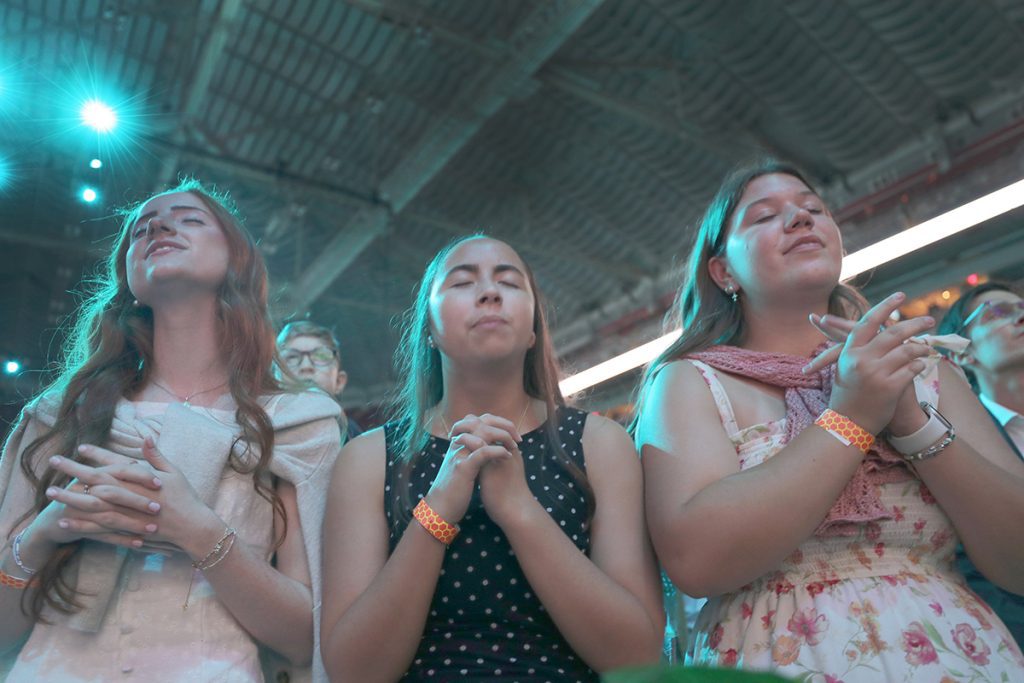
Young women pray while listening to Catholic musician Matt Maher perform ahead of the beatification Mass for Archbishop Fulton J. Sheen Sept. 24, 2026, at The Dome at America’s Center in St. Louis. Blessed Fulton J. Sheen is remembered as one of the most influential and innovative evangelists in American history. (OSV News photo/Bob Roller)
(OSV News) – Data points to “signs of strength and stability” in religious behavior in the U.S. — but there are “mixed signals” among young adults, and demographers advise taking a “long view” of any shifts, according to Pew Research Center.
On Oct. 28, Pew and the Knight Foundation released an analysis of several surveys to provide an updated look at the latest trends in religion among U.S. residents, with an additional focus on young adults.
Data was drawn from Pew’s 2026 National Public Opinion Reference Survey and its 2025 Cross-Sectional Engagement Survey. The aggregated data was compared with previous data — including Pew’s 2007, 2014 and 2023-2024 Religious Landscape Studies — with other data drawn from a phone survey conducted May 26-June 1.
The Pew-Knight report said following “a prolonged decline” in religion in the U.S., since 2020 “steady percentages” of the nation’s adults have said they identify with, value and, in some form, practice religion.
Since the COVID-19 low point, when houses of worship were closed or had very limited accessibility due to pandemic protocols, more Americans say they have attended religious services within the past month: 34% in person, and 45% either in person or by some form of broadcast, according to a June survey cited by the report.
— ‘Mixed signals’ when it comes to young adults —
But, researchers cautioned, Pew’s “latest surveys contain mixed signals about what is happening among young adults.”
Those born from 2004-2008, who are now about ages 18 to 22, are “reporting relatively high rates of attendance at religious services,” said the report.
Of that group, 41% attend a service at a house of worship at least once or twice a month — higher than the overall national average of 33%, the Pew-Knight report found.
Yet those who are just a few years older — about 23 to 26 — “are the least religious age group” in terms of prayer frequency as well as valuing and identifying with a religion, said the report. In contrast to their younger peers, 27% say they attend religious services at least monthly.
More broadly, said the report, the 18-22 year old cohort members “are no more religious today than young adults in this age range were in 2014.”
In addition, the report said, “young adults between 23 and 26 today are less religious than people in this age range were in 2014.”
Overall, both age groups “are significantly less religious than young adults of the same ages were in 2007,” the Pew-Knight report said.
Researchers added, “We have no clear evidence that any birth cohort we can track over time has become more religious in recent years.”
–Political affiliation, narrowing gap between men and women–
They also noted that the youngest Republican adults reported attending religious services more often than their Democrat counterparts.
However, said the report, the former “are not solely responsible for the high levels of religious attendance among the youngest adults,” since “the youngest Democrats also attend services at relatively high rates” compared with fellow Democrats in some older age groups.
Researchers highlighted that recent Pew surveys have seen a kind of gender reversal in religious practice, with the youngest men reporting more frequent attendance at religious service than their female peers.
Previously, “American women have tended to be more religious than American men,” said the report.
While “that’s still true today,” at least regarding prayer frequency and the valuation of religion, the gender differences “are less stark than they used to be,” the report said.
The gap is narrowing not due to increased religiosity among men, said the report.
Rather, “both women and men in the U.S. have become less religious over time” in terms of regular prayer, religious identification and religious valuation, the report said.
— Long view needed to understand ‘complicated picture’ —
The Pew-Knight report also noted that earlier studies have also showed “the youngest Americans entering adulthood with relatively high rates of religiousness,” only to have it “fade with time.”
“We have no way of knowing whether today’s youngest adults will follow that pattern or break it,” said researchers.
Ultimately, the report described religion among the nation’s young adults as “a complicated picture,” with the findings among several other major polls yielding variation in results.
The Pew-Knight report also stressed that “Americans who have just recently become adults are a difficult group to study in surveys.”
Spread between childhood homes, college and new employment, “they can be hard to reach in surveys,” said the report, noting the risk of biased findings if samples are not representative.
Sample sizes themselves are small, said the report, “since the nation’s youngest adults make up a relatively small share of the country’s population,” and the pool becomes even smaller when additional variables, such as political party affiliation, are factored in.
Ultimately, said the report, “it’s prudent to take a long view,” as religion scholars typically examine “religious change over decades.”
“Time will tell whether the relatively high religiousness of today’s youngest adults is a turning point or a blip in the data,” said the report.