VATICAN CITY (OSV News) – Pope Leo XIV has encouraged young Catholics preparing to receive the sacrament of confirmation to ask the Holy Spirit for the gift of perseverance, warning that too many young people “disappear from the parish” after receiving the sacrament.
Speaking off the cuff to roughly 1,000 young pilgrims from the northern Italian Archdiocese of Genoa May 16, the pope said that the fullness of the Holy Spirit received at confirmation provides the strength “to live our faith in a world that so often seeks to lead us away from Jesus.”
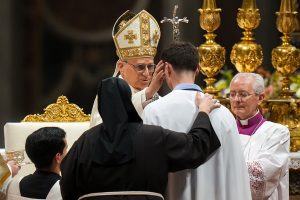
Pope Leo XIV confirms a man he baptized during the Easter Vigil in St. Peter’s Basilica at the Vatican April 4, 2026. (CNS photo/Lola Gomez)
“It is beautiful to receive this Sacrament, because the fullness of the Holy Spirit gives us this enthusiasm, this strength, this ability to follow Jesus Christ, to say ‘Yes’ to the Lord always, to have no fear of following Him courageously,” the pope said in the Vatican’s Hall of Blessings.
Pope Leo added that conferring confirmation is one of the greatest joys of a bishop’s ministry, but acknowledged that “there is another aspect that is rather sad.”
“Sometimes, when the bishop confers Confirmation — the gift of the Holy Spirit — you never see the young people again,” Pope Leo said. “They disappear from the parish.”
The pope urged the confirmation candidates to pray to the Holy Spirit for perseverance, encouraging each of them to make a personal commitment to persevere in following Christ after receiving the sacrament.
“It is so important that each of you also makes this commitment, this promise to the Lord: that you truly wish to continue as His friends, His disciples, His missionaries, and that you wish to persevere in the faith,” the pope said.
The Catechism of the Catholic Church teaches that confirmation, together with baptism and the Eucharist, constitutes the sacraments of Christian initiation, and that its reception is necessary for the completion of baptismal grace.
Pope Leo encouraged the confirmandi to return to their parishes, participate in community life and hold fast to the joy that they experienced during their preparation for the sacrament and their pilgrimage to Rome.
“May this joy live in your hearts and may you continue to be faithful disciples of Jesus Christ,” he said. “May you persevere in the faith.”
“Jesus Christ wants to walk with you, with each one of you, and with all of you in community, which is so important,” the pope said.
The Church teaches that confirmation provides a deepening baptismal grace, uniting the faithful more firmly to Christ, increasing the gifts of the Holy Spirit, and giving a special strength to spread and defend the faith
“We do not live our faith alone; we live it together,” Pope Leo said. “And forming these bonds of friendship and community is a way of living out perseverance as disciples of Jesus.”
Speaking ahead of the feast of Pentecost, which falls on May 24, the pope recalled the outpouring of the Holy Spirit upon the first apostles, who went on to “proclaim the Gospel, to proclaim the love of God.”
He told the candidates for confirmation, “You will all take part in this mission, because we are all sent: to your families, to your friends, to all people. And you must be a living witness to the Spirit who dwells in us.”
Social
(OSV News) – Bishop Michael M. Pham of San Diego said the faithful there “stand united in solidarity and prayer with the Muslim community” after a deadly May 18 shooting at a mosque complex in that city killed three adults, including a security guard.
The two teen suspects were later found dead of apparent self-inflicted gunshot wounds.
A nearby landscaper was also reported to have been shot at during the attack, but, according to police, was expected “to be OK.”
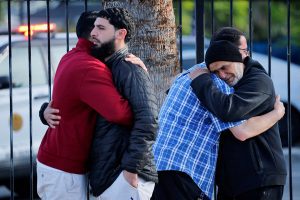
Men embrace outside the Islamic Center in San Diego May 19, 2026, after a deadly shooting the previous day. One of the three people killed by two teen shooters at a San Diego mosque was a beloved security guard who acted quickly to prevent more deaths, authorities and community members said. The two teenage gunmen killed themselves a few blocks away — in an attack police are investigating as a hate crime. (OSV News photo/Mike Blake, Reuters)
No children from the mosque’s school and no officers were injured, according to San Diego police.
Law enforcement is now investigating the shooting as a hate crime.
The attack unfolded just before 12 p.m. at the Islamic Center of San Diego, located in that city’s Clairemont neighborhood.
About two hours earlier, the mother of one teen suspect had alerted police she believed her son was suicidal and that “several of her weapons,” along with her car, had been taken, according to the San Diego police chief.
She said her son had left with a companion, both dressed in camouflage, and also said she had found a note left behind, which police later said contained “general hate speech.”
San Diego police said the suspects were ages 17 and 18, and that the names of victims and suspects were being withheld pending notifications.
Speaking at a press briefing, San Diego police chief Scott Wahl described the slain security guard’s actions as “heroic,” adding, “Undoubtedly, he saved lives today.”
Imam Taha Hassane, the Islamic Center’s director, told media that it was “extremely outrageous to target a place of worship” such as the center.
Hassane said, “The other mosques and all the places of worship in our beautiful city should always be protected.”
“The Islamic Center has been a longtime partner in our collaborative work for justice, especially in accompanying immigrants,” said Bishop Pham in his statement.
“Houses of worship must always be sanctuaries of peace, safety, and prayer. An attack on one faith community is an attack on the sacred dignity of all human life,” said the bishop.
Speaking “on behalf of the entire Roman Catholic community of San Diego,” Bishop Pham offered “my deepest condolences, solidarity, and fervent prayers to the families of the victims and the entire Muslim community.”
Social
WASHINGTON (OSV News) – The number of executions around the globe in 2025 surged to the highest recorded figure in 44 years, a new Amnesty International report said.
The May 17 report, titled “Death Sentences and Executions 2025,” comes soon after a recent video message from Pope Leo XIV marking 15 years since the abolition of the death penalty in his home state of Illinois, and shortly after the U.S. Department of Justice said in court filings it would seek the death penalty for the man charged with the fatal shootings of two people outside a May 21, 2025, event at the Capital Jewish Museum in Washington.
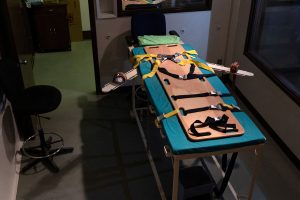
A lethal injection chamber at Washington State Penitentiary in Walla Walla, Washington, September 6, 2024. The number of executions around the globe in 2025 surged to the highest recorded figure in 44 years, according to a new Amnesty International report released May 17, 2026. (OSV News photo/Matt Mills McKnight, Reuters)
Amnesty International recorded executions of 2,707 people across 17 countries in 2025, the highest number recorded by the group since 1981. However, the group cautioned that its tally does not include what it believes to be thousands of executions carried out in China, adding that the country therefore remained the world’s top executioner.
“This alarming spike in the use of the death penalty is due to a small, isolated group of countries willing to carry out executions at all costs, despite the continued global trend towards abolition,” Agnès Callamard, Amnesty International’s secretary general, said in a statement. “From China, Iran, North Korea and Saudi Arabia to Yemen, Kuwait, Singapore and the USA, this shameless minority are weaponizing the death penalty to instill fear, crush dissent and show the strength state institutions have over disadvantaged people and marginalized communities.”
Excluding China, the report estimated that Iranian authorities, the main drivers behind the spike, executed at least 2,159 people, more than double their 2024 figure. Saudi Arabia carried out at least 356 executions; Kuwait and Singapore carried out 17 each; Egypt carried out 23. The U.S., meanwhile, carried out 47. According to the report, 46% of all known executions worldwide were attributed to drug-related offenses.
“It’s time for executing countries to step into line with the rest of the world and leave this abhorrent practice in the past,” Callamard said. “The death penalty does not make us safer. Rather, it is an irreversible affront against humanity that’s driven by fear, with utter disregard for international human rights law.”
Based in London, Amnesty International is an international non-governmental organization focused on human rights.
In his April video message, Pope Leo said, “The Catholic Church has consistently taught that each human life, from the moment of conception until natural death, is sacred and deserves to be protected.”
“Indeed, the right to life is the very foundation of every other human right,” he said.
“For this reason,” he continued, “only when a society safeguards the sanctity of human life will it flourish and prosper.”
The Catholic Church’s official magisterium opposes the use of capital punishment, considering it inconsistent with the inherent sanctity of human life, and advocates for the practice’s abolition worldwide.
The late Pope Francis revised the Catechism of the Catholic Church in 2018 to clarify the Church’s teaching that capital punishment is morally “inadmissible” in the modern world and that the Church works with determination for its abolishment worldwide.
In his 2020 encyclical, “Fratelli Tutti,” Pope Francis addressed the moral problem of capital punishment by citing St. John Paul II, writing that his predecessor “stated clearly and firmly that the death penalty is inadequate from a moral standpoint and no longer necessary from that of penal justice.”
Social
VATICAN CITY (OSV News) – Pope Leo XIV’s first encyclical, “Magnifica Humanitas,” will be published May 25, addressing artificial intelligence and the protection of human dignity, the Vatican has announced.
The encyclical, the title of which is Latin for “Magnificent Humanity,” was signed by the pope on May 15, the 135th anniversary of “Rerum Novarum,” Pope Leo XIII’s foundational 1891 social encyclical on labor and capital written during the first Industrial Revolution.
In an unprecedented first, Pope Leo XIV will be present in person at the Vatican press conference to mark the publication of the social encyclical, along with a tech founder from one of the world’s fastest growing AI companies.
The words “artificial intelligence” are seen on a computer screen in this illustration taken May 4, 2023. Pope Leo XIV’s first encyclical, “Magnifica Humanitas,” will be published May 25, addressing artificial intelligence and the protection of human dignity, the Vatican announced May 18, 2026. (OSV News photo/Dado Ruvic, Reuters)
Christopher Olah, co-founder of the artificial intelligence company Anthropic, which developed the AI large language model (LLM) named Claude, will speak on a panel presenting the document at the Vatican’s Synod Hall on May 25 at 11:30 a.m local time.
Also joining the panel will be Anna Rowlands, a British theologian specializing in Catholic social teaching who helped organize the Synod on Synodality, and Léocadie Lushombo, a professor of theological ethics at the Jesuit School of Theology at Santa Clara University. Cardinal Víctor Manuel Fernández, prefect of the Dicastery for the Doctrine of the Faith, and Cardinal Michael Czerny, prefect of the Dicastery for Integral Human Development, will also take part in the press conference. Pope Leo XIV and Cardinal Pietro Parolin, the Vatican Secretary of State, will give speeches at the end of the press conference.
Pope Leo XIV has expressed interest in the issue of artificial intelligence and the dignity of work since the first week of his pontificate, telling the College of Cardinals days after his election in May 2025 that he took his papal name partly in honor of Pope Leo XIII, whose landmark encyclical “Rerum Novarum” has shaped the Church’s social teaching for more than a century.
“In our own day, the Church offers to everyone the treasury of her social teaching in response to another industrial revolution and to developments in the field of artificial intelligence that pose new challenges for the defense of human dignity, justice and labor,” Pope Leo XIV said two days after his election.
The first American pope and a former mathematics major, Pope Leo has returned to the subject of AI again and again in speeches, messages and interviews in his first year, leading Time magazine to include him on its 2025 list of the world’s most influential people in artificial intelligence, with the magazine describing him as a spiritual counterweight to Silicon Valley.
Pope Leo has addressed the issue of AI in venues ranging from a sports stadium packed with teenagers, whom he told to use AI “in such a way that if it disappeared tomorrow, you would still know how to think,” to a gathering of legislators from 68 countries, where he insisted that artificial intelligence is a tool meant to serve human beings, not replace them. The pope has also warned priests not to use chatbots to write their homilies and expressed concern for AI’s potential effect on children’s “intellectual and neurological development.”
The pope’s 2026 message for the 60th World Day of Social Communications, published in January, has been his most robust document on AI and protecting human dignity to date. In the papal message, he underlined that “our faces and voices are unique, distinctive features of every person” that reveal “a person’s own unrepeatable identity” and that by “simulating human voices and faces, wisdom and knowledge, consciousness and responsibility, empathy and friendship,” AI systems “encroach upon the deepest level of communication, that of human relationships.”
Pope Leo also warned that AI systems “have increasingly taken control of the production of texts, music and videos,” putting “much of the human creative industry at risk of being dismantled and replaced with the label ‘Powered by AI,’ turning people into passive consumers of unthought thoughts and anonymous products without ownership or love.”
“The ability to access vast amounts of data and information should not be confused with the ability to derive meaning and value from it. The latter requires a willingness to confront the mystery and core questions of our existence,” Pope Leo said in a December speech to participants in an AI conference.
“It will therefore be essential to teach young people to use these tools with their own intelligence, ensuring that they open themselves to the search for truth.”
Social
SWOYERSVILLE – On May 9, 2026, the Swoyersville Council Knights of Columbus made a bus pilgrimage from Swoyersville to the National Centre for Padre Pio in Barto, Pennsylvania.
Organized by the St. Elizabeth Ann Seton Council’s Grand Knight Mark Perugino, the day was inspirational including: Reconciliation, Mass, blessing with Padre Pio’s relics, Rosary, Divine Mercy Chaplet, Lunch, Tour through the Saint Padre Pio Museum, and a film on the founding of the Centre.
The Centre was founded by Vera Calandra whose one daughter was healed by Padre Pio in 1968, a miracle that helped usher in the Saint’s Canonization.
Social
(OSV News) – How might you help a nation in political turmoil celebrate its 250th anniversary and the unlikely creation of the first large-scale, self-governing republic in the modern world?
Dedicate it to the Sacred Heart of Jesus — as the U.S. bishops will do for the United States of America on June 11, marking the first such formal consecration of the country to Christ’s heart.
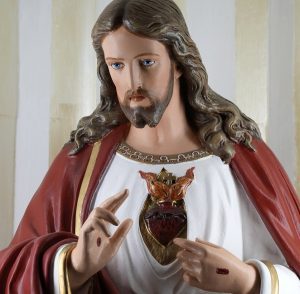
A statue depicting the Sacred Heart of Jesus is seen at Sacred Heart Church in the North End neighborhood of Boston April 22, 2026. (OSV News photo/Gregory A. Shemitz)
The prelates made the decision to do this during a Nov. 11, 2025, session of the U.S. Conference of Catholic Bishops’ fall plenary assembly in Baltimore — and while they were singularly focused on an exceptional gesture to mark our country’s semiquincentennial, the consecration still probably can’t come at a better time.
According to a CNN/SSRS poll released April 3, Americans are divided by intense levels of cynicism, viewing both the Democratic and Republican parties in deeply negative terms. A full 77% of Americans, the Pew Research Center reported April 15, think the nation’s political system needs major changes or complete reform.
Archbishop Alexander K. Sample of Portland, Oregon, who chairs the USCCB Committee for Religious Liberty, told OSV News there are three essential reasons the bishops voted for the consecration.
First “would be to place our nation under the kingship of Christ,” he said. “Yes, we are a democratic republic; we are a civil society — but no civil society can long endure without being under the kingship of Christ himself; to place ourselves under God’s providence and care.”
And while our young nation fought a revolution to throw off a monarchy, Archbishop Sample emphasized the continuity between Jesus’ kingship and America’s founding ideals.
“In the history of our nation, it’s undoubtable and it’s irrefutable that the faith — and our reliance on God — really was the foundation that our Founding Fathers placed this nation on,” he said. “So at this time, as we celebrate the 250th anniversary of the signing of the Declaration of Independence, it’s to remind all of us that — whatever civil government we might have — we are all under, ultimately, the kingship of Christ.”
Second, Archbishop Sample noted “there’s a certain reparation aspect to the Sacred Heart. I think we can’t forget that part of the consecration is to make reparation for offenses against God; against the heart of Christ.”
Some of those offenses, he remarked, are part of American history.
“We are a great and blessed nation — but there are mistakes that we have made as a people over these 250 years. And so this is a good time,” the archbishop added, “to also make reparation to the heart of Christ for those offenses against his love, and his mercy, and his justice — for all peoples.”
Finally, Archbishop Sample said, “there’s this desire, through this consecration, to also call us to have a greater heart for the poor and the suffering … as we honor the Sacred Heart of Jesus, we can’t just honor it as a private devotion. It has to move us, and move our hearts.”
Pope Francis, he said, “was a man who loved these beautiful, rich devotions we have in the faith … and wanted to call our attention to the fact that the heart of Christ is the heart of mercy … and through the heart of Jesus, we find healing and reconciliation.”
Pope Francis brought the Sacred Heart to wider Catholic attention with the 2024 encyclical “Dilexit Nos” (“He Loved Us”), observing the devotion needs to be revived for our era.
Devotion to the Sacred of Heart of Jesus — which traces its roots to at least the second century — grew during the Middle Ages and was later extended to the universal church following Christ’s revelations of his Sacred Heart to St. Margaret Mary Alacoque, a 17th-century French woman religious.
Emily Schumacher-Novak — associate director of Education and Outreach at the USCCB’s Secretariat of Justice and Peace — said the June 11 consecration is accompanied by an abundance of USCCB resources, including a prayer and downloadable prayer card; a Novena to the Sacred Heart (June 3-11); a ceremony to enthrone the Sacred Heart in the home; consecration resources for parishes; materials from the Knights of Columbus and the Pope’s Prayer Network; and the “We Hold These Truths – America 250” article and video series, which feature the contributions of Catholics to the United States.
“We are also offering a resource that invites people to do 250 hours of adoration and 250 works of mercy,” Schumaker-Novak said. “It’s that connection back to charity and justice that our Church calls us to — to pray for all the things in our world that need healing — that we can do in front of the Blessed Sacrament.”
The national consecration — at Mary, Queen of the Universe Basilica in Orlando, Florida — will be live streamed via the USCCB homepage on June 11.
“As the bishops of the United States do the consecration of the whole nation to the heart of Christ, the Sacred Heart of Jesus, we’re also encouraging local communities to do the same — especially in our families and in our dioceses,” concluded Archbishop Sample.
He noted family, parish and diocesan consecrations are not meant to replace the national consecration.
“It’s so we’re sort of doing it on all levels, so to speak,” said Archbishop Sample, “to really make this a meaningful moment in the light of the Church here in this great and blessed land.”
Social
(OSV News) – Sharing the Gospel means “we must be present in digital spaces,” and an annual collection by the nation’s Catholic bishops aims to bolster those efforts, said the bishop spearheading the initiative.
But this year’s funding campaign comes as the Catholic Church in the U.S. faces political and cultural challenges that have intensified “the critical need for the Catholic press,” one expert told OSV News.
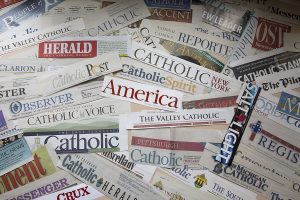
The mastheads of numerous Catholic newspapers are seen in this photo illustration. (OSV News photo/CNS file, Tyler Orsburn)
“When you give to the Catholic Communication Campaign, you shed light on the work of the Church and help the Church to shed the light of Christ on everyone,” said Bishop William D. Byrne of Springfield, Massachusetts, chair of the U.S. Conference of Catholic Bishops’ Committee on Communications.
The bishop shared his thoughts in a May 6 news release issued by the USCCB to announce this year’s collection, which takes place in many dioceses on the May 16-17 weekend.
Donations can also be made online anytime at igivecatholic.org/story/USCCB-CCC.
Each contribution is evenly split between local diocesan and national communications efforts.
Among the national-level initiatives the funds support are the USCCB’s posting of daily Mass readings, which include audio and video resources; livestreamed coverage of the bishops’ annual fall and spring assemblies, at which the Church’s mission priorities are discussed; and USCCB social media content, which “reaches hundreds of millions of users each year” to bring the bishops’ work “directly to Catholics and people of goodwill,” according to the USCCB release.
Collection proceeds also support the Rome bureau of Catholic News Service, the remaining division of the U.S. bishops’ long-running official news service. CNS Rome produces “in-depth coverage of Pope Leo XIV, his ministry and his travels,” said the release.
Also funded by the campaign are a series of roundtables on Catholics and mental health, with bishops and clinical experts discussing various issues on that topic. Videos of the talks can be accessed on the USCCB website.
The collection takes place as a combination of multiyear religious disaffiliation, shifting media distribution technologies, and reduced revenue streams have seen Catholic media outlets large and small shutter.
In 2006, U.S. Catholic newspapers numbered 196 with 6.5 million in circulation, according to figures from the Catholic Media Association, which serves Catholic journalists in the U.S. and Canada. In 2020, the number of newspapers had dropped 40%, to 118 with 3.8 million in circulation.
Those hurdles arrive just as the Church’s message, ministries and messengers — from Catholic Charities and other pro-life ministries to the U.S. bishops and Pope Leo himself — are coming under increasing attack in the public forum, including from misinformation fueled by artificial intelligence, making the mission of Catholic media all the more vital, said experts.
“In an era when AI-generated slop and poorly thought out hot takes are easy to find, Catholic media is well situated to offer something deeper: meaningful, authentic, truthful and engaging content from writers and creators across all platforms,” Kerry Weber, president of the Catholic Media Association and executive editor of America, the long-running Jesuit magazine, told OSV News.
Weber pointed to a 2023 report by the Center for Applied Research in the Apostolate, noting that the data showed “about half of American Catholics read their diocesan newspaper or magazine.”
Even higher engagement rates are seen in the parish bulletin, a publication that typically uses a classic newspaper distribution strategy for maximum engagement, with volunteers handing the publication out directly to Mass attendees at church entrances.
CARA found 90% of weekly Mass attenders read their parish bulletin and 87% of monthly Mass attenders read it. Close to 21.2 million Catholic adults, or 40% of all Catholic adults in the U.S., attend Mass at least monthly, according to Pew Research.
“Local Catholic media still has a real opportunity to make an impact within a community and also some real opportunity for growth, especially if it has appropriate financial and institutional support,” said Weber, pointing to CARA’s data.
“The Church’s communications are crucial for our Catholic unity and for disseminating the Gospel message,” Metropolitan Archbishop Borys A. Gudziak of the Ukrainian Catholic Archeparchy of Philadelphia told OSV News.
The archbishop has prioritized communications in his multiple leadership roles in the Ukrainian Greek Catholic Church and as president of Ukrainian Catholic University in Lviv, Ukraine.
“Our media bring to those in and outside the Church the beautiful, freeing, salvific words of Our Lord, his blessings and the witness of so many of his followers, which inspires us,” he said.
Greg Erlandson, longtime columnist and former director of Catholic News Service, told OSV News that “the critical need for the Catholic press” has “only gotten stronger.”
“We need to be able to look at what’s happening in the world and see it in the context of faith,” he explained. “And that’s the one thing that can’t be provided by secular news media.”
Erlandson highlighted in particular the need for diocesan news reporting, which provides “some place to come and see the events in their diocese, state, country and world, and to understand them from the point of view of faith.”
He cited as an example Catholic media coverage of Pope Leo’s recent apostolic visit to several nations in Africa. The journey took place as President Donald Trump fired repeated media broadsides at the pope over his opposition to the U.S.-Israel war with Iran, including making false statements that the pope supports Iran having a nuclear weapon.
Erlandson said while “secular media coverage” of the trip “primarily focused on what they interpreted as rebukes to President Trump” in the pope’s speeches during the trip, the task of “really finding out the details” and purpose of the trip lay with “the Catholic press.”
“I think that is really the ongoing mission of the Church,” said Erlandson, referring to the role of the Catholic press. “And it’s an evangelizing mission.”
Social
WARSAW, Poland (OSV News) – Before he started his general audience, Pope Leo XIV stepped out of his popemobile on May 13 and walked over to pray beside a plaque marking the spot where history took a turn that shocked the world 45 years before.
St. John Paul II was shot precisely there on May 13, 1981 — a day of the assassination attempt and one when Our Lady saved the pope’s life.
“Today we remember the memorial of Our Lady of Fátima,” Pope Leo addressed English-speaking pilgrims during his audience. “On this day 45 years ago an attempt was made on the life of Pope John Paul II, and for these reasons I dedicated my catechesis today to the Blessed Virgin Mary,” he added.
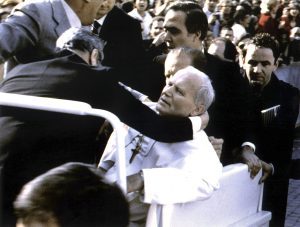
Angelo Gugel, private attendant to three popes, holds Pope John Paul II as he lies injured in his jeep in St. Peter’s Square on May 13, 1981, after being shot by Turkish gunman Mehmet Ali Agca. Gugel, the pontifical butler and witness to modern papal history, died at age 90 Jan. 14, 2026. He stood silently behind Pope John Paul for nearly three decades and contributed to saving the pope on the day of the assassination attempt. (OSV News file photo)
On that fateful day right before lunch, John Paul II rode slowly through St. Peter’s Square in an open white jeep, and he bent down to bless a small girl in the crowd. Seconds later, gunshots rang out.
Turkish gunman Mehmet Ali Agca shot the pope at close range. John Paul II collapsed into the arms of his secretary, then-Father Stanislaw Dziwisz. Blood soaked his white cassock as he was immediately rushed to Gemelli hospital, in what his personal secretary later recalled as “fight with time” to get the pontiff to the operating room.
“One hand fired, and another guided the bullet,” John Paul II would later say, convinced that the Our Lady of Fátima had spared his life. The attack took place exactly on the anniversary of the first apparition of the Virgin Mary to three shepherd children in Fátima, Portugal, in 1917. In 1982, the pontiff traveled to Fátima to thank the Blessed Mother for saving his life. The bullet removed from his body was later placed in the crown of the Fátima statue.
Italian journalist Alberto Michelini, who covered the pope for decades, told OSV News that for John Paul II the connection was never symbolic. “The Marian pope was saved thanks to the hand that diverted the deadly bullet — thanks to the hand of Mary,” Michelini said. “It was a true miracle.”
Father Miroslaw Cichon, director of the John Paul II Pontificate Documentation Center in Rome, told OSV News that the center’s archives preserve moving testimonies of the worldwide prayers that followed the attack, including an image of Our Lady of Czestochowa placed on the empty papal chair in St. Peter’s Square after the wounded pope was taken to the hospital.
Michelini linked the assassination attempt to the broader collapse of communism in Eastern Europe. “I covered the pope’s first trip to Poland,” he said. “From that extraordinary encounter with the crowds — something that worried the Kremlin greatly — we witnessed, within 10 years, from the Baltic to the Black Sea, the collapse of the Berlin Wall.”
For many historians, the geopolitical dimension of the attack can no longer be dismissed as speculation. Pawel Skibinski, Polish historian and former director of the Warsaw’s Museum of John Paul II and Primate (Cardinal Stefan) Wyszynski, said Soviet authorities viewed the Polish pope as a destabilizing force almost immediately after his election in 1978. “The pontificate of John Paul II was undoubtedly a factor changing the situation of believers in the Eastern bloc,” Skibinski, who is a professor of the University of Warsaw, told OSV News.
He said Soviet intelligence services closely monitored Vatican outreach to Catholics behind the Iron Curtain. “We do not have proof of a direct Politburo decision ordering the elimination of Karol Wojtyla,” Skibinski said, mentioning the highest executive, policymaking body within a Soviet communist party. But the beginning of coordinated activity by Soviet and Bulgarian services around Agca is a historical fact.
Skibinski pointed to findings from investigations conducted by Poland’s Institute of National Remembrance indicating that Agca — after escaping from a Turkish prison — underwent training linked to Soviet intelligence networks in Tehran, Iran. “The so-called Bulgarian trail is not speculation anymore,” Skibinski said. “From a historical point of view, there is no doubt.”
Yet the pope’s survival may have ultimately strengthened his authority rather than weakened it.
“The fact that he paid with his own blood for the truths he proclaimed increased his credibility,” Skibinski said. The attack transformed John Paul II into a global moral figure during one of the most fragile phases of the Cold War.
“It is a very important date in the pontificate,” Michal Senk, director of the Center for the Thought of John Paul II, based in Warsaw, told OSV News the assassination attempt intensified themes already present in Cardinal Wojtyla’s spirituality. “It was not a radical change of direction,” he said. “But after the attack he devoted even more attention to suffering, penance and forgiveness.”
Two years after the assassination attempt, on Dec. 27, 1983, the pope visited Agca at Rome’s Rebibbia prison and publicly forgave him — a gesture that became one of the defining images of his pontificate.
Michelini said the pope’s embrace of Agca became stronger than any speech about forgiveness. “Karol Wojtyla was a man of gestures,” he said. “His ability to speak to the world even without words transformed him into one of the most extraordinary natural leaders of our era.”
Still, Senk cautioned against romanticizing Agca or describing the prison meeting as reconciliation. “Agca never asked for forgiveness,” he said. “John Paul II forgave him without being asked. That is something radically evangelical.”
Senk described the Turkish gunman as “a professional killer” and “a compulsive liar,” insisting the burden of forgiveness rested entirely on the pope, who asked Italy to grant him official pardon to his assassin in 1999 — eventually granted to Agca in the Jubilee Year 2000 by the Italian president.
Father Miroslaw Cichon told OSV News that the assassination attempt left a lasting mark on John Paul II’s teaching, especially in his 1984 apostolic letter “Salvifici Doloris,” on the Christian meaning of suffering, written in 1984 “He linked his own fate and the fate of the world even more closely to Mary and the message of Fátima,” the priest said. “The pope’s physical suffering became an integral part of his teaching,” Father Cichon told OSV News.
“That suffering deepened his relationship with U.S. President Ronald Reagan,” Skibinski told OSV News, “who had survived an assassination attempt just weeks earlier.” The two men did not form a kind of secret alliance, Skibinski said, but they did share a common commitment to defending religious freedom and human dignity in Eastern Europe.
Senk noted that even after recovering, John Paul II never fully regained the robust health of his early years. “From that point, he became a man who suffered more often and more visibly,” Senk said. Yet he did not retreat. Security, however, changed forever. The open vehicle in St. Peter’s Square gave way to the glass-enclosed popemobile.
On March 25, 1984, John Paul II consecrated the world — including Russia — although not named specifically in the consecration text — to the Immaculate Heart of Mary, fulfilling a request tied to the Fátima apparitions.
Weeks later, on May 13, a massive explosion at a Soviet naval base in Severomorsk destroyed a large portion of the Northern Fleet’s missile stockpile. Soviet officials blamed a cigarette; no Western government claimed responsibility.
Senk cited the episode as an example of symbolic links many Catholics drew between Fátima and the weakening of Soviet power.
“The coincidence of dates is striking,” historian Skibinski told OSV News. He and others noted that John Paul II viewed history through a spiritual lens, where grace and geopolitics were intertwined. Father Cichon added that in his 2005 book “Memory and Identity,” the pope interpreted the assassination attempt “above all in theological terms.”
By the end of the 1980s, the Berlin Wall had fallen and communist regimes across Eastern Europe had collapsed. Two years later, the Soviet Union dissolved.
Iconic Italian television journalist Michelini told OSV News: “Perhaps the full truth about the assassination will never emerge, but it was clear that the Slavic pope had become a destabilizing force for the last empire.”
Father Cichon added that the assassination attempt marked a turning point — a “threshold moment,” giving John Paul II’s ministry a more “distinctly martyr-like and mystical” dimension.
Social
WASHINGTON (OSV News) – Ahead of the July 4 expiration of the One Big Beautiful Bill Act provision that eliminated Medicaid funds to health providers who also perform abortions, the U.S. bishops’ pro-life chairman expressed support for legislation that would block federal Title X family-planning grants and funds from going to those entities.
The Title X Abortion Provider Prohibition Act, legislation introduced in April in the Senate by Sens. Marsha Blackburn, R-Tenn., and Todd Young, R-Ind., with a similar version introduced in the U.S. House by Rep. Virginia Foxx, R-N.C., would codify a prohibition on Planned Parenthood and other abortion providers from participating in Title X.
An imaging table is seen inside the Planned Parenthood facility in St. Louis May 28, 2019. Ahead of the July 4, 2026, expiration of a provision in the One Big Beautiful Bill Act that eliminated funds to health providers who also perform abortions, the U.S. bishops’ pro-life chair expressed support May 8 for a bill that would block federal Title X family-planning grants and funds from going to abortion providers. (OSV News photo/Lawrence Bryant, Reuters)
Bishop Daniel E. Thomas of Toledo, Ohio, chair of the U.S. Conference of Catholic Bishops’ Committee on Pro-Life Activities, wrote a May 8 letter to Blackburn and Foxx to offer support for the bill.
“We have consistently called for the separation of abortion from the Title X family planning program, but organizations like Planned Parenthood, despite performing hundreds of thousands of abortions every year, continue to receive millions of dollars in taxpayer money annually,” Bishop Thomas wrote.
“This legislation would build upon Congress’s efforts to end access to taxpayer funding for one of the nation’s largest abortion providers, as was done with the passage of the One Big Beautiful Bill Act.” he continued. “Abortion has no place in a taxpayer-funded program. This legislation would further solidify the intended statutory distinction and would safeguard the integrity of federal health programs.”
The One Big Beautiful Bill Act, which enacted key items from President Donald Trump’s legislative agenda on issues including taxes and immigration, also included a provision eliminating Medicaid funds to health providers who also perform abortions. However, that provision is scheduled to expire on July 4, and pro-life groups have pushed the Trump administration and congressional lawmakers to renew it in subsequent legislation.
Although it was not named in the provision, Planned Parenthood, the nation’s largest abortion provider, sued in response, arguing the parameters for ending these funds effectively singled it out. However, courts eventually allowed the provision to go into effect.
Asked by a reporter in the Oval Office on May 12 if he would like to see Congress continue to block those funds, Trump replied, “Congress is now negotiating.”
“To put it mildly, it’s been a very thorny issue,” Trump continued. “It’s all under negotiation right now.”
Earlier this year, the Trump administration indicated it would provide another year of Title X grant money to Planned Parenthood the day before those funds were set to expire. The move prompted condemnation from leaders of pro-life groups.
In April 20 statements when they introduced the bill, the senators argued the legislation would realign the Title X Family Planning Program with its intended aim to assist low-income women with family planning services.
“Title X was designed to provide moms and children with necessary family planning services, not fund abortions. This legislation will protect life and ensure taxpayer dollars are protected from taking innocent lives,” Young said.
A statement from Young’s office cited support for the bill from pro-life organizations, including Susan B. Anthony Pro-Life America, Concerned Women for America Legislative Action Committee, March for Life Action, National Right to Life Committee, Americans United for Life and Students for Life Action.
In reference to the One Big Beautiful Bill Act, Planned Parenthood stated on its website, “Without Planned Parenthood, cancers go undetected, STIs go untreated, birth control isn’t available, and patients must travel farther and wait longer for care.”
The Catholic Church teaches that all human life is sacred from conception to natural death, and as such, opposes direct abortion.
Social
WASHINGTON (OSV News) – As the U.S. Senate prepares to consider a farm bill recently approved by the U.S. House, Catholic organizations together with the U.S. bishops sought to stress to lawmakers the importance of efforts to combat hunger, such as robust support for the Supplemental Nutrition Assistance Program, or SNAP, a major part of the nation’s social safety net.
The House on April 30 passed a $390 billion farm bill on a close to party-line vote; 14 Democrats and three Republicans broke with their respective parties in support of or opposition to the bill.
A combine harvests wheat in Kremlin, Okla., June 12, 2025. As the U.S. Senate prepares to considers a 2026 farm bill approved by the U.S. House, Catholic organizations sought to stress to lawmakers the importance of efforts to combat hunger, such as robust support for the Supplemental Nutrition Assistance Program, or SNAP, a major part of the nation’s social safety net. (OSV News photo/Nick Oxford, Reuters)
Julie Bodnar, outreach and policy adviser for the Secretariat of Justice and Peace at the U.S. Conference of Catholic Bishops, told OSV News, “Historically, the farm bill has been a bipartisan process.” She said the USCCB would like to “see that continue.”
“It’s historically been a bill that brings everything together, that acknowledges that the needs of farmers, the needs of rural America, that the needs of hungry people, they’re all linked,” she said. “There’s no need to pit them against each other. These interests are aligned. They’re not opposed.”
Opponents of the House’s farm bill have argued the near-party-line vote is a departure from longstanding norms of bipartisanship around the legislation. The bill faces an uncertain future in the Senate, where the upper chamber is expected to attempt to make its own changes before sending it back to the House.
Francisco “Frankie” Chevere, director of social policy and government affairs for Catholic Charities USA, told OSV News, “the chances of having a farm bill passed in the Senate are, at best, doubtful.”
A traditionally bipartisan piece of legislation, the farm bill in recent years has become more polarized. Congress last passed a farm bill in 2018 that expired in 2023, and even with Republican control of Congress and the White House since January 2025, lawmakers have thus far been unable to send a new farm bill to the president’s desk.
The One Big Beautiful Bill Act, which enacted key items of President Donald J. Trump’s legislative agenda on issues including taxes and immigration, included a provision increasing work requirements for SNAP recipients, including those experiencing homelessness, and other measures expected to cut SNAP. The House’s farm bill would lock in about $187 billion of those cuts to SNAP between 2025 and 2034.
“Over 3 million participants, kids, seniors, veterans, people with disabilities, working parents have already lost SNAP since July of last year,” Chevere said in reference to the One Big Beautiful Bill Act’s July 4 passage. Some estimates are as high as 4.3 million.
Catholic groups including Catholic Charities USA, Catholic Relief Services, and the Society of St. Vincent de Paul USA, Catholic Rural Life, and the USCCB committees on Domestic Justice and Human Development and International Justice and Peace, have urged lawmakers to make several changes to the legislation.
In a February letter, they advocated for the delay of newly enacted state cost-sharing requirements for SNAP benefits, the elimination of the felony-based exclusion from SNAP participation to promote reintegration and food security for dependants, and for Puerto Rico to be transitioned into full participation in SNAP over the course of a decade.
The One Big Beautiful Bill Act also implemented a cost-sharing structure with the states for the administration of SNAP. Bodnar said the USCCB would like to see that cost shift delayed by two years so that the changes “can be made thoughtfully, so that they can be made carefully, so that families aren’t the ones paying the price for administrative errors.”
John Berry, national president of the Society of St. Vincent de Paul USA, told OSV News, “Every human person is sacred and has the right to sufficient food in order to live their life with dignity. As Pope Leo XIV recently stated, ‘No one can remain on the sidelines in the fight against hunger.'”
Berry said the Society of St. Vincent de Paul USA is committed to fighting hunger in the U.S.
“We have thousands of food pantries, meal sites and food programs throughout the country,” he said. “But with more than 47 million people across every state and congressional district struggling to put food on the table, SNAP continues to be the nation’s most effective and responsive tool to combat hunger.”
Berry said his organization is seeking a farm bill that “delays the newly enacted state cost-sharing requirements for SNAP benefits so all states have time to succeed in lowering errors and protect participation, eliminates the felony based exclusion from SNAP participation, and provides Puerto Rico a structured opportunity to transition from the Nutrition Assistance Program (NAP) to full SNAP participation.”
Puerto Rico, a U.S. territory, is not included in SNAP, and relies instead on a separate program with a fixed rate. Proponents of its inclusion in SNAP point to the island’s geography and more than 1.3 million low-income residents as circumstances that leave many vulnerable to hunger, especially in the event of natural disasters, such as hurricanes, or power grid failures.
Chevere said “providing equal treatment to all territories of the United States in SNAP” is another key priority for Catholic Charities USA.
“At the present time, Puerto Rico, which is the largest territory of the United States, doesn’t have full SNAP benefits,” he said. “There are other territories that do have SNAP benefits, like the Virgin Islands. Puerto Rico and Guam, they don’t have full SNAP benefits.”
Marilyn Richardson, senior policy and legislative specialist for Catholic Relief Services, the overseas relief and development arm of the Catholic Church in the U.S., pointed to funding for U.S.-grown and produced agriculture commodities used in international food assistance as another key area.
“CRS’ top priority is making sure that U.S. international food assistance programs (like Food for Peace) are continued, with adequate staffing and funding, and flexible enough to respond quickly to the level of hunger we’re now seeing globally,” Richardson said. “These programs are lifesaving and life-affirming. They prevent hunger around the world, support farmers and their families, and improve nutrition and education outcomes for vulnerable communities.”
Richardson said passing a farm bill is closely tied to human dignity and food security concerns.
“The farm bill is very important in shaping U.S. international food assistance,” she said. “It authorizes and funds major programs like Food for Peace and McGovern-Dole, which are central to the U.S. response to global hunger. Through these programs, the U.S. responds to urgent hunger needs and supports long-term food security around the world, reflecting a commitment to care for our global family.”
She added, “The policies set in the farm bill directly affect how many can be served and how quickly and effectively that assistance reaches those most in need.”