WILLIAMSPORT – As the current school year begins to wind down, administrators at Saint John Neumann Jr./Sr. High School are preparing for an exciting change next year.

Beginning in the 2026-2027 academic year, the Williamsport-based school will transition to an innovative four-day school week – an approach school leaders believe will expand opportunities for students while also strengthening academic success, personal growth, and faith formation.

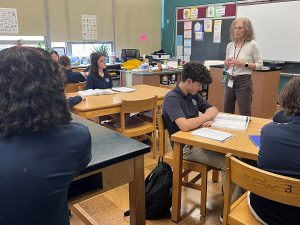
Chris Miller, science teacher at Saint John Neumann Jr./Sr. High School, teaches a lesson on April 16, 2026. (Photo/Eric Deabill)

Under the new model, students in grades 6 through 12 will attend classes Monday through Thursday, with extended school days to ensure they exceed instructional requirements set by the Commonwealth of Pennsylvania.

Fridays, although not required attendance days, will be anything but idle. Fridays are now being reimagined as a time for enrichment.

“We are going to be moving to a four-day innovative learning model, with the fifth day being reserved for extension activities and different opportunities for our students,” principal Alisia McNamee said. “Fridays are going to be fantastic.”

YEARS IN THE MAKING

The decision to change the traditional 5-day school week follows several years of careful research, planning, and consultation.

Drawing from data received from the Strategic Growth Plan for the Diocese of Scranton Catholic School System which was completed last year, school administrators examined ways to enhance the experience of students while remaining rooted in academic excellence.

“We had the opportunity to go visit a school that has already implemented this model and used that as a blueprint,” McNamee explained, referring to Bishop McCort High School, which is in Johnstown. “We spent a lot of time talking with them, visiting them, and just doing our homework to see how we could implement that here at Saint John Neumann.”

Administrators also gathered feedback from students, families, and faculty – who overwhelmingly supported the change.

By shifting from measuring instructional time in days to hours, the school will not only meet but still exceed the 990 hours required annually at the secondary level.

NOT JUST A DAY OFF

While the idea of a four-day week may initially sound like a reduction, Diocesan leaders are quick to emphasize the new innovative learning model provides much more flexibility.

“Students will be able to take advantage of using Fridays to either get extra tutoring or explore things beyond the curriculum that we right now wouldn’t have the opportunity to do,” Kristen Donohue, Superintendent of Catholic Schools, said.

Students will still have the option to come to Saint John Neumann Jr./Sr. High School on Fridays. In addition to having the opportunity for one-on-one academic support, Donohue also sees the opportunity for college visits, internships, field trips, and guest speakers. Partnerships with local businesses, universities and healthcare providers are also being explored, opening doors to real-world experiences.

“I think this model will attract students,” Donohue added. “It really is a game changer for our students and our families.”

FACULTY & STUDENTS EMBRACE POSSIBILITIES

Faculty members are already embracing the shift, seeing it as a chance to rethink how learning happens both inside and outside the classroom.

“We’re no longer just disseminators of information,” Dr. Chad Greevey, Assistant Principal/Curriculum Director, said. “We’re the ones who are helping facilitate the learning with students, helping to direct them in a way that they might not have thought about before, and opening up those doors and pathways.”

That flexibility is also resonating with students.

“I’m excited,” junior Maverick Dunkleberger said. “There are many different opportunities for us to succeed in other things, not just school, but internships and other experiences.”

Dunkleberger, who hopes to study mechanical engineering, sees the potential for hands-on learning on Fridays that connects directly to his future goals.

“I would like to get an internship with Textron to just learn more,” he explained.

Sophomore Haylee Meixel echoed that enthusiasm, especially as she begins to think about college.

“I think there are a lot of opportunities,” she said. “Being in National Honor Society, I can come in on Friday and tutor kids or use those days off to work.”

For Monica Frasca, a sophomore who commutes 50 minutes each way from Mifflinburg to school, the change offers both practical and personal benefits.

“Sometimes not coming in on Fridays would be great for gas and not having to sit in a car for two hours,” she said. “I would love to get to spend that time with my siblings at home.”

STRENGTHENING FAITH AND SERVICE

Beyond academics, the new schedule also opens the door for deeper engagement with faith and service – hallmarks of Catholic education.

Father Glenn McCreary, pastor of nearby Saint Boniface Parish, sees new possibilities for student involvement.

“We could use servers on Friday which is actually our most robust daily Mass,” he said. “We also have a lot of activities and programs going on. Kids could sort food that is going to the food pantry, or they could help with mailings as they go out.”

These possible Friday experiences, Father McCreary noted, would allow students to live out their faith in tangible ways while strengthening their connection to the Church.

While school leaders acknowledge there may be challenges in implementing the new learning model, the overall outlook is one of excitement.

“We are just brimming with excitement,” McNamee said. “We know there will be some hiccups along the way … but what we’re doing will be a game changer.”

Prospective students and families are welcome to learn more about the new innovative learning model by taking a tour of Saint John Neumann Jr./Sr. High School any weekday. You can contact the school directly at 570-323-9953. Additional information on Saint John Neumann Jr./Sr. High School is also available at sjnra.org.

EXETER – Students at Wyoming Area Catholic School recently stepped away from their normal routines to learn a lesson that may shape their digital decisions for years to come.

On Wednesday, April 29, 2026, a representative from the Pennsylvania Attorney General’s Office led several interactive presentations to help students better understand the opportunities – and dangers – of the digital world.

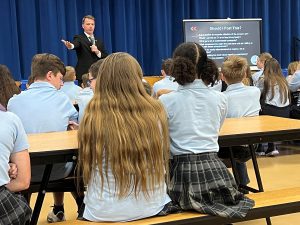
Dana Neely, Education & Outreach Specialist with the Pennsylvania Office of Attorney General, held a presentation called “IRL – Being Smart in the Digital World” for students at Wyoming Area Catholic School in Exeter on April 29, 2026. (Photo/Eric Deabill)

Dana Neely, a former teacher, held three different age-appropriate sessions to help students think critically about their digital footprint and the lasting impact of what they post online.

“The moment you post something, you’ve already lost control of it,” Neely told students in grades 5-8, noting that even deleted content can remain accessible or be shared through screenshots.

Students were quick to name the platforms they use – ranging from YouTube and TikTok to Snapchat and online gaming chats – and openly discussed both the benefits and risks of social media.

While the students recognized the value of social media for connection and entertainment, they also identified concerns such as cyberbullying, scams, and negative effects on mental health.

Using real-life examples, Neely emphasized that online behavior could have serious consequences, from damaged reputations to legal trouble. He encouraged students to take responsibility not only for what they share, but also how they respond to others – especially in situations involving bullying or threats.

For fifth-grade student Chloe Kelly, the message was clear.

“I thought that it was important to be careful with the internet because if you say one thing, it can ruin your entire reputation,” she said, adding that her parents help guide her online activity.

Seventh-grader Hannah Beekman said the presentation reinforced the importance of thinking before posting.

“I learned that it could be a very bad thing, what you post, so make sure you double check on what you post,” she said. “I do think about it and double check what I’m posting, and I make sure all the things I have are private for my friends and family.”

The presentation went beyond warnings, focusing also on forming habits rooted in character and good judgement – values that align closely with the mission of Catholic education.

Students were encouraged to pause and ask themselves key questions before posting things online: Is this a positive or accurate reflection of the person I am? Would I say this on TV or in front of my family? Could it be easily misunderstood? Am I posting out of anger?

As the presentations ended, Neely left the students with a simple but powerful reminder.

“It’s all about making good choices,” he said, “and helping your friends make good choices too.”

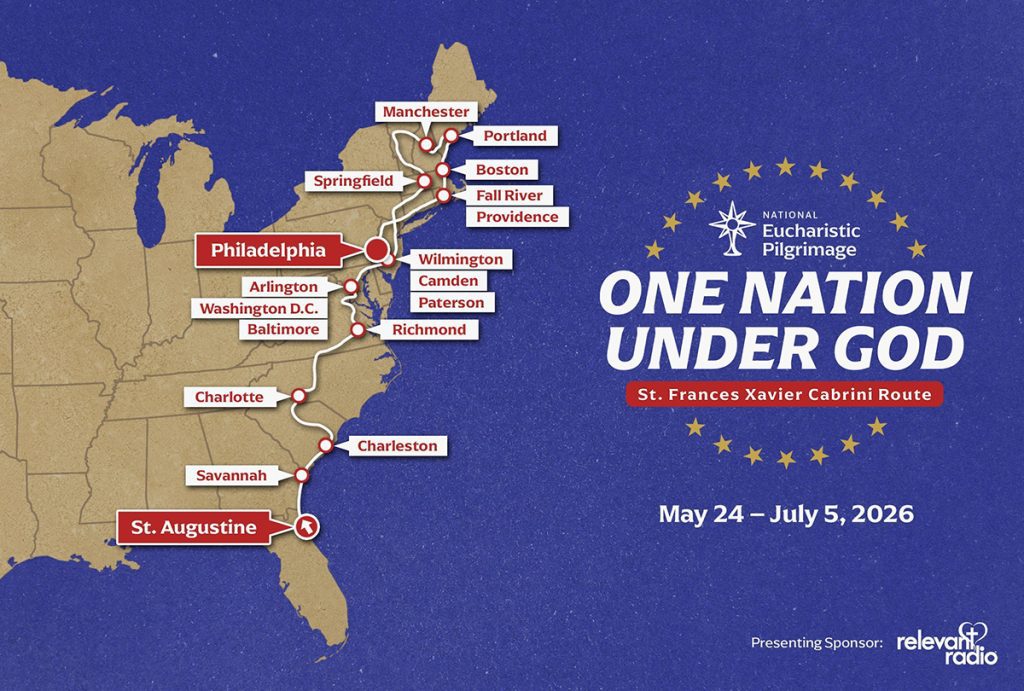
A graphic depicts the 2026 route of the National Eucharistic Pilgrimage, which begins May 24 in St. Augustine, Fla., and ends in Philadelphia July 5. (OSV News graphic/National Eucharistic Congress)

(OSV News) – Before the Declaration of Independence was boldly signed in 1776, before pilgrims feasted at what became popularly regarded as the “First Thanksgiving” in 1621, there was St. Augustine, Florida.

The coastal Florida city was founded in 1565 by Spanish Catholic explorer Pedro Menéndez de Avilés, is celebrated as the longest continually inhabited European-founded city in the U.S., and is home to the United States’ oldest continuously operating parish, the Cathedral Basilica of St. Augustine.

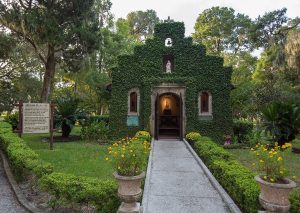
A file photo shows the historic chapel of the Shrine of Our Lady of La Leche at Mission Nombre de Dios in St. Augustine, Fla., with the statue of the nursing and watchful mother of Jesus. (OSV News photo/St. Augustine Catholic)

It is also the May 24 starting point for the 2026 National Eucharistic Pilgrimage, themed “One Nation Under God” in honor of America’s 250th year.

The pilgrimage begins on the historic grounds of America’s oldest Marian shrine: the National Shrine of Our Lady of La Leche at Mission Nombre de Dios, which Bishop Erik T. Pohlmeier of St. Augustine has described as “the oldest site of continuous Catholic presence in the United States.”

With its founding, St. Augustine became the site of an early Mass in what is now the United States, celebrated in 1565 to commemorate the landing of a Spanish explorer, his crew and Catholic clergy.

“As we focus this year on the Declaration of Independence and the 250th anniversary of that, St. Augustine helps us begin not with politics, but with worship,” said Jason Shanks, National Eucharistic Congress president. “And I think that’s critically important.”

Both the shrine and the mission, its caretakers say, “stand as living witnesses” not just to the founding of St. Augustine, but also to the practice of the Mass in the United States. The site roots its history in the landing of Spanish Admiral Pedro Menéndez de Avilés. In 1565, his crew sighted land on Aug. 28, the feast of St. Augustine, and Menéndez came ashore Sept. 8. The admiral claimed the land for Spain, “establishing the settlement that would become the first permanent European settlement in what is now the continental United States,” according to the shrine’s website.

Soon after landfall, the expedition’s chaplain, Father Francisco López de Mendoza Grajales, celebrated a Mass of thanksgiving.

The shrine and mission grounds, known as “The Sacred Acre,” still yield discoveries, said the shrine’s rector, Father Timothy Lindenfelser.

“We’re constantly doing archaeological excavations. Most recently, we found the foundations of the Franciscan church that was on the property. That was found with burials of Indigenous people around it, and then the kitchen that was connected to it,” he said. “Every time we do a renovation or do archaeological digs, we’re always finding new things.”

The mission and shrine’s website describes Father Francisco’s Mass as the “first Catholic Mass of Thanksgiving in what is now the United States, establishing the first parish and planting the roots of the Catholic faith in the New World.”

However, “we do not claim to be the first Catholic Mass in what is today the United States,” said Father Lindenfelser. “The first that’s documented would have been in Pensacola in 1559. The Spanish established a settlement there, so we know there were priests and Mass was celebrated. But the settlement didn’t last.”

Kathleen Bagg, the Diocese of St. Augustine’s communications director, elaborated, telling OSV News, “What makes St. Augustine historically significant is that the Sept. 8, 1565, Mass of Thanksgiving was connected to the founding of the first permanent European settlement in what is now the continental United States, and to a Catholic community whose presence has continued into the present day.”

“The phrase ‘first Catholic Mass of Thanksgiving in what is now the United States’ is intended as a historical distinction connected to the founding of St. Augustine, rather than a claim that no earlier Masses had ever been celebrated elsewhere in territories that later became part of the United States,” she said.

If the wording seems intentionally careful, it is because there is some historical wrestling over the location of the first Mass celebrated in what would become the United States of America.

“There are a whole series of Spanish expeditions into Florida and elsewhere in the Southeast, long before Pensacola was established in 1559,” said J. Michael Francis, a history professor and chair of Florida studies at the University of South Florida.

He noted expeditions led by Juan Ponce de León — the first of which made landfall in 1513, probably south of Cape Canaveral — as well as subsequent expeditions, and the settlement of San Miguel de Guadalupe.

“It hasn’t been located archaeologically,” Francis told OSV News, “but it was likely somewhere in present-day South Carolina in 1526. That settlement lasted for less than one year — but assuredly there were many Masses said at San Miguel. Then you have the 1539 Hernando de Soto expedition, and there were likely dozens — if not hundreds — of Masses said between 1539 and 1543 during the course of that expedition.

“So,” he emphasized, “this is where it gets really tricky.”

The 1565 Mass at St. Augustine, held on the feast of the Nativity of Mary, “is often attributed to an account written by the priest” — Father Francisco López de Mendoza Grajales — “who allegedly said that Mass. But he never says that in his account. What he says is that on Sept. 8, 1565 — when Menéndez, the founder of St. Augustine, comes ashore — they greet him singing the ‘Te Deum laudamus,'” a hymn of rejoicing.

Father López, Francis continued, “said Menéndez — and all of the others with him — approached him on their knees, and they kissed the cross. … But he never specifically says, ‘I said Mass.’ He says there were ‘other ceremonies.’ There’s another account — that has been attributed to Pedro Menéndez de Avilés’ brother-in-law — in which he says that on that day, Menéndez ordered that a solemn Mass be said.

“So what often happens with these kind of stories is that different sources get conflated,” Francis stressed.

Bagg pointed out what she described as another “important historical nuance.”

“While St. Augustine remained continuously inhabited as a city, Catholic parish life was interrupted during the British period (1763–1784), when Spanish clergy departed and public Catholic worship ceased until the arrival of the Minorcans and Father Pedro Camps in 1777,” she told OSV News. “Even with that interruption in sacramental life, the broader Catholic presence associated with the founding of St. Augustine and Mission Nombre de Dios remains foundational in American Catholic history.”

Ultimately, the St. Augustine site remains a place of witness. When the tourist trolleys stop at the National Shrine of Our Lady of La Leche at Mission Nombre de Dios, Father Lindenfelser says visitors often find themselves deeply affected.

“Many people have come back to the faith,” he said. “Some people have for the very first time heard the message of the Gospel, just because they were sitting there — and one of the chaplains or one of the staff, we come up and talk to them,” Father Lindenfelser said.

“So, it’s still today a great place of evangelization,” he added, “by just being present to those who come.”

VATICAN CITY (OSV News) – Pope Leo XIV has encouraged young Catholics preparing to receive the sacrament of confirmation to ask the Holy Spirit for the gift of perseverance, warning that too many young people “disappear from the parish” after receiving the sacrament.

Speaking off the cuff to roughly 1,000 young pilgrims from the northern Italian Archdiocese of Genoa May 16, the pope said that the fullness of the Holy Spirit received at confirmation provides the strength “to live our faith in a world that so often seeks to lead us away from Jesus.”

Pope Leo XIV confirms a man he baptized during the Easter Vigil in St. Peter’s Basilica at the Vatican April 4, 2026. (CNS photo/Lola Gomez)

“It is beautiful to receive this Sacrament, because the fullness of the Holy Spirit gives us this enthusiasm, this strength, this ability to follow Jesus Christ, to say ‘Yes’ to the Lord always, to have no fear of following Him courageously,” the pope said in the Vatican’s Hall of Blessings.

Pope Leo added that conferring confirmation is one of the greatest joys of a bishop’s ministry, but acknowledged that “there is another aspect that is rather sad.”

“Sometimes, when the bishop confers Confirmation — the gift of the Holy Spirit — you never see the young people again,” Pope Leo said. “They disappear from the parish.”

The pope urged the confirmation candidates to pray to the Holy Spirit for perseverance, encouraging each of them to make a personal commitment to persevere in following Christ after receiving the sacrament.

“It is so important that each of you also makes this commitment, this promise to the Lord: that you truly wish to continue as His friends, His disciples, His missionaries, and that you wish to persevere in the faith,” the pope said.

The Catechism of the Catholic Church teaches that confirmation, together with baptism and the Eucharist, constitutes the sacraments of Christian initiation, and that its reception is necessary for the completion of baptismal grace.

Pope Leo encouraged the confirmandi to return to their parishes, participate in community life and hold fast to the joy that they experienced during their preparation for the sacrament and their pilgrimage to Rome.

“May this joy live in your hearts and may you continue to be faithful disciples of Jesus Christ,” he said. “May you persevere in the faith.”

“Jesus Christ wants to walk with you, with each one of you, and with all of you in community, which is so important,” the pope said.

The Church teaches that confirmation provides a deepening baptismal grace, uniting the faithful more firmly to Christ, increasing the gifts of the Holy Spirit, and giving a special strength to spread and defend the faith

“We do not live our faith alone; we live it together,” Pope Leo said. “And forming these bonds of friendship and community is a way of living out perseverance as disciples of Jesus.”

Speaking ahead of the feast of Pentecost, which falls on May 24, the pope recalled the outpouring of the Holy Spirit upon the first apostles, who went on to “proclaim the Gospel, to proclaim the love of God.”

He told the candidates for confirmation, “You will all take part in this mission, because we are all sent: to your families, to your friends, to all people. And you must be a living witness to the Spirit who dwells in us.”

(OSV News) – Bishop Michael M. Pham of San Diego said the faithful there “stand united in solidarity and prayer with the Muslim community” after a deadly May 18 shooting at a mosque complex in that city killed three adults, including a security guard.

The two teen suspects were later found dead of apparent self-inflicted gunshot wounds.

A nearby landscaper was also reported to have been shot at during the attack, but, according to police, was expected “to be OK.”

Men embrace outside the Islamic Center in San Diego May 19, 2026, after a deadly shooting the previous day. One of the three people killed by two teen shooters at a San Diego mosque was a beloved security guard who acted quickly to prevent more deaths, authorities and community members said. The two teenage gunmen killed themselves a few blocks away — in an attack police are investigating as a hate crime. (OSV News photo/Mike Blake, Reuters)

No children from the mosque’s school and no officers were injured, according to San Diego police.

Law enforcement is now investigating the shooting as a hate crime.

The attack unfolded just before 12 p.m. at the Islamic Center of San Diego, located in that city’s Clairemont neighborhood.

About two hours earlier, the mother of one teen suspect had alerted police she believed her son was suicidal and that “several of her weapons,” along with her car, had been taken, according to the San Diego police chief.

She said her son had left with a companion, both dressed in camouflage, and also said she had found a note left behind, which police later said contained “general hate speech.”

San Diego police said the suspects were ages 17 and 18, and that the names of victims and suspects were being withheld pending notifications.

Speaking at a press briefing, San Diego police chief Scott Wahl described the slain security guard’s actions as “heroic,” adding, “Undoubtedly, he saved lives today.”

Imam Taha Hassane, the Islamic Center’s director, told media that it was “extremely outrageous to target a place of worship” such as the center.

Hassane said, “The other mosques and all the places of worship in our beautiful city should always be protected.”

“The Islamic Center has been a longtime partner in our collaborative work for
justice, especially in accompanying immigrants,” said Bishop Pham in his statement.

“Houses of worship must always be sanctuaries of peace, safety, and prayer. An attack on one faith community is an attack on the sacred dignity of all human life,” said the bishop.

Speaking “on behalf of the entire Roman Catholic community of San Diego,” Bishop Pham offered “my deepest condolences, solidarity, and fervent prayers to the families of the victims and the entire Muslim community.”

WASHINGTON (OSV News) – The number of executions around the globe in 2025 surged to the highest recorded figure in 44 years, a new Amnesty International report said.

The May 17 report, titled “Death Sentences and Executions 2025,” comes soon after a recent video message from Pope Leo XIV marking 15 years since the abolition of the death penalty in his home state of Illinois, and shortly after the U.S. Department of Justice said in court filings it would seek the death penalty for the man charged with the fatal shootings of two people outside a May 21, 2025, event at the Capital Jewish Museum in Washington.

A lethal injection chamber at Washington State Penitentiary in Walla Walla, Washington, September 6, 2024. The number of executions around the globe in 2025 surged to the highest recorded figure in 44 years, according to a new Amnesty International report released May 17, 2026. (OSV News photo/Matt Mills McKnight, Reuters)

Amnesty International recorded executions of 2,707 people across 17 countries in 2025, the highest number recorded by the group since 1981. However, the group cautioned that its tally does not include what it believes to be thousands of executions carried out in China, adding that the country therefore remained the world’s top executioner.

“This alarming spike in the use of the death penalty is due to a small, isolated group of countries willing to carry out executions at all costs, despite the continued global trend towards abolition,” Agnès Callamard, Amnesty International’s secretary general, said in a statement. “From China, Iran, North Korea and Saudi Arabia to Yemen, Kuwait, Singapore and the USA, this shameless minority are weaponizing the death penalty to instill fear, crush dissent and show the strength state institutions have over disadvantaged people and marginalized communities.”

Excluding China, the report estimated that Iranian authorities, the main drivers behind the spike, executed at least 2,159 people, more than double their 2024 figure. Saudi Arabia carried out at least 356 executions; Kuwait and Singapore carried out 17 each; Egypt carried out 23. The U.S., meanwhile, carried out 47. According to the report, 46% of all known executions worldwide were attributed to drug-related offenses.

“It’s time for executing countries to step into line with the rest of the world and leave this abhorrent practice in the past,” Callamard said. “The death penalty does not make us safer. Rather, it is an irreversible affront against humanity that’s driven by fear, with utter disregard for international human rights law.”

Based in London, Amnesty International is an international non-governmental organization focused on human rights.

In his April video message, Pope Leo said, “The Catholic Church has consistently taught that each human life, from the moment of conception until natural death, is sacred and deserves to be protected.”

“Indeed, the right to life is the very foundation of every other human right,” he said.

“For this reason,” he continued, “only when a society safeguards the sanctity of human life will it flourish and prosper.”

The Catholic Church’s official magisterium opposes the use of capital punishment, considering it inconsistent with the inherent sanctity of human life, and advocates for the practice’s abolition worldwide.

The late Pope Francis revised the Catechism of the Catholic Church in 2018 to clarify the Church’s teaching that capital punishment is morally “inadmissible” in the modern world and that the Church works with determination for its abolishment worldwide.

In his 2020 encyclical, “Fratelli Tutti,” Pope Francis addressed the moral problem of capital punishment by citing St. John Paul II, writing that his predecessor “stated clearly and firmly that the death penalty is inadequate from a moral standpoint and no longer necessary from that of penal justice.”

VATICAN CITY (OSV News) – Pope Leo XIV’s first encyclical, “Magnifica Humanitas,” will be published May 25, addressing artificial intelligence and the protection of human dignity, the Vatican has announced.

The encyclical, the title of which is Latin for “Magnificent Humanity,” was signed by the pope on May 15, the 135th anniversary of “Rerum Novarum,” Pope Leo XIII’s foundational 1891 social encyclical on labor and capital written during the first Industrial Revolution.

In an unprecedented first, Pope Leo XIV will be present in person at the Vatican press conference to mark the publication of the social encyclical, along with a tech founder from one of the world’s fastest growing AI companies.

The words “artificial intelligence” are seen on a computer screen in this illustration taken May 4, 2023. Pope Leo XIV’s first encyclical, “Magnifica Humanitas,” will be published May 25, addressing artificial intelligence and the protection of human dignity, the Vatican announced May 18, 2026. (OSV News photo/Dado Ruvic, Reuters)

Christopher Olah, co-founder of the artificial intelligence company Anthropic, which developed the AI large language model (LLM) named Claude, will speak on a panel presenting the document at the Vatican’s Synod Hall on May 25 at 11:30 a.m local time.

Also joining the panel will be Anna Rowlands, a British theologian specializing in Catholic social teaching who helped organize the Synod on Synodality, and Léocadie Lushombo, a professor of theological ethics at the Jesuit School of Theology at Santa Clara University. Cardinal Víctor Manuel Fernández, prefect of the Dicastery for the Doctrine of the Faith, and Cardinal Michael Czerny, prefect of the Dicastery for Integral Human Development, will also take part in the press conference. Pope Leo XIV and Cardinal Pietro Parolin, the Vatican Secretary of State, will give speeches at the end of the press conference.

Pope Leo XIV has expressed interest in the issue of artificial intelligence and the dignity of work since the first week of his pontificate, telling the College of Cardinals days after his election in May 2025 that he took his papal name partly in honor of Pope Leo XIII, whose landmark encyclical “Rerum Novarum” has shaped the Church’s social teaching for more than a century.

“In our own day, the Church offers to everyone the treasury of her social teaching in response to another industrial revolution and to developments in the field of artificial intelligence that pose new challenges for the defense of human dignity, justice and labor,” Pope Leo XIV said two days after his election.

The first American pope and a former mathematics major, Pope Leo has returned to the subject of AI again and again in speeches, messages and interviews in his first year, leading Time magazine to include him on its 2025 list of the world’s most influential people in artificial intelligence, with the magazine describing him as a spiritual counterweight to Silicon Valley.

Pope Leo has addressed the issue of AI in venues ranging from a sports stadium packed with teenagers, whom he told to use AI “in such a way that if it disappeared tomorrow, you would still know how to think,” to a gathering of legislators from 68 countries, where he insisted that artificial intelligence is a tool meant to serve human beings, not replace them. The pope has also warned priests not to use chatbots to write their homilies and expressed concern for AI’s potential effect on children’s “intellectual and neurological development.”

The pope’s 2026 message for the 60th World Day of Social Communications, published in January, has been his most robust document on AI and protecting human dignity to date. In the papal message, he underlined that “our faces and voices are unique, distinctive features of every person” that reveal “a person’s own unrepeatable identity” and that by “simulating human voices and faces, wisdom and knowledge, consciousness and responsibility, empathy and friendship,” AI systems “encroach upon the deepest level of communication, that of human relationships.”

Pope Leo also warned that AI systems “have increasingly taken control of the production of texts, music and videos,” putting “much of the human creative industry at risk of being dismantled and replaced with the label ‘Powered by AI,’ turning people into passive consumers of unthought thoughts and anonymous products without ownership or love.”

“The ability to access vast amounts of data and information should not be confused with the ability to derive meaning and value from it. The latter requires a willingness to confront the mystery and core questions of our existence,” Pope Leo said in a December speech to participants in an AI conference.

“It will therefore be essential to teach young people to use these tools with their own intelligence, ensuring that they open themselves to the search for truth.”

SWOYERSVILLE – On May 9, 2026, the Swoyersville Council Knights of Columbus made a bus pilgrimage from Swoyersville to the National Centre for Padre Pio in Barto, Pennsylvania.

Organized by the St. Elizabeth Ann Seton Council’s Grand Knight Mark Perugino, the day was inspirational including: Reconciliation, Mass, blessing with Padre Pio’s relics, Rosary, Divine Mercy Chaplet, Lunch, Tour through the Saint Padre Pio Museum, and a film on the founding of the Centre.

The Centre was founded by Vera Calandra whose one daughter was healed by Padre Pio in 1968, a miracle that helped usher in the Saint’s Canonization.

(OSV News) – How might you help a nation in political turmoil celebrate its 250th anniversary and the unlikely creation of the first large-scale, self-governing republic in the modern world?

Dedicate it to the Sacred Heart of Jesus — as the U.S. bishops will do for the United States of America on June 11, marking the first such formal consecration of the country to Christ’s heart.

A statue depicting the Sacred Heart of Jesus is seen at Sacred Heart Church in the North End neighborhood of Boston April 22, 2026. (OSV News photo/Gregory A. Shemitz)

The prelates made the decision to do this during a Nov. 11, 2025, session of the U.S. Conference of Catholic Bishops’ fall plenary assembly in Baltimore — and while they were singularly focused on an exceptional gesture to mark our country’s semiquincentennial, the consecration still probably can’t come at a better time.

According to a CNN/SSRS poll released April 3, Americans are divided by intense levels of cynicism, viewing both the Democratic and Republican parties in deeply negative terms. A full 77% of Americans, the Pew Research Center reported April 15, think the nation’s political system needs major changes or complete reform.

Archbishop Alexander K. Sample of Portland, Oregon, who chairs the USCCB Committee for Religious Liberty, told OSV News there are three essential reasons the bishops voted for the consecration.

First “would be to place our nation under the kingship of Christ,” he said. “Yes, we are a democratic republic; we are a civil society — but no civil society can long endure without being under the kingship of Christ himself; to place ourselves under God’s providence and care.”

And while our young nation fought a revolution to throw off a monarchy, Archbishop Sample emphasized the continuity between Jesus’ kingship and America’s founding ideals.

“In the history of our nation, it’s undoubtable and it’s irrefutable that the faith — and our reliance on God — really was the foundation that our Founding Fathers placed this nation on,” he said. “So at this time, as we celebrate the 250th anniversary of the signing of the Declaration of Independence, it’s to remind all of us that — whatever civil government we might have — we are all under, ultimately, the kingship of Christ.”

Second, Archbishop Sample noted “there’s a certain reparation aspect to the Sacred Heart. I think we can’t forget that part of the consecration is to make reparation for offenses against God; against the heart of Christ.”

Some of those offenses, he remarked, are part of American history.

“We are a great and blessed nation — but there are mistakes that we have made as a people over these 250 years. And so this is a good time,” the archbishop added, “to also make reparation to the heart of Christ for those offenses against his love, and his mercy, and his justice — for all peoples.”

Finally, Archbishop Sample said, “there’s this desire, through this consecration, to also call us to have a greater heart for the poor and the suffering … as we honor the Sacred Heart of Jesus, we can’t just honor it as a private devotion. It has to move us, and move our hearts.”

Pope Francis, he said, “was a man who loved these beautiful, rich devotions we have in the faith … and wanted to call our attention to the fact that the heart of Christ is the heart of mercy … and through the heart of Jesus, we find healing and reconciliation.”

Pope Francis brought the Sacred Heart to wider Catholic attention with the 2024 encyclical “Dilexit Nos” (“He Loved Us”), observing the devotion needs to be revived for our era.

Devotion to the Sacred of Heart of Jesus — which traces its roots to at least the second century — grew during the Middle Ages and was later extended to the universal church following Christ’s revelations of his Sacred Heart to St. Margaret Mary Alacoque, a 17th-century French woman religious.

Emily Schumacher-Novak — associate director of Education and Outreach at the USCCB’s Secretariat of Justice and Peace — said the June 11 consecration is accompanied by an abundance of USCCB resources, including a prayer and downloadable prayer card; a Novena to the Sacred Heart (June 3-11); a ceremony to enthrone the Sacred Heart in the home; consecration resources for parishes; materials from the Knights of Columbus and the Pope’s Prayer Network; and the “We Hold These Truths – America 250” article and video series, which feature the contributions of Catholics to the United States.

“We are also offering a resource that invites people to do 250 hours of adoration and 250 works of mercy,” Schumaker-Novak said. “It’s that connection back to charity and justice that our Church calls us to — to pray for all the things in our world that need healing — that we can do in front of the Blessed Sacrament.”

The national consecration — at Mary, Queen of the Universe Basilica in Orlando, Florida — will be live streamed via the USCCB homepage on June 11.

“As the bishops of the United States do the consecration of the whole nation to the heart of Christ, the Sacred Heart of Jesus, we’re also encouraging local communities to do the same — especially in our families and in our dioceses,” concluded Archbishop Sample.

He noted family, parish and diocesan consecrations are not meant to replace the national consecration.

“It’s so we’re sort of doing it on all levels, so to speak,” said Archbishop Sample, “to really make this a meaningful moment in the light of the Church here in this great and blessed land.”

(OSV News) – Sharing the Gospel means “we must be present in digital spaces,” and an annual collection by the nation’s Catholic bishops aims to bolster those efforts, said the bishop spearheading the initiative.

But this year’s funding campaign comes as the Catholic Church in the U.S. faces political and cultural challenges that have intensified “the critical need for the Catholic press,” one expert told OSV News.

The mastheads of numerous Catholic newspapers are seen in this photo illustration. (OSV News photo/CNS file, Tyler Orsburn)

“When you give to the Catholic Communication Campaign, you shed light on the work of the Church and help the Church to shed the light of Christ on everyone,” said Bishop William D. Byrne of Springfield, Massachusetts, chair of the U.S. Conference of Catholic Bishops’ Committee on Communications.

The bishop shared his thoughts in a May 6 news release issued by the USCCB to announce this year’s collection, which takes place in many dioceses on the May 16-17 weekend.

Donations can also be made online anytime at igivecatholic.org/story/USCCB-CCC.

Each contribution is evenly split between local diocesan and national communications efforts.

Among the national-level initiatives the funds support are the USCCB’s posting of daily Mass readings, which include audio and video resources; livestreamed coverage of the bishops’ annual fall and spring assemblies, at which the Church’s mission priorities are discussed; and USCCB social media content, which “reaches hundreds of millions of users each year” to bring the bishops’ work “directly to Catholics and people of goodwill,” according to the USCCB release.

Collection proceeds also support the Rome bureau of Catholic News Service, the remaining division of the U.S. bishops’ long-running official news service. CNS Rome produces “in-depth coverage of Pope Leo XIV, his ministry and his travels,” said the release.

Also funded by the campaign are a series of roundtables on Catholics and mental health, with bishops and clinical experts discussing various issues on that topic. Videos of the talks can be accessed on the USCCB website.

The collection takes place as a combination of multiyear religious disaffiliation, shifting media distribution technologies, and reduced revenue streams have seen Catholic media outlets large and small shutter.

In 2006, U.S. Catholic newspapers numbered 196 with 6.5 million in circulation, according to figures from the Catholic Media Association, which serves Catholic journalists in the U.S. and Canada. In 2020, the number of newspapers had dropped 40%, to 118 with 3.8 million in circulation.

Those hurdles arrive just as the Church’s message, ministries and messengers — from Catholic Charities and other pro-life ministries to the U.S. bishops and Pope Leo himself — are coming under increasing attack in the public forum, including from misinformation fueled by artificial intelligence, making the mission of Catholic media all the more vital, said experts.

“In an era when AI-generated slop and poorly thought out hot takes are easy to find, Catholic media is well situated to offer something deeper: meaningful, authentic, truthful and engaging content from writers and creators across all platforms,” Kerry Weber, president of the Catholic Media Association and executive editor of America, the long-running Jesuit magazine, told OSV News.

Weber pointed to a 2023 report by the Center for Applied Research in the Apostolate, noting that the data showed “about half of American Catholics read their diocesan newspaper or magazine.”

Even higher engagement rates are seen in the parish bulletin, a publication that typically uses a classic newspaper distribution strategy for maximum engagement, with volunteers handing the publication out directly to Mass attendees at church entrances.

CARA found 90% of weekly Mass attenders read their parish bulletin and 87% of monthly Mass attenders read it. Close to 21.2 million Catholic adults, or 40% of all Catholic adults in the U.S., attend Mass at least monthly, according to Pew Research.

“Local Catholic media still has a real opportunity to make an impact within a community and also some real opportunity for growth, especially if it has appropriate financial and institutional support,” said Weber, pointing to CARA’s data.

“The Church’s communications are crucial for our Catholic unity and for disseminating the Gospel message,” Metropolitan Archbishop Borys A. Gudziak of the Ukrainian Catholic Archeparchy of Philadelphia told OSV News.

The archbishop has prioritized communications in his multiple leadership roles in the Ukrainian Greek Catholic Church and as president of Ukrainian Catholic University in Lviv, Ukraine.

“Our media bring to those in and outside the Church the beautiful, freeing, salvific words of Our Lord, his blessings and the witness of so many of his followers, which inspires us,” he said.

Greg Erlandson, longtime columnist and former director of Catholic News Service, told OSV News that “the critical need for the Catholic press” has “only gotten stronger.”

“We need to be able to look at what’s happening in the world and see it in the context of faith,” he explained. “And that’s the one thing that can’t be provided by secular news media.”

Erlandson highlighted in particular the need for diocesan news reporting, which provides “some place to come and see the events in their diocese, state, country and world, and to understand them from the point of view of faith.”

He cited as an example Catholic media coverage of Pope Leo’s recent apostolic visit to several nations in Africa. The journey took place as President Donald Trump fired repeated media broadsides at the pope over his opposition to the U.S.-Israel war with Iran, including making false statements that the pope supports Iran having a nuclear weapon.

Erlandson said while “secular media coverage” of the trip “primarily focused on what they interpreted as rebukes to President Trump” in the pope’s speeches during the trip, the task of “really finding out the details” and purpose of the trip lay with “the Catholic press.”

“I think that is really the ongoing mission of the Church,” said Erlandson, referring to the role of the Catholic press. “And it’s an evangelizing mission.”