VATICAN CITY (CNS) – The Catholic Church is both a community made up of fragile and limited human beings and a divine reality, Pope Leo XIV said at his weekly general audience.

The pope continued his series on the Second Vatican Council March 4 in St. Peter’s Square, emphasizing one of its principal documents, the Dogmatic Constitution on the Church, “Lumen Gentium,” which examines the nature and identity of the Church.

He said the Church is “a community of men and women who share the joy and struggle of being Christians, with their strengths and weaknesses, proclaiming the Gospel and becoming a sign of the presence of Christ who accompanies us on our journey through life.”

Pope Leo XIV smiles as he speaks to visitors during his general audience in St. Peter’s Square at the Vatican March 4, 2026. (CNS photo/Vatican Media)

However, he added, it also has a “divine dimension.” Its divine nature “does not consist in an ideal perfection or spiritual superiority of its members, but in the fact that the Church is generated by God’s plan for humanity, realized in Christ,” he said.

As proof of this coexistence, Pope Leo pointed to the life of Jesus Christ to illustrate the two dimensions of the Church. People were moved by his humanity, the sounds of his voice, as well as his message.

“Those who decided to follow him were moved precisely by the experience of his welcoming gaze, the touch of his blessing hands, his words of liberation and healing,” the pope said. “At the same time, however, by following that man, the disciples opened themselves to an encounter with God. Indeed, Christ’s flesh, his face, his gestures and his words visibly manifest the invisible God.”

It is through this humanity, through the struggles and fragility of the faithful that Christ’s presence is manifested, the pope said.

“This is what constitutes the holiness of the Church: the fact that Christ dwells in her and continues to give himself through the smallness and fragility of her members,” he said.

Pope Leo said this dichotomy is quintessential of God’s love, making himself visible through the weakness of his creation and “continuing to manifest himself and to act.” The faithful are called to act through communion and charity among all.

“Let us strive to be authentic witnesses of the love of Christ so that all can recognize in us and among us the charity that characterizes true Christians and builds up the Church,” the pope said in his greetings to English-speakers.

ROME (OSV News) – A Synod on Synodality study group has recommended the creation of a new “Pontifical Commission for Digital Culture and New Technologies” in the first of 15 synod study group reports expected in the coming weeks.

The Vatican published the first two final reports from its Synod on Synodality study groups on March 3.

Pope Leo XIV, with regional representatives of synod teams, listens to and answers questions from participants in the Jubilee of Synodal Teams and Participatory Bodies in the Vatican audience hall Oct. 24, 2025. The final reports for two Synod on Synodality study groups, on formation for the priesthood and on navigating the Church’s presence in digital spaces, were released on March 3, 2026. (CNS photo/Vatican Media)

The first report contains recommendations on navigating the Church’s presence in digital spaces, including a proposal for a Vatican office or commission to monitor emerging theological, pastoral and canonical questions; prepare guidelines and training strategies for bishops, priests, religious and laypeople; and support bishops’ conferences in integrating digital mission into their pastoral plans.

The second report focuses on guidelines for the formation of future priests and includes a call for more women to play a role in aiding the formation of seminarians for the priesthood. The report also lists 26 real world examples of “best practices” from seminaries around the world.

In one of the examples, the report points to how almost all seminaries in France now include at least one woman on their seminary council with voting rights, after a 2021 directive from the country’s bishops. In one French seminary, a married couple, a marriage counselor and her retired husband, married 39 years with six children, lives in the seminary as an integral part of its formation team alongside six priests.

Pope Leo XIV directed that the study group reports be made public, according to the General Secretariat of the Synod, “in order to share with the entire People of God the fruit of the reflection and discernment undertaken, thereby giving concrete expression to one of the essential characteristics of the synodal Church: transparency and accountability.”

Cardinal Mario Grech, the secretary general of the Synod of Bishops, noted the final reports “are to be understood as working documents, a point of departure rather than arrival,” but said they “already contain valuable indications … from which local Churches and various ecclesial realities may draw inspiration from this very moment.”

The General Secretariat of the Synod will publish 13 more study group final reports, according to its website, with the next batch expected March 10.

The study groups were established by Pope Francis following the first session of the Synod on Synodality in October 2023. Twelve groups were originally formed to examine issues raised at that assembly, including women’s participation in the Church, the role of papal nuncios and the liturgy in a synodal perspective.

The groups, composed of cardinals, bishops, priests and lay experts from both inside and outside the Vatican, had originally been asked to submit their conclusions by June 2025. After the death of Pope Francis and the election of Pope Leo XIV last year, the new pope extended the deadline, requesting final reports be delivered “insofar as possible” by Dec. 31, 2025.

The proposals drawn from all of the final reports will be submitted to Pope Leo XIV, who will evaluate and may approve them, the secretariat said.

The 26-page final report from the study group on the Church’s mission in the digital environment provided recommendations both at the diocesan level and for the bishops’ conferences and Roman Curia to better serve the needs of people online.

The report reflected on feedback gathered from Catholics throughout the global synod process, citing clergy who said they felt “ill-equipped to navigate digital spaces.”

The report called on appropriate Vatican bodies to study potential canonical adaptations to accommodate what it termed “supraterritorial digital realities,” acknowledging that online ministry often goes beyond traditional geographic diocesan boundaries. The group noted that “much more consultation and discernment remains to be done regarding jurisdictional issues.”

Additional Vatican-level proposals included developing guidelines on digital risks such as polarization and manipulation, fostering international networks of those engaged in digital mission, and creating a Church-wide digital resource hub.

The group’s recommendations emphasized that digital spaces represent genuine terrain for evangelization. Local churches, it said, should affirm digital culture as “a real space for mission, where true human relationships occur.” The report also cautioned that “mainstream digital platforms are not neutral but have algorithms that may hinder the spread of positive messages.”

The second report, a 24-page document, provided guidelines and recommendations for how seminarians are formed, including closer immersion in parish life, the inclusion of women in the process of formation, and greater lay involvement in decisions about priestly candidates.

Rather than issuing a wholesale revision of the 2016 Ratio Fundamentalis Institutionis Sacerdotalis, a document from the Congregation for the Clergy on priestly formation, which the synod secretariat said the group judged as “still valid in its fundamental principles,” the study group produced a guiding document for its implementation in a “missionary synodal key.”

Among its key guidelines, the report called for priestly formation to be immersed in the life of the Christian community, with the possibility of alternating traditional seminary residence with periods living in parish communities or other ecclesial environments, particularly during later stages of formation. The document specified this should not prolong the overall formation period.

The report called on seminaries to include “well-prepared and competent women as co-responsible at all levels of formation, also within the formation team, in order to benefit from their indispensable contribution to vocational discernment and to the accompaniment of candidates to the priesthood.”

Responsibility for the formation of future priests, the document said, “cannot remain limited to the Bishop and those directly given the task of formation, but requires the contribution of the entire People of God.” It called for bishops to promote listening and interaction among people of different vocations in drafting national formation plans, and said the People of God should be “truly listened to” before the conferral of Holy Orders.

The document includes 26 real-world best practice examples from seminaries around the world. Among those highlighted: a program in eight U.S. dioceses focused on healing wounds caused by the excessive use of technology and family breakdown, centered on an eight-day silent retreat and a small-group chastity program; and a Nigerian seminary that requires seminarians to perform all maintenance work and cleaning of their seminary building to “experience the dignity of human labor.”

The report also outlined a three-year action plan under the supervision of the Dicastery for the Clergy, in which each episcopal conference could establish a working group to oversee implementation of synodal elements in its seminaries. Comprehensive reports would be submitted to the dicastery at the end of the three-year period, which would compile a summary report for the pope.

With the submission of their final reports, both study groups have concluded their mandates and are considered dissolved. The General Secretariat of the Synod and the competent Vatican dicasteries will now work to translate the findings into proposals to be submitted to the pope.

(OSV News) – The leader of the U.S. Catholic bishops has echoed Pope Leo XIV’s call for deescalation and dialogue in the Middle East, following the joint attacks on Iran launched Feb. 28 by the U.S. and Israel, which killed Iran’s longtime supreme leader, 86-year-old Ayatollah Ali Khamenei.

The attacks prompted a wave of strikes by Iran across the region, with deaths and casualties — including the loss of at least three U.S. military personnel — on all sides.

In a March 1 statement, Archbishop Paul S. Coakley of Oklahoma City, president of the U.S. Conference of Catholic Bishops, warned the “growing conflict risks spiraling into a wider regional war.”

A protester throws a smoke-emitting object as supporters of Iraqi Shi’ite armed groups attempt to move toward the U.S. embassy located in Baghdad’s Green Zone March 1, 2026, while riot police deploy to block their advance, following the Israeli and U.S. strikes on Iran and the killing of Iran’s Supreme Leader Ayatollah Ali Khamenei Feb. 28. (OSV News photo/Ahmed Saad, Reuters)

Noting Pope Leo’s plea for peace in his March 1 Angelus remarks — with the pope warning of an “irreparable abyss” if the violence continues to spiral — Archbishop Coakley said, “We are faced with the possibility of a tragedy of immense proportions.

“My brother bishops and I unite our voice with our Holy Father and make the heartfelt appeal to all parties involved for diplomacy to regain its proper role,” Archbishop Coakley said. Quoting the pope’s remarks, he said, “We ask for a halt to the spiral of violence, and a return to multilateral diplomatic engagement that seeks to uphold the ‘well-being of peoples, who yearn for peaceful existence founded on justice.'”

The USCCB president stressed that “all nations, international bodies, and partners committed to peace must exert every effort to prevent further escalation.”

Describing the present moment as “critical,” Archbishop Coakley invited “Catholics and all people of goodwill to continue our ardent prayers for peace in the Middle East, for the safety of our troops and the innocent, that leaders may seek dialogue over destruction, and pursue the common good over the tragedy of war.”

His statement contained a link to a June 2025 appeal for prayer and diplomacy by Bishop A. Elias Zaidan, chair of the USCCB’s Committee on International Justice and Peace, after the U.S. had launched precision strikes on several of Iran’s key nuclear facilities.

In that statement, Bishop Zaidan, head of the Maronite Eparchy of Our Lady of Lebanon of Los Angeles, had urged “multilateral diplomatic engagement for the attainment of a durable peace between Israel and Iran.”

Archbishop Coakley concluded his March 1 statement by imploring “the intercession of our Blessed Mother, Mary, Queen of Peace, to pray for our troubled world and for a lasting peace.”

(OSV News) – Pope Leo XIV issued a fervent appeal for return of diplomacy in “these dramatic hours” in the Middle East and Iran, condemning use of weapons that cause “destruction, pain, and death.”

Pope Leo spoke roughly 12 hours after the U.S. and Israel revealed that Iran’s supreme leader, 86-year-old Ayatollah Ali Khamenei, is among the country’s senior leaders killed in their initial assault on Iran, started in the early morning hours on Feb. 28.

Emergency personnel work at the site of an Iranian strike, after Iran launched missile barrages following attacks by the U.S. and Israel on Feb. 28, 2026, in Beit Shemesh, Israel March 1. (OSV News photo/Ammar Awad, Reuters)

During his Sunday Angelus prayer March 1, the pope said he was “following with profound concern” these events and warned of a potential “tragedy of enormous proportions.” He appealed for the warring parties to assume “the moral responsibility of halting the spiral of violence” before it becomes “an irreparable abyss.”

The pope insisted the nations return to diplomacy.

“Stability and peace are not built through mutual threats, nor with weapons that sow destruction, pain, and death, but only through reasonable, authentic, and responsible dialogue,” he said.

The ongoing joint U.S. and Israeli attack on Iran has targeted Tehran and cities across Iran, with Gulf countries caught in the crossfire as Iran launches retaliatory strikes.

“Faced with the possibility of a tragedy of enormous proportions, I address to the parties involved a heartfelt appeal to assume the moral responsibility of halting the spiral of violence before it becomes an irreparable abyss,” he said.

“May diplomacy regain its role and promote the good of the peoples who yearn for peaceful coexistence based on justice,” he added, urging the world to “continue to pray for peace.”

What Pope Leo called a “spiral of violence” continued to unfold Sunday as mutual attacks escalated hour by hour throughout the Middle East.

Israel and Iran launched fresh attacks March 1, with the BBC reporting that Iran’s state-run Islamic Republic News Agency said Tehran has been hit by 60 attacks in 24 hours, leaving 57 people dead — numbers reportedly provided by the Tehran Province Red Crescent Society.

Israel’s military said on X March 1 that its strikes have killed 40 Iranian commanders, including Abdolrahim Mousavi, the chief of staff of Iran’s armed forces, Abdolrahim Mousavi. Iranian state television confirmed the death.

In the conflict’s opening 24 hours, two people were killed in Tel Aviv as an Iranian missile hit a residential building, while 120 people in Israel were injured from Iran’s counterstrikes, The Jerusalem Post reported.

The Guardian reported Iran’s president, Masoud Pezeshkian, was quoted as having called the killing of Iran’s supreme leader “an open war against Muslims” and having said that Iran “considers bloodshed and revenge against the perpetrators and commanders of this crime as its legitimate duty and right, and will fulfill this great responsibility and duty with all its might.”

Iran’s ally, Russia, condemned Khamenei’s killing, with President Vladimir Putin saying that the “murder” of Khamenei was a “cynical violation of all norms of human morality.”

President Donald Trump took to Truth Social on March 1 warning Iran to not retaliate further.

“Iran just stated that they are going to hit very hard today, harder than they have ever hit before,” President Trump wrote on his social network. He added, “THEY BETTER NOT DO THAT, HOWEVER, BECAUSE IF THEY DO, WE WILL HIT THEM WITH A FORCE THAT HAS NEVER BEEN SEEN BEFORE!”

Pope Leo, during his Angelus appeal, reminded people that in recent days, “we have also received disturbing news of clashes between Pakistan and Afghanistan.” He raised a “plea for an urgent return to dialogue.”

“Let us pray together that harmony may prevail in all the world’s conflicts,” he said, adding, “Only peace, a gift of God, can heal the wounds between peoples.”

WASHINGTON (OSV News) – The U.S. bishops and a Catholic immigration advocacy group were among those who offered their support to a lawsuit challenging President Donald Trump’s executive order limiting birthright citizenship.

Oral argument in the case, Trump v. Barbara, is scheduled for April 1.

A demonstrator holds a placard during a protest outside the Supreme Court May 15, 2025, as the justices heard oral arguments in Trump v. CASA related to lower courts placing an injunction on Trump’s executive order of Jan. 20, 2025, to end birthright citizenship. In a 6-3 ruling, the Supreme Court June 27 limited the scope of federal courts to block presidential policies nationwide. On April 1, 2026, the court will hear oral arguments in Trump v. Barbara, a challenge to the order ending birthright citizenship. (OSV News photo/Leah Millis, Reuters)

Within hours of returning to the Oval Office in January 2025, Trump signed an executive order seeking to change the longstanding legal interpretation of the 14th Amendment, which states, “All persons born or naturalized in the United States, and subject to the jurisdiction thereof, are citizens of the United States and of the State wherein they reside.”

Trump’s order sought to end birthright citizenship for children born in the U.S. to parents without legal status or temporary visa holders. Lawsuits promptly followed.

Previously, the Supreme Court limited the ability of federal judges to issue nationwide injunctions against the order while litigation over it proceeds, but did not directly address the merits of the order itself.

A series of amicus briefs, sometimes called friend of the court briefs, were filed in either support or opposition to the order. Amicus briefs are filed by groups or individuals who are not a party to the case but have an interest in it, asking the court to consider certain arguments.

One such brief was filed by the U.S. Conference of Catholic Bishops and the Catholic Legal Immigration Network Inc., also known as CLINIC.

Their brief argued they were “motivated by the teachings of the Catholic
Church,” including “the central belief that every person is imbued with an inviolable dignity, and that all human life, created in the image and likeness of God, is sacred.”

“It is through this lens that the Church stands for ‘treating people humanely, treating people with the dignity that they have,'” the brief argued, citing comments made by Pope Leo XIV at Castel Gandolfo Nov. 18, 2025. “These teachings extend to immigrants in the United States without legal status and their American children who were born in the United States.”

“Not only is the principle of birthright citizenship woven into our Nation’s history and Western tradition, but it is also consistent with Catholic teaching,” the brief continued. “Birthright citizenship aligns with the Church’s teaching that humans were created as social beings and that political authority is morally bound to affirm and protect the inherent dignity of every human person in the community. In turn, birthright citizenship reflects the Catholic principle of subsidiarity by recognizing persons as members of the community from birth, thereby enabling their participation in civic life and ensuring that state power serves the human person as a social being.”

The brief concluded that “ending birthright citizenship lacks historical, legal, and moral support.”

“The principle of citizenship by birth is firmly rooted in Western legal tradition, enshrined in the Fourteenth Amendment, and reaffirmed by this Court’s precedent,” it said. “It is equally grounded in Church teachings, which affirms the inherent dignity of every human person, especially the innocent child.”

“As Catholics, our faith compels us to protest laws that deny the dignity of the human person and harm innocent children, particularly when such laws resurrect the very injustices the Fourteenth Amendment was enacted to repudiate,” it added. “At its core, this case is not solely a question about citizenship status or the Fourteenth Amendment. It is a question of whether the law will affirm or deny the equal worth of those born within our common community — whether the law will protect the human dignity of all God’s children.”

A brief in support of the executive order filed by the America First Policy Institute, a think tank that supports Trump-aligned policies, argued, “both the Executive and Legislative branches have broad constitutional authority over matters of immigration and foreign relations and have extensive powers related to national defense and sovereignty.”

“Accordingly, AFPI believes that each branch has the power and the duty to end birthright citizenship for children of illegal aliens, alien tourists, and aliens in the U.S. legally but temporarily,” they argued.

Other amici curiae, or those who filed briefs, included members of Congress, state attorneys general, legal organizations, and immigration policy groups.

Another brief from Evan D. Bernick and Jed H. Shugerman, professors who identified themselves as originalist scholars, argued, “For nearly all of the first 235 years under the Constitution, the citizenship of every child born in the United States to alien parents, with immaterial exceptions, was a given. Then, in 2025, the Trump administration changed course.”

Catholic social teaching on immigration balances three interrelated principles — the right of persons to migrate in order to sustain their lives and those of their families, the right of a country to regulate its borders and control immigration, and a nation’s duty to regulate its borders with justice and mercy.

VATICAN CITY (Vatican News) – The following is the text of Pope Leo XIV’s introduction to his book “Peace Be with You!” published by HarperCollins and available in bookstores in the United States and English-speaking countries starting Feb. 24. The book is the English-language version of the volume “E pace sia!” published in August 2025 by the Vatican Publishing House.

Peace is one of the great issues of our time, and is both a gift and a commitment: a gift from God built by men and women throughout the ages.

Pope Leo XIV reads his Christmas message before giving his solemn blessing “urbi et orbi” (to the city and the world) from the central balcony of St. Peter’s Basilica at the Vatican Dec. 25, 2025. (CNS photo/Vatican Media)

We live in a world wounded by too many conflicts and struck by bloody hostilities. Bitter nationalism tramples on the rights of the weakest. Even before it is crushed on the battlefield, peace is defeated in the human heart when we give in to selfishness and greed and when we allow partisan interests to prevail instead of looking to the common good. Many writers have said that it is when we refuse to listen to other people’s stories that we begin to deprive them of their dignity. Depersonalizing others is the first step in any war. To know others, on the other hand, is a foretaste of peace. But in order to know, one must first know how to love. Saint Augustine said that “no one can be known except through friendship” (Eighty-three Different Questions, 71).

I would like to reflect here on this dual dimension of peace, which is vertical (peace as a gift from Above) and horizontal (peace as the responsibility of each person).

Peace is a gift that God has given to men and women of every age through Jesus’ birth in Bethlehem. The angels announced peace on earth because God became man. He embraced humanity so deeply that with his cross he destroyed the enmity of sin. Saint Augustine writes: “We, too, shall be a source of additional glory to God in the highest when, after the resurrection of our spiritual body, we shall be lifted up in the clouds to meet Christ, on condition, of course, that we work for peace with good will while we are here on earth” (Sermons, 193). The glory of God descended upon the earth to make us participants in his infinite goodness. This gift calls into action the responsibility of our answer, of our “good will,” as the Saint of Hippo writes.

Furthermore, peace is the gift that the Risen One gave to his disciples. It is a peace “injured” by the wounds of the crucifixion, because Jesus’ peace gushes forth from a heart that loves and lets itself be struck by the suffering of every time and place. “The Lord appeared to His disciples after His resurrection, as ye have heard, and saluted them, saying, ‘Peace be unto you.’ This is peace indeed, and the salutation of salvation: for the very word salutation has received its name from salvation” (Saint Augustine, Sermons, 116).

However, peace is also a commitment and responsibility for each one of us. Peace means teaching children to respect others and not to bully others when they play. Peace means overcoming our personal pride and making room for the other, in our family, at work, in sports. Peace is when our heart and our life are inhabited by silence, meditation and listening to God; because God never blesses violence, he never approves of taking advantage of others, or of the frenzied abuse of the one Earth that is disfiguring Creation, a caress of the Creator.

We may feel powerless before the many wars being fought around the world. We can respond in various ways to what I called the ‘globalization of powerlessness’: believers can, first and foremost, give voice to prayer. Prayer is an “unarmed” force that seeks only the common good, without exclusions. By praying, we disarm our ego and become capable of gratuitousness and sincerity.

Moreover, our heart is the most important battlefield. It is there that we must learn the bloodless but necessary victory over the impulses of death and the tendencies toward domination: only peaceful hearts can build a world of peace. We must practice a culture of reconciliation, by creating non-violent workshops, places where suspicion of others can become an opportunity for encounter. The heart is the source of peace: there we must learn to meet rather than clash with each other, to trust and not of mistrust, to listen and understand instead of closing ourselves to others.

Finally, politics and the international community are responsible for facilitating the mediation of conflicts, utilizing the arts of dialogue and diplomacy. “O Lord God, grant your peace to us …, the peace of rest, the peace of the Sabbath which has no evening”: with these words of Augustine, let us ask the Father to grant our world, all people, especially those who are most forgotten and who suffer the most, the blessing grace of a just and lasting peace.


Group photo: 
Nick Carr, Alfredo Pisa, Fr. Tom Dzwonczyk, Assistant Pastor, Fr. David Cappelloni, Pastor, and Martha Gervasi.

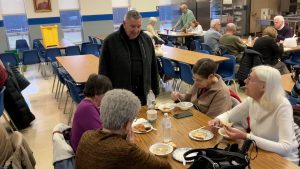
SS. Anthony and Rocco and Our Lady of Mt. Carmel Parishes Holy Name Society and Altar and Rosary Society, Dunmore held its Annual Combined Communion Breakfast on Sunday, March 1st at La Buona Vita. The day began with 8:30am Mass at St. Anthony of Padua Church. Mass was celebrated by the Reverend David P. Cappelloni, Pastor. 

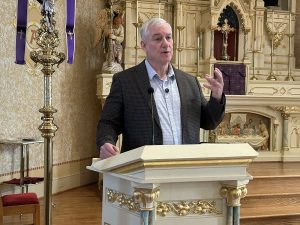
Principal Speaker was Mr. Nick Carr. Toastmaster was Father Thomas Dzwonczyk. Mr. Alfredo Pisa offered remarks on behalf of both parish societies. Father Cappelloni offered the invocation, remarks and final blessing.