SCRANTON – The Most Rev. Joseph C. Bambera, Bishop of Scranton, will once again travel throughout the Diocese of Scranton during Lent 2026 to lead Holy Hours in each of the Diocese’s 12 deaneries, continuing a tradition that began several years ago.

The 2026 Lenten Holy Hours will begin on Thursday, Feb. 19 at Our Lady of Perpetual Help Parish in Wyalusing, Bradford County, and continue through Tuesday, March 24, at SS. Peter and Paul Parish in Plains, Luzerne County.

Each Holy Hour will offer Catholics the opportunity to gather for prayer, reflection, and Eucharistic devotion during the Lenten season.

This year’s theme that Bishop Bambera will preach on is: Finding Peace in Challenging Times.

First launched several years ago as part of the National Eucharistic Revival, the Lenten Holy Hours with Bishop Bambera have drawn strong participation and elicited positive responses from parishioners. Many attendees return year after year, finding the evenings to be a moment of quiet encounter with Christ.

Each Holy Hour includes Exposition of the Blessed Sacrament, time for silent prayer and adoration, a homily offered by Bishop Bambera, and sacred music that enhances the reverent atmosphere.

“It is such a special occasion to have the Bishop with us and to have him here in our little town,” Christine Aydelotte said after a 2024 Holy Hour at Nativity of the Blessed Virgin Mary Parish in Tunkhannock. “He helps to strengthen our bond with Jesus. He’s an inspiration and a reminder that we all play a small part in our one Holy Catholic Apostolic Church.”

Amid a busy and often chaotic season – leading up to Easter – many parishioners have found profound peace in spending quiet time in prayer before the Lord.

“If people put themselves fully into this experience and really sit with the Lord, He makes Himself known. I think everyone, when they fully enter into it, has their own personal revelation,” Concetta Cooney said following a 2025 Holy Hour at Saint John the Evangelist Parish in Pittston.

Every Holy Hour will take place at 7 p.m.

All are welcome to attend any of the Holy Hours, regardless of parish or deanery affiliation.

With the beginning of Lent now only a month away, Bishop Bambera invites the faithful to save the dates of these special Holy Hours and encourages them to attend at least one of the special evenings of prayer.

SCRANTON – On Ash Wednesday, Feb. 18, 2026, the Most Rev. Joseph C. Bambera, Bishop of Scranton, will be principal celebrant and homilist for the 12:10 p.m. Mass at the Cathedral of Saint Peter in Scranton.

Ash Wednesday marks the start of Lent, a 40-day season of prayer, fasting and almsgiving that ends at sundown on Holy Thursday. It is a period of preparation to celebrate the Lord’s Resurrection at Easter.

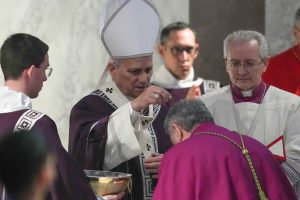
Bishop Bambera places ashes on the forehead of parishioner Eileen Notarianni during a Mass for Ash Wednesday on March 5, 2025. This year, Ash Wednesday is on Feb. 18, 2026.

During Lent, fasting and abstinence regulations are observed. Fasting and abstinence are church-imposed penitential practices that deny us food and drink during certain seasons and on certain days. These acts of self-denial dispose us to free ourselves from worldly distractions, to express our longing for Jesus, to somehow imitate His suffering.

Fasting is to be observed on Ash Wednesday (Feb. 18, 2026) and Good Friday (April 3, 2026) by all Catholics over 18 years of age to the beginning of their 60th year. On days of fasting, one full meal is allowed. Two smaller meals, sufficient to maintain strength, may be taken according to one’s needs, but together should not equal another full meal, unless dispensed or excused.

Abstinence from meat is to be observed by all Catholics who are 14 years of age or older. Ash Wednesday, all of the Fridays of Lent, and Good Friday are days of abstinence.

A full listing of Ash Wednesday Masses for all 102 parishes in the Diocese of Scranton is now available on the Diocese of Scranton website at dioceseofscranton.org.

(OSV News) – Two U.S. bishops Feb. 3 urged Catholics to be “faithful stewards of memory” and “courageous witnesses to truth” during Black History Month, observed in February.

Bishop Daniel E. Garcia of Austin, Texas, chairman of the U.S. Conference of Catholic Bishops’ Subcommittee for the Promotion of Racial Justice and Reconciliation, and Auxiliary Bishop Roy E. Campbell Jr. of Washington, chairman of the USCCB’s Subcommittee on African American Affairs, issued a joint statement to commemorate the month.

Deacon Michel Hodge distributes Communion during Mass at the inaugural New York Black Catholic Congress at Blessed Sacrament Church in New Rochelle, N.Y., Nov. 22, 2025. Two U.S. bishops in a Feb. 3, 2026, statement urged Catholics to be “faithful stewards of memory” and “courageous witnesses to truth” during Black History Month, observed in February. (OSV News photo/Gregory A. Shemitz)

They noted that the 2026 observance marks 100 years of commemorating Black history in the United States. “This milestone is an opportunity for us to prayerfully reflect on the ways history has been preserved, honored, and passed on across generations,” Bishop Garcia and Bishop Campbell said.

In 1926, Carter G. Woodson, an American historian, author and journalist, initiated the first Negro History Week in February of that year. He selected the week that included the birthdays of two key figures in the history of Black Americans: President Abraham Lincoln (Feb. 12) and abolitionist Frederick Douglass (Feb. 20).

It expanded and became Black History Month, officially recognized by President Gerald R. Ford in February 1976, and later codified by Congress in 1986. The combined efforts marked what the Smithsonian’s National Museum of African American History & Culture called a century of commemorating the history, achievements and contributions of Black Americans.

The bishops pointed to “Open Wide Our Hearts,” the U.S. bishops’ pastoral letter against racism, in which they said the bishops “recognized that the lived experience of the vast majority of African Americans bears the marks of our country’s original sin of racism.”

“During this year’s observance of Black History Month, we encourage the faithful to consider the lessons of history, honoring our heroes of the past and learning from the mistakes of the past,” they said.

“Although we may at times encounter people or situations in our country that seek to erase ‘memory’ from our minds and books, it can never be erased from our hearts,” they continued.

“May our reflections strengthen our faith and communities. Let us be faithful stewards of memory. Let us be courageous witnesses to truth. Let us pray and work to honor the inherent dignity of every person and the sacred stories of every people.”

In a joint reflection they issued with the statement, Bishop Garcia and Bishop Campbell emphasized that racism is a sin against human dignity.

“As shepherds of the Church, entrusted with the care of souls and the proclamation of the Gospel, we care deeply for our people, their joys and sorrows, and the stories they carry. This is especially important in our efforts to witness to the dignity of every person, which requires acknowledging the times in our nation’s history when racism has prevented that dignity from being realized,” they said.

“This reflection is about the sacred task of remembering,” they added. “We must recommit ourselves to the sacred task of remembering — especially the stories of those whose voices have long been unheard. Sacred Scripture and Tradition offer a way forward for helping us understand why telling our stories is central to the Gospel mandate.”

VATICAN CITY (CNS) – Pope Leo XIV has added the feast day of St. John Henry Newman, who is “a radiant light for the Church on pilgrimage through history,” to the General Roman Calendar so that “his Optional Memorial be celebrated by all on 9 October.”

Cardinal Arthur Roche and Archbishop Vittorio Francesco Viola, respectively prefect and secretary of the Dicastery for Divine Worship and the Discipline of the Sacraments, announced the pope’s decision in a decree published by the Vatican Feb. 3.

St. John Henry Newman, a British-born scholar who dedicated much of his life to the combination of faith and intellect at universities, is pictured in an undated portrait. In a decree published by the Vatican Feb. 3, 2026, Pope Leo XIV added the feast day of St. John Henry Newman to the General Roman Calendar so that “his Optional Memorial be celebrated by all on Oct. 9.” (OSV News file photo/Crosiers)

Previously, the feast day of St. Newman was inscribed only in the proper calendar of the Congregation of the Oratory – the religious congregation to which he belonged – and the proper calendar of England and Wales. Now his memorial, celebrated on the date of his conversion to Catholicism in 1845, is included in the calendar of the universal church.

“Throughout his long life, Cardinal Newman was unstinting in this service to which he had been called. The service of intellectual enquiry; the service of preaching and teaching; as well as service to the poor and the least,” said the decree, dated Nov. 9.

“His lively mind has left us enduring monuments of great importance in the fields of theology and ecclesiology, as well as poetic and devotional compositions. His constant search to be led out of shadows and images into the fullness of the truth has become an example for every disciple of the Risen One,” the decree said.

In a separate note, Cardinal Roche said the inclusion of St. Newman in the General Roman Calendar “is intended to present his figure as an outstanding example of the constant search for the truth that enlightens and saves” and to help the faithful contemplate him “as a man led by the ‘kindly light’ of God’s grace to find peace within the Catholic Church.”

Bishops’ conferences around the world will need to translate from Latin the prayers issued by the dicastery for Mass on his feast day as well as those used in the Liturgy of the Hours and in the Roman Martyrology, and have the translations confirmed by the dicastery.

Cardinal Roche said the collect or opening prayer for Mass on his feast day reveals “the very essence of the saint’s spiritual journey,” which can become “for us too a source of inspiration and a reason for humble prayer, we who desire to be led out of shadows and appearances, so as to arrive at the full light of truth.”

The Gospel reading for his feast is from the 13th chapter of St. Matthew, the cardinal said, in which “the Kingdom of God is compared to a net cast into the sea that gathers all kinds of fish. Only one who becomes a disciple can understand the parable of the Kingdom, becoming “like a master of a house, who brings out of his treasure what is new and what is old.”

The decree came after Pope Leo proclaimed the British saint a doctor of the church Nov. 1, the feast of All Saints.

Celebrating Mass in St. Peter’s Square the Vatican Nov. 1, Pope Leo concluded the Jubilee of the World of Education and proclaimed St. Newman the 38th doctor of the church, including him among the men and women of the Christian East and West who have made decisive contributions to theology and spirituality.

Earlier that week, Pope Leo had officially recognized St. Newman as co-patron of education along with St. Thomas Aquinas.

St. Newman was born in London Feb. 21, 1801, and was ordained an Anglican priest in 1825. He joined the Catholic Church in 1845 and was ordained a Catholic priest in Rome at the church of the Pontifical Urbanian College May 30, 1847. He was made a cardinal in 1879 by Pope Leo XIII and died in 1890.

VATICAN CITY (CNS) – Pope Leo XIV praised consecrated men and women for going to the world’s peripheries and refusing to abandon their people, even amid conflict.

“They remain, often stripped of all security, as a living reminder – more eloquent than words – of the inviolable sacredness of life in its most vulnerable conditions,” he said Feb. 2 in his homily for Candlemas – the feast of the Presentation of the Lord – which also marks the Catholic Church’s celebration of World Day for Consecrated Life.

Pope Leo XIV receives the gifts from women religious as he celebrates Mass marking the feast of the Presentation of the Lord in St. Peter’s Basilica at the Vatican Feb. 2, 2026. The Mass also marked the Vatican celebration of the World Day for Consecrated Life. (OSV News photo/Simone Risoluti, Vatican Media)

“Even where weapons roar and arrogance, self-interest and violence seem to prevail,” he said, the presence of these consecrated men and women “proclaims the words of Jesus” in his parable of the lost sheep: “See that you do not despise one of these little ones, for … their angels in heaven always look upon the face of my heavenly Father.”

The pope’s Mass began with the pope blessing with holy water the candles used for the entrance procession. Dozens of consecrated men and women led the candlelit procession while the lights in St. Peter’s Basilica remained dimmed, and thousands of people who filled the basilica held lit candles as well.

After the darkened basilica was filled with light, Pope Leo, who joined the Order of St. Augustine as a young man and served as a missionary in Peru for decades, reflected on the mission of religious men and women in the Church and in the world.

“Dear brothers and sisters, the Church asks you to be prophets — messengers who announce the presence of the Lord and prepare the way for him,” he said in his homily. “You are called to this mission above all through the sacrificial offering of your lives, rooted in prayer and in a readiness to be consumed by charity,” he said.

Docile to the action of the Holy Spirit, the founders and foundresses of their religious orders and communities offer “wonderful models of how to fulfil this mandate faithfully and effectively,” he said.

“Living in constant tension between earth and heaven, they allowed themselves to be guided with faith and courage,” he said. Some founders “were led to the silence of the cloister, others to the demands of the apostolate,” but all of them returned “humbly and wisely, to the foot of the cross and to the tabernacle, where they offered everything and discovered in God both the source and the goal of all their actions.”

Pope Leo highlighted those founders who “embarked on perilous undertakings.”

“They became a prayerful presence in hostile or indifferent environments; a generous hand and a friendly shoulder amid degradation and abandonment; and witnesses of peace and reconciliation in situations marked by violence and hatred,” he said. “They were ready to bear the consequences of going against the current, becoming, in Christ, a ‘sign of contradiction,’ sometimes even to the point of martyrdom.”

One way to honor these brothers and sisters, he said, is “by carrying forward their legacy.”

“You are called to bear witness to God’s saving presence in history for all peoples, even within a society in which false and reductive understandings of the human person increasingly widen the gap between faith and life,” he said.

“You are called to testify that the young, the elderly, the poor, the sick and the imprisoned hold a sacred place above all else on God’s altar and in his heart,” he said, and to show how each of the least is “an inviolable sanctuary of God’s presence, before whom we must bend our knee, in order to encounter him, adore him and give him glory.”

Many religious communities have established “outposts of the Gospel … in a wide variety of challenging contexts, even in the midst of conflict,” he said. “These communities do not abandon their people, nor do they flee” as they seek to uphold the sacredness of human life in its most vulnerable conditions.

“Consecrated life, in its serene detachment from all that is passing, reveals the inseparable bond between authentic care for earthly realities and a hope filled with love for what is eternal” and gives meaning to everything else, he said.

Through their promise to follow Christ more closely by professing the evangelical counsels of poverty, chastity and obedience, consecrated men and women “empty” themselves so that Christ, “the one eternal messenger of the covenant who remains present among humanity today, can melt and purify hearts with his love, grace and mercy,” Pope Leo said.

Through this self-emptying and life in the Spirit, he said, consecrated men and women “can show the world the way to overcome conflict, sowing fraternity through the freedom of those who love and forgive without measure.”

“Dear consecrated men and women, today the Church gives thanks to the Lord and to you for your presence,” he said, encouraging them “to be leaven of peace and signs of hope wherever Providence may lead you.”

(OSV News) – In a message to the Archdiocese of Milan, Pope Leo XIV expressed his hope that the 2026 Winter Olympic and Paralympic Games will be an occasion of solidarity and bridge-building between peoples and cultures.

The papal message was read during a Jan. 29 Mass marking the arrival of the “Cross of Athletes” and the official launch of the archdiocese’s Olympic pastoral initiative, “For Each Other.”

In his message, which was signed on his behalf by Cardinal Pietro Parolin, Vatican secretary of state, the pope said he hoped the Olympic Games would bring about “sentiments of friendship and fraternity, strengthening awareness of the value of sport at the service of the integral development of the human person.”

Archbishop Mario Delpini of Milan stands next to the “Cross of Athletes” in the sacristy of the Basilica of San Babila in Milan Jan. 29, 2026. The cross was entrusted to the archdiocese by Athletica Vaticana, the Holy See’s sports association, ahead of the 2026 Winter Olympic and Paralympic Games in Milan and Cortina d’Ampezzo. (OSV News photo/Archdiocese of Milan)

“The Holy Father assures his prayers so that these days of healthy competition may contribute to building bridges between cultures and peoples, promoting hospitality, solidarity, and peace,” the message stated.

The “For Each Other” initiative, which will coincide with the Feb. 6-22 Winter Olympics and the March 6-15 Paralympics, will feature activities, performances and events hosted in parishes across Milan.

At the heart of the activities will be the 11th-century Basilica di San Babila, dedicated to St. Babylas of Antioch, where the opening Mass was celebrated and which will be known as the “Church of Athletes” throughout the Olympic and Paralympic Games.

During the Mass, the “Cross of Athletes” was entrusted to the archdiocese by Athletica Vaticana, the Holy See’s sports association. Blessed by Pope Francis at the 2013 World Youth Day in Rio de Janeiro, the cross has been placed in chapels in the Olympic host cities of London in 2012 and Paris in 2024.

According to the Archdiocese of Milan, the cross, which will remain at the altar in the Basilica di San Babila until the end of the Paralympics, “symbolizes the close bond between sporting activities and the values of solidarity, inclusion, and personal growth.”

In his homily, Archbishop Mario Delpini of Milan said the Olympic and Paralympic Games could serve as a form of rigorous spiritual education, describing the athletic competitions as “school of asceticism” and a “school of life” where one learns how to handle both victory and defeat.

For Olympians and Paralympians, the games will be a chance to learn “what strength is needed to accept defeat without becoming depressed, to live victory without becoming arrogant, to live through the disordered reactions of others, the unexpected anger, the irritating stubbornness, the paralyzing discouragement.”

Reflecting on the presence of the “Cross of Athletes,” which features a void silhouette of Christ’s crucified body, Archbishop Delpini said the cross offered “more of a glimpse than a figure” of the body of Christ that “encourages our questions, our gaze, and our attention.”

“If you want to know what love is, if you want to know if there is hope,” the archbishop said, “look to Jesus, adore the crucified and risen body, listen to his words and follow him, for he is the way, the truth, and the life.”

(OSV News) – A change is coming in 2026 for the pope’s top man in America. Cardinal Christophe Pierre, apostolic nuncio to the United States, turned 80 Jan. 30, and he is widely expected to have his retirement accepted by Pope Leo XIV in the coming weeks. Nuncio to the U.S. since 2016, Cardinal Pierre’s retirement would draw to a close his nearly five-decade career in service to the Holy See’s diplomatic mission.

The French-born cardinal, whose upbringing was spent in various French-speaking African countries, was ordained a priest in 1970 in his native Archdiocese of Rennes. After completing degrees at the Catholic Institute of Paris, the Pontifical Lateran University and Pontifical Ecclesiastical Academy, the latter two in Rome, Cardinal Pierre entered the Holy See’s diplomatic service in 1977.

Cardinal Christophe Pierre, papal nuncio to the United States, blesses Deacon Robert Cousar before he reads the Gospel during the Raskob Foundation Family Mass at St. Joseph Church in Wilmington, Del., Sept 20, 2025. Cardinal Pierre turned 80 Jan. 30, 2026. (OSV News photo/Don Blake, The Dialog)

The next two decades brought him to postings first in New Zealand, followed by Mozambique, Zimbabwe, Cuba, Brazil and Switzerland at the European office of the Holy See’s mission to the United Nations in Geneva.

In 1995, Cardinal Pierre was named apostolic nuncio to Haiti by St. John Paul II and was ordained a titular archbishop the same year. After nearly four years in Haiti, where he facilitated the laicization of the county’s president at the time, former Salesian priest Jean-Bertrand Aristide, Cardinal Pierre was sent as apostolic nuncio in Uganda in 1999. There he decried the government’s advocacy of condom use as promoting “outright promiscuity,” as over 8% of the Ugandan population was infected with HIV/AIDS at the time.

In 2007, Cardinal Pierre was assigned to Mexico, where he served as apostolic nuncio until Pope Francis appointed him to the U.S. nunciature in Washington in 2016. Pierre followed the now-controversial Archbishop Carlo Maria Viganò, who served as apostolic nuncio to the United States from 2011 and, in 2024, was found to be excommunicated after standing trial at the Vatican for schism.

Three years previously, in an interview with Catholic News Service, Cardinal Pierre said Archbishop Vigano’s portrait stayed in the D.C. nunciature despite his inflammatory statements against Pope Francis. “We are not Americans (who) want to take away the statues. We respect history,” Cardinal Pierre had said.

During his tenure as nuncio in the U.S., Cardinal Pierre was without a doubt Pope Francis’ biggest defender in America, and he was named a member of the college of cardinals in 2023. Cardinal Pierre, who had known Pope Francis since Francis had been archbishop of Buenos Aires, observed in the same 2021 CNS interview that Pope Francis was “not a dictator” but was “a mobilizer,” describing his desire “to help the Church be Church here” was his primary motivation.

Cardinal Pierre’s regular addresses to the plenary assemblies of U.S. bishops often centered on application of Pope Francis’ emphases and priorities, particularly synodality — which the nuncio told CNS is emblematic of “the strength of the Church.”

As apostolic nuncio, much of Cardinal Pierre’s time was occupied in overseeing the process of appointing bishops in the United States. He has been widely respected among the bishops for identifying candidates who personified the qualifications Pope Francis wanted to see in bishops, and yet who were, at the same time, also less likely to fan the flames of any polarization or ideologies. Several Church insiders have understood Cardinal Pierre’s role often as a check to Cardinal Blase J. Cupich of Chicago, one of two American members of the Dicastery for Bishops, which ultimately presents candidates for the episcopacy to the pope.

In retirement Cardinal Pierre is expected to split his time between his native France and Rome.

It is rumored that Cardinal Pierre’s successor will be in place in Washington by the spring, which will mean his first address to the U.S. bishops could take place at their June plenary in Orlando. Who it will be is anybody’s guess. But certainly Pope Leo, as the first American-born successor of Peter, will take keen interest in the appointment.

Whoever the new apostolic nuncio might be is expected to be fully Pope Leo’s man in the U.S., like Cardinal Pierre was for Pope Francis. He is anticipated to oversee the appointment of archbishops for several major American sees such as Chicago and Los Angeles, as well as replacements for a growing list of baby-boom-age bishops ready for retirement.

The new nuncio will also be Pope Leo’s key liaison with President Donald Trump, particularly as his administration’s immigration policies are increasingly met by resistance by the U.S. bishops and by Rome. And Cardinal Pierre’s successor will also take up the reins of animating unity at a time when some bishops are increasingly comfortable speaking without wide consultation and collegiality — seen most recently when three American cardinals entered the political fray outside of the episcopal conference — risking a further fracturing of the country’s episcopate.

But, ultimately, it would seem from Pope Leo’s leadership style so far, he doesn’t so much need a defender as much as a diplomat to help him bring the Church together.

VATICAN CITY (CNS) – The increasing number of people who do not see the Gospel as a fundamental resource for their life should inspire – not discourage – Catholics in rediscovering the joy of evangelization, Pope Leo XIV said.

The transmission of the faith is “a topic of great urgency,” the pope said in remarks to members and officials of the Dicastery for the Doctrine of the Faith and others participating in its plenary session at the Vatican Jan. 27-29.

Pope Leo XIV meets with members and officials of the Dicastery for the Doctrine of the Faith and others participating in its plenary session during an audience at the Vatican Jan. 29, 2026. (CNS photo/Vatican Media)

Meeting with the group at the Vatican Jan. 29, Pope Leo praised the dicastery for its “valuable service” of helping the pope and the world’s bishops proclaim the Gospel by promoting and safeguarding the integrity of Catholic teaching on faith and morals.

“It does this by drawing upon the deposit of faith and seeking an ever deeper understanding of it in the face of new questions,” he said, citing Pope Francis’ apostolic constitution on the reform of the Roman Curia, “Praedicate Evangelium” (“Preach the Gospel”).

Of great importance today, he said, is the “transmission of the faith,” a topic discussed during the dicastery’s plenary.

“We cannot ignore the fact that, in recent decades, there has been a breakdown in the way Catholics pass down the Christian faith” from generation to generation, he said, and that “there is an increasing number of people who no longer perceive the Gospel as a fundamental resource for their life, especially among the younger generations.”

In fact, he added, many young men and women “live without any reference to God and the Church, and while this causes us believers pain, it must also lead us to rediscover the ‘delightful and comforting joy of evangelizing,’ which is at the very heart of the life and mission” of the Catholic Church.

Reiterating his appeal during his extraordinary consistory with the College of Cardinals in early January, Pope Leo said, the Catholic Church wants to be a missionary Church “that looks beyond itself, at others” and that proclaims the Gospel, “above all through the power of attraction,” reminding them that “it is not the Church that attracts, but Christ.”

Pope Leo highlighted the importance of the dicastery’s work, which includes offering clarification on Church doctrine “through pastoral and theological guidance on often very sensitive issues” as well as handling “delicta graviora,” that is, “more grave crimes” against church law, which include the abuse of minors.

He encouraged the dicastery to continue their task of “welcoming and accompanying, with every kindness and judgment, the bishops and superiors general called to deal with cases of crimes reserved to the dicastery.”

“This is a very delicate area of ministry, in which it is essential to ensure that the requirements of justice, truth and charity are always honored and respected,” he said, further encouraging them to continue to contribute to the whole church in a “humble and unobtrusive manner.”