(OSV News) – As deposed Venezuelan President Nicolás Maduro made his first appearance Jan. 5 in a New York courtroom on narco-terrorism charges after the Trump administration carried out what President Donald Trump called on social media “a large scale strike against Venezuela,” uncertainty about immigration status lingered for some Venezuelan migrants in the U.S.

Astrid Liden, communications officer for the Hope Border Institute, a group that works to apply the perspective of Catholic social teaching in policy and practice to the U.S.-Mexico border region, and a Venezuelan-American, told OSV News, “In recent years, hundreds of thousands of Venezuelans have sought protection in the United States, many passing through the US-Mexico border. Millions of Venezuelans live abroad due to the situation in Venezuela, and we share their hope in the end of the reign of Maduro, whose rule led to the displacement of so many.”

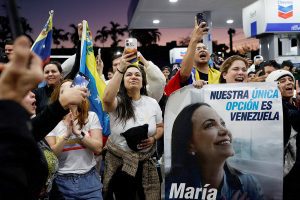
A woman holds a banner depicting Venezuelan opposition leader and Nobel Peace Prize laureate, Maria Corina Machado, as people react in Miami Jan. 3, 2026, to the news that U.S. forces struck Venezuela and captured its President Nicolas Maduro. (OSV News photo/Marco Bello, Reuters)

However, she added, “The recent end of TPS for Venezuelans by the Trump administration sets a very dangerous precedent and puts hundreds of thousands of Venezuelans at risk.”

Maduro was arraigned in a Manhattan federal court by Judge Alvin Hellerstein. Cameras are prohibited in most federal court proceedings, but according to reporters, Hellerstein said, “It’s my job to assure this is a fair trial.”

At the brief hearing, Maduro said through an interpreter that he was “innocent” and “still president of my country.”

Maduro’s regime was seen as illegitimate by many countries around the world, including the European Union. Venezuela’s opposition demonstrated through collecting digitized voter tallies that their candidate, Edmundo González Urrutia, won the 2024 presidential election with 67% of the vote; but Maduro refused to cede power. The Biden administration, which recognized González as Venezuela’s rightful president-elect, in January 2025 said Maduro “clearly lost the 2024 presidential election and has no right to claim the presidency.”

However, world leaders also expressed concern that the U.S. military action to remove Maduro flouted international law.

At an emergency meeting of the United Nations Security Council just prior to Maduro’s hearing, U.N. Secretary General Antonio Guterres said he was “deeply concerned that rules of international law have not been respected,” while U.S. ambassador Mike Waltz called the action a “surgical law enforcement operation.”

The previous day, Pope Leo XIV expressed “deep concern” following Maduro’s capture.

“This must guarantee the country’s sovereignty, ensure the rule of law enshrined in the Constitution, respect the human and civil rights of all, and work to build together a serene future of collaboration, stability, and harmony, with special attention to the poorest who suffer due to the difficult economic situation,” he said after reciting the Angelus prayer with pilgrims gathered in St. Peter’s Square Jan. 4.

At a Jan. 3 press conference, Trump said the U.S. will “run the country” of Venezuela “until such time as we can do a safe, proper and judicious transition,” but questions remained about that process.

But the action also highlighted uncertainty for some Venezuelans in the U.S.

In 2025, the Trump administration ended Temporary Protected Status for about 600,000 Venezuelans living in the U.S., stripping their legal status to remain in the U.S. TPS status is sometimes granted to countries where natural disasters or civil unrest have fueled displacement.

Asked during an appearance on “Fox News Sunday” Jan. 4 whether Venezuelans in the U.S. who were previously under TPS can apply for asylum, Homeland Security Secretary Kristi Noem suggested they can do so, but did not directly address whether deportations to that country would continue.

“Every individual that was under TPS has the opportunity to apply for refugee status and that evaluation will go forward,” Noem said, without elaborating on how those evaluations would be made.

In a comment on the subject at his press conference, Trump said, “Frankly, some wanna stay and some probably wanna go back.”

Catholic immigration advocates previously urged the Trump administration to leave TPS status in place for countries including Venezuela in part because of its political instability.

“The dismantling of a corrupt autocratic regime does not occur simply through the removal of its head — we know this well,” Linden said. “This protection in the United States must be maintained until voluntary and safe return truly becomes a viable option. As Pope Leo XIV has said, we must ensure that ‘the good of the beloved Venezuelan people’ — both those in the country and those abroad — remains enshrined. We must see Venezuelans, including the leaders elected in 2024, involved in a process of democratic transition for there to be a country where Venezuelans can one day return to.”

J. Kevin Appleby, senior fellow for policy at the Center for Migration Studies in New York and the former director of migration policy for the USCCB, told OSV News, “TPS should be renewed at least until a democratically-elected government is in power, so that people feel they will not face persecution upon return.”

He added, “Moreover, the remittances that would flow to the country from half a million Venezuelans with TPS would help steady the country economically.”

In comments to reporters on Maduro’s hearing, Notre Dame Law School professor and organized crime expert Jimmy Gurulé, a former federal prosecutor and former assistant U.S. attorney general, said the hearing is likely the first part of what will be a lengthy legal process.

“While justice will ultimately be served in the Maduro case, it won’t be anytime soon,” he said.

A jury trial in the Maduro case, Gurulé said, “is unlikely to commence until sometime in 2027” in part because “the list of pretrial issues goes on and on.”

“Initially, defense attorneys will challenge the legality of the court’s jurisdiction over Maduro,” he said. “Defense counsel will argue that the U.S. military invasion of Venezuela and subsequent apprehension of Maduro not merely violated principles of international law, but constituted the crime of aggression.”

“Maduro’s defense attorneys will seek broad criminal discovery, which could include a request for the disclosure of classified evidence,” he added. He said that could involve lengthy litigation under the Classified Information Procedures Act, which “balances the government’s needs to protect secrets with a defendant’s rights to a fair trial.”

VATICAN CITY (CNS) – An estimated 33 million visitors and pilgrims came to the Vatican to celebrate the Jubilee Year, exceeding early forecasts, officials said at a news conference at the Vatican Jan. 5.

Archbishop Rino Fisichella, pro-prefect of the Dicastery for Evangelization’s section for new evangelization and chief organizer of the 2025 Holy Year, said the figure is based on estimates from a study by Roma Tre University, online registrations for the Holy Year, and the number of people who passed through the Holy Doors of Rome’s major basilicas and attended papal events.

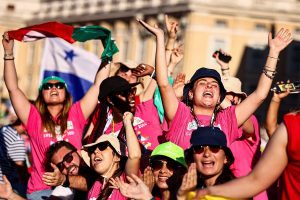
Young Catholics celebrate ahead of the welcome Mass of the Jubilee of Youth in St. Peter’s Square at the Vatican July 29, 2025. (OSV News photo/Yara Nardi, Reuters)

By the time the Holy Year ends Jan. 6, he said, at least 33 million people will have taken part, which breaks down to more than 90,000 people a day. The period with the most pilgrims in Rome was during the Jubilee of Young People from July 21 to Aug. 10, which registered more than 13 million people.

Early estimates had expected that the Jubilee Year would bring 30 million to 35 million visitors to the Vatican. The city saw about 22 million people come to Rome in 2024, Roberto Gualtieri, mayor of Rome, said during the news conference.

Based on data collected solely from registered pilgrims, visitors from the United States ranked second only to Italy, accounting for nearly 13 percent of the total number of registered visitors, Archbishop Fisichella said. Pilgrims from more than 185 countries participated in the Jubilee Year.

“It is inevitable that such a milestone also brings with it an assessment of this year, which in many respects has been extraordinary. Begun under Pope Francis, the Jubilee concludes under Pope Leo XIV,” the archbishop said in Italian. “The funeral and the new election were added to the entire Jubilee program, showing the whole world the ability to act with determination and confidence amid an exceptional series of events.”

Archbishop Fisichella thanked Rome’s officials for their hard work in supporting the inflow of visitors, and said that the increase also led to increased visitor rates across the city’s tourist sites.

Gualtieri agreed, saying it was a year of unprecedented tourism across the city. To accommodate the Jubilee Year and the influx of visitors, construction crews completed 110 projects across Rome, including the restoration of historic squares, monuments and holy sites.

Lamberto Giannini, Rome’s prefect, who coordinates maintaining law and order in the city, said that city and Vatican teams worked together to complete the many construction projects “without serious accidents or workplace injuries and with extensive oversight to prevent mafia infiltration — something clearly possible given the scale of the investments.”

Vatican leaders have already begun planning the next Jubilee Year, which will take place in 2033 to commemorate the 2,000th anniversary of the death and resurrection of Jesus.

“The journey, therefore, is not finished,” Archbishop Fisichella said. “This was only a significant step, preparing the way for another event of grace that must be planned with foresight and a strong awareness of an upcoming global event.”

(OSV News) – Pope Leo XIV expressed “deep concern” following the capture of Venezuelan President Nicolás Maduro and his wife, Cilia Flores, by the United States in a large-scale attack.

After reciting the Angelus prayer with pilgrims gathered in St. Peter’s Square Jan. 4, the pope said the “well-being of the beloved Venezuelan people must prevail over all other considerations and lead to overcoming violence and pursuing paths of justice and peace.”

Captured Venezuelan President Nicolas Maduro arrives at the Downtown Manhattan Heliport in New York City Jan. 5, 2026, as he heads towards the Daniel Patrick Moynihan United States Courthouse for an initial appearance to face U.S. federal charges including narco-terrorism, conspiracy, drug trafficking, money laundering and others. (OSV News photo/Eduardo Munoz, Reuters)

Entrusting Venezuela to its patroness, Our Lady of Coromoto, as well as the country’s recently canonized saints – Sts. José Gregorio Hernández and Carmen Rendiles – Pope Leo called on Catholics to pray and highlighted the need to respect Venezuela’s right to autonomy and self-determination.

“This must guarantee the country’s sovereignty, ensure the rule of law enshrined in the Constitution, respect the human and civil rights of all, and work to build together a serene future of collaboration, stability, and harmony, with special attention to the poorest who suffer due to the difficult economic situation,” he said.

After months of tension, U.S. President Donald Trump ordered the nighttime military operation Jan. 3, capturing Maduro and his wife, and transporting them to New York to face narco-terrorism conspiracy charges, The Associated Press reported.

According to AP, Venezuelan officials said some people were killed in the U.S. attack but did not disclose the number of casualties.

Reactions from around the world have been mixed, with many, particularly Venezuelans in the diaspora, hailing Maduro’s capture, while others expressed concerns that the U.S. attack violated international law.

The country’s bishops issued a brief “message of accompaniment and closeness with the People of God” via Instagram and X that did not comment directly on the capture of the Venezuelan president and his wife, but instead urged for “prayer for the unity of our people.”

“In light of the events that our country is experiencing today, let us ask God to grant all Venezuelans serenity, wisdom, and strength,” the bishops said. “We express our solidarity with those who were wounded and the families of those who died.”

Less than an hour later, the bishops issued a second brief statement calling on the people of Venezuela “to live more intensely in hope and fervent prayer for peace in our hearts and in society, rejecting any type of violence.”

“May our hands open for encounter and mutual aid, and may the decisions that are taken always be made for the well-being of our people,” the bishops wrote.

The statement was shared by other Latin American bishops’ conferences, including the bishops of Argentina and Mexico.

The Mexican bishops’ conference said it was “united in prayer with the bishops of Venezuela to ask God for serenity, wisdom, and strength for the Venezuelan people.”

In a brief comment to SIR, the news agency of the Italian bishops’ conference, Archbishop Jesús González de Zárate of Valencia, Venezuela, president of the country’s bishops conference, said he had been “awake since 2 a.m. to follow what was happening” and that he was accompanying “our people with prayer.”

While Venezuelans are still in shock, Archbishop Zarate said, “the facts are still in development to properly assess” the situation and emphasized his “trust in God and the values of our people.”

Bishop Juan Carlos Bravo Salazar of Petare, a diocese located east of the Venezuelan capital of Caracas, issued a statement Jan. 3 on the diocese’s Instagram account acknowledging that the people of Venezuela “are living through moments of confusion, uncertainty, and pain, in which we do not see clearly what is happening.”

“Our strength and hope are in the Lord of life and peace,” Bishop Bravo said, urging the need “to maintain serenity, peace, and above all a climate of prayer.”

He also urged caution, asking people to “take shelter and not go out.”

“For the good of our people, do not make calls to (take to) the streets, nor disseminate unverified and unconfirmed information, nor from sources that are not reliable or official. Let us stay in communication among ourselves, between pastoral zones, and with our closest collaborators,” he said.

(OSV News) – “Be open to what the Lord has in store for you,” Pope Leo XIV said in a video address to thousands of youth and young adults attending the SEEK 2026 conference.

The annual gathering — taking place Jan. 1-5 at event locations in Columbus, Ohio, Denver and Fort Worth, Texas — has drawn an estimated 26,000 participants for talks and workshops on encountering Christ, with the schedule including daily Mass, Eucharistic adoration, the sacrament of reconciliation and fellowship.

Pope Leo XIV is seen in a screenshot delivering a video message to young Catholics attending at SEEK26 — his latest of several video messages to youth in the U.S. since becoming pope. The annual gathering — taking place Jan. 1-5 at event locations in Columbus, Ohio, Denver and Fort Worth, Texas — has drawn an estimated 26,000 participants for talks and workshops on encountering Christ, with the schedule including daily Mass, Eucharistic adoration, the sacrament of reconciliation and fellowship. (OSV News screenshot/Vatican News)

Among the scheduled keynote speakers were Father Mike Schmitz, Matt Fradd, Chris Stefanick, Sister of Life Mary Grace and Sister Josephine Garrett, a sister of the Holy Family of Nazareth.

For 2026, conference organizer FOCUS — an international Catholic outreach ministering on more than 200 college campuses in the U.S., Mexico and Europe, as well as at some 20 parishes — selected the theme “To the Heights,” a favorite exhortation of the recently canonized St. Pier Giorgio Frassati, an avid mountaineer and patron of young adults.

As of midday Jan. 2, FOCUS reported that attendees numbered 16,115 in Columbus, 5,907 in Denver and 4,503 in Fort Worth.

In his pre-recorded video message to the SEEK attendees, which was posted along with a transcript to the Vatican website, Pope Leo appeared to echo St. Frassati’s sentiment, urging SEEK attendees to reflect on the call of the first two disciples of Jesus as detailed in John 1:35-51.

The pope said that Andrew and the other disciple — initially followers of John the Baptist — pursued Jesus, whose first recorded words in John’s Gospel were a question posed to the two: “What do you seek?”

“Jesus asks the disciples this question because he knows their hearts,” said Pope Leo. “They were restless — in a good way. They did not want to settle for the normal routine of life. They were open to God and were longing for meaning.”

And, said the pope, “today, Jesus directs this same question to each one of you.”

Pope Leo noted that conference attendees’ hearts may also be “restless, searching for meaning and fulfillment” as well as for “direction in your lives.”

To such profound questions, said the pope, “The answer is found in a person. The Lord Jesus alone brings us true peace and joy, and fulfills every one of our deepest desires.”

John’s Gospel passage details the process of discovering Christ and developing a life-changing relationship with him, said the pope, noting that the first two disciples replied to Jesus’ question by asking where he was staying.

“They wanted to get to know him personally by spending time with him,” said Pope Leo.

Although “the two disciples were initially with Jesus only for a few hours,” said the pope, “that encounter changed their lives forever.”

Andrew immediately sought out his brother Simon (whom Jesus later renamed Peter), excitedly sharing that he had found the Messiah — “in other words, ‘We have found the one we were looking for!'” said the pope.

Such a response to meeting Christ “is the answer that all of us can give once we too get to know the Lord,” said Pope Leo, adding that the Gospel passage “also therefore speaks to us of what it means to be a missionary. … We desire to share with others what we have received so that they, too, can come to know the fullness of love and truth found only in him.”

As they “draw close to Jesus” during the SEEK 2026 conference, Pope Leo urged attendees, “Do not be afraid to ask him what he is calling you to,” whether that vocation is the priesthood, religious life, or marriage and family life.

“If you sense the Lord calling you, do not be afraid,” said Pope Leo. “Once again, let me emphasize that he alone knows the deepest, perhaps hidden, longings of your heart, and the path that will lead you to true fulfillment. Let him lead and guide you!”

Pointing to the conference start date of Jan. 1, the feast of Mary, Mother of God, Pope Leo entrusted attendees to her maternal intercession.

He concluded his message with a blessing, saying, “I gladly invoke upon all of you and upon your families the divine blessings of this Christmas season.”


OBITUARY
REVEREND CONNELL A. MCHUGH

Reverend Connell A. McHugh, Pastor Emeritus of Good Shepherd Church, Drums, and current Sacramental Minister at Holy Rosary Parish, Hazleton, died on January 4, 2026, after having faithfully served the Diocese of Scranton for 54 years.

Rev. Connell A. McHugh was born in Hazleton, the son of Connell and Katherine (Faeley) McHugh. He attended the former St. Gabriel’s School for both his elementary and high school education, graduating in 1964. He began his preparation for the priesthood at St. Charles Borromeo College in Catonsville, Maryland, which was staffed by the Sulpician Order. He continued his studies at St. Pius X in Dalton, the former Diocesan seminary, in the fall of 1966. It was at St. Pius X that he developed a love of biblical studies, inspired by Fr. Robert Barone, a native of Hazleton and a former student of Fr. Raymond Brown whom Father McHugh regarded as the greatest biblical scholar in the United States of any Christian denomination. Fr. McHugh and classmate Fr. William Karle were largely responsible along with Fr. Devlin of Scranton University to have seminarians receive degrees from Scranton University. Fr. McHugh graduated with a B.A. in philosophy from Scranton University in 1969.

In 1969, Fr. McHugh entered Our Lady of Angels Seminary in Selkirk, New York, just outside of Albany.  He was privileged to have excellent Scripture professors including Fr. John O’Grady and visiting biblical scholars such as Fr. Shaun Kiel. Fr. McHugh completed his studies at Our Lady of Angels in 1972, graduating with high honors and earning both a Master of Arts and a Master of Divinity, both in theology.  He was ordained to the priesthood by Bishop J. Carroll McCormick on May 13, 1972.

Father McHugh’s summer assignment was at St. Clare’s in Scranton. He then served for a year as assistant Pastor of St. Mary’s, Dunmore and then two years at Nativity of Our Lord in South Scranton. Fr. McHugh also taught in both Diocesan high schools and junior high schools while in the Scranton Area.

In 1975, Father McHugh was assigned as assistant Pastor of St. Francis, West Hazleton, and as catechist at Bishop Hafey High School. He remained as assistant Pastor of St. Francis for nine and a half years and as catechist Bishop Hafey High School for 10 years.

Father McHugh was appointed Pastor of St. Patrick’s, White Haven, in January 1985 and Catholic Chaplain of the White Haven Center. He was named Pastor of St. Francis, West Hazleton, in July 1994, and remained pastor until 2007. He also taught at Bishop Hafey again from 2005-2007. He served briefly at Holy Redeemer High School in Wilkes-Barre and as weekend celebrant for Good Shepherd, Drums, and St. John Bosco, Conyngham. He was appointed Pastor of Good Shepherd in 2012 and served there for over 8 years until his retirement. In retirement, Fr. McHugh became the Sacramental Minister at Holy Rosary Parish Hazleton.

Fr. McHugh was very active in sports, sponsoring many high school boys’ and girls’ basketball teams that competed successfully in the Scranton, Wilkes-Barre, and Hazleton areas. His players were drawn from regional high schools. Father also was an avid tennis player locally and at clubs in Scranton and Wilkes-Barre. Father wrote sports articles for many years for Panorama magazine as was widely recognized as an authority on vintage sports cards, especially baseball ones.

Many people know Fr. McHugh for his decades of biblical presentations in which he attempted to offer a high level of scholarship in the tradition of Fr. Raymond Brown and his good friend and mentor, Fr. Robert Barone.

Viewings will take place on Friday January 9, 2026, from 5:30 p.m. to 6:30 p.m. and Saturday January 10, 2026, from 9 a.m. – 10 a.m. in Holy Rosary Parish, 240 South Poplar Street, Hazleton. Vespers will be celebrated Friday evening at 6:30 p.m. in the church.

A Pontifical Mass of Christian Burial will be celebrated by the Most Reverend Joseph C. Bambera, D.D., J.C.L., Bishop of Scranton, on Saturday January 10, 2026, at 10 a.m. in Holy Rosary Parish, 240 South Poplar Street, Hazleton.

Arrangements are entrusted to the care of the Joseph B. Conahan Funeral Home, Hazleton.

VATICAN CITY (CNS) – The world is not saved by threatening violence or by judging, oppressing or getting rid of others, Pope Leo XIV said.

“Rather, it is saved by tirelessly striving to understand, forgive, liberate and welcome everyone, without calculation and without fear,” the pope said during Mass in St. Peter’s Basilica for the feast of Mary, Mother of God, and World Peace Day Jan. 1.

Therefore, at the beginning of a new year with “new and unique days that await us, let us ask the Lord to help us experience at every moment, around us and upon us, the warmth of his fatherly embrace and the light of his benevolent gaze,” he said in his homily.

Pope Leo XIV prays before a statue of Our Lady of Hope and the Christ child during Mass for the feast of Mary, Mother of God, and World Peace Day in St. Peter’s Basilica at the Vatican Jan. 1, 2026. (CNS photo/Vatican Media)

The Mass marked the 59th World Day of Peace celebrated by the church. The pope’s message for the world day, published in December, was dedicated to the humble, “unarmed and disarming” peace of the risen Christ who loves unconditionally.

Thousands of people were present in the basilica for the celebration on New Year’s Day, including young people dressed as the three kings who visited Jesus. A figurine of the infant Jesus was before the altar, in keeping with the Christmas season of celebration, and an image of Our Lady of Hope was to the side of the main altar as a sign of the Jubilee of hope, which will end Jan. 6.

In his homily, Pope Leo reflected on the mystery of Mary’s divine motherhood, which “helped give a human face to the source of all mercy and benevolence: the face of Jesus. Through his eyes — first as a child, then as a young man and as an adult — the Father’s love reaches us and transforms us.”

By being born of Mary in a grotto, he said, “God presents himself to us ‘unarmed and disarming,’ as naked and defenseless as a newborn in a cradle.”

“He does this to teach us that the world is not saved by sharpening swords, nor by judging, oppressing or eliminating our brothers and sisters,” he said. Rather, the world is saved by seeking to understand, forgive, free and welcome everyone with love.

Mary bearing the Christ child represents “two immense, ‘unarmed’ realities” that come together, he said: “that of God, who renounces every privilege of his divinity to be born in the flesh, and that of a human person who, trustingly and fully, embraces God’s will.”

“Thus, at the dawn of the new year, the liturgy reminds us that for each of us, every day can be the beginning of a new life, thanks to God’s generous love, his mercy and the response of our freedom,” Pope Leo said. “It is beautiful to view the coming year in this way: as an open journey to be discovered.”

“Indeed, through grace, we can venture forth on this journey with confidence — free and bearers of freedom, forgiven and bringers of forgiveness, trusting in the closeness and goodness of the Lord who accompanies us always,” he said.

Overlooking St. Peter’s Square after Mass, Pope Leo urged Christians to help usher in “an era of peace and friendship among all peoples.”

“The Jubilee, which is about to end, has taught us how to cultivate hope for a new world. We do this by converting our hearts to God, so as to transform wrongs into forgiveness, pain into consolation, and resolutions of virtue into good works,” he said.

The Son of God also illuminates “the consciences of people of goodwill, so that we can build the future as a welcoming home for every man and woman who comes into the world,” he said.

“The heart of Jesus, therefore, beats for every man and woman; for those who are ready to welcome him, like the shepherds, and for those who do not want him, like Herod,” he said.

“His heart is not indifferent to those who have no heart for their neighbor: it beats for the righteous, so that they may persevere in their dedication, as well as for the unrighteous, so that they may change their lives and find peace,” Pope Leo said.

Every unborn child reveals “the divine image imprinted in our humanity,” he said, and he called for prayers for peace: “first, among nations bloodied by conflict and suffering, but also within our homes, in families wounded by violence or pain.”