(OSV News) – Amid soaring domestic and global tensions, the head of the U.S. Conference of Catholic Bishops has called for a Holy Hour for peace as “a moment of renewal for our hearts and for our nation.”
In a Jan. 28 statement, Archbishop Paul S. Coakley of Oklahoma City, president of the USCCB, said that “the current climate of fear and polarization, which thrives when human dignity is disregarded, does not meet the standard set by Christ in the Gospel.”
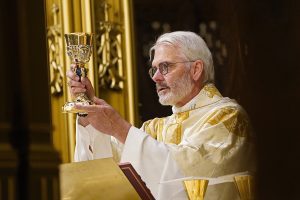
Archbishop Paul S. Coakley of Oklahoma City, president of the U.S. Conference of Catholic Bishops, is pictured in a file photo. In a Jan. 28, 2026, statement, Archbishop Coakley calls for a Holy Hour for peace as a step toward national healing following a trio of recent killings by immigration enforcement personnel. (OSV News photo/Gregory A. Shemitz)
He pointed to “the recent killing of two people by immigration enforcement officers in Minneapolis and that of a detained man in Texas,” referencing the deaths of Renee Nicole Good and Alex Pretti, respectively slain by federal agents Jan. 7 and 24 as they protested immigration enforcement actions in Minneapolis.
Archbishop Coakley appeared to reference the death of Cuban immigrant Geraldo Lunas Campos, whose Jan. 3 death in a Texas immigration detention facility has been ruled a homicide.
Campos, the third detainee to die at the facility, had pleaded for medication before apparently being slammed to the ground by guards, according to sworn court testimony by several fellow detainees. Immigration and Customs Enforcement officials at the facility claimed Campos had died while attempting suicide and that guards had tried to save him. A federal judge on Jan. 27 blocked the federal government from deporting the witnesses until they could provide depositions.
The three deaths “are just a few of the tragic examples of the violence that represent failures in our society to respect the dignity of every human life,” said Archbishop Coakley. “We mourn this loss of life and deplore the indifference and injustice it represents.”
Archbishop Coakley’s message comes amid a growing chorus of outcry from the nation’s Catholic bishops over the increasingly frayed domestic and international order.
During their annual plenary meeting in November, the USCCB issued a special pastoral message on immigration, which condemned “the indiscriminate mass deportation of people” and prayed for “an end to dehumanizing rhetoric and violence, whether directed at immigrants or at law enforcement.”
In his Jan. 28 message, Archbishop Coakley acknowledged that “many people today feel powerless in the face of violence, injustice, and social unrest.
“To those who feel this way, I wish to say clearly: your faithfulness matters. Your prayers matter. Your acts of love and works of justice matter,” he said.
Archbishop Coakley said he was “deeply grateful for the countless ways Catholics and all people of good will continue to serve one another and work for peace and justice.
“Whether feeding the hungry, welcoming the stranger, caring for the sick, accompanying the lonely, visiting the imprisoned, or striving daily to love their neighbors, no work of mercy or act of justice is ever wasted in the eyes of God,” said Archbishop Coakley.
“While proper laws must be respected, works of mercy, peacefully assembling, and caring for those in your community are signs of hope, and they build peace more surely than anger or despair ever could,” he said.
Referencing Matthew 10:42, he added, “Christ reminds us that even ‘a single cup of cold water’ given in his name will not go unrewarded.”
The archbishop invited “my brother bishops and priests across the United States to offer a Holy Hour for Peace in the days ahead,” providing a link to a USCCB webpage with instructions, Scripture readings and a “Litany of Peace.”
The instructions also included a passage from St. John Paul II’s 1987 encyclical “Sollicitudo Rei Socialis” (“The Concern of the Church for the Social Order”), which in turn marked the 20th anniversary of St. Paul VI’s 1967 encyclical “Populorum Progressio” (“On the Development of Peoples”).
The quoted passage from St. John Paul II’s encyclical – which stressed the centrality of the Eucharist – affirmed that while “no temporal achievement is to be identified” with the awaited glory of God’s kingdom, “that expectation can never be an excuse for lack of concern for people in their concrete personal situations and in their social, national and international life, since the former is conditioned by the latter, especially today.”
“Let us pray for reconciliation where there is division, for justice where there are violations of fundamental rights, and for consolation for all who feel overwhelmed by fear or loss,” said Archbishop Coakley.
“I encourage Catholics everywhere to participate, whether in parishes, chapels, or before the Lord present in the quiet of their hearts for healing in our nation and communities,” he said.
“May this Holy Hour be a moment of renewal for our hearts and for our nation,” he added. “Entrusting our fears and hopes to the Sacred Heart of Jesus, let us ask the Lord to make us instruments of his peace and witnesses to the inherent dignity of every person.”
Social
VATICAN CITY (CNS) – Pope Leo XIV called for an end to all antisemitism, prejudice, oppression and persecution worldwide.
“I renew my appeal to the community of nations always to remain vigilant so that the horror of genocide never again befall any people and that a society based on mutual respect and the common good be built,” he said Jan. 28.
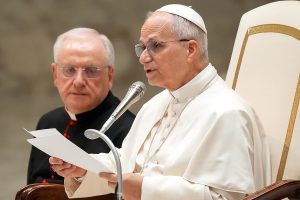
Pope Leo XIV talks to pilgrims and visitors during his weekly general audience in the Paul VI Audience Hall at the Vatican Jan. 28, 2026. (CNS photo/Lola Gomez)
The pope made his remarks during his greeting to Italian-speaking visitors after leading his general audience talk in the Paul VI Audience Hall.
The pope recalled the previous day’s commemoration of International Holocaust Remembrance Day, which is marked Jan. 27 each year, the anniversary of the day in 1945 when Soviet troops liberated the Auschwitz-Birkenau concentration camp complex. The camp was the largest of the Nazi work and death camps; an estimated 1.1 million of the more than 6 million victims of the Holocaust died there.
“On this annual occasion of painful remembrance, I ask Almighty God for the gift of a world without any more antisemitism, prejudice, oppression or persecution of any human being,” Pope Leo said.
The pope also commemorated Holocaust Remembrance Day with a post on X Jan. 27, recalling “that the Church remains faithful to the unwavering position of the Declaration #NostraAetate against every form of antisemitism. The Church rejects any discrimination or harassment based on ethnicity, language, nationality or religion.”
Later the same day, the pope underlined the importance of praying for peace when speaking to reporters as he was leaving the papal villa in Castel Gandolfo outside of Rome.
When asked about the situation in the Middle East, specifically the arrival of the U.S. aircraft carrier, the USS Abraham Lincoln, which is equipped with guided-missile destroyers, Pope Leo said, “I will just say that we must pray very much for peace.”
Though regular, everyday people may seem “small” or insignificant, he said, “we can raise our voices and always seek dialogue rather than violence to resolve problems, especially on this day when we commemorate the Shoah.”
“Let us fight against all forms of antisemitism,” he said.
Social
(OSV News) – More U.S. Catholic bishops are sounding the alarm over an increasingly frayed social order both at home and abroad — while calling for a renewal of heart and a recommitment to Gospel values safeguarding God-given human dignity.
Archbishop José H. Gomez of Los Angeles, Bishop Anthony B. Taylor of Little Rock, Arkansas, and Archbishop Paul D. Etienne of Seattle are among the latest prelates to weigh in on widespread unrest and division, with Archbishop Etienne issuing a Jan. 26 pastoral letter on “A Well-Ordered Society Rooted in Truth, Justice, and Peace.”
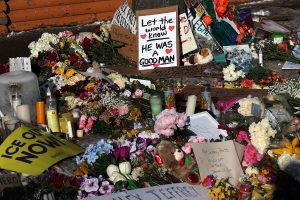
A makeshift memorial is seen in Minneapolis Jan. 27, 2026, at the site where 37-year-old Alex Pretti was fatally shot by federal agents trying to detain him. (OSV News photo/Evelyn Hockstein, Reuters)
Three key sources – the Second Vatican Council, Catholic social teaching and a Jan. 9 address by Pope Leo XIV to Holy See-accredited diplomats – “illuminate our path with clarity and a renewed urgency,” said Archbishop Etienne in his letter.
The latest statements and reflections – which follow comments already made by Archbishop Paul S. Coakley of Oklahoma City, president of the U.S. Conference of Catholic Bishops; Archbishop Bernard A. Hebda of St. Paul and Minneapolis and Cardinal Joseph W. Tobin of Newark, New Jersey – came within days of the fatal shooting of 37-year-old nurse Alex Pretti, a U.S. citizen, by federal agents during a protest amid an immigration enforcement operation in Minneapolis.
Another U.S. citizen and Minneapolis resident, 37-year-old Renee Nicole Good, was shot to death by a federal agent at a separate immigration-related protest Jan. 7.
Hours after Pretti’s death, Minnesota Gov. Tim Walz said at a Jan. 24 news conference the nation was at “an inflection point” amid the Trump administration’s crackdown on immigrants lacking legal authorization to live and work in the U.S., which has seen Minneapolis and several other cities become flashpoints.
In their respective reflections, the various bishops agreed that current societal tensions have reached an untenable crisis point.
“The country cannot go on like this,” said Archbishop Gomez in a Jan. 27 column published by Angelus, the news outlet of the Archdiocese of Los Angeles.
“Polarization and partisanship are poisoning the social fabric of our country,” warned Bishop Taylor in a Jan. 24 column published by Arkansas Catholic, his diocese’s news outlet. “We have reason to worry about the direction our society has taken in recent years. And we have reason to work to shore up our democracy before it is too late.”
In his pastoral letter, Archbishop Etienne pointed broadly to “turbulent times” that have been “marked by conflict abroad, fragmentation at home, and profound questions about our shared moral life.”
In an accompanying Jan. 26 blog post, the archbishop said he had been moved to issue the teaching having “read my own mail, seen fissures in the unity of our Church, witnessed the fracturing of our American society and watched in dismay at the escalation of war around the world.”
Bishop Taylor cited his own family’s experience during the Second World War, when his grandfather “lost 20 first cousins in the Holocaust,” also known as the Shoah, the systematic murder of 6 million Jews by Germany’s Nazi regime and its allies and collaborators.
“I want to be clear that the current times are not identical, and Trump is no Hitler,” Bishop Taylor stated. “But the moral decline of our country is real. And we are doomed to repeat failures of the past if we are not willing to remember them and learn from them.”
He noted “many obvious parallels with the 1930s” that “should give us pause” — specifically, German society’s move at the time “away from respect for human dignity, peace and moral restraint.”
“I fear that the same dynamics are now happening in our country with the decline of civil discourse,” said Bishop Taylor.
He noted that Adolf Hitler’s policies as Germany’s leader leveraged post-World War I fears and crises to gain popular support for what ultimately became his “dictatorial powers,” which in turn emboldened him to invade other nations. Refugees fleeing the Nazi regime were often refused entry to other nations, and many – like his own relations – were ultimately slain, he said.
“Obviously, these tragic examples are not what is happening here today. But these are the kinds of atrocities to which the dehumanization of mass, indiscriminate deportation can naturally lead,” said Bishop Taylor, noting “sad chapters in the history of our own country” such as mass deportations of Native Americans and enslaved Africans, as well as the “indiscriminate imprisonment of Japanese-Americans in internment camps” during WWII.
Archbishop Gomez lamented that as the U.S. marks its 250th anniversary this year, “what’s happening now seems to be moving us away from the values of our nation’s founding.”
He stressed that “America was the first nation to be established on the belief that human rights come from God and that the government’s purpose is to protect these rights,” and that “we do not lose our rights based on the color of our skin, or the language we speak, or for not having the proper documents.
“Right now our government seems to be treating undocumented immigrants — men, women, and children — as if they have no rights. That should not be happening,” said Archbishop Gomez.
“This is a pro-life issue,” said Bishop Taylor. “And it will remain a pro-life issue so long as millions of people continue to live lives trapped in desperate circumstances, where countries with means refuse to help.”
Archbishop Gomez named “the root cause of the current crisis” as “the country’s broken immigration system,” and advocated support for the bipartisan Dignity Act.
Despite its “flaws,” said Archbishop Gomez, the legislation would reform visa and asylum processes, enhance border security and provide greater verification for employers while offering “a path to a legal status” for millions of people who have been living and working in the U.S. without authorization.
Archbishop Gomez also said that in the present moment, “the first task is to restore order and peace to our streets, and insist on calm and restraint in our public discourse.”
“There is no question that the federal government has the duty to enforce immigration laws. But there must be a better way than this,” he said.
The archbishop said he hoped “all sides in this conflict — federal authorities, city and state officials, and those protesting the enforcement actions — will take a step back in the interests of the common good.”
The principle of the common good – founded on human dignity, social well-being and a just, peaceful order – was one stressed by Archbishop Etienne in his pastoral letter, which highlighted charity, or love of neighbor, and respect for the rule of law as “two essential pillars of any Christian society.”
“These do not stand apart from the principles of our social teaching, but they flow directly from them,” he explained, adding that “our Catholic Social Teaching makes clear that rights also come with corresponding duties.”
Archbishop Etienne clarified in his blog announcement that in writing the letter, he focused not on “speaking to specific, outrageous behaviors of individuals, nations or leaders,” but “to simply speak to what a well-ordered society looks like.”
In his letter, Archbishop Etienne noted that Pope Leo’s Jan. 9 address — which he said had inspired his pastoral — “framed the challenges of our age through the lens of St. Augustine’s ‘The City of God.'” The treatise, written by the saint in the early fifth century, contrasted the ongoing struggle between good and evil in human history — and the archbishop noted how the pope used it to offer “a deeply Christian vision of peace, justice, and right order.”
“I implore every Catholic to read Pope Leo XIV’s Jan. 9 address,” Bishop Taylor also said, emphasizing that St. Augustine’s “seminal work” offers a roadmap for “a more just and peaceful coexistence among peoples,” while cautioning against “grave dangers to political life arising from false representations of history, excessive nationalism and the distortion of the ideal of the political leader.”
Writing in his pastoral letter, Archbishop Etienne said that “in these turbulent times, the Church once again lifts high the Gospel as the light by which we must walk.”
He explained that “Catholic Social Teaching begins with the unshakeable truth that every human being is created in the image and likeness of God,” and that “this fundamental dignity forms the bedrock of all moral life and a just society.”
“God created us in his image and we need to treat other people like we believe that,” noted Archbishop Gomez.
The rule of law is “a moral achievement” that “embodies the conviction that justice, not force, must govern human relationships,” wrote Archbishop Etienne in his pastoral letter. “Laws grounded in moral truth safeguard the weak, hold the strong accountable, and restrain the impulses of domination that St. Augustine identifies with the ‘city of man.'”
Quoting Pope Leo, the archbishop said that “when nations and leaders abandon dialogue in favor of coercion, they erode ‘the foundation of all peaceful civil coexistence.'”
The Catholic principle of solidarity — “the social expression of charity” — extends to “all levels of society,” from the family to the international community, and remains crucial in “a world that has so many levels of interdependence,” said Archbishop Etienne.
Subsidiarity, another core principle of Catholic social teaching, “affirms that decisions should be made at the most local level possible, respecting the integrity of families, parishes, and communities,” Archbishop Etienne said.
“Brothers and sisters, the world around us is undergoing profound change and we are experiencing no small amount of fragmentation, but Christ remains our sure foundation,” wrote Archbishop Etienne. “Pope Leo XIV’s Augustinian vision reminds us that the destiny of society depends on the love that shapes it.”
He added, “May we choose, again and again, the path of truth, justice, charity, and peace.”
Social
ST. PAUL, Minn. – After a second fatal shooting in January involving federal agents in Minneapolis during an increase in federal immigration enforcement, Archbishop Bernard A. Hebda presided over an evening Mass for peace Jan. 25 at the Cathedral of St. Paul in St. Paul.
“My brothers and sisters, I suspect that if you’ve been watching the news or listening to the news, you might think that we’re in a period of great darkness,” the archbishop said in his homily. “I feel that. My heart breaks. And yet we know, brothers and sisters, that it’s precisely into that darkness that Jesus comes to bring hope. That’s what brings us here on (this) cold afternoon. It’s because we know that on our own we can’t fix this situation, but that it’s only the light of Christ.”
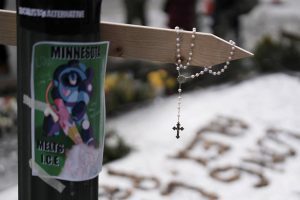
A rosary hangs from a cross at a makeshift memorial in Minneapolis Jan. 25, 2026, at the site where a man was fatally shot by federal agents trying to detain him. The Department of Homeland Security said Alex Pretti, a 37-year-old intensive care nurse, had a handgun and approached Border Patrol officers during a targeted operation Jan. 24. (OSV News photo/Tim Evans, Reuters)
Archbishop Hebda announced Jan. 25 he would preside over special prayers and the 5 p.m. Mass following the Jan. 24 shooting death of Alex Jeffrey Pretti, 37, of Minneapolis, during an incident with federal agents in south Minneapolis. Pretti was an intensive care nurse who worked for the U.S. Department of Veterans Affairs.
Pretti’s death came after an Immigration and Customs Enforcement agent shot and killed 37-year-old Renee Good, also of Minneapolis, during an altercation as she was driving her vehicle.
In his Jan. 25 statement, Archbishop Hebda asked “all people of good will to join me in prayer today for Alex Jeffrey Pretti, for his parents, and for his loved ones.”
In his homily, Archbishop Hebda underscored the need for Christians to make Jesus’ “light shine” in the darkness. He noted that in the Gospel of Matthew read at Mass, Jesus began his public ministry at the precise moment St. John the Baptist was arrested, “in the midst of the darkness.”
“And what, brothers and sisters, is the first thing Jesus says in that whole Gospel of St. Matthew? He says, ‘Repent.’ It’s his first word. Repent. He speaks about our heart, the need for conversion in our heart,” he said. The special Votive Mass for the Preservation of Peace fell on the feast of the Conversion of St. Paul, a man who opposed Christ and was present when the Church’s first martyr, St. Stephen, was killed, Archbishop Hebda said.
“That’s how violent that society was. That’s how deep were those divisions,” he said. “That’s what makes Paul’s conversion so significant for us in this day, in 2026, brothers and sisters, in that we have a God for whom nothing is impossible, a God who’s able to change hearts.
“We ask him to change our hearts, first of all,” he continued. “But we have confidence that he’s able to change the hearts of all people, and indeed, that he’s able to bring compromise — not in the truth — but he’s able to bring people together so that they’re able, together, to follow that light that is Jesus.”
During the Mass, Archbishop Hebda also prayed for Pretti and encouraged attendees to help those in the community afraid to leave their homes amid the ongoing federal immigration enforcement operation. He suggested material help, prayer and financial assistance, including via the Minnesota Catholic Relief Fund at the Catholic Community Foundation of Minnesota.
The 5 p.m. Mass was preceded by an extended period of Eucharistic adoration with a chaplet of Divine Mercy and Benediction.
In announcing the Jan. 25 special intentions at the evening Masses held at the Cathedral and Basilica of St. Mary in Minneapolis, Archbishop Heda said that “the loss of another life amidst the tensions that have gripped Minnesota should prompt all of us to ask what we can do to restore the Lord’s peace.”
“While we rightly thirst for God’s justice and hunger for his peace, this will not be achieved until we are able to rid our hearts of the hatreds and prejudices that prevent us from seeing each other as brothers and sisters created in the image and likeness of God,” he said. “That is as true for our undocumented neighbors as it is for our elected officials and for the men and women who have the unenviable responsibility of enforcing our laws. They all need our humble prayers.”
He added: “Wherever you find yourself this afternoon, I hope you will take a few moments to join us in prayer.”
Anne Bisciglia, 71, of North St. Paul said she arrived at the Cathedral at 2 p.m. to pray for “struggling Minneapolis.”
“The Lord is our only hope for unity and peace,” Bisciglia said. “So, I wanted to come and spend time with him.”
In Minneapolis, the basilica offered its scheduled 5:30 p.m. Mass for Pretti, his family and the Twin Cities community.
“My heart breaks for his family and friends who grieve Alex’s loss and will no doubt experience acute pain as a result of his death,” said Father Daniel Griffith, the basilica’s rector and pastor, in a Jan. 24 statement.
“The Twin Cities community is experiencing indescribable grief and trauma these past many days in the wake of the violent death of Renee Good and the tumult that has followed,” he said. “This continues to be a time of fear and anguish — including for our immigrant brothers and sisters, many of whom remain at home — understandably absent from work, school, and church.
“In the midst of the suffering and dismay, Minnesotans are also coming together to talk, to grieve, and to pray,” he continued. “Please join me in also praying for the safety and wellbeing of all in our Twin Cities community. … May the God of goodness and compassion soon deliver us from this present suffering and may all people of good will unite to stitch together a future of lasting justice and peace.”
Social
ROME (CNS) – All Christians are called to invite everyone to trust in Christ, who enlightens and consoles, Pope Leo XIV said.
“Every authentic encounter with the Lord is, in fact, a transformative moment that grants a new vision and a new direction for the task of building up the Body of Christ,” the pope said as he closed the Week of Prayer for Christian Unity Jan. 25 during an ecumenical evening prayer service at Rome’s Basilica of St. Paul Outside the Walls.
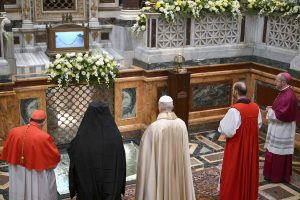
Pope Leo XIV, center, leads an ecumenical evening prayer service at Rome’s Basilica of St. Paul Outside the Walls Jan. 25, 2026, as he closed the Week of Prayer for Christian Unity. All Christians are called to invite everyone to trust in Christ, who enlightens and consoles, Pope Leo said. (OSV News photo/Simone Risoluti, Vatican Media)
Every year, the week “invites us to renew our commitment to this great mission, bearing in mind that the divisions among us — while they do not prevent the light of Christ from shining — nonetheless make the face which must reflect it to the world less radiant,” he said.
As the service began, Orthodox Metropolitan Polykarpos of Italy and Anglican Bishop Anthony Ball, the archbishop of Canterbury’s representative to the Holy See, joined Pope Leo in descending the stairs under the main altar to pray before the relics of St. Paul. Several leaders and representatives of numerous churches and Christian communions worldwide attended the prayer service, including Armenian Orthodox Archbishop Khajag Barsamian, the representative of the Armenian Apostolic Church to the Holy See,
The theme for the 2026 celebration of the week was inspired by St. Paul’s letter to the Ephesians (4:4), “There is one body and one Spirit, just as you were called to the one hope of your calling.”
“We are one! We already are! Let us recognize it, experience it and make it visible!” Pope Leo said in his homily.
The synodal journey of the Catholic Church, which is and must be ecumenical, he said, “is a path for growing together in mutual knowledge of our respective synodal structures and traditions.”
“As we look toward the 2,000th anniversary of the Passion, Death and Resurrection of the Lord Jesus in 2033, let us commit ourselves to further developing ecumenical synodal practices and to sharing with one another who we are, what we do and what we teach,” the pope said.
The mission of all Christians today is “to proclaim Christ and to invite everyone to place their trust in him,” he said. This shared task is to “say humbly and joyfully to the world: ‘Look to Christ! Come closer to him! Welcome his word that enlightens and consoles!'”
Pope Leo underlined the importance of celebrating the 1700th anniversary of the Council of Nicaea in Iznik, Turkey, in November with representatives of so many Christian traditions.
“Reciting the Nicene Creed together in the very place where it was formulated was a profound and unforgettable testimony to our unity in Christ,” he said. “May the Holy Spirit find in us docile minds even today, so that we may proclaim the faith with one voice to the men and women of our time!”
Concluding his homily, Pope Leo prayed that “the seeds of the Gospel may continue to bear fruit on this continent in unity, justice and holiness, for the benefit of peace among the peoples and nations of the whole world.”
Social
(OSV News) – Three U.S. bishops who chair committees of the U.S. Conference of Catholic Bishops are applauding two pieces of legislation designed to support pregnant women through an array of resources, including continued access to higher education.
“We were grateful to see the U.S. House of Representatives pass the Pregnant Students’ Rights Act and the Supporting Pregnant and Parenting Women and Families Act,” said Archbishop Shelton J. Fabre of Louisville, Kentucky, Bishop David M. O’Connell of Trenton, New Jersey, and Bishop Daniel E. Thomas of Toledo, Ohio, in a Jan. 23 joint statement.
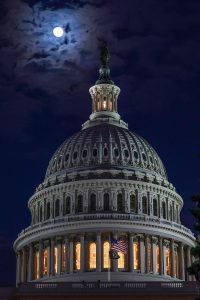
The moon rises over the U.S. Capitol dome in Washington Dec. 2, 2025. The chairmen of three U.S. bishops’ committees — pro-life, Catholic education and domestic policy — issued a joint statement Jan. 23, 2026, applauding House passage of two bills designed to support pregnant women through an array of resources, including continued access to higher education. (OSV News Photo/Evelyn Hockstein, Reuters)
The three prelates respectively chair the USCCB’s committees on Domestic Justice and Human Development, Catholic Education and Pro-Life Activities.
The Pregnant Students’ Rights Act, introduced in December by Rep. Ashley Hinson, R-Iowa, in December, cleared the House in a 217-211 vote on Jan. 22. The legislation requires colleges and universities that participate in federal student aid programs to provide both prospective and current students with information on rights and resources for carrying a baby to term while enrolled.
The required information must include a list of community and campus resources, accommodations and information on filing a discrimination complaint regarding a student’s intention to carry a baby to term.
The act “is needed legislation that would simply ensure that colleges and universities at least provide information about the resources, services, rights, and accommodations available for pregnant and parenting students,” said the three bishops in their Jan. 23 statement.
Bishops O’Connell and Thomas had also sent a Jan. 22 letter to Congress urging approval of the act, saying that “society and too many colleges and universities can give the impression that having a baby while a student is not only a great challenge but an unsurmountable detriment to women’s lives.
“Young women who are pregnant may thus feel that they have to choose between their baby or their education and feel pressured to have an abortion,” wrote the two bishops in their letter. “Many college and university students are unaware of the support available to them if they are pregnant or parenting, and that support can make a difference.”
The U.S. Senate is expected to vote on its own version of the bill in the coming week, said the USCCB in its Jan. 23 announcement of the three bishops’ joint statement.
The Supporting Pregnant and Parenting Women and Families Act, introduced in early January by Rep. Michelle Fischbach, R-Minn., passed the House 215-209 on Jan. 21. The act would allow states to use TANF (Temporary Assistance for Needy Families) funds for pregnancy centers that support protecting the life of the mother and her unborn child, and that offer services such as pregnancy testing, prenatal and pregnancy education, counseling, diapers, baby clothes and other material resources.
The legislation “would help ensure that key public resources are available to pregnancy help centers, which compassionately accompany women in need with baby supplies, childcare assistance, health and parenting information, career services, and more,” said the three bishops in their statement. “Amid great uncertainty and difficulty, such support can make a life-saving difference.”
They added that “building a culture of life requires helping mothers to be able to welcome their new children.
“Too often, however, expectant and vulnerable women are essentially told that they have to choose either their child or their future,” they wrote. “No one should have to make this ultimately false choice.”
Social
WASHINGTON (OSV News) – As thousands gathered in the cold, to stand for the unborn, March for Life president Jennie Bradley Lichter reminded the crowd that what has “saved so many lives and moved countless hearts” on the abortion issue over the years is the marchers’ “unfailing hope” their “love for the littlest ones and for moms who need a hand,” their joy and “the sheer number of you who are here year after year.”
The theme of the 53rd annual March for Life was “Life Is a Gift” and both the crowd and the speakers at the rally embraced their personal experience of the gift of life.
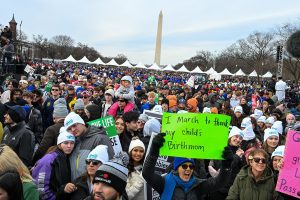
A woman with a sign reacts as pro-life advocates gather during the 53rd annual March for Life rally in Washington Jan. 23, 2026. (OSV News photo/Leslie E. Kossoff)
At the start of the event, Lichter introduced the “Friends of Club 21” choir, a group of teens and young adults with Down syndrome who sang the national anthem. She said the group embodied the theme of the march.
For Ariel Hartshorn, who traveled 17 hours to the march on a bus from Benedictine College in Kansas, her brother with Down syndrome was a big part of her reason for attending.
“I know that a lot of people with Down syndrome are aborted and that just breaks my heart,” she told OSV News, calling her brother “the most joyful” person who “brings so much joy to everybody’s life.” She said “it’s really important that we march for life and that we be that change” in society for people like her brother.
Vice President JD Vance, who recently announced that he and his wife, Usha, are expecting their fourth child, also felt the march’s theme in a personal way, telling the crowd, “Life is a gift and I know for me personally this year, there is so much to be thankful for. I’m grateful to my own family, for my beautiful wife, Usha, and that God has given us the miracle of new life again.”
One speaker at the march, Sarah Hurm, told those gathered that she was “living proof” that life is a gift through her journey of nearly aborting her son with the abortion pill regimen and being able to reverse that procedure through the help of a pro-life ministry.
She spoke about being a 26-year-old single mom who already had three children and was not receiving support from her baby’s father or the abortion clinic where she felt like a “transaction,” not a person.
The words of an abortion clinic worker stuck with her. The worker told her the baby had a “strong heartbeat” and she was “lucky the heartbeat bill hadn’t passed because if it had we wouldn’t be able to continue.”
“As soon as I walked out of the facility,” Hurm said, “it was as if the world went from dark gray to bright blue. The clinic had felt lifeless, outside I felt life again. That sharp contrast between darkness and light made me feel something I will never forget. I instantly began to regret my decision and I broke down in my car.”
Despite having taken the first pill in the regimen, Hurm was able to save her son through a hotline number that offered abortion pill reversal treatment. “Today,” she said, “my son is one of the greatest joys of my life.”
She encouraged the crowd to make efforts to help women facing unexpected pregnancies. “Saving a life can be as simple as answering a phone call, driving a friend to an ultrasound, or helping her pick out a car seat,” she emphasized. “Small sacrifices can become enormous victories that support moms like me and children like mine. You have that power. Be that person who connects a woman to hope.”
Benedictine College student Maria Draves felt the importance of supporting women facing unplanned pregnancies, saying she traveled to the march “for the innocent children who don’t have a voice for themselves” but that it was also important to “remember the mothers because a lot of these mothers are in really difficult situations, and so we have to keep them in our prayers as well and do everything we can to take care of them.”
Lily Doyle, a student at Franciscan University, saw defending the dignity of the unborn as connected to the dignity of all vulnerable people. “It’s important now more than ever to be sure that everyone, no matter who they are, what they feel, young, old, pre-born, know that their life is worth living,” she emphasized, “every person matters no matter what.”
Lichter noted the 250th anniversary of the signing of the Declaration of Independence and its emphasis on the right to life, telling the crowd “never forget that the United States of America was built on the foundation of the right to life” and “you are standing in a great American tradition when you stand up for the right to life like you’re doing today.”
Bringing her husband and three children out on stage, Lichter celebrated past generations of marchers and noted that her kids “have grown up as marchers and they are thrilled to see you all here today.”
Amanda and Drew Ide from Minnesota were also a part of bringing the next generation of marchers as they went along the route with their young baby, Zoey, following the rally. Drew said he felt “like there’s a turn in our culture to be able to see people seeing the value in protecting even the youngest people of our society.”
“We are just out here representing the value of life and hoping that it can impact legislation,” Amanda said, adding that as evangelical Christians they wanted to be “walking the walk, not just talking the talk.”
Social
His Excellency, Bishop Joseph C. Bambera, announces the following appointments, as follows:
PAROCHIAL VICARS:
Reverend Stephen Kwasi Brenyah, from Parochial Vicar, Our Lady of the Rosary Parish, Carbondale, to ministry, Diocese of Sunyani, Ghana, effective December 27, 2025.
Reverend Paul Kwadwo Yeboah, from Parochial Vicar, Saint Faustina Kowalska Parish, Nanticoke, and Our Lady of Mount Carmel Parish, Hunlock Creek, to ministry, Diocese of Sunyani, Ghana, effective December 27, 2025.
Reverend Boniface Ameyaw, from ministry, Diocese of Sunyani, Ghana, to Parochial Vicar, Our Lady of the Rosary Parish, Carbondale, effective January 20, 2026.
Reverend Michael Osei-Boateng, from ministry, Diocese of Sunyani, Ghana, to Parochial Vicar pro tem, Saint Thomas More Parish, Lake Ariel, effective January 20, 2026.
Social
(OSV News) – Amid the 2026 Week of Prayer for Christian Unity Jan. 18-25, OSV News spoke with Bishop Joseph C. Bambera of Scranton, Pennsylvania, who serves as chair of the U.S. Conference of Catholic Bishops’ Committee on Ecumenical and Interreligious Affairs and the Catholic co-chair of the Holy See’s International Catholic-Pentecostal Dialogue committee, part of the Dicastery for Promoting Christian Unity.
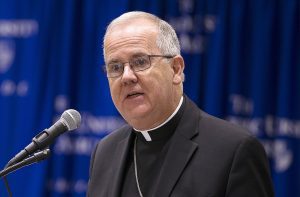
Bishop Joseph C. Bambera of Scranton, Pa., speaks at The Catholic University of America in Washington in this Nov. 7, 2019, file photo. He is chair of the U.S. Conference of Catholic Bishops’ Committee on Ecumenical and Interreligious Affairs and the Catholic co-chair of the Holy See’s International Catholic-Pentecostal Dialogue committee, part of the Dicastery for Promoting Christian Unity. (OSV News photo/Tyler Orsburn)
This interview has been edited for length and clarity.
OSV News: How has the recent commemoration of the 1700th anniversary of the Council of Nicaea impacted this year’s observance of the Week of Prayer for Christian Unity?
Bishop Bambera: This year obviously is a very significant year to mark Christian unity, particularly in light of the council’s 1700th anniversary. It certainly is a very significant step forward (in Christian unity) this year.
Our Holy Father, Pope Leo XIV, has really established for his pontificate (a concern for Christian unity) in that incredible gesture of traveling to Nicaea to meet with Ecumenical Patriarch Bartholomew, and to profess a desire, certainly between the Catholic community and the Orthodox community, to pursue – based on our shared appreciation for that creed – work for unity.
OSV News: Where would you say we’re currently at with Catholic-Orthodox efforts to reunite?
Bishop Bambera: It’s very difficult for me to actually spell out specifically where we stand in terms of that relationship. However, I think we see clearly a desire for us to start to move forward in the gesture of Pope Leo going to Nicaea.
And I think we see it also in the gestures of the U.S. Conference of Catholic Bishops, as the conference is now regularly inviting Orthodox observers to come to our plenary meeting in November, as we did this past year.
I also think (the move toward unity gains momentum) because of some of the upheaval that we see in our world and in various countries in which there is tremendous concern for the well-being of people. I’m thinking of Ukraine in particular, and obviously the Middle East.
I think that the need is for us as Christians – Orthodox, Catholics, Protestants – to give whatever evidence we can of our desire to fulfill that prayer of Jesus (for unity, in John 17:1-26). If Christian leaders can’t work together in harmony and peace, how would we ever expect there to be harmony and peace in our world?
Quite the contrary; we need to witness to that. We need to be a voice to those political and social entities that are disrupting peace. We need to call them to something more.
OSV News: So, would you say that these efforts for Christian unity really are, from the perspective of our responsibilities to the Lord, fundamental to creating world peace for all people?
Bishop Bambera: I certainly think they contribute to it.
OSV News: How do you think increased Christian unity might help with interreligious dialogue?
Bishop Bambera: Our ability to journey together as Christians can only impact our relationship with other religions in a positive way. … There’s a wonderful quote attributed to Mahatma Gandhi (the Indian political activist and nonviolence advocate), who had a great, great appreciation as a Hindu for Christ and for the message of the Gospel. He was asked if he would ever consider becoming a Christian, and his response was that he would become a Christian when Christians began to live the example and teaching of their Master.
Doesn’t that really speak very powerfully to the roots of this Week of Prayer for Christian Unity? We are responding to a prayer of Jesus. And so we have to get our house in order first.
I think for anybody to look at us in a way that sees our desire to journey together with them, be they Christians or of other religious traditions — before they’re going to trust us, they have to see that we’re willing to walk this talk.
OSV News: How can this week of prayer speak to the divisions that exist among Catholics themselves in the U.S.?
Bishop Bambera: We ought not set ecumenism to the side. It’s vital to our understanding of the Second Vatican Council. You can’t read the council without a lens towards Christian unity.
And it clearly, clearly is at the heart of the agenda of Pope Leo XIV, as it was with Pope Francis and recent pontiffs.
In the heart of that is this incredible prayer of Jesus (Jn 17:1-26) that establishes this invitation to all of us to work for unity. It’s not an add-on.
OSV News: The work of Christian unity seems to take place at two levels — expert theological dialogue, and the everyday encounters of fellow Christians with one another. How do these two levels intersect and interact?
Bishop Bambera: I think the easiest way to respond to that is to say it really goes back to Pope Francis, who put it in his own style very, very well (during ecumenical vespers for the close of the 2024 Week of Prayer for Christian Unity). He said that if we are focused on theological unity, and if we are looking at addressing all of the various theological factors that have led up to divisions within the churches, repairing those breaks in unity will take centuries. It took a long time for them to surface. It’s going to take a long time for them to be mended.
But there’s also, he said, a unity of life and love, whereby all of us, not just theologians, but more particularly the people in our pews — who are the visible presence and witness to faith and life and indeed unity — are going to embrace it much, much more readily and deeply and authentically. I can see that very, very well in my own life as a priest over the last 43 years in ordained ministry.
At times, from a theological perspective, perhaps we’ve lost our enthusiasm at times for unity. I think on the heels of the Council, many individuals thought that we would be able to move forward very quickly in terms of establishing unity. That’s not necessarily been the case.
But what I think you start to see on a very grassroots level is people walking together as brothers and sisters, almost to the point of not even recognizing our differences.
OSV News: Do you think one obstacle to Christian unity is a fear that oneness will mean compromising the tenets of a given Christian denomination, including Catholicism?
Bishop Bambera: I think so often people worry that we’re going to give away the store to simply achieve this level of unity that we commit ourselves to. And I think it’s so important that we don’t impose a false sense of unity.
The true and most authentic way for us to journey together as brothers and sisters is never to diminish who we are, and never to set up some false sense of unity that we haven’t yet established. It’s to acknowledge our differences.
It’s to recognize there’s a phenomenon called “receptive ecumenism,” whereby we look at really what is best in the other, and it’s not so much what we can give to you, but what we can learn from you and make a part of our lives.
We acknowledge our differences, we respect them, and we learn from one another ways in which we can grow together – recognizing that that full unity may be far, far in the future, but also recognizing that Jesus’ prayer is a prayer that is before us today, and whatever way we can walk together as brothers and sisters is what we’re called to do.
Social
SCRANTON (Jan. 23, 2026) – Due to the significant winter storm forecast to impact northeastern Pennsylvania this weekend, Catholic Social Services of the Diocese of Scranton is extending hours at all of the emergency shelters it operates to ensure individuals experiencing homelessness have access to warmth, safety, and care during dangerous weather conditions.
The National Weather Service is predicting heavy snowfall throughout the day Sunday, with snowfall rates potentially reaching an inch or more per hour, along with frigid temperatures that pose a serious risk to those without adequate shelter.
“With prolonged snowfall and dangerously cold temperatures expected, this storm presents a real threat to individuals who are unsheltered,” Joe Mahoney, Chief Executive Officer of Catholic Social Services, said. “Our priority is simple: to ensure people are safe, warm, and out of harm’s way.”
SCRANTON Saint Anthony’s Haven, 409 Olive Street, Scranton Weston Field House, 982 Providence Road, Scranton
In Scranton, Catholic Social Services operates both Saint Anthony’s Haven and the City of Scranton’s Code Blue Shelter at Weston Field.
Both shelters will open as scheduled at 7 p.m. on Friday and Saturday evenings. While guests typically depart early the following morning, on Sunday, Jan. 25, 2026, both shelters will remain open throughout the entire day on Sunday, since snowfall is expected to begin early in the morning.
Food and beverages will be available, including meals provided by Saint Francis of Assisi Kitchen in Scranton. Guests will also have access to movies and games throughout the day.
Both the Code Blue Shelter and Saint Anthony’s Haven will operate normally Sunday night, with guests able to remain until 7:00 a.m. Monday, with flexibility on the departure time depending on weather conditions.
WILKES-BARRE Mother Teresa’s Haven, 39 East Jackson Street, Wilkes-Barre
In Wilkes-Barre, Mother Teresa’s Haven, an emergency shelter for men operated by Catholic Social Services, will open early on Sunday evening, between the hours of 3-4 p.m. due to the storm.
Mother Teresa’s Haven, which can accommodate up to 20 men, is located directly above Saint Vincent de Paul Kitchen, and will serve as a vital resource for individuals seeking warmth and protection from the elements.
HAZLETON Divine Providence Shelter, 214 West Walnut Street, Hazleton
Similarly in Hazleton, the Divine Providence Shelter will also open earlier on Sunday evening, between 3-4 p.m., due to weather conditions. Divine Providence Shelter is known for providing shelter, warmth, and safety during the severe weather.
Catholic Social Services urges anyone experiencing homelessness – or anyone concerned about someone who may need shelter – to take advantage of these extended hours. Members of the community are also encouraged to share this information with those who may benefit.