VATICAN CITY (CNS) – The Vatican’s fat red yearbook, known as the Annuario Pontificio, will now be available and updated regularly on an app and online.
The digital platform “will guarantee reliable and immediate access to certified content, promoting an accurate and documented account of the life of the church,” the Vatican Secretariat of State said in a press release Dec. 9.
The pontifical yearbook lists: all Vatican offices and staff; the world’s dioceses and mission territories; bishops, cardinals and international religious orders of men and women; papal diplomats and ambassadors to the Vatican; historical notes, such as a list of the popes and their years in office, and more.
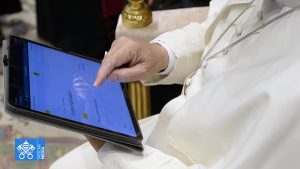
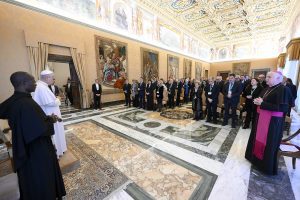
Pope Leo XIV tries a new digital platform of the Vatican’s yearbook, known as the Annuario Pontificio, at the Vatican Dec. 6, 2025. (CNS photo/screengrab courtesy Vatican Secretary of State)
Archbishop Edgar Peña Parra, substitute for general affairs in the secretariat, and others met with Pope Leo XIV Dec. 6 to present the initiative and to let him try searching the platform on a tablet.
“Thank you for this work, which will be of great use to so many people who work serving the church,” the pope told those present. “I encourage you to continue in this spirit of service, so that what is established with care and attention may become an even greater help over time.”
Archbishop Parra said, “The digitization of the Pontifical Yearbook represents a significant step in the renewal of the Holy See’s tools of service. At a time when communication is increasingly rapid and global, offering immediate and reliable access to information on the life of the church — with certified data — means putting technology at the service of the church’s mission.”
The thick, hardcover yearbook typically numbers more than 2,500 pages and is available only in Italian. Printed once a year, the Vatican used to send out changes and updates once or twice a month via email and post them online. Officials from the Secretariat of State are responsible for updating the volume.
Now, as a digital resource, information will be revised and updated more often, the secretariat’s press release said.
After creating an account online and paying the annual subscription fee ($79), the online version is available at annuariopontificio.catholic or on an app optimized for smartphones and tablets.
After the initial rollout, the platform will add expanded capabilities, such as other languages and past data for archival purposes.
The hardcopy volume will still be published, the secretariat said, because of the historical value of such documentation.
Social
(OSV News) – Religious affiliation in the U.S. is “holding steady,” with recent steep declines leveling off — but there’s no evidence a religious revival is underway, and Christianity continues to lose more members than it gains, according to a new report from the Pew Research Center.
On Dec. 8, the center released an analysis of data from its annual National Public Opinion Reference Surveys, as well as data from its 2023-2024 U.S. Religious Landscape Study, which polled close to 37,000 randomly sampled adults.
In addition, Pew drew on data from the General Social Survey, conducted by NORC (formerly the National Opinion Research Center) at the University of Chicago; and the American Time Use Survey by the U.S. Bureau of Labor Statistics.
The combined data indicates that “key measures of religiousness” — such as belief, prayer and communal worship — have continued to remain level over the past five years.
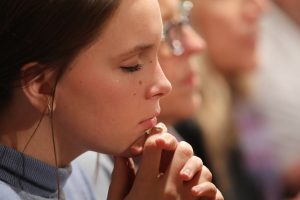
A young woman prays at the National Prayer Vigil for Life in Washington Jan. 19, 2023. (OSV News photo/Bob Roller)
Since 2020, about 70% of U.S. adults have indicated they identify with a religion, said Pew.
Similar levels of stability have been reported for daily prayer (now about 46%), the importance of religion in respondents’ lives (currently 43%) and attendance at religious services at least once or twice a month (34% as of 2025).
That “recent stability” is “striking because it comes after a prolonged period of religious decline,” said Pew, which noted that “for decades, measures of religious belonging, behaving and believing had been dropping nationwide.”
The previous long-term declines “were driven largely by generational shifts,” said Pew.
Older “birth cohorts” — those born during the same time period, a more specific measure than the broader term “generation” — tend to be “highly religious,” said Pew.
As members of older birth cohorts have died, “they’ve been replaced in the population by younger cohorts of adults who are far less religious” — and at the same time, those across birth cohorts “have grown less religious as they have aged,” the report said.
Amid slight year-to-year shifts, “no birth cohort has become more or less religious in recent years,” said Pew.
In fact, said Pew, “On average, young adults remain much less religious than older Americans.”
“Over the past five years, those born in 1954 or earlier have consistently said they identify with a religion (now 83%), pray daily (now 59%), regard religion as very important to their lives (now 55%) and attend religious services at least monthly (43% in 2025).
Those born in the period 1995-2002 have remained much less religious, with slightly more than half (55%) identifying with a religion, under a third (30%) praying daily and ranking religion as important to their lives (32%), and just over a quarter (26%) attending religious services at least monthly as of 2025.
Pew said that “today’s young adults also are less religious than young people were a decade ago.”
While “some media reports have suggested there may be a religious revival taking place among young adults, especially young men,” Pew said its polls, along with other high-quality survey data, “show no clear evidence that this kind of nationwide religious resurgence is underway.”
In particular, and despite claims to the contrary, “there is no indication that young men are converting to Christianity in large numbers,” said Pew.
At the same time, said Pew, “it’s possible smaller changes are happening in some places that just aren’t widespread enough to show up in national surveys.”
Pew also found that although “some recent reports suggest that young people are increasingly turning to traditional forms of Christianity, such as Orthodox Christianity and Catholicism,” the data continues to show that “among both younger and older U.S. adults, Christianity loses far more people than it gains through religious switching.”
“Overall, 1% of U.S. adults ages 18 to 24 now identify as Orthodox Christians after having been raised in another religion or with no religion,” but “an equal share of these adults has left Orthodoxy,” said Pew.
And “when it comes to Catholicism, far more young people have switched out than in,” Pew reported.
While “12% of today’s youngest adults have switched out of Catholicism,” just “1% of adults ages 18 to 24 have switched into Catholicism, meaning that they identify as Catholic today after having been raised in another religion or no religion.”
But for “nones” — defined by Pew as those who identify themselves as atheist, agnostic or “nothing in particular” in terms of religious affiliation — “this ratio is reversed.”
A quarter of adults ages 18-24 have become “nones” after being raised otherwise, and “far fewer young adults have left the ‘nones'” having been raised as such, said Pew.
Still, the report pointed out that “there are some interesting things happening with religion among young people.”
Young men are “now about as religious as women in the same age group,” which marks “a notable change from the past, when the reverse was the case, said Pew.
That pattern also contrasts with one detected among older people, where women are “much more religious” than their male counterparts, the report said.
But, said Pew, the “narrowing of the gender gap” in religiousness among younger men and women isn’t due to men becoming more religious — rather, the switch is “driven by declining religiousness among American women,” said Pew.
The report also highlighted nuances in religiousness among younger birth cohorts, noting that “today’s youngest adults (people born in 2003 or later) are no less religious than slightly older people born between 1995 and 2002.”
And, said Pew, “in some ways, today’s youngest adults are more religious than today’s second-youngest adults.”
In its 2023-2024 Religious Landscape Survey, Pew noted that “30% of adults born between 2003 and 2006 say they attend religious services at least once a month,” while among those born between 1995 and 2002 the number was just under one quarter (24%).
Pew’s 2025 National Public Opinion Reference Survey in 2025 found a similar pattern, but the center cautioned in its report the sample size for respondents born in 2003 or later was very small (just 154).
However, said Pew, previous Religious Landscape Surveys have shown that gaps between the two cohorts have emerged over time, with religious attendance dropping among both groups as they aged, and declining more quickly among the youngest group.
“These patterns may reflect the fact that many of the youngest adults still live in their childhood homes and follow the religious customs of their families,” said Pew. “As they get older and more of them leave home, their religious habits may change.”
For that reason, “we shouldn’t assume that the religiousness of today’s youngest adults is a sign of a major shift in American religion,” said Pew. “Perhaps in the future we’ll look back and see that we were at a pivotal moment in 2025.”
But, said Pew, “Historical data suggests the patterns we see today are a normal result of the youngest adults possibly following the religiousness of their parents for a few years past the age of 18, after which their religiousness begins to drop.”
Social
ROME (CNS) – Celebrating the feast of the Immaculate Conception as the Jubilee Year was ending, Pope Leo XIV prayed that “Jubilee hope” would “blossom in Rome and in every corner of the earth,” bringing with it reconciliation, nonviolence and peace.
Standing near the Spanish Steps in central Rome, at the foot of a towering column topped by a statue of Mary, the pope led thousands of Romans, pilgrims and tourists in prayer Dec. 8.
At dawn that morning, a firefighter named Roberto Leo, the fire service’s longest serving department head in Rome, climbed up 100 rungs of an aerial ladder to place a wreath of white flowers on the outstretched arms of the statue about 90 feet above the ground.
Pope Leo XIV leads prayers to Mary at a statue erected in her honor near the Spanish Steps in the center of Rome Dec. 8, 2025, the feast of the Immaculate Conception. (CNS photo/Vatican Media)
Following a tradition begun in 1958 by St. John XXIII, Pope Leo blessed a basket of white roses that assistants placed at the foot of the statue and read a prayer specifically written for this year’s feast, with references to what is going on in the church, the city and the world.
In the prayer to Mary, Pope Leo noted that the Jubilee year brought millions of pilgrims to Rome, representing “a humanity tried, at times crushed, humble like the earth from which God shaped it and into which he never ceases to breathe his Spirit of life.”
“Look, O Mary, upon the many sons and daughters in whom hope has not been extinguished: May what your Son has sown sprout within them — he, the living Word who in each person asks to grow still more, to take on flesh, face and voice,” the pope prayed.
As the Holy Doors of the major basilicas of Rome are about to close at the end of the Jubilee Jan. 6, he said, “may other doors now open: doors of homes and oases of peace where dignity may flower again, where nonviolence is taught, where the art of reconciliation is learned.”
The pope prayed that Mary would “inspire new insights in the church that walks in Rome and in the particular churches that in every context gather the joys and hopes, the griefs and anxieties of our contemporaries — especially the poor and all who suffer.”
Pope Leo also expressed the hope that baptism, which washes every person free of original sin, would “bring forth holy and immaculate men and women, called to become living members of the Body of Christ — a body that acts, consoles, reconciles and transforms the earthly city where the city of God is being prepared.”
In a world filled with “changes that seem to find us unprepared and powerless,” he asked Mary to intercede and help.
“Inspire dreams, visions and courage, you who know better than anyone that nothing is impossible for God, and at the same time that God does nothing alone,” he prayed.
The pope also asked Mary to help the church always be “with and among the people, leaven in the dough of a humanity that cries out for justice and hope.”
Before heading to the Spanish Steps, the pope had led the recitation of the Angelus prayer at noon with visitors in St. Peter’s Square.
By preserving Mary from any stain of sin from the moment of her conception, he said, God granted her “the extraordinary grace of a completely pure heart, in view of an even greater miracle: the coming of Christ the savior into the world as man.”
That extraordinary grace bore extraordinary fruit, he said, “because in her freedom she welcomed it, embracing the plan of God.”
“The Lord always acts in this way: he gives us great gifts, but he leaves us free to accept them or not,” the pope said. “So, this feast, which makes us rejoice for the unsullied beauty of the Mother of God, also invites us to believe as she believed, giving our generous assent to the mission to which the Lord calls us.”
Social
PARIS (OSV News) – Notre Dame de Paris celebrated the first anniversary of its reopening Dec. 7 with a major milestone: more than 11 million people have visited the iconic cathedral in the past 12 months. The cathedral had been closed since April 15, 2019, when a fire destroyed much of the iconic structure. It was reopened Dec. 7, 2024, amid much fanfare. Prior to the fire, an estimated 8 to 9 million people visited the cathedral each year.
For the cathedral’s rector, Msgr. Olivier Ribadeau Dumas, this year has been “extremely rich,” while also being “a year of fine-tuning in terms of organization.” “We had to relearn how to run the cathedral,” he explained. “We had to rebuild what you might call the ‘family’ of the cathedral, which has grown since the restoration work.”
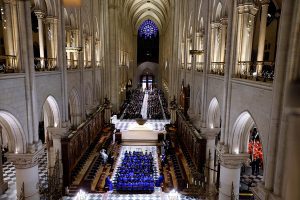
Attendees stand inside Notre Dame Cathedral in Paris Dec. 7, 2024, during a ceremony to mark its reopening following the 2019 fire. (OSV News photo/Ludovic Marin, pool via Reuters)
Today, the cathedral employs eight priests and one deacon, 45 staff members, 310 active volunteers, and more than 50 people responsible for the cathedral’s security operations.
“All are motivated by the same desire to welcome visitors,” Msgr. Ribadeau Dumas explained. “I am struck by the efforts of everyone, including external service providers, to welcome them with a smile, thus giving the cathedral a smiling face!”
On average, 30,000 to 35,000 visitors from all over the world enter the cathedral every day.
“This does not prevent the cathedral from being a sanctuary where one can find silence and peace,” the rector said. “All our efforts are aimed at introducing visitors to the mystery of this cathedral, which is first and foremost a place of prayer.”
During the course of the year, 1,600 liturgical services were celebrated at Notre Dame, during which visitors continued to wander through the side aisles and behind the choir.
“Their numbers were slightly reduced during services to preserve the contemplation of the faithful,” the rector explained.
Since its reopening, Notre Dame has taken on a new dimension as a pilgrimage destination. “This is new, and it is growing,” Msgr. Ribadeau Dumas told OSV News. “Many dioceses in France now organize pilgrimages to Notre Dame.”
In total, more than 650 pilgrimages took place, a third of which were from abroad, including 60 from North America.
“Americans have always shown great interest and generosity toward Notre Dame,” Msgr. Ribadeau Dumas noted. “It is important that they be able to come here.”
For the rector, the richness of this year lay in the diversity of the people who entered the cathedral. “We welcomed many patrons and heads of state with some 600 protocol visits,” he said. “But we have welcomed with the same care many elderly or sick people, associations for people with disabilities, in precarious situations or isolated. Our Lady is Our Lady of humanity, of all humanity,” he emphasized.
For the rector, it is of high importance that entry to the cathedral remains free, and he insisted that visitors should not be categorized as tourists or pilgrims.
“Many who entered as simple visitors came out having had a truly spiritual experience,” he said, referring to the “spiritual fruits” of the visits he has witnessed this year. “We did not expect it to this extent. What happens to each person at Notre Dame is the secret of the Holy Spirit, but something happens. Some were touched very deeply.”
According to testimonies, the passage in front of the reliquary of the crown of thorns, behind the choir, moved visitors deeply throughout the year.
“It is the most important relic in Christianity, and it is very evocative,” the rector noted. Msgr. Ribadeau Dumas proposed a major change for 2026, which went into effect on Dec. 5: The crown of thorns will now be displayed every Friday of the year, from 3 p.m. to 6:30 p.m., and no longer only on Fridays during Lent and on the first Friday of the month, as was the case until now.
The crown of thorns, placed on Jesus’ head by his captors to cause him pain and mock his claim of authority, was acquired by St. Louis, then-King Louis IX of France, in Constantinople in 1239 for 135,000 livres — nearly half of France’s annual expenditure at the time, according to the BBC.
Firefighters and police officers formed a human chain to rescue the crown of thorns from the inferno at Notre Dame on the day of the 2019 fire. On Dec. 13, 2024, this holiest relic of Paris’ cathedral was returned to its proper home on the Île de la Cité.
Many visitors were also struck this year by the discovery of the cathedral’s 29 side chapels, which have been completely restored and refurbished with a new identity and coherence.
Throughout the years, Chinese visitors discovered the St. Paul Chen chapel, honoring the 19th-century Chinese seminarian later canonized by St. John Paul II. Mexicans and other Latin Americans found the renovated post-World War II chapel of the Virgin of Guadalupe. On May 28, a new chapel for Eastern Christians — home to eight icons — was inaugurated. And on Nov. 8, the restored icon of Our Lady of Czestochowa returned to her chapel during a Mass for the Polish community.
“Everyone should be able to come home and say, ‘this is our Notre Dame,'” the rector said.
A year into reopening, Notre Dame is a “living cathedral,” he added. “When I celebrated Mass there for the first time a year ago, I strongly felt that these stones had witnessed centuries and centuries of prayers before mine. Since then, praying there every day, I know that I am continuing what has been accomplished by the generations that preceded us.”
On Nov. 29, the rector blessed a large Nativity scene featuring 150 figurines from Provence, in southern France, and on the same day the Christmas market opened at the cathedral square. It brings together French artisans and creators. In the evening, the illuminated facade of Notre Dame lights up a square joyfully occupied by musicians and singers, where tastings of typical French regional cuisine delight everyone.
Social
VATICAN CITY (CNS) – Christmas carols in every language and culture are expressions of how music can convey “feelings and emotions, even the deepest movements of the soul,” Pope Leo XIV said after listening, clapping and singing along at the Vatican Christmas concert with the poor.
“As the melodies touched our hearts, we felt the inestimable value of music: not a luxury for the few, but a divine gift accessible to everyone, rich and poor, learned and simple,” the pope said Dec. 6 as he thanked Canadian singer Michael Bublé, Italian singer Serena Autieri and the choir of the Diocese of Rome.
Pope Leo was seated in the center aisle behind the main guests — about 3,000 people assisted by the papal almoner and Catholic charities in Rome.
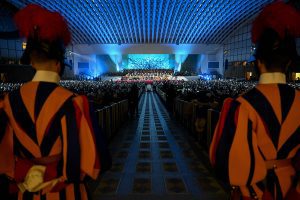
Swiss Guards stand watch as Pope Leo XIV and thousands of guests assisted by the papal almoner and Catholic charities attend a Christmas concert in the Vatican’s Paul VI Audience Hall Dec. 6, 2025. (CNS photo/Vatican Media)
“Music is like a bridge that leads us to God,” the pope said. It is like “an imaginary stairway connecting earth and heaven.”
“It is not a coincidence that the feast of Christmas is very rich in traditional songs, in every language and every culture,” he said. “It is as though this mystery could not be celebrated without music, without hymns of praise.”
And it was that way from the very beginning, the pope said, noting how the Gospel of Luke “tells us that while Jesus was being born in the stable in Bethlehem, there was a great concert of angels in heaven.”
“And who listened to that concert? To whom did the angels appear? To the shepherds, who were keeping watch at night to guard their flock,” he said.
“Music can lift our hearts,” the pope told his audience, which included migrants and refugees, people who sleep outside around the Vatican and people in need because of job loss.
Music is uplifting “not because it distracts us from our sufferings, because it numbs us or makes us forget the problems and difficult situations of life,” he said, “but because it reminds us that we are not just this: we are far more than our problems and our troubles, we are God’s beloved children!”
Pope Leo asked everyone in the audience to use Advent and the preparation for Christmas as a time to be attentive to people in need and open to listening “to the song of God’s love, which is Jesus Christ.”
“Yes, Jesus is God’s song of love for humanity,” he said. “Let us listen to this song! Let us learn it well, so that we too can sing it with our lives.”
Social
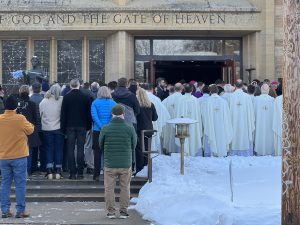
MINNEAPOLIS (OSV News) – On a cold, wintery day, with the congregation gathered around Archbishop Bernard A. Hebda of St. Paul and Minneapolis and Auxiliary Bishops Kevin T. Kenney and Michael Izen outside the main doors of Annunciation Catholic Church in Minneapolis, the rite of reparation began Dec. 6 that restored the space for worship.
The special Mass was held more than three months after an Aug. 27 shooting during an all-school Mass killed two students — 8-year-old Fletcher Merkel and 10-year-old Harper Moyski — and injured 18 students and three adults. The suspected shooter died of a self-inflicted gunshot wound at the scene, police said.
“My brothers and sisters, the resurrection of Jesus Christ from the dead proclaims that evil and death do not have the final word; God does,” the archbishop prayed outside the church, with temperatures in the low 20s.
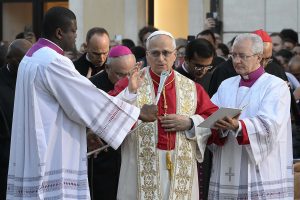
The faithful gather with Archbishop Bernard A. Hebda of St. Paul and Minneapolis and Auxiliary Bishops Kevin T. Kenney and Michael Izen, Father Dennis Zehren, pastor of Annunciation, Father Tom Margevicius, master of ceremonies, and Deacons Kevin Conneely and Eric Cooley in front of the main doors to Annunciation Catholic Church in Minneapolis Dec. 6, 2025, for the “Rite of Reparation After the Desecration of a Church.” (OSV News photo/Joe Ruff, The Catholic Spirit)
“An Easter preface of the Eucharistic prayer proclaims, ‘By dying, he destroyed our death, and by rising, restored our life,'” the archbishop prayed. “As our archdiocesan patron St. Paul asserted, ‘Where, O death, is your victory: Where, O death, is your sting?’
“Our Blessed Mother lived this faith and cooperated with God’s plan for her life, despite the difficulties it would occasion. We profess that our souls now will rejoin hers in proclaiming the greatness of the Lord in this church, dedicated in her honor, and now reclaimed for the glory of God.”
Accompanied by chanting of the Litany of the Saints, servers entered the church carrying incense, the cross and candles, followed by the bishops, vested in purple, deacons, and priests of the archdiocese in white vestments, other liturgical ministers and all the assembly.
The parish asked that the media not be allowed inside for the Mass. Materials prepared for the rite suggested that part of the litany would include prayers related to the rite of reparation, including the faithful praying “bring healing to those who were injured,” “bring healing and comfort to those suffering the harm done to their children,” and “restore the sanctity of this church, dedicated to your glory and the Annunciation of the Blessed Virgin Mary.”
Inside the church, the altar was bare, unadorned with candles, altar cloths, flowers or other displays of joy, the materials stated. Archbishop Hebda, Bishop Kenney and Bishop Izen processed to their chairs.
A deacon filled two vessels with water and the congregation joined the archbishop in prayer as he blessed the water “which will be sprinkled on us as a memorial of our baptism; it was used when this sacred space was first consecrated, and will now be used in reparation for the evils which have occurred.”
Escorted by deacons, Archbishop Hebda and Father Dennis Zehren, pastor of Annunciation, sprinkled the altar and sanctuary, the church walls and the congregation with the holy water.
Readings from the first Saturday of Advent included verses from Isaiah proclaiming, “O people of Zion, who dwell in Jerusalem, no more will you weep; He will be gracious to you when you cry out, as soon as he hears he will answer you.”
The Gospel from Matthew recounted Jesus visiting towns and villages, teaching in synagogues, proclaiming “the Gospel of the Kingdom, and curing every disease and illness.” After the readings and Archbishop Hebda’s homily, the altar was prepared for the celebration of the Eucharist, and the Mass proceeded.
In notes prepared for his homily, the archbishop began by recounting the “blustery day in March of 1963, as the church universal was engaged in the renewal brought about by the Second Vatican Council, this church was formally dedicated by Archbishop (Leo) Binz.”
The parish had been in existence for more than 40 years, and the building had been in use for a few months, the archbishop wrote.
“As part of that ritual, Archbishop Binz would have anointed the altar and walls of the church with sacred chrism,” he continued, “the same chrism that is used to claim an infant as a child of God in baptism, the same chrism that is used at confirmation to seal us with the gifts of the Holy Spirit, the same chrism with which the hands of a priest are anointed, the same chrism that is poured on the head of a bishop on the day of his ordination.
“The anointing with sacred chrism is a sign of being set aside for God, of being claimed by God,” the archbishop wrote. “If there was any question about that in the case of Annunciation Church, one would only have to look at the inscription on the facade: ‘This is the house of God and the gate of heaven.'”
The readings at a Mass of dedication don’t focus on the building, the archbishop noted. “But rather on the people who make up the community that will worship there, the living stones, who, being nourished by the Eucharist and strengthened by the other sacraments, are called to go out of the church, out of the sacred space, and renew the world.”
Still, the building is important in part as “an architectural recognition of the truth that we’re all created to give God praise.”
“We know all too well what happened here, however, on the morning of Aug. 27. This safe haven, this place of refuge, this foretaste of the order of the heavenly kingdom, was disturbed by a chaos that no one could have imagined,” the archbishop wrote. “It’s for that chaos that we’ve come together to engage in this act of penance and reparation this day.
“This community will never forget what happened that day and will forever remember with great love Harper and Fletcher, whose beautiful and inspiring lives were cut short as they and fellow students gathered for the Eucharist,” he added.
The archbishop expressed gratitude for Father Zehren and Matt DeBoer, principal of Annunciation Catholic School, and for the children and parishioners of Annunciation, for reminding the faithful that Aug. 27 wasn’t the end of the story.
“I’ve never seen such an outpouring of love and mutual support as I have witnessed here these last three months,” the archbishop wrote. “The sorrow understandably lingers, but there’s a Christ-centered resilience here that is remarkable — and praise God — it’s been contagious.
“Today we gather penitentially for this rite of reparation in the hope of restoring the order that Christ desires for his Church, his family. We cannot undo the tragic loss of Fletcher and Harper, but we can communicate to the world that we recognize that the power of God is far in excess of any evil; that where sin abounds, grace abounds all the more,” he wrote.
“We cannot let Satan win, and we, by God’s grace, reclaim this space today for Christ and his Church.”
The light that illuminates and reminds the faithful of Christ’s presence in the tabernacle and in the community must be shared with others, the archbishop said.
Advent is an appropriate time for the rite of reparation as the church prepares for Christmas and the reality that Jesus came into the world, took on weak human flesh to be with sadness and grief, to be with the Moyskis and the Merkels, and with all those impacted by the tragedy of Aug. 27, the archbishop wrote.
“I thank you for being with me this morning,” the archbishop wrote, “for praying with me for God’s blessing on this space and this community. May it be a moment of true renewal for our Church, here at Annunciation and throughout our archdiocese. Praised be Jesus Christ, now and forever.”
Social
VATICAN CITY (CNS) – Human beings are meant to be actively involved in the world of creation, not just passive consumers of content generated by technology, Pope Leo XIV said.
“How can we ensure that the development of artificial intelligence truly serves the common good and is not just used to accumulate wealth and power in the hands of a few?” he asked Dec. 5.
The pope was speaking to people taking part in a conference held in Rome Dec. 5 organized by the Centesimus Annus Pro Pontifice Foundation and the Strategic Alliance of Catholic Research Universities.
The conference, titled “Artificial Intelligence and Care of Our Common Home,” included the presentation of a book of the same name that compiles research by experts analyzing and assessing the impact of AI, especially in the fields of business, finance, education and communication, and proposes solutions to some of the most urgent challenges.
Pope Leo XIV meets with people taking part in a conference on AI in Rome during an audience at the Vatican Dec. 5, 2025. The conference was organized by the Centesimus Annus Pro Pontifice Foundation and the Strategic Alliance of Catholic Research Universities. To the far right of the pope is Bishop Claudio Giuliodori, general ecclesiastical assistant of the University of the Sacred Heart in Milan, Italy. (CNS photo/Vatican Media)
Pope Leo said, “The research carried out by Centesimus-SACRU represents a truly valuable contribution,” since “coordinated and concerted action involving politics, institutions, businesses, finance, education, communication, citizens and religious communities” is needed.
It is “essential to teach young people to use these tools with their own intelligence, ensuring that they open themselves to the search for truth, a spiritual and fraternal life, broadening their dreams and the horizons of their decision making,” the pope said. “We support their desire to be different and better, because never before has it been so clear that a profound reversal of direction is needed in our idea of maturing.”
“We must pause and reflect with particular care upon the freedom and inner life of our children and young people, and the possible impact of technology on their intellectual and neurological development,” he said.
“The new generations must be helped, not hindered, on their path to maturity and responsibility,” he said. “The well-being of society depends on their ability to develop their talents and respond to the demands of the times and the needs of others, with generosity and freedom of mind.”
“The ability to access vast amounts of data and information should not be confused with the ability to derive meaning and value from it,” Pope Leo said. “The latter requires a willingness to confront the mystery and core questions of our existence, even when these realities are often marginalized or ridiculed by the prevailing cultural and economic models.”
Addressing this challenge, he said, “requires asking an even more fundamental question: What does it mean to be human in this moment of history?”
“Human beings are called to be co-workers in the work of creation, not merely passive consumers of content generated by artificial technology,” he said. “Our dignity lies in our ability to reflect, choose freely, love unconditionally and enter into authentic relationships with others.”
While artificial intelligence has opened “new horizons for creativity,” he said, “it also raises serious concerns about its possible repercussions on humanity’s openness to truth and beauty, and capacity for wonder and contemplation.”
“Recognizing and safeguarding what characterizes the human person and guarantees his or her balanced growth is essential for establishing an adequate framework for managing the consequences of artificial intelligence,” the pope said.
“This commitment comes before any partisan interest or profit, which is increasingly concentrated in the hands of a few,” he said. “Only through widespread participation that gives everyone the opportunity to be heard with respect, even the humblest, will it be possible to achieve these ambitious goals.”
Social
WASHINGTON (OSV News) – Despite an uptick in executions in the U.S. in 2025, opponents of the death penalty lauded decreases in new death sentences and waning public support for the practice during comments at a Dec. 3 press event announcing a new coalition called the U.S. Campaign to End the Death Penalty.
Laura Porter, the campaign’s director, said in a statement that the new coalition comes at “a critical juncture in our country’s history with the death penalty, with executions on the rise and new experimental execution methods being promoted in a handful of states despite growing opposition to the death penalty.”
“It is more important than ever that we shine a light on capital punishment’s failures and come together to show growing bipartisan support for ending executions,” Porter said.
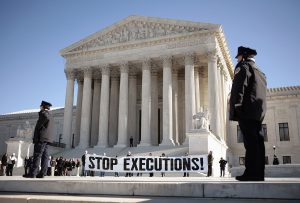
A file photo shows protesters calling for an end to the death penalty outside the U.S. Supreme Court in Washington. On Dec. 3, 2025, a coalition of more than 50 organizations from across the country announced the formation of the U.S. Campaign to End the Death Penalty to unite behind a national strategy to end capital punishment in the United States. (OSV News photo/Jason Reed, Reuters)
According to data from the Death Penalty Information Center, as of Dec. 3, 44 prisoners have been executed in 11 states in the U.S. in 2025, with three more scheduled before the end of the year.
Sister Helen Prejean, a Sister of St. Joseph, who is author of “Dead Man Walking” and a member of the coalition’s advisory council, told reporters, “Simply by being a human person, we have an inalienable right to life, and you cannot entrust over to government ever to have the wisdom or the know how, or the purity of heart, to be able to carry (the death penalty) out.”
The number of executions in the U.S. nearly doubled in 2025 from the previous year, when 25 executions were carried out.
Among the first actions of his second term earlier this year, President Donald Trump signed an executive order directing the U.S. attorney general to “pursue the death penalty for all crimes of a severity demanding its use,” and to “seek the death penalty regardless of other factors for every federal capital crime” that involves the “murder of a law-enforcement officer” or a “capital crime committed by an alien illegally present in this country.”
Some states, such as Florida, have sought to follow suit, dramatically increasing their scheduled executions.
However, an October 2025 Gallup poll found that although a slim majority of Americans favor the death penalty for people convicted of murder, that number continued a steady decline over 30 years, dropping from a peak of 80% in 1994 to 52% in 2025. While statistically similar to its findings in the previous two years, the 2025 result marks the lowest in Gallup’s death penalty trend since 1972, when 50% were in favor.
“I am full of hope on this issue, despite the harshness and terribleness of what’s going on, because I know I’ve been with the people too much, and I see they get the message,” Sister Helen said.
The coalition of more than 50 organizations aims to further increase the number of Americans opposed to the death penalty, advocate for more states to end the practice, and decrease the number of new sentences.
Demetrius Minor, executive director of Conservatives Concerned, a group that opposes the death penalty on pro-life and limited government grounds, told reporters “more and more conservatives across the country are questioning the death penalty and advocating for change.”
Minor argued there is “significant growing interest in the pro-life community to explore how the death penalty fits into their advocacy for life issues, and many are taking on the death penalty.”
“Every successful repeal of the death penalty in the last 20 years has included support from pro-life Republican legislators,” he said. “We expect much more of that in the years to come, and by working in collaboration with the U.S. campaign to end the death penalty and its partners, we can ensure that these efforts continue to be inclusive and bipartisan in the future.”
The Catholic Church’s official magisterium opposes the use of capital punishment as inconsistent with the inherent sanctity of human life, and advocates for the practice’s abolition worldwide.
The late Pope Francis revised the Catechism of the Catholic Church in 2018 to clarify the church’s teaching that capital punishment is morally “inadmissible” in the modern world and that the church works with determination for its abolishment worldwide.
In his 2020 encyclical “Fratelli Tutti,” Pope Francis addressed the moral problem of capital punishment by citing St. John Paul II, writing that his predecessor “stated clearly and firmly that the death penalty is inadequate from a moral standpoint and no longer necessary from that of penal justice.”
About a decade prior to becoming Pope Leo XIV earlier this year, then-Bishop Robert Prevost also raised his voice in support of abolishing capital punishment, writing in a March 5, 2015, post on X, then known as Twitter, “It’s time to end the death penalty.”
Social
AND THE WINNER IS—-
The VOICE of JOHN Ministry is pleased to announce the winner of the 2025 Christmas Card Contest who submitted the winning verse after her mom showed her the article in the Catholic Light inviting area students to participate in the Christmas Card Contest.
Isabella Novajosky, an 11th grade student from Lakeland Jr/Sr High School and a member of Queen of the Apostles Parish in Avoca, defines herself as prolife. She is a member of the National Honor Society, FCCLA (family, career, community, leaders of America), Future Business Leaders of America, and Students Against Dangerous Decisions.
Her Mom, Mary Novajosky, read about the contest and encouraged Isabella to write a verse appropriate for the art depicted on the card. Competing against students throughout the Scranton and Allentown diocese, Isabella chose a beautiful bible verse befitting the artistry of Linda Ross, from St Matthew’s Parish in East Stroudsburg.
Reflecting on John 3:16 “For God so loved the world, that He gave His only begotten Son, that whosoever believeth in Him should not perish, but have everlasting life”.
From Isabella, and the entire team of the VOICE of JOHN Ministry, we wish you peace and blessings as this Christmas we celebrate the greatest gift ever given – Jesus, The Christ”.
Social
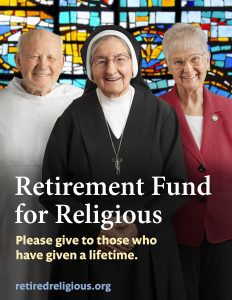
SCRANTON – The National Religious Retirement Office (NRRO) is announcing that the annual Retirement Fund for Religious collection will be held in parishes throughout the Diocese of Scranton on the weekend of Dec. 13-14.
In 2024, Catholics across the Diocese of Scranton contributed $70,104.60 to the collection, mostly through their home parishes.
“The generosity of U.S. Catholics continues to make a profound difference in the lives of aging religious,” John Knutsen, NRRO director, said. “This year, we invite all Catholics to help provide the care and dignity these women and men of faith so richly deserve.”
Rising health-care costs and the absence of traditional retirement plans have placed significant financial strain on many religious communities.
The Retirement Fund for Religious helps address this need, supporting more than 21,000 religious over the age of 70.
In 2024, the average annual cost of care was about $56,600 per person, with skilled nursing care averaging $96,000.
Since its establishment in 1988, the collection has raised over $1 billion, with nearly $900 million distributed for direct care and over $103.7 million allocated to retirement planning projects.
Since 2009, the annual total cost to support senior women and men religious has exceeded $1.1 billion.
In 2024, the appeal raised over $28.1 million, providing financial assistance for the retirement needs of 266 U.S. religious communities.
Beyond financial aid, the collection supports educational programs, empowering religious communities to plan for their long-term needs.
For more information on the collection, visit retiredreligious.org.
 AND THE WINNER IS—-