SCRANTON – Please see the graphic below regarding Mass times (both local and from the Vatican) for Christmas 2025.
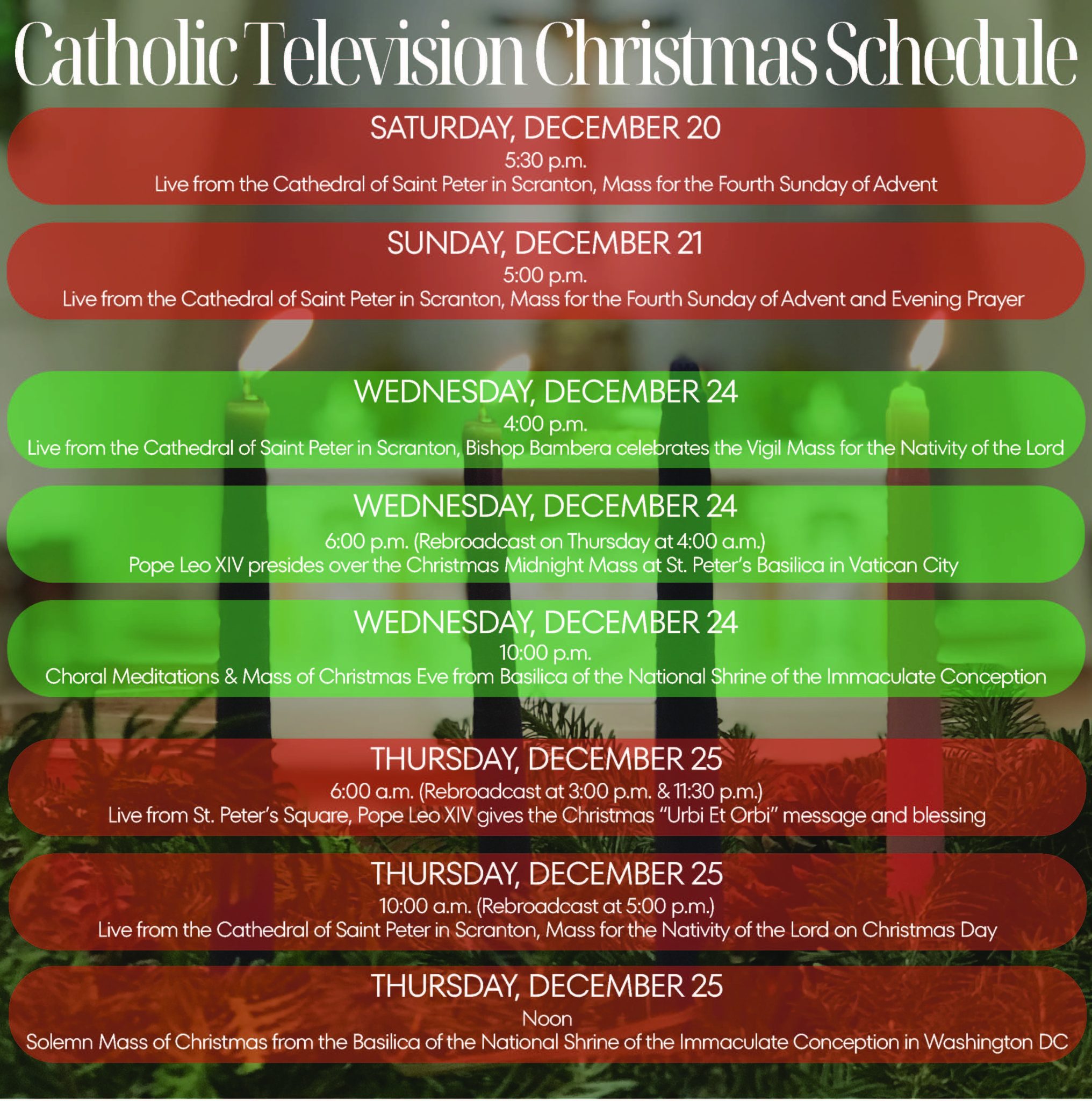
SCRANTON – Please see the graphic below regarding Mass times (both local and from the Vatican) for Christmas 2025.
SCRANTON – Through the continued partnership of Catholic Social Services of the Diocese of Scranton and the Friends of the Poor and Catherine McAuley Center, roughly 5,000 children in the greater Scranton area will wake up with presents under the tree on Christmas morning.
On Tuesday, Dec. 16 and Wednesday, Dec. 17, the organizations hosted their annual ‘Gifts for Kids’ distribution at The University of Scranton.
Pre-registered families were invited to shop for toys for their children at the event – which takes hundreds of volunteers to put together each year. The gifts are all donated by parishes, schools, individiuals and businesses throughout the community.
CARBONDALE – The basement hall at Our Lady of Mount Carmel Church transformed into Santa’s workshop on Tuesday, Dec. 9, 2025, as Catholic Social Services of the Diocese of Scranton provided early holiday cheer for many families in the greater Carbondale area.
Catholic Social Services welcomed families from across Lackawanna County’s Upper Valley for its annual Gifts for Kids distribution, offering toys, winter clothing, books, games, and stocking stuffers to the families of 284 pre-registered children.
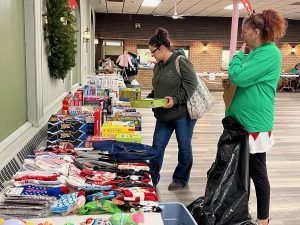
Parents were able to shop for two brand-new, unwrapped gifts for each child – and for many, the chance to choose something personal made all the difference.
“It’s joyful,” said CSS caseworker Christina Hoffman, who spent the day walking with parents as they selected gifts. “We’re making it a positive event. It is all about gift giving and being here to help one another throughout the holiday season.”
For parents like Nate Jones, who shopped for two children, the help is essential.
“I’m on a budget – I get SSI – so this helps me out a lot,” he said. “I know their personalities.”
Danielle Pevec of Carbondale was shopping for her young daughter.
“My daughter is very tall and finding clothes for her is a little difficult, so being able to shop that way was very helpful,” she said.
Pevec even spotted a family game – Pictionary – that struck the perfect chord.
“Every day, I ask her a ‘question of the day,’” she explained. “Last night, I asked, ‘What is something you’d like to learn with me?’ She said drawing. I caught Pictionary out of the corner of my eye, and that’s why I picked it. We’ll be able to draw together and have fun at the same time.”
Longtime volunteer Trish Smith, who dresses each year as the ‘Grinch’ for the toy distribution, said the day never loses its magic.
“The smiles, the people – it just brings joy,” she shared. “I love the music. I love the people. It is something that brings smiles and a little bit of happiness to people.”
Behind the scenes, the toy distribution takes months of planning.
Jolette Lyons, CSS Director of Lackawanna County Offices, noted that planning begins in April, with registration in the fall, and toy collections throughout the year.
“Everybody wants their kid to have a nice Christmas. Everybody wants toys under the Christmas tree for their children and so the opportunity to serve the community like this is really wonderful for us,” Lyons said.
For families who missed the registration deadline, CSS offered a second chance distribution on Wednesday, Dec. 10, ensuring that no child in Lackawanna County’s Upper Valley goes without presents on Christmas morning.
Catholic Social Services in Hazleton will also distribute toys to hundreds of children in that community from Dec. 20-23.
SCRANTON – Despite cold temperatures, dozens of people gathered at Cathedral Cemetery on Saturday, Dec. 13, 2025, for an annual event to honor the men and women who served our nation and now rest there.
Families, volunteers, and area veterans all participated in the 2025 Wreaths Across America ceremony this year.
“This is a magnificent event,” Mary Alice Fenwick, location coordinator for the Cathedral Cemetery’s Wreaths Across America event, said. “This is our fifth year doing the event here. We are blessed to be able to try to pay tribute to the men and women who gave everything for us.”
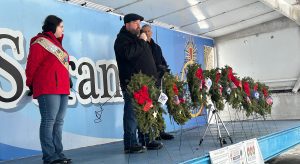
The Fenwick family has helped to coordinate the Wreaths Across America effort each year at Cathedral Cemetery. Mary Alice Fenwick, along with her daughter Megan and granddaughter Molly.
“We were truly blessed to have this many people come out this year. We were fortunate to have so many wreaths. We have wonderful, generous donors,” Mary Alice added.
Wreaths Across America, which began in 1992 in Maine, has grown into a nationwide effort held annually each December. Its mission is simple but profound: to remember the fallen, honor those who serve and teach future generations the value of freedom.
“We have approximately 15,000 veterans that are interred in this cemetery, and every year, I feel like it gets a little bit bigger,” Megan Fenwick added. “The Northeast PA Marine Corps League comes every year for us. They are able to do the 21-gun salute and do the colors.”
This year’s ceremony began early, with volunteers setting up the City of Scranton show mobile and preparing for the formal program. Members of the Catholic community were joined by local organizations, including Girl Scouts, union members, and veterans’ groups, all united in a shared purpose.
At the heart of the ceremony itself is a simple but powerful act repeated thousands of times nationwide: laying a wreath on a veteran’s grave and speaking his/her name aloud.
“It is a great way to honor our veterans, especially at this time during the Christmas season,” donor Alice McDermott said. “My dad was a veteran. It’s emotional not having him here with us, but it gives us a time to stop and think about what they did for our country and the freedoms they gave us.”
McDermott, a parishioner at nearby Mary, Mother of God Parish, said she sees the event resonate strongly with children who participate.
“They don’t even know half of these people that they’re laying wreaths on – but they thank them,” she added. “Freedom is everything.”
Molly Fenwick, a Girl Scout Juliette, served as the emcee of this year’s ceremony.
“I started when I was around seven in Girl Scouts, and now I’m here coordinating my own event,” she said. “It’s a big event. People look forward to it every year.”
After all the wreaths had been placed on veterans’ graves, organizers reflected on both gratitude and responsibility.
“I’m just proud to be a part of this wonderful organization,” Mary Alice said.
“It’s important for the next generation to know this is why we have the freedoms we have,” Megan added.
PITTSTON – As Advent began on Sunday, Nov. 30, 2025, the three Catholic parishes in Pittston came together to continue a beloved tradition of providing help – and hope – to local families in need at Christmas.
The parishes of Saint John the Evangelist, Saint Joseph Marello, and Our Lady of the Eucharist collected toys and gifts that would later be distributed by the Greater Pittston Santa Squad.
The three parishes had been collecting new, unwrapped toys throughout November, but efforts culminated with a two-hour drop off event at Our Lady of Mount Carmel Parish Center prior to a public tree lighting and living nativity celebration.
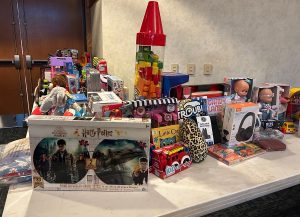
“Our parishioners in all three parishes have been preparing now for several weeks,” Father Joseph Elston, pastor of the three Pittston parishes, explained.
“Hundreds and hundreds of families benefit from this,” he added.
The Greater Pittston Santa Squad is a nonprofit that conducts a months-long effort to match toys to the specific wishes of local children. The organization interviews families, catalogs gift requests, and coordinates a major distribution day in mid-December.
In all, an estimated 1,700 children benefitted from this year’s effort.
“There is a great need in the area,” Father Elston said. “A lot of people cooperate and donate money and toys and time.”
Parish volunteers say the response from parishioners has been consistently generous.
“Every year, it amazes us how much we get,” Brandon Jopling, Director of Music and Liturgy at Saint Joseph Marello Parish, said. “They’re very supportive and very generous. We get a lot of good quality toys.”
Jopling said the parishes intentionally schedule the collection on the First Sunday of Advent as a way of grounding parish life in the true meaning of the season.
“It’s a way to kick off Advent and center our hearts towards the importance of what this season means,” he added.
Volunteer Lisa Wallace described the annual initiative not just as a charity effort, but as a visible expression of living the Gospel message.
“It shows that people care, people want to give, people want to help,” Wallace said. “Everybody goes through hard times, so there is always someone out there that can help.”
The Santa Squad uses the former Seton Catholic gym as workspace in the weeks leading up to Christmas. That is where volunteers sort, match, and prepare gifts for distribution.
While most parishes have a toy or gift collection effort, the Pittston parishes have embraced their partnership with the Santa Squad because of its mission and local impact.
“It has been a tradition for the past three or four years,” Jopling said, “and we can’t wait for it to continue.”
EAST STROUDSBURG– The Feast of Our Lady of Guadalupe was celebrated widely across the Diocese of Scranton this month, as parishes gathered to honor the Blessed Mother under her title as Patroness of the Americas.
Observed annually on Dec. 12, the Feast of Our Lady of Guadalupe commemorates the appearances of the Blessed Mother to Juan Diego in 1531.
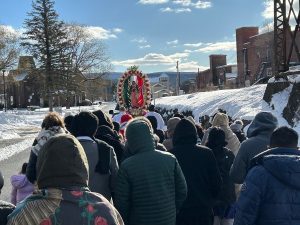
Her image, miraculously imprinted on the tilma of Juan Diego, became a powerful sign of God’s love and mercy, leading to the spread of the Gospel throughout the Americas.
Nearly 500 years later, her message continues to inspire prayer, unity, and hope.
The Most Rev. Joseph C. Bambera, Bishop of Scranton, joined the faithful for three major celebrations in Scranton, Wilkes-Barre, and East Stroudsburg. Each event highlighted the deep devotion Hispanic Catholics hold for Our Lady of Guadalupe and the rich faith they bring to the Church.
Families Celebrate in Scranton
On Sunday, Dec. 7, Bishop Bambera celebrated Mass at the Cathedral of Saint Peter with the faithful of Saint Teresa of Calcutta Parish. The Mass, held at 12:15 p.m., was followed by a festive cultural celebration across the street at the Diocesan Pastoral Center.
“The Hispanic members of our community have a great love for Our Lady of Guadalupe,” Father Jonathan Kuhar, pastor of Saint Teresa of Calcutta Parish, said. “Even though she appeared in Mexico, it was for the benefit of all the peoples of America.”
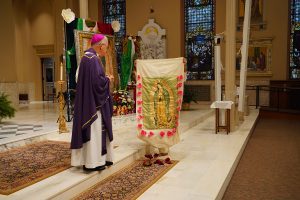
“It is a big thing for us. We love it,” parishioner Esau Orellana said. “We all come together for this Mass. It was beautiful – the music and the songs. The Cathedral was full of people and we love seeing that.”
Throughout the afternoon, families gathered to share food, music, dance, and even a reenactment of the story of Our Lady of Guadalupe.
“We’re showing the story on how this all started and how she represents Mexico, Mariah Coplin, who played Our Lady of Guadalupe, explained.
“It was a beautiful moment, especially for the young kids,” Luis Coplin, who played the local bishop, added. “It was very beautiful to have all the people see the history of their country.”
“At first, nobody believed Juan Diego. Everybody said he was crazy,” Jose Antonio Galdamez Cortez reflected, thinking about the character he portrayed in the reenactment. “We planned this for about a month. It was a lot of hard work.”
Citywide Witness of Hope in Wilkes-Barre
On Friday, Dec. 12, Bishop Bambera joined the faithful of Saint Nicholas-Saint Mary Parish in Wilkes-Barre for Mass at 6 p.m. at Saint Nicholas Church and a reception afterward.
The celebration began with a large public procession through city streets at 4 p.m., drawing participants of all ages who braved the cold weather to walk, pray, sing, and dance in honor of the Blessed Mother.
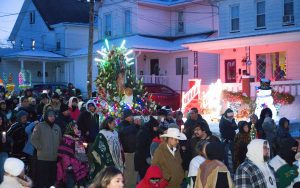
“The procession was just beautiful,” parishioner Adriana Sosa said. “It is our way to show our appreciation to her, showing our love for her in this cold weather.”
For many, Our Lady of Guadalupe represents comfort and hope, especially for those facing hardship.
“She appeared to Juan Diego. He was the poorest of them all. He was at rock bottom,” Sosa added. “She gives us hope that no matter who we are, she will be there for us.”
Parishioner Michelle Bazan noted the importance of teaching younger generations about the devotion.
“It has been carried on for nearly 500 years,” she said. “If we don’t pass that on to future generations, it will eventually get lost.”
“This is honestly one of my favorite days of the year,” parishioner Luz Castro added. “From the mañanitas in the morning, to the procession, to the Mass, and then having food and the community together, all to show our love to Our Lady of Guadalupe.”
Faith perseveres through the storm
Despite heavy snowfall and strong winds, the faithful of Saint Matthew Parish in East Stroudsburg gathered on Sunday, Dec. 14, for an outdoor procession followed by Mass with Bishop Bambera.
“It’s cold out – but it shows our culture and how we express it,” parishioner Adriel Lopez said. “I just like seeing everyone.”
Participants from many cultural backgrounds walked together, praying the rosary and honoring Our Lady.
“It makes me feel like we’re one big happy family,” parishioner Rey Pomaquiza Morocho said.
Deacon Angel Luis Rivera reflected on the deeper meaning of the celebration.
“She brought two cultures together – the Spanish culture and the Indigenous people,” he said. “She is our mother. It is bringing our faith to life.”
He also expressed gratitude for the Bishop’s presence in the Poconos.
“The Bishop is the father of the Diocese,” Deacon Rivera added. “It is so lovely that our Bishop has time to spend with us. I love the fact that he takes that time.”
SCRANTON – The Diocese of Scranton Catholic School System is turning a key pillar of its recently completed Strategic Growth Plan into action – by investing millions of dollars in long-needed infrastructure improvements.
With 19 schools across five counties, and many of those buildings approaching a century old, the Strategic Growth Plan made clear that deferred maintenance had accumulated for many years.
The Plan’s first goal – the development of a master facility plan at each school – underscored the need for updated roofs, windows, HVAC systems, electrical infrastructure, masonry work, and steady annual investments.
YEAR ONE: SUMMER OF ROOFS
After a comprehensive assessment of every school building was completed by an independent contractor, the Diocese of Scranton Catholic School System took the rare step of securing a major loan to accelerate capital improvements.
With the help of this financing, $8 million in renovations are underway across multiple schools.
“It was the summer of roofs,” Luke Alar, Schools Facilities Coordinator, said.
Alar joined the Catholic Schools Office in 2023 and has spearheaded the system-wide planning effort.
“The roofs were really the low-hanging fruit that needed to be done,” Alar added.
Five major roof replacements were completed or are substantially complete at Holy Redeemer High School, Saint Jude School, All Saints Academy, Holy Rosary School, and La Salle Academy.
In some cases – the projects were urgent.
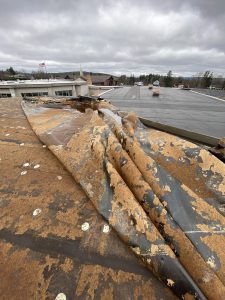
Take for example the gymnasium roof at Saint Jude School in Mountain Top which was damaged in March 2025 during a major windstorm. The age and condition of the roof contributed to its ultimate failure.
“It almost looked like a monster came in and opened it like a blanket,” Alar explained. “These were projects that couldn’t wait. The whole theory and concept on how we came up with the first projects was building envelope – keeping the water out and the heat on.”
YEAR TWO: HVAC AND WINDOWS
Because the financing can be drawn over 18 months, effectively giving the Catholic School System two summers for work – Alar said crews will be “going as strong as we can” in summer 2026.
“We’re now switching to HVAC and windows,” he noted.
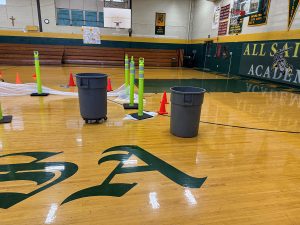
Among the projects already in the planning process are new boilers at Notre Dame Elementary and High School – which have shared a single boiler since construction – and Holy Cross High School, which still has its original boiler from the 1960s.
With some buildings dating back to the early 1900s, the Catholic School System faces what Alar describes as a “university-level” infrastructure situation. But rather than seeing the scope as overwhelming, he calls it a blessing.
“It’s exciting and I’m blessed to have this opportunity,” he said. “It is not a job. We are bringing children to Jesus. We’re making saints. We’re preparing their souls for heaven. That gives you more motivation and excitement to do what you’re doing.”
Alar added that the long-term goal – spelled out in the Strategic Growth Plan – is to establish a capital budget at each school so that investment becomes annual, consistent, and sustainable.
“This is not the end,” Alar emphasized. “We want people to look back and say we made wise choices and were frugal with how we spent the money.”
For Kristen Donohue, Diocesan Secretary for Catholic Education and Superintendent, the facility work is more than construction – it’s a promise to families being fulfilled.
“We completed our Strategic Growth Plan and identified deferred maintenance as a key component that needed to be addressed so we can continue to deliver our strong product for years to come,” she said. “We made it a priority.”
Donohue echoed Alar’s statements that the improvements focus first on the overall building envelope of all schools.
“We are making sure we have a sound structure in which our students, teachers, and administrators can work and enjoy their Catholic education,” she said.
Donohue praised Alar’s leadership, calling the work underway a “huge task for anyone.”
She also noted the close partnership Alar has forged with the Diocesan Office for Property and Risk Management – an office that has been invaluable in assistance with all the projects.
“There are needs within each of our school buildings,” Donohue said. “We are working to address as many outstanding issues as we can now and plan to continue addressing needs well into the future. Giving our students the best facilities we possibly can is paramount.”
ARCHBALD – Even with temperatures only in the mid-twenties, nearly 200 runners and walkers gathered for the 17th annual Saint Nicholas 5K Fun Run and Walk at Christ the King Parish on Dec. 6, 2025.
While winter is an unusual season for races in northeastern Pennsylvania, this beloved event has become an event that many local athletes and parishioners await each year.
“It’s an event that began as a fundraiser for our youth group and it has since become a huge social event here in Archbald,” Father Ryan Glenn, pastor, said. “It raises funds for our parish, and it brings together the running community and walking community.”
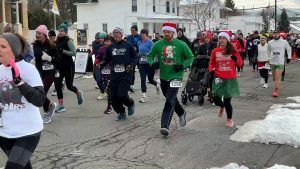
After the race, participants gather in the parish hall to enjoy hearty soups and baked goods.
“We usually have it around Saint Nicholas’ Feast Day, so people are really in the holiday spirit. It’s a really festive day and a lot of fun,” Father Ryan added. “It’s something unique to bring people together and to bring them to our parish community.”
Amy Hassaj, chairperson of the race committee, said the event embodies community spirit.
“We have runners from all over the Valley that look forward to this. This year was an awesome turnout,” she said. “Along with all the volunteers from the parish, people that donated soups and local businesses that donated soups and baked goods, it really just brought everybody together.”
For many runners, like David Schweitzer from Saint John Vianney Parish in Scott Township, it’s an annual tradition.
“This is my fourth year in a row running the Saint Nicholas 5K,” Schweitzer said. “Every year, this event seems to get bigger and better. The parish does more and more to make it a great day and worth coming out to. I always have a great time here.”
Schweitzer placed third in his age division and finished ninth overall.
“In past years, I’ve been able to run a personal record. That didn’t happen this year but that is okay. It’s a nice flat out-and-back, which makes for a quick run,” he added.
For younger runners, like Jack Kopa who is only a teenager, the race is an opportunity to track progress during the off-season and compete in a friendly environment.
“I’ve been doing it for three years now,” said Kopa, who took first place in the 15-19 age group. “I cut a whole minute off my time, so it has been positive.”
Since the 5K race has gotten so popular over the years, funds raised also now supports parish ministries like Christ the King’s clothing closet, pantry, and community outreach.
But for organizers – more than just the money raised – they welcome the opportunity to highlight the spirit of their parish.
“This is one of our flagship events at our parish. But for as much as it raises funds, it’s really a community building opportunity,” Father Ryan explained.
SCRANTON – Surrounded by family, friends, and fellow parishioners who supported them for five years of formation, eight men were ordained to the Permanent Diaconate for the Diocese of Scranton during a joyful Mass on Saturday, Nov. 29, 2025, at the Cathedral of Saint Peter.
The day marked a profound moment in the life of the Church of Scranton, and a milestone for the newly ordained who will now serve the People of God in the ministries of Word, Liturgy, and Charity.
The Most Rev. Joseph C. Bambera, Bishop of Scranton, served as principal celebrant and homilist for the Mass, which drew clergy from throughout the Diocese.
In a homily rooted in the Gospel of Matthew, Bishop Bambera reminded the men that ordained ministry in the Church is not a place of privilege, but a call to radical service.
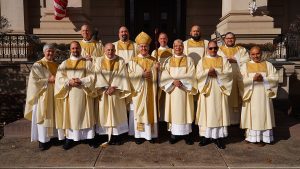
“To be a disciple of Jesus means to put ourselves in the humble, demanding role of servant to others, to intentionally seek the happiness and fulfillment of those entrusted to our care, regardless of the cost to ourselves,” Bishop Bambera said. “There is simply no other way to understand and manifest authentic ministry in the Church.”
Quoting Pope Leo XIV, the Bishop emphasized that perfection is not the requirement for ministry – credibility in witness is.
“God has called you to a vital ministry in service of the Gospel. Set aside your fears. Embrace your call with deep trust in Jesus’ promise to walk with you always,” he added. “Live the truth of the Gospel that is rooted in the person of Jesus. Follow always His example of selfless love and mercy.”
The men ordained included Fernando B. Alves, Francisco Castelan, Michaelangelo J. Colaneri, Frank A. Fanelli, Joel Marte, Jorge A. Roca, Rafael Sanchez Velasquez, and Christian D. Saunders.
The Ordination Mass featured the rich and ancient rituals of the Rite of Ordination of Deacons.
During the Election of Candidates, each man was called by name and presented to the Bishop, who formally affirmed their readiness for Ordination.
In the Promise of the Elect, the candidates declared their intention to be ordained and to undertake the duties of the diaconate.
As the cantor of the Mass chanted the Litany of Supplication, the eight candidates prostrated themselves before the altar – a powerful gesture of surrender and vulnerability.
For many ordinands, it was the most moving moment of the day.
“You put yourself in the absolute most vulnerable position and completely and totally turn everything that you are over to Him,” newly ordained Deacon Michaelangelo Colaneri said. “It is symbolic that you are dying to yourself and rising to Christ. When you are really in that moment, the symbolism takes true effect.”
The heart of the Sacramental ritual came with the Laying on of Hands and Prayer of Ordination, as Bishop Bambera conferred the Sacrament upon each man.
Following the prayer, the men were vested with the stole and dalmatic, handed the Book of the Gospels, and welcomed with the fraternal kiss by the attending deacons – a sign of belonging to the order.
Immediately following Mass, the emotional impact of the day was evident. As the newly ordained deacons greeted family and friends, many shed a few tears.
“It’s such a heart warming feeling to see friends and family that travelled for hours to come here. It’s such a moving experience,” Colaneri added. “This was beyond compare to anything I’ve ever had in my entire life.”
For Deacon Fernando Alves, who has been assigned to Saint Luke Parish in Stroudsburg, formation was both challenging and transformative.
“No one comes in thinking they know it all,” he said. “Most of us know that we’re not worthy to be here. We know we’re here because of what others have helped us with.”
But the journey was never solitary. Alves said he became close with his fellow deacons undergoing formation.
“We challenged each other and pushed each other forward,” Alves explained.
Deacon Joel Marte, one of three men who is being assigned to Saint Matthew Parish in East Stroudsburg, said the moment of vesting was unforgettable.
“When you get those garments, you see them and hear about them, but until you’re getting vested, that is when everything came together,” Marte shared. “That is when the tears came down.”
He, too, spoke of the deep bonds forged among the eight candidates.
“We have all become very close. We’ve shared our family, we share stories, faith, our backgrounds,” Marte said. “It is a bond I can’t explain.”
INDIANAPOLIS – Eighty-six young people and chaperones from the Diocese of Scranton traveled by bus to Indianapolis in late November to join more than 16,000 participants at the National Catholic Youth Conference (NCYC).
During the 2025 Jubilee Year of Hope, the event served as a major opportunity for Catholic teenagers to learn more about their faith and was a reminder that the future of the Church is vibrant, joyful, and deeply rooted in Christ.
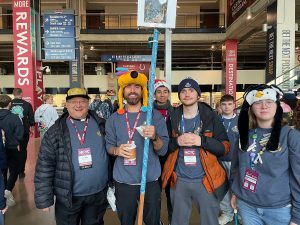
Pilgrims from nine different parishes attended this year’s conference. The parishes included: Our Lady Queen of Peace, Brodheadsville; Saints Peter and Paul, Towanda; Saint Matthew, East Stroudsburg; Saint Luke, Stroudsburg; Exaltation of the Holy Cross, Hanover Township; Saint Catherine of Siena, Moscow; Saint Eulalia, Roaring Brook Township; Our Lady of the Snows, Clarks Summit; and Saint Gregory, Clarks Green.
“We were with 16,000 other Catholic kids. I’ve never been able to experience that before,” Edward Scavone, a junior from Our Lady of the Snows Parish, said. “That was so cool.”
Breakout sessions covered topics including discipleship, vocations, and social challenges.
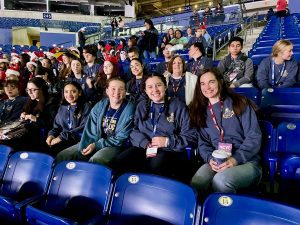
Several Diocesan participants highlighted a session led by Bishop Joseph Espaillat of the Archdiocese of New York called “Faith Amidst the Storm.”
“His energy and his compassion for humanity – and for being so real with our kids – was incredibly moving,” Christian Brown, youth minister for Saint Catherine of Siena and Saint Eulalia Parishes, said.
During the session, the young adults were asked what the world needs right now. While many answered peace, hope, love, or kindness – Bishop Espaillat challenged them that what is needed more than anything right now is faith.
Marinellys Marte, from Saint Matthew Parish, said the session encouraged teens to approach their faith with courage.
“We talked about how there are a lot of problems in the world and how we have to use the tools God gives us to fight our battles,” Marte said. “Saints weren’t wimps. They were strong people who leaned on God.”
Other participants repeatedly cited Eucharistic Adoration inside Lucas Oil Stadium – the home of the Indianapolis Colts football team – as a defining moment of the conference.
“It was very moving for me. There were 16,000 people all kneeling. I was trying to fight back the tears – but then everyone on the ground floor went up and kneeled as close as they could – and I started crying,” she said.
“It was a very beautiful event because we got one-on-one time with God,” Layla Reyes of Saints Peter and Paul Parish, added.
Going into the conference, Natalie Weidner of Exaltation of the Holy Cross Parish, was excited to participate in a digital encounter with Pope Leo XIV.
“I think it’s just great that I got to listen to him talk. Not a lot of people get that opportunity,” Weidner said.
As the conference ended, participants said NCYC renewed their enthusiasm to live and share their faith.
“The power of the Holy Spirit was present here,” Hannah Rocco, a senior from Saint Eulalia Parish who is preparing for college, stated. “I’m excited to see where God is calling me in the next steps of my life.”