VATICAN CITY (CNS) – The “confrontational” tone dominating both global and national politics is “deepening instability and unpredictability day by day,” Pope Leo XIV wrote in his message for World Peace Day.
“It is no coincidence that repeated calls to increase military spending, and the choices that follow, are presented by many government leaders as a justified response to external threats,” he wrote in the message for the Jan. 1 observance.
But peace must be protected and cultivated, Pope Leo said. “Even when it is endangered within us and around us, like a small flame threatened by a storm, we must protect it.”
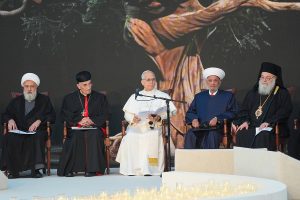
Pope Leo XIV sits between Cardinal Bechara Rai, patriarch of the Maronite Catholic Church, left, and Sheikh Abdul Latif Derian, the grand mufti of Lebanon, at an ecumenical and interreligious meeting in Martyrs’ Square in Beirut Dec. 1, 2025. In his message for World Peace Day, the pope said religious leaders must refute “forms of blasphemy that profane the holy name of God” by using religion to defend war. (CNS photo/Lola Gomez)
Throughout the coming year, Pope Leo will give visiting heads of state signed copies of his message, which was released by the Vatican Dec. 18, and Vatican ambassadors will distribute it to government leaders in the countries where they serve.
Cardinal Michael Czerny, prefect of the Dicastery for Promoting Integral Human Development, presented the message at a Vatican news conference.
“In some ways we have been beaten into accepting the logic of war, the logic of armaments, the logic of enemies,” the cardinal said. Pope Leo’s message recognizes that “the first triumph of the logic of war is that we give up our hope for peace.”
“I am not a soldier, I have never been a soldier,” the cardinal said, but “even a soldier can be comforted” by Pope Leo’s appeal to cultivate “peace in his heart and in his relationships and in his prayer and in his aspirations.”
While the message “does not diminish in any way the horrors that we are surrounded with,” he said, “it puts an enormous part of the responsibility on ourselves.”
The theme of the pope’s message, “Peace be with you all: Towards an ‘unarmed and disarming’ peace,” begins with the first words he said to the crowd in St. Peter’s Square May 8, the night of his election.
Pope Leo wrote in the message that he and all religious leaders have an obligation to teach and preach against “the growing temptation to weaponize even thoughts and words” and to condemn the use of religion to justify violence and exaggerated forms of nationalism.
“Unfortunately, it has become increasingly common to drag the language of faith into political battles, to bless nationalism, and to justify violence and armed struggle in the name of religion,” the pope wrote.
“Believers must actively refute, above all by the witness of their lives, these forms of blasphemy that profane the holy name of God,” Pope Leo said.
What is needed instead, he said, is prayer, spirituality and ecumenical and interreligious dialogue “as paths of peace and as languages of encounter within traditions and cultures.”
The message echoed what Pope Leo had told reporters Dec. 2 after meeting Christian, Muslim and Druze leaders in Turkey and Lebanon during his first foreign trip: “The more we can promote authentic unity and understanding, respect and human relationships of friendship and dialogue in the world, the greater possibility there is that we will put aside the arms of war, that we will leave aside the distrust, the hatred, the animosity that has so often been built up and that we will find ways to come together and be able to promote authentic peace and justice throughout the world.”
The first step in sowing peace, the pope wrote, is to believe that peace is possible and that all people desire it.
“When we treat peace as a distant ideal,” he wrote, “we cease to be scandalized when it is denied, or even when war is waged in its name.”
“When peace is not a reality that is lived, cultivated and protected, then aggression spreads into domestic and public life,” he said. When that happens, “it could even be considered a fault not to be sufficiently prepared for war, not to react to attacks, and not to return violence for violence.”
Statistics show that is already happening, the pope said.
Global military expenditures “increased by 9.4% in 2024 compared to the previous year, confirming the trend of the last ten years and reaching a total of $2718 billion — or 2.5% of global GDP,” he wrote, citing studies by the Stockholm International Peace Research Institute.
Pope Leo also decried a shift in education and in the media that instead of focusing on achievements in peacemaking and diplomacy since World War II and on remembering with horror just how many people died in that war, “we now see communication campaigns and educational programs – at schools, universities and in the media – that spread a perception of threats and promote only an armed notion of defense and security.”
That shift becomes especially frightening given advancements in weapons technology, particularly the development of drones, robots and other automated lethal weapons systems that can be controlled by artificial intelligence.
“There is even a growing tendency among political and military leaders to shirk responsibility, as decisions about life and death are increasingly ‘delegated’ to machines,” he wrote.
Pope Leo called on Christians and all people of goodwill to join forces “to contribute to a disarming peace, a peace born of openness and evangelical humility.”
“Goodness is disarming,” he wrote. “Perhaps this is why God became a child.”
Pope Leo prayed that as the Jubilee Year draws to a close, its legacy would be a “disarmament of heart, mind and life.”
Social
VATICAN CITY (CNS) – The tenacious hope of people of faith, believing in a better tomorrow, keeps God’s plan of salvation alive in the world, Pope Leo XIV said.
They keep hope alive even though today, just like in the past, there are other kinds of plans unfolding, he said during an evening prayer service in St. Peter’s Basilica Dec. 31.
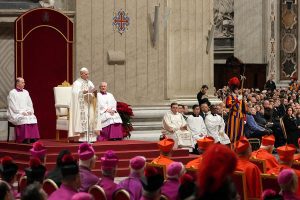
Pope Leo XIV gives his homily as he leads a New Year’s Eve evening prayer service in St. Peter’s Basilica at the Vatican Dec. 31, 2025. (CNS photo/Lola Gomez)
They include plans “aimed at conquering markets, territories and zones of influence. Weaponized strategies, cloaked in hypocritical speeches, ideological proclamations and false religious motives,” he said.
The pope, accompanied by dozens of cardinals and bishops, and thousands of visitors in the basilica, prayed vespers and then sang the “Te Deum” (“We praise you, O God”) in thanksgiving for the blessings of the past year.
The prayer service was held less than a week before the official close of the Holy Year 2025, which was inaugurated by Pope Francis when he opened the Holy Door of St. Peter’s Basilica during Christmas Eve Mass in 2024. Pope Leo was scheduled to close the door Jan. 6, the feast of the Epiphany, thereby officially marking the end of the Holy Year.
“Let us thank God for the gift of the Jubilee, which has been a great sign of (God’s) plan of hope for humanity and the world,” Pope Leo said in his homily.
In this plan, God has “reserved a special place for this city of Rome,” he said. “Not because of its glories, not because of its power, but because Peter and Paul and so many other martyrs shed their blood here for Christ.”
“That is why Rome is the city of the Jubilee,” he told the congregation, which included Rome’s mayor, Roberto Gualtieri, who was seated in the front row.
The birth of the Son of God “suggests a plan, a great plan for human history,” the pope said, which will “sum up all things in Christ, in heaven and on earth.”
“Sisters, brothers, today we feel the need for a wise, benevolent, merciful plan,” he said. “May it be a free and liberating, peaceful, faithful plan, like the one the Virgin Mary proclaimed in her canticle of praise: ‘His mercy is from age to age to those who fear him.'”
“The Holy Mother of God, the smallest and highest among creatures, sees things through the eyes of God: she sees that with the might of his arm, the Most High disperses the plots of the arrogant, overthrows the powerful from their thrones and raises up the lowly, fills the hands of the hungry with good things and empties those of the rich,” he said.
“God loves to hope with the heart of the least” and the meek, he said, “and he does so by involving them in his plan of salvation.”
“The more beautiful the plan, the greater the hope,” he said. “And indeed, the world goes on like this, driven by the hope of so many simple people, unknown but not to God, who, despite everything, believe in a better tomorrow, because they know that the future is in the hands of the One who offers them the greatest hope.”
After the service, Pope Leo visited the Vatican Nativity scene in St. Peter’s Square and prayed at the creche while the band of the Swiss Guard played Christmas carols. He then greeted the faithful gathered there, exchanging small talk and wishing people a happy new year.
Social
VATICAN CITY (CNS) – Close to 3 million pilgrims and visitors attended audiences, liturgies or meetings at the Vatican with Pope Leo XIV from the time of his election in May through December, according to the Prefecture of the Papal Household.
The prefecture, which handles the free tickets to audiences and Masses, as well as arranges the pope’s daily schedule of meetings, published statistics for the year Dec. 30.
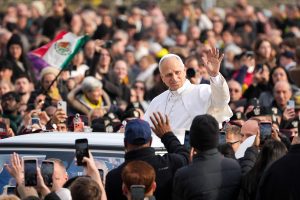
Pope Leo XIV greets visitors and pilgrims from the popemobile as he rides around St. Peter’s Square at the Vatican before his weekly general audience Dec. 17, 2025. (CNS photo/Lola Gomez)
The numbers did not include events outside the Vatican — for instance, it did not count the Mass with more than 1 million people the pope celebrated Aug. 3 at Tor Vergata on the outskirts of Rome to conclude the Jubilee of Youth, nor did the tabulations include the crowds who came to see him in Turkey and Lebanon during his first foreign trip as pope Nov. 27-Dec. 2.
The prefecture did include people who came to see Pope Francis before his death April 21. The pope, who was hospitalized from Feb. 14 to March 23, was present for eight Wednesday or Jubilee general audiences at the Vatican, welcoming 60,500 people.
In special audiences with groups, Pope Francis encountered more than 10,000 people; some 62,000 people joined Pope Francis for Masses and prayer services and an estimated 130,000 joined him for the midday recitation of the Angelus prayer on Sundays, the prefecture said. That means he encountered 262,820 people in 2025
Pope Leo held 36 general and Jubilee audiences during the year since his election May 8, encountering just over 1 million people, the prefecture reported.
In special audiences with smaller groups, the office said, he met with another 148,300 people.
Some 796,500 people attended liturgies celebrated by Pope Leo at the Vatican during the year, and an estimated 900,000 people joined him for the recitation of the Angelus on Sundays and holy days.
The prefecture said that meant 2,913,800 people had encountered Pope Leo at the Vatican in 2025.
The total for 2024, which was not a Holy Year, was close to 1.7 million people at audiences and prayers with Pope Francis.
Social
ST. PAUL, Minn. (OSV News) – Amid poinsettias and sparkling Christmas trees, Archbishop Bernard A. Hebda of St. Paul and Minneapolis told Catholics gathered Dec. 28 at the Cathedral of St. Paul that the promise of the 2025 Jubilee of Hope did not disappoint, as the church focused on mercy and conversion.
In his homily, Archbishop Hebda referred to the gleaming crosier he held, recently refurbished after being discovered in a St. Paul scrapyard earlier this year. He called it “an icon for all of us … of what it is that we hope to experience in the Jubilee Year, in that we find we have this opportunity to experience the treasures of the Catholic Church, and we’re given that opportunity for renewal.”
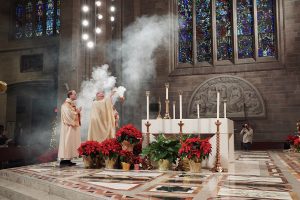
Archbishop Edward J. Weisenburger of Detroit incenses the altar at the beginning of Mass with the Rite for the Solemn Closing of the Jubilee Year of Hope on Dec. 28, 2025, at the Cathedral of the Most Blessed Sacrament in Detroit. Archbishop Weisenburger asked the faithful to reflect and give God thanks for all the graces they have received during the jubilee year, and to remember families who, like the Holy Family, have been forced to flee their homes. (OSV News photo/Izzy Cortese, Detroit Catholic)
The crosier, an ornate shepherd’s staff that is one of the symbols of a bishop’s office — fortified its rescuer’s waning Catholic faith, Archbishop Hebda said. He added that with the graces of the Holy Year, “We hope that all of us have had the chance to be shined up, to look better, to be ready, and indeed to be instruments of hope” willing to share Christ-centered hope with others.
Masses held at cathedrals on the feast of the Holy Family Dec. 28 marked the closing of diocesan celebrations of the Jubilee Year of Hope, which began at the Vatican Dec. 24, 2024. Bishops opened the year in their dioceses Dec. 29, 2024.
The Holy Year will end at the Vatican Jan. 6, 2026, with the closing of the Holy Door at St. Peter’s Basilica on the solemnity of the Epiphany of the Lord.
In the United States, bishops gave thanks for the graces of the Holy Year and reflected on the importance of hope. Pope Francis assigned the theme “Pilgrims of Hope” to the ordinary Jubilee Year in “Spes Non Confundit,” a declaration known as a papal bull, announcing the Holy Year issued May 9, 2024.
A jubilee year, also known as a holy year, is ordinarily held every 25 years as a time of repentance and mercy. It includes pilgrimages, especially to Rome. Over the course of the year, millions of pilgrims visited Rome to walk through Holy Doors designated at the city’s four major basilicas: St. Peter’s Basilica at the Vatican, and St. John Lateran, St. Mary Major and St. Paul’s Outside the Walls in Rome. Some planned their travels to coincide with particular Vatican celebrations, such as of youth, families and athletes, designed to include an audience with the pope.
Before his final illness and death in April, Pope Francis greeted communication professionals gathered in January for the Jubilee of the World of Communication. After his election in May, Pope Leo XIV continued audiences with jubilee event attendees.
Meanwhile, dioceses worldwide designated holy sites, including their cathedrals, as local pilgrimage designations for the Holy Year.
In Detroit, Archbishop Edward J. Weisenburger reflected upon changes that took place in the Jubilee Year, including his appointment to the Archdiocese of Detroit in February.
“I was in a different state, a different place, a different diocese when this started,” Archbishop Weisenburger said in his homily, according to Detroit Catholic, the digital news service of the Archdiocese of Detroit. “Hope has, in so many respects, I feel, been lived out in my life during this time. And as we join with the rest of the universal church in bringing it to a conclusion, I think we recognize that hope is not ended, but hope has in so many ways been restored, sustained and fulfilled.”
He encouraged Catholics to “continue for the rest of our years on this trajectory, this path given to us by Pope Francis and then continued under Pope Leo, recognizing that to be followers of Christ is always and everywhere to be a people of hope.”
In Miami, Archbishop Thomas G. Wenski said that the Jubilee Year “could not have come soon enough” and it “has called each one of us to spiritual renewal and to the transformation of the world by reintroducing hope to the world.”
“Perhaps because of the ascendant secularism of our times, perhaps because of the mediocre witness or even counter-witness of too many Christians, many people today have lost hope – or perhaps they never had it in the first place,” he said.
He noted that politics and ideologies are “peddling an ersatz or false hope” with which many try to replace religion. However, “A world without God is a world without hope; without hope, there is no future,” he said. “When the Word became flesh and was born of the Virgin Mary, hope was born — for Jesus, who came into the world to save it, is the hope of the world.”
The Archdiocese of Galveston-Houston marked the end of the Jubilee Year with Masses celebrated by Archbishop Joe S. Vásquez and Auxiliary Bishop Italo Dell’Oro at the Co-Cathedral of the Sacred Heart in Houston and St. Mary Cathedral Basilica in Galveston.
In his homily, Archbishop Vásquez quoted Pope Leo, who Dec. 20 said that “the hope this year has given us does not end.”
In Los Angeles, Archbishop José H. Gomez encouraged people to foster hope in their families, tying the Jubilee theme to the liturgical feast, which celebrated the Holy Family of Jesus, Mary and Joseph.
“Jesus is our hope,” Archbishop Gomez said. “In the child who comes to us in the silence of the holy night, we are given the power to become children of God, sons and daughters of God. And when we reflect on the story of Christmas, we notice that when the Magi and the shepherds go off in search of Jesus, they find Mary and Joseph and the infant lying in the manger. They find Jesus in the heart of his human family. And my dear brothers and sisters, God wants us to find Jesus in our own families. … And love is what makes our families holy.”
In St. Paul, Archbishop Hebda also emphasized that God calls the faithful to form their faith in the context of family, with Jesus, Mary and Joseph as examples.
“The hope, brothers and sisters, is that throughout this year we’ve had the opportunity to really engage in conversion, to come before the Lord, to recognize our sinfulness, to recognize our neediness, and to seek the Lord’s extraordinary mercy,” he said, adding, “A Holy Year is always a time of extraordinary grace.”
Social
ROME (CNS) – The path to conversion, the door to God’s mercy and the call to live in Christian hope all continue beyond the Jubilee Year, said the three cardinals who closed the Holy Doors at three major basilicas in Rome.
On the feast of the Epiphany, Jan. 6, Pope Leo will solemnly close the Holy Door of St. Peter’s Basilica at the Vatican, formally concluding the Holy Year 2025, which Pope Francis opened on Christmas Eve 2024. But diocesan and other local celebrations of the Jubilee concluded Dec. 28.
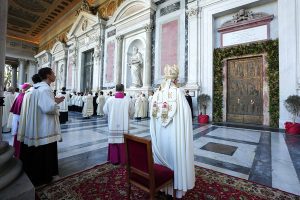
Cardinal James M. Harvey, archpriest of Rome’s Basilica of St. Paul Outside the Walls stands in front of the basilica’s Holy Door after solemnly closing it Dec. 28, 2025, as the Jubilee Year drew to a close. (CNS photo/Lola Gomez)
Cardinal Rolandas Makrickas, archpriest of Rome’s Basilica of St. Mary Major, presided over the rite of closing the basilica’s Holy Door at dusk Dec. 25 before celebrating a special Mass. Cardinal Baldassare Reina, papal vicar of Rome and archpriest of the Basilica of St. John Lateran, did the same there Dec. 27. And U.S. Cardinal James M. Harvey, archpriest of the Basilica of St. Paul Outside the Walls, presided over the closing of its Holy Door and the celebration of Mass Dec. 28.
The Holy Doors are bricked up between Jubilee Years, which usually occur every 25 years. Pope Leo has indicated, however, that an extraordinary Holy Year will be celebrated in 2033, to mark the 2,000th anniversary of the death and resurrection of Jesus.
“What is closing is not divine grace, but a special time of the church, and what remains open forever is the heart of the merciful God,” Cardinal Makrickas said in his homily Dec. 25. While the Holy Door is closed, “the door that truly matters remains that of our heart: it opens when it listens to the word of God, it widens when it welcomes our brother or sister, it is strengthened when it forgives and asks for forgiveness,” he said.
“In this basilica, precisely during this Holy Year, we have been granted the grace of a very special task: to safeguard a memory that becomes prophecy,” he said, drawing attention to the late Pope Francis, who is buried at St. Mary Major “and honored by thousands of faithful every day.”
According to SIR, the news agency of the Italian bishops’ conference, an estimated 20 million pilgrims passed through the Holy Door at the basilica in the past year.
Hope, the theme of the Jubilee Year, “moved the countless pilgrims who left on our roads the footprints of steps weighed down by the burdens pressing upon their hearts,” Cardinal Reina told people during the Mass at St. John Lateran. “They passed through the Holy Door in order to find the One they were seeking. The door of our cathedral bears the imprints of the caresses of all those who passed through it in search of mercy.”
Though the Holy Door is closed, he said, “we know that the Risen One passes through closed doors and never tires of knocking on our closed doors, in order to offer and to find mercy. Yes, to find it — because he too seeks it.”
“Indeed, he has told us of the final surprise: that in the end we will be judged on love, on mercy, on the glass of water given to the thirsty; on the morsel of bread to the hungry; on closeness to those who are imprisoned or ill; on clothing the naked; on welcoming the stranger,” Cardinal Reina said.
At St. Paul Outside the Walls, the burial place of the Apostle Paul, Cardinal Harvey noted that the Jubilee’s theme, “Hope does not disappoint,” was taken from St. Paul’s Letter to the Romans. “It is not only a motto, but is most of all a profession of faith,” the cardinal said.
“In a world marked by war, crises, injustices and confusion, the church wanted to reaffirm that Christian hope is far different from trying to flee history,” he said; rather, “it is expressed in the ability to pass through it with one’s gaze fixed on Christ.”
The Holy Door is not simply a material passageway, Cardinal Harvey said, “it is a spiritual threshold, a call to each one of us to leave behind that which weighs on our hearts to enter the space of mercy. Crossing it means recognizing that salvation flows from humbly entrusting ourselves to the only One who can give us fullness of life.”
Social
WASHINGTON (OSV News) – In a year that brought both a new U.S. president and a new pope, the issue of immigration emerged as a flashpoint between them and as a key issue for the U.S. church.
President Donald Trump was sworn in for a second, nonconsecutive term in the White House Jan. 20, becoming the nation’s 47th president four years after he left office as its 45th. In his second inaugural address, Trump said he would begin “the process of returning millions and millions of criminal aliens back to the places from which they came.”
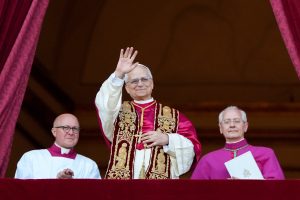
Pope Leo XIV, the former Cardinal Robert F. Prevost, waves to the crowds in St. Peter’s Square at the Vatican after his election as pope May 8, 2025. The new pope was born in Chicago. (CNS photo/Lola Gomez)
Immigration and Customs Enforcement arrests have increased since then. However, as the Trump administration seeks to meet a goal of 3,000 such arrests per day, many of the individuals impacted have never been charged with a crime, arrest data shows.
On May 8, Pope Leo XIV was elected pontiff following the death of Pope Francis on April 20.
Ever since, Pope Leo has navigated the immigration issue “very effectively, I think,” Kenneth Craycraft, a professor of moral theology at Mount St. Mary’s Seminary and School of Theology in Cincinnati and author of “Citizens Yet Strangers: Living Authentically Catholic in a Divided America,” told OSV News.
“He has condemned the hateful rhetoric and lack of due process for immigrants, while also defending the rights of nations to control their borders. His statements have been careful, circumspect and wise,” Craycraft said.
John White, a professor of politics at The Catholic University of America in Washington, concurred, telling OSV News Pope Leo is “adhering to the Gospel message.”
“I think that he is a very careful man. He’s a very deliberate man,” White said of the pontiff’s approach. “I think one of the things that is so interesting here is that Pope Leo has both South American roots, but also American roots; he speaks perfect English, obviously, and directs that message toward American Catholics, which I think is important.”
In November, the U.S. Conference of Catholic Bishops approved a “special pastoral message on immigration,” voicing “our concern here for immigrants” at their annual fall plenary assembly in Baltimore.
The statement came as a growing number of bishops acknowledged that some of the Trump administration’s immigration policies risk presenting the church with both practical challenges in administering pastoral care and charitable endeavors, as well as religious liberty challenges.
At least one member of the Trump administration, “border czar” Tom Homan, called the U.S. Catholic bishops “wrong” in comments to reporters at the White House Nov. 14. “The Catholic Church is wrong,” he said. “I’m a lifelong Catholic, but I’m saying it not only as a border czar, but I’m also saying this as a Catholic, I think they need to spend time fixing the Catholic Church.”
The bishops’ message marked the first such message by the U.S. bishops in over 12 years, coming after a 2013 response to the federal government’s contraceptive mandate. Pope Leo praised the message, telling reporters, “I would just invite all people in the United States to listen to them.”
White cited dispensations from the obligation to attend Sunday Mass for the faithful if they fear for their well-being in San Bernardino, California, amid immigration enforcement raids as among “one of the biggest stories and through lines of the year” for the U.S. church.
Trump’s return to the White House was marked by a slew of executive orders in addition to his birthright citizenship order, such as one withdrawing from the 2015 Paris Agreement on climate, another to expand the use of the federal death penalty, and another directing the U.S. government to only recognize two sexes, male and female.
On July 4, Trump signed “the One Big Beautiful Bill Act,” a reconciliation bill enacting much of his legislative agenda on taxes and immigration. Catholic leaders alternately praised and criticized various provisions in the legislation, with some arguing its cuts to Medicaid and SNAP would harm the poorest families, while others pointed to a provision stripping Medicaid funding from entities that perform abortion – such as Planned Parenthood – for one year. However, as of the beginning of December, that provision remained blocked by a federal judge.
Craycraft argued, “It’s been a very disappointing and disconcerting first year” of the second Trump administration.
“The president’s erratic behavior, name-calling, and Truth Social rants indicate a person who is neither psychologically nor morally fit for the most important political office in the world,” he said. “Many Catholics were hoping that holding their noses and voting for him would yield some affirmative pro-life policies and measures. But the President endorses IVF, surrogacy and mifepristone, all very much in conflict with Catholic moral theology.”
The Food and Drug Administration’s approval of a new generic form of mifepristone – a pill commonly, but not exclusively, used for early abortion – was met with pushback from pro-life groups who argued that the administration should review the safety of the original drug instead.
The Trump administration also moved to formally dissolve the U.S. Agency for International Development and move a small number of its remaining functions under the purview of the State Department. Cuts to funding for the government’s now-shuttered humanitarian aid agency in countries all over the globe included funding for efforts by Catholic and other faith-based humanitarian groups such as Catholic Relief Services, the overseas charitable arm of the Catholic Church in the U.S.
The issue of political violence was another that colored 2025. Charlie Kirk, a conservative activist and founder of Turning Point USA was killed Sept. 10 during an event at Utah Valley University in Orem. After his death, Kirk received praise from his allies in conservative politics for his willingness to debate and his advocacy for their cause. However, in discussions about his legacy, his critics also pointed to his controversial political rhetoric on subjects including race, persons experiencing same-sex attraction or gender dysphoria, and immigrants.
“The assassination of Charlie Kirk has contributed to the further decline in American political discourse,” Craycraft said, adding, “It’s a very sad episode in American public life.”
The targeted killings of Minnesota House of Representatives Speaker Emerita Melissa Hortman and her husband, Mark Hortman, and the firebombing of the Pennsylvania governor’s mansion, which is being investigated as the attempted murder of Democratic Gov. Josh Shapiro, were among other instances of political violence.
In a message released in October, Archbishop Timothy P. Broglio of the U.S. Archdiocese for the Military Services — who, until the U.S. bishop’s plenary in November, was the president of USCCB — urged every American to “reflect on the value of every human life, see Christ in each person, even those whose politics you oppose.”
After Pope Leo released his first apostolic exhortation, “Dilexi Te” (“I have loved you”), about love and care for the poor on Oct. 9, Archbishop Broglio issued a statement at the time urging the faithful to engage the document “on the challenges we face with contemporary migration,” and said Pope Leo “encourages us to respond with four actions: welcome, protect, promote and integrate. This is a sharp contrast to the culture of fear being imposed upon our sisters and brothers in Christ.”
Social
(OSV News) – Life issues are perennially critical to the robust public witness of the Catholic Church, but 2025 nonetheless proved a particularly eventful year across a wide spectrum of related concerns.
The year opened with the annual National Prayer Vigil for Life, where worshippers praised and thanked God “for the gift of human life in all its forms and at every stage” and ended with a new coalition of more than 50 organizations pledging to end the death penalty in the United States once and for all.
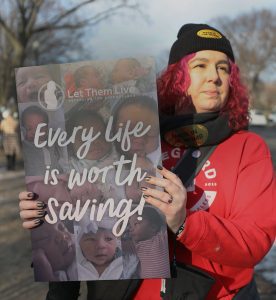
A woman holds up a pro-life sign ahead of the 52nd annual March for Life rally in Washington Jan. 24, 2025. (OSV News photo/Bob Roller)
Remarks by Pope Leo XIV in an impromptu Sept. 30 Castel Gandolfo press scrum demonstrated the expanse – and continuity – of the life issues of concern to the church.
The pope, who shortly after being elected the successor to Pope Francis reaffirmed the church’s teaching against abortion, responded to a media question concerning the Chicago Archdiocese’s plans to give an immigration advocacy award to U.S. Sen. Dick Durbin, D-Ill., a Catholic who supports keeping abortion legal, over the objections of pro-lifers. (Durbin ultimately declined to accept the award.)
“Someone who says, ‘I’m against abortion but says I’m in favor of the death penalty’ is not really pro-life,” the pontiff remarked. “So someone who says that ‘I’m against abortion, but I’m in agreement with the inhuman treatment of immigrants who are in the United States,’ I don’t know if that’s pro-life. … Church teaching on each one of those issues is very clear.”
On the same day as the pope’s remarks, the U.S. Food and Drug Administration announced approval of a new generic form of mifepristone — a pill commonly, but not exclusively, used for early abortion — marking the second time a Trump administration has permitted a generic form of mifepristone.
“It is shockingly inconsistent that the FDA approved a generic for mifepristone, while at the same time reviewing the effects of this lethal drug,” Kat Talalas, assistant director of communications in the U.S. Conference of Catholic Bishops’ Secretariat of Pro-Life Activities, told OSV News on Dec. 3.
On Dec. 9, Susan B. Anthony Pro-Life America called for FDA Commissioner Marty Makary to be fired, arguing that Makary has “slow-walked a promised safety study of women’s real-world experiences taking abortion drugs.” The White House rejected that claim and the call for his firing.
Pro-life groups and politicians characterized the move as an abandonment of pro-life principles, concerns that were reinforced on Oct. 16 when President Donald Trump announced a policy proposal to increase access to in vitro fertilization.
Trump made campaign trail promises to expand IVF, an action the Catholic Church and other experts warn will fuel large-scale destruction of embryonic human life while doing little to increase the nation’s overall birth rate. The U.S bishops expressed concern on Oct. 17, saying that while reproductive technologies such as IVF can be “well intended” to assist infertile couples, they nonetheless “strongly reject” efforts to promote IVF.
Other family life matters – such as health insurance, cash support for parents and food assistance benefits, also known as SNAP – also grabbed headlines in 2025.
Affordable Care Act subsidies – which would cost an estimated $350 billion over the next decade, if extended – cover some 22 million Americans. Set to expire Dec. 31, their absence will result in estimated average health insurance premium increases of 26%, with a congressionally approved extension far from certain.
As a result, the nonpartisan Congressional Budget Office predicted 4.2 million more Americans will go without coverage, while critics point to enrollment fraud and the benefit to insurance companies instead of patients.
The complications of substituting direct subsidies for ACA exchange assistance are a point for current debate, but the U.S. Catholic bishops addressed the need for health care reform as early as 1993 in “A Framework for Comprehensive Health Reform,” insisting “every person has a right to adequate health care.”
The One Big Beautiful Bill Act – signed into law July 4 – is expected to challenge family finances in several ways. Estimated to cut $930 billion from Medicaid and $285 billion from the Supplemental Nutrition Assistance Program, it also increases the national debt on paper by $3.4 trillion.
After the bill’s passage, Archbishop Timothy P. Broglio of the U.S. Archdiocese for the Military Services – then president of the U.S. Conference of Catholic Bishops – issued a statement citing what he described as “unconscionable cuts to health care and food assistance, tax cuts that increase inequality, immigration provisions that harm families and children, and cuts to programs that protect God’s creation.”
Twenty U.S. Catholic bishops signed onto an interfaith effort opposing the One Big Beautiful Bill Act, which would enact key provisions of President Donald Trump’s legislative agenda on taxes and immigration, calling it a “moral failure.”
Republicans have, however, pointed to monetary gains for families. A Dec. 3 House Ways and Means Committee press release noted, “Families are benefiting from a slew of tax cuts, including a bigger child tax credit, a larger standard deduction, making the lower 2017 tax rates permanent and President Trump’s additional tax relief, like no tax on tips, no tax on overtime, and no tax on Social Security.”
A lesser-known provision of the One Big Beautiful Bill Act, dubbed “Trump Accounts,” gives every American newborn $1,000 if parents open a tax-deferred investment account. Private firms invest the money — and parents can make annual pretax contributions up to $2,500 — which can be accessed once a child turns 18. To qualify for an account, a baby must be a U.S. citizen, have a Social Security number and be born between Jan. 1, 2025, and Dec. 31, 2028.
Families coast-to-coast are also being impacted by amplified immigration enforcement policies, including raids, arrests and deportations in multiple cities.
As OSV News reported in July, three Florida immigration detention sites were accused of denying timely medical care (potentially resulting in deaths), having freezing and overcrowded cells with no bedding or hygiene access, and of carrying out degrading treatment — including beatings, shackling and isolation, with detainees being forced to eat with their hands cuffed behind their backs.
“If the administration succeeds in deporting the numbers of people it says it wants to deport, it will not only change the church in America. It will change America,” Archbishop Thomas G. Wenski of Miami told OSV News on Nov. 4.
On July 20, Archbishop Wenski and some 25 Knights of Columbus rode their motorcycles to pray a rosary at the entrance of Alligator Alcatraz, the controversial migrant detention center in the Florida Everglades.
On Nov. 12, the U.S. Conference of Catholic Bishops voted overwhelmingly to issue a rare group statement voicing “our concern here for immigrants” at their annual fall plenary assembly in Baltimore.
A day later, on the feast of the patron saint of immigrants St. Frances Xavier Cabrini – and a day after the U.S. Catholic bishops issued a special pastoral message on immigration – a coalition of Catholic organizations held a second wave of prayer vigils across the country Nov. 13 for what organizers called “a national day of public witness for our immigrant brothers and sisters.”
Assisted suicide and the death penalty also continued to make their mark in 2025, with both the New York Assembly and Senate passing the Medical Aid in Dying Act, a controversial bill now awaiting Gov. Kathy Hochul ‘s signature.
The Albany-based New York Alliance Against Assisted Suicide organized four vigils on Dec. 3 and 4 to urge Hochul to veto a measure its opponents consider “a very dangerous bill.”
On Dec. 12, Illinois became the 12th state, along with the District of Columbia, to legalize assisted suicide, amid outcry among the state’s Catholic bishops and other pro-life and disability advocates. Gov. JB Pritzker signed SB 1950 into law, allowing terminally ill adults who are Illinois residents to end their lives through self-administered lethal drugs prescribed by a physician.
As of Dec. 15, 46 prisoners have been executed in 11 U.S. states, a sharp increase over 25 executions in 2024. According to The Death Penalty Information Center, there are two more executions scheduled for 2025. The center notes, “For every 8.2 people executed in the United States in the modern era of the death penalty, one person on death row has been exonerated.”
On Dec. 3, a new coalition of more than 50 organizations launched the U.S. Campaign to End the Death Penalty. Laura Porter, the campaign’s director, said the coalition comes at “a critical juncture in our country’s history with the death penalty, with executions on the rise and new experimental execution methods being promoted in a handful of states despite growing opposition to the death penalty.”
“It is more important than ever,” said Porter in a statement, “that we shine a light on capital punishment’s failures, and come together to show growing bipartisan support for ending executions.”
Social
(OSV News) – As 2025 draws to a close, the plight of persecuted Christians around the world remains dire – and in many places, deeply forgotten. The year has exposed how fragile religious freedom is, even as the faithful strive to survive with courage, hope and community.
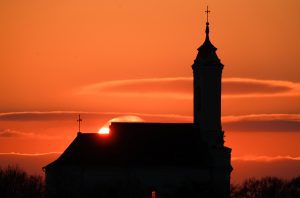
A Catholic church is silhouetted during sunset in Zaslavl, Belarus, April 10, 2019. The Catholic Church in Belarus is suffering persecution from the regime of President Alexander Lukashenko with the state interfering traditional Corpus Christi processions and arresting priests. (OSV News photo/Vasily Fedosenko, Reuters)
Church leaders like Regina Lynch, executive director of Aid to the Church in Need pontifical charity, warn that “there are more cases, there are more countries where religious freedom doesn’t exist or … is being eaten away.”
Nigeria: Ground zero for Christian persecution
As the 2025 Jubilee Year drew to a close, nowhere was the crisis of Christian persecution more visible than in Nigeria, where militant Islamist groups and extremist herding militias continue to ravage Christian villages, abduct clergy and laity, and destroy homes and churches.
In the latest sign of Christian tragedy in the country, Father Emmanuel Ezema was abducted late on Dec. 2 from his residence in St. Peter’s Catholic Church in Rumi, in Kaduna State, the Diocese of Zaria said on Dec. 3, according to Reuters.
On Nov. 21, in one of the worst cases of kidnappings in the recent history of Africa’s most populous country, more than 300 children, along with their teachers, were taken at gunpoint from St. Mary’s Catholic School in Papiri, in central Nigeria. Fifty managed to escape and were reunited with their families, 100 more were released Dec. 8 and the remaining children were returned to their homes right before Christmas.
In the northeast – particularly dioceses such as Maiduguri – Christians live under constant threat from militants and violent herdsmen. As Bishop John Bogna Bakeni of Maiduguri put it, “Every day is a grace … because we never know what will happen in the next hour.”
On Oct. 31, President Donald Trump announced that the U.S. would again designate Nigeria a “country of particular concern” for religious freedom and threatened to suspend nonhumanitarian aid and take “action” if the Nigerian government did not act swiftly to protect Christians from extremist violence. The U.S. carried out a deadly strike in northwestern Nigeria Dec. 25, with President Trump stating the attack targeted Islamic State group terrorists who persecuted Christians in that nation.
The Trump Administration’s move put Nigeria in the spotlight of mainstream media reports – otherwise the atrocities have been mostly forgotten by global media companies.
“It’s difficult to get the secular media to to report on these situations,” ACN’s Lynch told OSV News. “Occasionally the BBC will say something, but it’s really a battle to be that voice there.”
She said she looks with hope to parliamentarians in the European Union, and members of the U.S. Congress – “people who are ready to listen, who do believe that there is persecution of Christians in some of these countries.” She said the job of organizations like ACN is to “to move them … to do something about this.”
“What’s really a big concern for us today is the growing jihadism in West Africa, in the Sahel region,” the official said, calling “atrocities” in Nigeria but also Burkina Faso “really, really horrible.”
Lynch underlined that in countries like Nigeria, “all people are being attacked, not just Christians, but anybody who does not accept this form of jihadism.”
The latest Intersociety advocacy group report revealed that an average of 32 Christians are killed in Nigeria every day. The report, published in August, indicates that as many as 7,000 Christians were massacred across the country in the first 220 days of 2025.
Amid this horror, faith persists. Surveys show that up to 94% of Nigerian Catholics claim to attend Mass weekly or daily.
Syria and Gaza
Over the past months, Christians in Syria – along with other religious minorities – have faced a sharp increase in targeted violence, insecurity and displacement. A brutal reminder came on June 22, when a suicide bomber attacked Mar Elias Church, a Greek Orthodox church in the Dweila neighborhood of Damascus, during Divine Liturgy.
At least 20 worshippers were killed and more than 60 injured. The attacker, reportedly linked to Islamic State group, opened fire before detonating his vest. According to witnesses, around 350 people were present inside the church at the time.
But that was not an isolated incident. In the southern district of Sweida – a region with substantial Christian and Druze populations – a wave of sectarian violence erupted in July 2025. Militias attacked Christian and Druze neighborhoods: in the village of Al-Sura, the Greek Melkite Church of St. Michael was burned down, while 38 Christian homes were also destroyed by fire, leaving many families homeless. As one displaced Christian recalled, “This community has lost everything.”
Religious-freedom advocates describe the security situation for Christians and other minorities as “disastrous.” According to ACN’s statistics, the Christian population in Syria has shrunk from roughly 2.1 million in 2011 (before the war) to about 540,000 today. The sense of vulnerability and fear among survivors and remaining Christians is deep.
Syrian Archbishop Jacques Mourad of Homs warned that the “church in Syria is dying,” lamenting that many believers feel they have no future in their homeland under the new Islamist-led government of Ahmed al-Sharaa.
Still, church leaders insist on the importance of Christians remaining in their ancestral lands. “These are the living stones. These are the roots. They carry the roots of our faith,” Lynch said.
Mentioning Gaza, where a 400-strong flock still shelters in the premises of Holy Family Catholic Parish and St. Porphyrios Orthodox Church, amid difficulties of winter and as a ceasefire was reached in October after two years of constant Israeli bombardment of the enclave, Lynch said, “They manage, but it’s not easy. … It’s terribly sad.”
Belarus
While the Nov. 20 release of two priests offers a rare glimmer of hope, for most Christians in Belarus the situation remains bleak – marked by harsh sentences, legal restrictions and suppression of independent religious life.
The release of Fathers Andrzej Juchniewicz and Henrykh Akalatovich came only after a visit in October by the papal envoy Claudio Gugerotti.
It was described as a “gesture of mercy,” interpreted as linked to high-level Vatican intervention. While it was a joy that the outspoken priests supporting freedom in Belarus have been freed, Szoszyn recalled, the most prominent group of political prisoners – many of them Catholics – is still behind bars.
Among them is Ales Bialiatski, winner of the 2022 Nobel Peace Prize. His supporters have urged Western church leaders to take up his cause four years after he was detained and jailed in Belarus on trumped-up charges.
Overall repression remains widespread as Catholics face sweeping legal and administrative restrictions, such as the 2023 religious-freedom law under which all parishes must re-register or risk liquidation; this law curbs missionary activity, religious education, minority-language worship and monastic life.
Dozens of clergy – Catholic, Orthodox, and Protestant – have been arrested on vague charges ranging from “extremist material” or “subversive activity” to treason and espionage. Political prisoners arrests occurred after the rigged 2020 and 2022 elections and the subsequent crackdown on civil society and dissent.
Prominent lay Catholics are also targeted. Andrzej Poczobut – a journalist and member of Belarus’s Polish minority – remains imprisoned since 2021. In December 2025, the European Parliament awarded him the Sakharov Prize for Freedom of Thought, making him a “symbol of the struggle for freedom and democracy” in Belarus.
From India to Nicaragua, religious freedom shrinks
In 2025, religious oppression in India has also taken damaging forms. In one high-profile case, two Catholic nuns from Kerala, Sisters Vandana Francis and Preeti Mary, along with an Indigenous youth, were arrested in Chhattisgarh on charges of “human trafficking and forced religious conversion.”
Their detention sparked outrage, with religious leaders and civil-society figures calling the charges “unlawful,” and demanding their immediate release.
A special court granted them conditional bail in August 2025 – but the case remains a stark reminder how legal and administrative tools can be used to harass Christians, stigmatize their humanitarian work, and suppress minority faiths.
In a scathing editorial on Aug. 3, Deepika, a Malayalam daily published by the Catholic bishops in India’s Kerala state, slammed the growing Hindu fundamentalism in the country under the patronage of governments in different states, reminding that Hindu fundamentalism had gained a presence in the country and was suppressing the voices of minorities, especially Christians.
Persecution against Christians has steadily increased since 2014 when Prime Minister Narendra Modi came to power, according to the United Christian Forum, based in New Delhi, the nation’s capital.
Some of the patterns in persecution have changed dramatically. “It’s become, in some countries, more sophisticated,” Lynch said, citing India and China and coordinated extremist networks.
On the other side of the world, in Central America, the situation for Christians is also catastrophic – though less visible. In Nicaragua, a systematic crackdown on religious institutions has unfolded under the authoritarian regime of Daniel Ortega and Rosario Murillo.
Over the past years, more than 200 clergy and religious leaders have been detained, expelled or forced into exile. Churches and charitable organizations have had their legal status revoked, properties seized and worship restricted severely.
Although reported attacks in 2025 dropped to just around 3 dozen compared to 321 in 2023 – experts warn that this “decline” masks a deeper reality: the church has been decimated. Many clergy no longer dare report harassment or violence.
Religious freedom report alarming
A 1,200-page Religious Freedom Report, published by ACN Oct. 21, is drawing urgent warnings from Catholic aid officials who say persecution is expanding across continents and deepening in severity.
“There are more cases, there are more countries where religious freedom doesn’t exist or is being eaten away and is less than was before,” Lynch said.
She emphasized ACN is sending humanitarian and logistical help as needed but “prayer is something that those persecuted communities appreciate most.”
Traveling the world, “I’ve heard to myself how much it means to the local Christian population to know that there are Christians elsewhere in the world praying for them,” she said.
Advocacy is another pillar. “Being a voice for the voiceless is a very important aspect,” Lynch said.
At the same time, rising secularism in the West is making raising awareness more difficult. “With the secularization that we have in our so-called Western countries today, it’s not always easy to … raise the awareness that … Christians are being killed.”
Yet those experiencing persecution firsthand offer a sharp contrast in conviction. One man falsely accused of blasphemy in Pakistan refused to renounce his faith despite torture. Lynch recalled: “He looked at a crucifix on the wall behind me and said: ‘But he suffered so much more than I did.'”
Social
(OSV News) – In his papal bull proclaiming the Jubilee Year, the late Pope Francis emphasized the theme of hope, a much-needed virtue in a time of uncertainty, war, and tribulation.
Yet in “Spes Non Confundit” (“Hope Does Not Disappoint”), the pope unknowingly described what many Catholics would feel in the year to come.
“Everyone knows what it is to hope. In the heart of each person, hope dwells as the desire and expectation of good things to come, despite our not knowing what the future may bring,” he wrote.
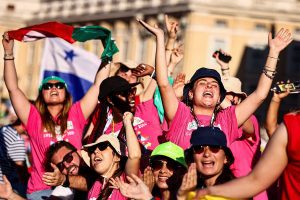
Young Catholics celebrate ahead of the welcome Mass of the Jubilee of Youth in St. Peter’s Square at the Vatican July 29, 2025. (OSV News photo/Yara Nardi, Reuters)
In 2024, the pope’s health was already a cause for concern due to a persistent flu at the beginning of the year, as well as limited mobility that required the use of a cane and a wheelchair.
While the intense monthly schedule of Jubilee events was worrisome, there was still the hope that the ailing pontiff would be able to participate.
However, those hopes were dashed once his health took a turn for the worse in February, and on April 21, just one day after delivering what would be his final Easter Sunday “urbi et orbi” blessing, Pope Francis died.
For Archbishop Rino Fisichella, organizer of the Jubilee 2025 events and pro-prefect of the Dicastery for Evangelization, the pope’s death “created a silence that was felt in the streets of Rome and the world, as well as in every Christian community.”
In an interview via email Dec. 3, Archbishop Fisichella told OSV News that it was in those days of mourning that “the motto of the Jubilee took on a different light.”
“The faithful understood that Christian hope is not a sentiment, but a promise. I saw people crossing the Holy Door with tears in their eyes and yet with a new inner strength,” he said.
“One cannot forget that hope strongly recalls eternal life, a promise that was realized in the resurrection of Jesus Christ,” Archbishop Fisichella added. “An everlasting life is the true announcement of the Christian faith and of this Jubilee.”
Interregnum
Despite his ill health, Pope Francis’ death still came as a shock to many and triggered a series of events that occurred only once in the Catholic Church’s history.
The last time the death of a pope and the election of his successor occurred in a Jubilee Year was in 1700 with the death of Pope Innocent XII and the election of Pope Clement XI.
Aside from the uncertainty regarding who would be the next leader of the Catholic Church, Archbishop Fisichella acknowledged that it “was useless to deny” that the interregnum period caused “a certain objective difficulty.”
Alessandro Gisotti, deputy editorial director of Vatican Media, told OSV News Nov. 11 that the Jubilee faced challenges even before the pope’s death.
“Unfortunately, practically from the beginning of this Jubilee, Pope Francis was limited by illness, then hospitalization, and finally his death. He was only able to experience the importance and intensity of this Jubilee to a certain point,” Gisotti said.
“When the pope was at Gemelli Hospital, the Jubilee continued, but without the pope, it was naturally more subdued,” he added.
Nevertheless, Archbishop Fisichella said, “the machine did not stop.”
For both Archbishop Fisichella and Gisotti, the death of Pope Francis and the conclave and election of Pope Leo XIV did not stop the Jubilee but instead redefined it.
“The death of Francis and the election of Leo had, in a way, restarted the Jubilee in terms of attendance,” Gisotti noted.
“The cardinals supported me immediately and wanted the Jubilee to continue with its manifestations. Continuity was guaranteed by the very nature of the Jubilee, which does not belong to a pontiff, but to the church and to the people of God,” Archbishop Fisichella told OSV News.
Despite the demanding schedule, the archbishop added, “Pope Leo XIV accepted the calendar without fear and, from the beginning, chose to maintain the programmed Jubilee commitments.”
“This allowed for stability and offered a true continuity that is evident to all, given the incredible numbers of pilgrims,” he added.
This was most evident at the Jubilee of Youth in Rome, which drew an estimated 1 million young people from around the world
The Jubilee of Youth
Like many young Catholics, Joey Pfeiffer, a 17-year-old from Miami, was at a crucial point in his life and trying to discover his own sense of faith.
“I’ve always grown up in the Catholic faith,” he told OSV News Dec. 1. “But I’m a very factual guy, and I hadn’t really found any proof that God existed.
For Pfeiffer, attending the Jubilee of Youth, meeting with Catholics his age, and witnessing their joy despite facing similar doubts, helped him build “a foundation in my faith.”
“I saw all these people so filled with spirit and so alive about these different experiences that they’re going through,” he told OSV News. “And I feel like it helped me create a sense of security, knowing that God was there because I saw it in these different people.”
The Jubilee of Youth wasn’t just an occasion to connect with faith that was exclusive to young people. It also offered a chance for those who led those groups to pass on the joy of those days they had received in the past.
“Looking back at the graces received in the Jubilee 2000, we experienced joy, gratitude and mercy. We knew that we wanted to be a part of transmitting it to the next generation,” said Elias Rosado from New Jersey, who, along with his wife, Jessica, led a group of 170 young people from the Neocatechumenal Way to Rome for the event.
Speaking to OSV News Nov. 30, Rosado said the Jubilee helped him and his wife rediscover that “we are not alone on our true pilgrimage, which is our life.”
“We experienced that God provided an answer to our suffering today, and in our marriage. Facing infertility, we experienced joy and consolation in this suffering to see how the Lord can use our suffering and make it glorious; that our suffering has meaning,” Rosado told OSV News.
Both Pfeiffer’s and Rosado’s experiences of the pilgrimage echoed what Archbishop Fisichella witnessed during the many Jubilee year events, where “pilgrims did not limit themselves to venerating the places of faith, but wanted to touch the living flesh of the Gospel.”
The Vatican official noted that the Jubilee Year initiatives linked to the corporal works of mercy “have shown a church that does not fear translating theology into concrete gestures.”
“The signs of hope are precisely these: those that translate our faith into life daily. The signs become innumerable because they are the fruit of the centrality of faith,” he told OSV News.
A door opened, a door closed
In December 2024, Pope Francis opened the Holy Door in St. Peter’s, marking the beginning of the Jubilee. The task of closing that door now falls to his successor, Pope Leo XIV.
Gisotti told OSV News that Pope Leo is continuing “that spirit of hope desired by Pope Francis” and that his experience as a missionary “capable of speaking to everyone” brings “an extraordinary international dimension to his papacy.”
For Archbishop Fisichella, the fact that Pope Francis would not be the one to end the Jubilee of Hope is one of “profound symbolic value.”
“Let this unfinished gesture become an invitation for every believer: The mission of the church never closes,” he said.
The message he believes Pope Leo will give at the closing of the Jubilee Year will entrust the faithful with bringing “hope, peace and communion into their own homes.”
“Crossing the Holy Door means assuming the responsibility to bring hope where it is missing,” he said.
Archbishop Fisichella told OSV News that the Holy Year brought the “dimension of the pilgrimage back to the center” and that among the fruits of the Jubilee that “will accompany the church in the coming decade” is the “rediscovery of personal responsibility in the faith that is strengthened by hope.”
“The ‘Pilgrims of Hope’ return to their dioceses with a stronger sense of belonging and, above all, with the awareness that daily witness is the first place of evangelization,” he said.
Social
(OSV News) – As Pope Leo XIV wrapped up his first apostolic visit to Turkey and Lebanon, he gave a hint on his flight back to Rome as to which other countries he might visit in 2026.
Speaking to journalists aboard the papal flight Dec. 2, the pope was asked by Argentine journalist Elisabetta Pique about his travel plans for the coming year.
“As for trips, nothing is certain yet. I hope to make a trip to Africa. That would possibly be the next trip,” he said. “Personally, I hope to go to Algeria to visit the places from the life of St. Augustine, but also to continue the dialogue, building bridges between the Christian world and the Muslim world.”
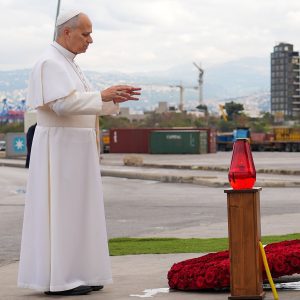
Pope Leo XIV prays at a memorial marking the site of a deadly explosion in 2020 at the port in Beirut Dec. 2, 2025. (CNS photo/Lola Gomez)
He also said that he was “working on some other countries,” including several in Latin America.
“Obviously, I would love to visit Latin America; Argentina and Uruguay are waiting for the pope’s visit. Peru, I think they will receive me, too! And then, if I go to Peru, (I could visit) many neighboring countries as well. But the plan is not yet defined,” he said.
The pope’s response echoed similar sentiments when asked the same question by journalists gathered outside the papal residence in Castel Gandolfo Nov. 18, noting that “next year we’ll start planning bit by bit.”
While several possible destinations were mentioned – including the Marian sites of Fatima and Guadalupe – the pope acknowledged that although he would be happy to travel, “the problem is scheduling with all the commitments” already in place.
Unlike his predecessor, Pope Francis, who, before his election, was considered more of a “homebody” and rarely traveled unless for official church business or an event, then-Cardinal Robert Francis Prevost could be described as a seasoned traveler.
In his role as a missionary and prior general of the Augustinian order, the future pope traveled extensively, particularly in Africa and Asia.
Drawing on his history, his words about future trips, and a healthy dose of speculation, it’s possible to get a sense of where Pope Leo intends to visit in 2026.
The ‘papal debt’
The opening of the Holy Doors in December 2024 marked the start of an intense period with major events for various groups each month.
While he was in frail health, Pope Francis dying just a day after delivering his “urbi et orbi” blessing on Easter Sunday, April 20, came as a shock to everyone.
After his election, Pope Leo hit the ground running; not only did he have to dedicate time to learning the ins and outs of the labyrinth that is the Roman Curia, but he also inherited an intense schedule of events and meetings that expected the presence of the Roman pontiff.
Among these “papal debts,” outside of the arduous Jubilee events, was his trip to Turkey to mark the 1,700th anniversary of the First Council of Nicaea. Pope Francis had accepted an invitation by Orthodox Patriarch Bartholomew I to make a joint pilgrimage to mark the occasion.
The added stop to Lebanon was the fulfillment of Pope Francis’ long-held desire to visit the country, which has faced political and economic instability, and most recently, military strikes from Israel in its campaign to strike at Hamas and its allies.
But beyond Turkey and Lebanon, Pope Leo mentioned to journalists two other countries that would fall under the “papal debts” category: Argentina and Uruguay.
In 2021, as COVID-19 restrictions slowly lifted, Pope Francis met with Guzman Carriquiry, who, before being named Uruguay’s ambassador to the Holy See, had served in various offices since the pontificate of St. Paul VI.
During that meeting to present his credentials, Carriquiry said Pope Francis confirmed that a visit to Uruguay and Argentina was still on track.
“In no way is it out of the question!” the late pope said, according to Carriquiry. “I have the desire and the intention to travel to Rio de la Plata — to Uruguay, and to my country.”
A visit to both countries, especially Argentina, by Pope Leo would certainly satisfy that debt. Pope Francis, much to the dismay of his compatriots, never had the chance to visit his homeland as pope, unlike his predecessors, who did so within the first year of their pontificates.
Two homes, one possible homecoming
Though born in Chicago, Pope Leo has made no secret of the fact that a different “Chi-town” holds a special place in his heart, after greeting his “beloved Diocese of Chiclayo” in his first address after his election.
That affection is definitely reciprocated in Chiclayo, where he served as bishop from 2015 to 2023, and in Peru, which considers the pope as one of its own.
When asked at Castel Gandolfo about visiting Latin America in 2026, Pope Leo said that while Uruguay and Argentina were pending, he would like to “go to Peru, of course.”
While both sides desire a visit, Peru’s ongoing political instability and the upcoming April elections make a visit unlikely, at least in the first half of 2026.
It is standard procedure for Roman pontiffs to avoid papal visits to countries during election periods or where their presence might be used for political advantage.
Aboard the papal flight, the pope said the Vatican was “looking into” whether a possible trip to Peru and neighboring countries would happen in 2026 or 2027.
And while the next U.S. presidential election won’t be held until 2028, it doesn’t seem likely that a visit to his homeland will happen in the immediate future, given the growing divide between the Trump administration and Pope Leo over his criticism of U.S. policies targeting migrants.
Possible return to familiar territory
Aside from fulfilling commitments made by his predecessor, what can be gleaned from the pope’s words is that his first visits will be to places with which he has had personal connections, with Africa at the top of the list.
Both in his capacity as prior general of the Augustinian order and as prefect of the Dicastery for Bishops, the pope had visited Tanzania, Kenya, Congo, and especially Nigeria, which he visited nine times.
A 10th visit to Nigeria, this time as pope, would give a much-needed shot in the arm for Christians, who have increasingly become targeted for attacks and kidnappings in the country.
Algeria could be another stop, and Pope Leo made clear aboard the flight from Lebanon that his purpose in visiting the country would be to foster dialogue between Christians and Muslims.
“It is interesting: the figure of St. Augustine helps greatly as a bridge because, in Algeria, he is highly respected as a native son,” he said.
Whether it’s due to a personal connection or a significant event, for Pope Leo, what ultimately determines his future travel plans is where he can best fulfill his duty as pontiff.
In his interview with Crux’s Vatican correspondent Elise Ann Allen, the pope said he was called “to confirm others in their faith because that is the fundamental role of the successor of Peter.”
“I don’t see my main role as trying to be the problem-solver of the world,” he said. “My role is to announce the Good News, to preach the Gospel.”