EAST STROUDSBURG – Notre Dame Elementary School marked a memorable Catholic Schools Week 2025 with a powerful display of generosity.
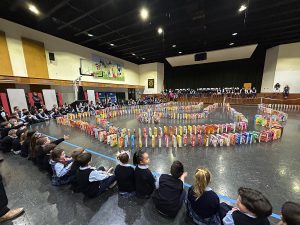
Throughout the week, students, families, and teachers collected hundreds of cereal boxes, which were meticulously organized into an impressive domino display inside the school gymnasium.
“We feel that it is an exciting, fun thing for the kids to do, as well as teaching them about giving to other people, and taking care of the needy,” principal Sister Dorothy Kibler, I.H.M., explained.
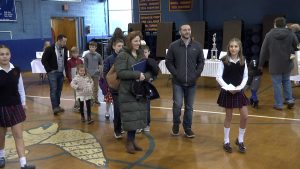
On Jan. 30, the entire school gathered to watch – and loudly cheer – as the boxes toppled over onto one another in a grand spectacle.
Hundreds of cereal boxes donated by students from Notre Dame Elementary School are lined up in a domino display inside the school gym on Jan. 30, 2025. (Photo/Dan Piazza)
“I love it. It’s probably the best week so far,” sixth grader Anastazja Nowak said.
All the cereal boxes used in the domino chain were donated to the food pantry at Saint Matthew Parish, where they will help feed people in need. The event was part of Notre Dame Elementary’s ongoing efforts to foster a sense of community service in their students.
“I try to give back as much as I can to my community, be as nice as I can, the best person I really can be,” sixth grader Arthur Gonzales explained.
When she heard students preparing for the big event on their weekly podcast – using the word ‘domino’ very intentionally – she began thinking about how important Catholic education can be in creating a ‘domino’ effect of serving others in the spirit of Christ.
“Our Catholic education will hopefully have a domino effect in our world, a domino effect on how we treat our friends, how we are with our families, and how we go out into our world,” the long-time educator and principal explained.
Founded on strong Catholic values, Notre Dame Elementary has long been known for its dedication to student success and academic excellence. The school prides itself on its nurturing environment, where each child’s intellectual, emotional, and spiritual needs are met.
“It really prepares them for everything,” parent Jessica Corcoran stated.
“They use a very student-centered teaching style, and they provide individualized instruction,” parent Peng Zhang added. “They use all sorts of activities to train the students and educate them and make sure that they develop good behaviors … most importantly, they teach love.”
Social
SCRANTON – Dressed in colorful costumes and proudly pulling carefully created floats, the youngest students at All Saints Academy took center stage during a special event to mark Catholic Schools Week 2025.
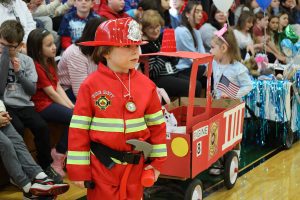
On Jan. 29, pre-K and kindergarten students at the Scranton-based elementary school paraded around their gym, participating in a ‘furry friends’ parade.
“Pre-school and kindergarten students had the opportunity to build a float for one of their stuffed animals, their furry friends,” principal Brittany Haynos-Krupski explained. “You saw Ghostbuster floats, birthday floats, you saw Irish step dancing floats, Mario, every possibility.”
In addition to the floats, many of the students dressed up to match the theme of their float – filling the gym with little firefighters, princesses, and many other characters.
Kindergarten and pre-K students from All Saints Academy in Scranton participate in the ‘furry friends’ parade as part of Catholic Schools Week 2025. (Photo/Dan Gallagher)
“I heard so many parents and teachers say it was such a great morning, just to see the excitement in the students’ eyes was priceless,” Haynos-Krupski said.
The event captured the essence of Catholic schools as more than just places of learning, but as close-knit families where every student, no matter their age, is celebrated.
The rest of the student body filled the gymnasium bleachers and loudly cheered as each student and float took their turn in the spotlight.
“When you walk into our building, you feel that sense of family. I have heard from parents, I’ve heard it from people touring our school, I’ve heard faculty and staff. It is that idea of community,” Haynos-Krupski added.
All Saints Academy administrators decided to bring back the ‘furry friends’ parade during Catholic Schools Week this year for the first time since 2020.
Teachers say the event – and all the activities held during Catholic Schools Week 2025 – celebrate the heart of what Catholic schools are all about.
“In a Catholic school, you have the opportunity to teach a child’s spirit as well as their academics,” Amanda Valletta said. “We teach the students to grow in their faith, to become leaders, and that helps them in the real world when they graduate.”
As the parade wrapped up, many of the pre-K and kindergarten students were beaming with pride as their parents and grandparents snapped pictures on their cell phones. For many, it will be a day they remember, and a reminder of the deep sense of love and support that makes All Saints Academy a true family.
Social
MOUNTAIN TOP – During Catholic Schools Week 2025, eighth grade students at Saint Jude School created memories that will last a lifetime.
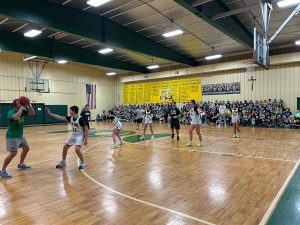
Among the week’s most anticipated events was the spirited and fun-filled pep rally where eighth grade students face off in a basketball game against their coaches – a tradition that has become a favorite for the whole school.
“It is so much fun. I love Catholic Schools Week because as an eighth grader we get to do all the fun stuff,” student Leah Smith said.
Eighth grade students from Saint Jude School in Mountain Top face off in a basketball game against their coaches as part of a pep rally for Catholic Schools Week 2025. (Photo/Dan Piazza)
Catholic Schools Week is a time for students, faculty, and families to come together to celebrate the values and educational opportunities that Catholic schools provide.
At Saint Jude School, administrators stress it is not just about academics, but also about building strong relationships and a sense of community. The pep rally and basketball game, which are held in the school gym, perfectly highlighted that philosophy.
“We had all our students here in the stands cheering and we had our cheerleaders come out to do their routines. It made for a fun day,” parent Frank Carone said.
Carone is the father of two students at Saint Jude School. He says the competitive basketball match is all about school spirit, camaraderie, and the bond between students, staff, and parents.
“The atmosphere in this gym was just incredible. Kids cheering and yelling, cheering for the eighth graders against the dads, it makes for such a great time, a great atmosphere,” he added.
Sister Ellen Fischer, principal, says the pep rally is something the kids look forward to every year. She agrees it is much more than just a game – it’s a celebration of the Saint Jude School family – emphasizing the significant role that parents play in their children’s education.
“It gives us a chance to focus on the great things that are happening here at Saint Jude School and it’s time for our children to enjoy the week,” Sister Ellen stated.
Saint Jude School’s commitment to creating a family-like atmosphere is evident in everything they do, especially during events like the pep rally. Throughout the entirety of Catholic Schools Week, the Luzerne County-based school held many other activities to celebrate the school’s values of faith, knowledge, and community, all of which were focused on togetherness.
Students, teachers, staff, and families all shared in the fun, creating lasting bonds and reinforcing the importance of supporting one another, both in and out of the classroom.
“We are a family, from before school starts to after school is over, and every minute in between,” teacher and parent Carrie Grandzol said.
Being able to celebrate each other’s accomplishments is what sets Saint Jude School apart.
“You see this in how our teachers and our administration react to our students and you see how our students react to one another as well,” Grandzol added.
Social
CLARKS GREEN – Our Lady of Peace School launched Catholic Schools Week 2025 with excitement and energy, hosting an open house on the first day of the annual celebration.
The open house gave prospective students and their families a chance to explore the school, meet its dedicated teachers, and learn more about the diverse programs that set the school apart – everything from faith-based education to hands-on STREAM experiences.
The open house is special because of the unique role that the school’s 7th and 8th grade students get to play. The student ambassadors got to lead prospective families on tours, offering a firsthand look at what makes Our Lady of Peace School so special.
Eloise Giroux, student council president for Our Lady of Peace School in Clarks Green, helps to lead prospective families on tours during an open house held as part of Catholic Schools Week. (Photo/Dan Piazza)
“It is so much fun,” eighth grader Eloise Giroux said. “They get to meet the teachers, look at the curriculum … Our Lady of Peace is really a great school. It is such a family.”
Giroux has attended the Lackawanna County elementary school for the last eight years and is currently serving as student council president.
“We have so many fun programs, basketball, cheerleading, OLP Players, the theater program,” she explained. “It’s really a great school academically, spiritually, and socially. You learn so many things.”
Leah Steinberg, another eighth-grade student, also served as a student ambassador. She transferred to Our Lady of Peace School in seventh grade, and said the school quickly helped her grow more confident in her faith.
“It is the foundation to our education. I always believe in putting God first and trying to glorify him in anything I can do,” Steinberg said. “It is amazing that I had the opportunity to come here to learn so much about my faith and more about academics.”
Ann D’Arienzo, who has served as principal at Our Lady of Peace School for the last seven years, says students not only practice their faith by praying together, celebrating Mass regularly and having religion classes – but points to service projects that help to build student character and a desire to give back.
“We start as early as pre-school to explain to our students, and to model for our children, how important it is to give back to our community,” the long-time educator said. “Whether it is through coat drives, pajama drives, we put together toiletry kids for those that have been displaced due to weather disasters, they are able to recognize how fortunate they are.”
Members of the ‘Falcon Family Alliance,’ the parent organization that helps to plan activities at the school, were also on hand for the open house.
The group’s co-chair, Mary Ann Morgan, said the open house isn’t just a chance to “show off” to the community, but is important for members of the school community to feel pride in everything they have accomplished.
“I hope parents can feel the school is alive. It’s growing and we’re a community that works together to support each other,” Morgan said.
Social
(OSV News) – President Donald Trump has signed an executive order that aims to expand access to in vitro fertilization, or IVF, a practice the Catholic Church warns is enormously destructive to embryonic human life.
A form of artificial reproductive technology, IVF unites a woman’s eggs and a man’s sperm outside of their respective bodies in a laboratory setting, with one or more embryonic children selected for implantation in the woman’s uterus, and the remaining embryonic children either destroyed or frozen indefinitely.
Trump’s Feb. 18 executive order “directs policy recommendations to protect IVF access and aggressively reduce out-of-pocket and health plan costs for such treatments,” according to a statement issued that same day by the White House.
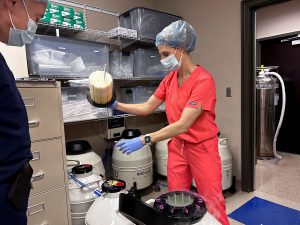
Dr. Andrew Harper, medical director for Huntsville Reproductive Medicine, P.C., looks on as Lynn Curry, nurse practitioner for Huntsville Reproductive Medicine, P.C., opens IVF cryopreservation dewar in Madison, Ala., March 4, 2024. U.S. President Donald Trump signed an executive order Feb. 19, 2025, to develop policy recommendations to expand access to and affordability of in vitro fertilization. (OSV News photo/Roselle Chen, Reuters)
Costs for IVF, which are “often not fully covered by health insurance,” can range “from $12,000 to $25,000 per cycle” and “multiple cycles may be needed to get pregnant,” said the White House in its statement.
The executive order delivers on “promises for American families” made by Trump, while seeking to address declining fertility rates in the U.S., said the White House.
That drop is part of a global downturn in fertility rates, with 2024 rates at 2.2 births per woman, down from approximately 5 in the 1960s and 3.3 in 1990, according to the United Nations’ World Fertility Report 2024.
The White House statement quoted Trump as saying, “We want more babies, to put it very nicely.”
However pro-family demographers put cold water on an IVF policy leading to a baby boom when Trump floated the idea on the 2024 campaign trail.
Lyman Stone, senior fellow and director of the Pronatalism Initiative at the Institute for Family Studies told OSV News in September that people tend to delay fertility with more reproductive technology options.
“So you freeze your eggs when you’re 31, and you say, ‘Well, I don’t need to be in any particular rush, because at the end of the day, I’ve got all the time in the world,'” he said. But given some of the inherent difficulties in births to older mothers, that’s not always true, meaning “these two factors more or less cancel out.”
“So the net result is that there are no extra babies,” he said.
IVF treatments are opposed by the Catholic Church because they frequently involve the destruction of human embryos, in addition to other ethical and moral issues.
Out of more than 413,000 artificial reproductive technology cycles recorded in 2021, only 112,088 resulted in pregnancy. Of those, only 97,128 babies were successfully born, according to U.S. Centers for Disease Control and Prevention data.
Multiple embryos are typically created for use in an IVF cycle, so the number of human embryos currently created each year by IVF in the U.S. runs into the hundreds of thousands — with the majority typically lost through what fertility clinics on their websites explain as “IVF attrition.”
Bishop Michael F. Burbidge of Arlington, Virginia — who in November 2024 completed his three-year term as chair of the U.S. Conference of Catholic Bishops’ Committee on Pro-Life Activities — addressed IVF in his Jan. 22 pastoral letter, “The Christian Family, In Vitro Fertilization and Heroic Witness to True Love.”
Citing the Catechism of the Catholic Church, the Second Vatican Council, papal writings, Catholic bioethicists and journalistic coverage of the IVF industry, while also providing an array of pastoral resources for couples struggling with infertility, Bishop Burbidge warned that IVF poses both an “obvious” and “subtle” threat to human dignity.
He said those threats include the eugenic destruction of millions of embryonic children, the unraveling of the integral bond between childbearing and marital love, the erosion of a child’s right to natural parents, and dangers to health, safety and religious liberty.
In a Feb. 19 statement, Bishop Burbidge described Trump’s executive order as a “disappointing and unnecessary action” that is “incompatible with the president’s evident support for the good of human life and his desire to encourage family formation.”
The order is “likely to unjustly promote IVF in a way that will result in the abandonment or death of millions of embryonic human persons,” said Bishop Burbidge in his statement.
In addition, the expansion of IVF access stands to “involve all taxpayers with a serious moral injustice, provide federal subsidies for already lucrative IVF businesses, and ignore the risks to parents and children of America’s broadly unregulated IVF industry,” he said.
Some pro-life advocacy leaders have begun speaking out against Trump’s IVF executive order. Live Action president Lila Rose, a Catholic, called the proposal “heartbreaking” and said “IVF is NOT pro-life” in social media postings Feb. 18.
“IVF turns children into a product to be created, sold, and discarded — violating their basic human rights,” she said.
Social
NAIROBI, Kenya (OSV News) – As the United States paused foreign assistance to countries across the world, confusion, panic and desperation has gripped many organizations that benefit from the funds, including church-based groups.
Be it clinics for antiretroviral treatment, rural community water projects or even remote or city slum schools feeding programs, Catholic organizations were direct or indirect beneficiaries of the support delivered through the U.S. Agency for International Development.
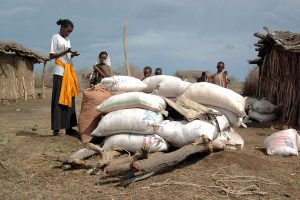
A file photo shows a family counting food aid sacks donated by USAID at their compound in Goraye, Ethiopia. As the United States paused foreign assistance to countries across the world in January 2025, confusion, panic and desperation has gripped many organizations that benefit from the funds, including church-based groups. (OSV News photo/Andrew Heavens, Reuters)
“It is devastating on all levels, from the church to the community,” Gabriel Njiru, director of Caritas in the Diocese of Garissa in Kenya, told OSV News. “The stop order came without any notice and we could not continue the work with the communities.”
Njiru had to stop midway a small water project the agency was implementing in the northeastern Kenyan diocese. The project aimed at giving the communities water for domestic use as well as enabling them to run a small irrigation scheme.
“The people on the ground had to pack and go home,” he said.
Africa was to date the largest regional recipient of the U.S aid each year, administered through the State Department and the USAID. In the past decade, it has averaged around $8 billion annually. In 2023, the U.S. provided as much as $15.7 billion, with three quarters channeled through USAID. The agency provided assistance to 130 countries in 2023, with five out of the 10 biggest recipients in the world being in Africa: Ethiopia, Congo, South Sudan, Somalia and Nigeria.
USAID in Africa supported projects in a multitude of areas, including health, education, economic growth, human rights and democracy, with HIV/AIDS assistance being the largest in the non-humanitarian aid category.
Many programs in these areas largely remain disrupted, but local humanitarian aid experts say the situation in the HIV/AIDS programs area is desperate.
The 90-day pause in aid delivery for spending review initially included the President’s Emergency Plan for AIDS Relief, or PEPFAR, although the government later allowed a limited waiver for life-saving HIV treatment services. According to Doctors Without Borders, “PEPFAR support has helped save more than 25 million lives and encouraged the fight against HIV to be a truly global one” — with the majority of beneficiaries in Africa.
Still, things are far from normal for the organizations whose work with HIV/AIDS held hope for completely erasing the disease from the face of the earth. Officials in church-based humanitarian organizations are not making demands, they say, but asking for dialogue and discussions with the Trump administration so that the changes are carried out in a “humane way,” with everything from salaries, work spaces and supplies uncertain at the moment.
“The feeling expressed is that of alarm, confusion, feeling stuck, panic and desperation,” said Pascalia Sergon, the development and programs officer at the African Jesuit AIDS Network, or AJAN.
The network – through 21 centers in 17 countries in Africa – coordinates the efforts of the Society of Jesus in the fight against HIV/AIDS.
A few of the Jesuits centers receive the funding directly from the U.S. government, according to Sergon, but the majority collaborate with the U.S agency-funded organizations in a dynamic network of services that enables the beneficiaries to receive combined services.
“The new policy on funding has broken the cycle where these organizations or government institutions were fully funded by USAID,” said Sergon. “The big concern is where will all these people go. Where will AJAN refer them to? Where will other services be procured from?”
Alphas Okeyo Otieno, an official at the Oyugis Integrated Project, an HIV/AIDS outreach in Western Kenya, said they were already feeling the impact of the halt of aid. Brothers from the Congregation of Our Lady Mother of Mercy have been running the project since 2002.
Oyugis project, named after the town its based in, provides adults and children infected or affected through family members by HIV/AIDS with drugs, and nutritional support. The project currently supports 2,800 people.
“We were fully dependent on the U.S funding for the drugs and payment of personnel. If the suspension continues, it will be difficult for us since we cannot afford the drugs,” Otieno told OSV.
According to Father David Osaka, the priest in charge of family life in the Kenyan Archdiocese of Kisumu, the U.S funds were being used to pay support for staff working with people living with HIV.
“I don’t think the government will be able to cope,” he said “If drugs are not available, there will be deaths. These are people struggling to put food on the table. They cannot also take the drugs on an empty stomach.”
Immediate results of the pause, according to the Jesuits’ network, include broken health systems, leading to the suspension of mobile medical clinics and grounding of community health workers. Soon, the organization fears, there will be no supplies of medicine, with hospitals labs running out of stock and communities receiving incomplete services because the majority of the intervening partners are closed.
The network fears long-term effects such as more cases of deaths due to lack of antiretroviral drugs, increase of infections across the generations, more AIDS orphans, and a spike in poverty.
Meanwhile, officials say while they cannot stop the U.S from signing more policies affecting foreign aid, they cannot allow the work with the needy communities to sink.
“This can be an opportunity to work against corruption in our institutions and countries, so that we direct resources to important sectors like health,” Sergon said.
Social
VATICAN CITY (CNS) – Artists and cultural figures must be “custodians of the beatitudes,” embracing their vocation to create beauty, reveal truth and inspire hope in a troubled world, Pope Francis wrote to people participating in the Jubilee for Artists and the World of Culture.
“Art is not a luxury, but a necessity of the spirit. It is not an escape, but a responsibility, an invitation to action, a call, a cry,” said the homily Pope Francis prepared for the Jubilee Mass Feb. 16 in St. Peter’s Basilica.
Cardinal José Tolentino de Mendonça, prefect of the Dicastery for Culture and Education, celebrated the Mass with artists from more than 100 countries and read the pope’s homily during the liturgy.
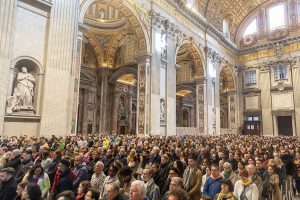
People attend Mass in St. Peter’s Basilica for the Jubilee of Artists and the World of Culture at the Vatican Feb. 16, 2025. (CNS photo/Pablo Esparza)
“To instruct in beauty is to instruct in hope, and hope is never separated from the drama of existence – it crosses the daily struggle, the fatigue of living, the challenges of our time,” the homily said.
Pope Francis was unable to attend the Mass because he was hospitalized for treatment of a respiratory tract infection. He had also missed the audience he planned with artists and other Jubilee pilgrims Feb. 15.
In a message for the midday Angelus, released by the Vatican after the Mass, Pope Francis wrote that art is “a universal language that spreads beauty and unites peoples, contributing to bringing harmony into the world and silencing every cry of war.”
At the beginning of the Jubilee Mass, Cardinal Tolentino de Mendonça blessed artists and cultural leaders, calling them “cultural prophets” and “drivers of peace” and praying for their vocations.
Reflecting on the beatitudes from the day’s Gospel account from St. Luke, the pope’s prepared homily said that “artists and people of culture are called to be witnesses to the radical vision of the beatitudes,” emphasizing that their mission is to “give voice to the voiceless” and “transform pain into hope.”
At the heart of the beatitudes, he said, is a divine reversal of worldly expectations — where the poor, the meek, the persecuted and the suffering are the ones truly blessed. “Art is called to participate in this revolution,” he said, urging artists to “bow before the wounds of the world, listen to the cry of the poor, the suffering, the persecuted, refugees, and those imprisoned.”
Particularly in a time of deep social, economic and spiritual crises, Pope Francis wrote, artists play a crucial role in ensuring that humanity does not lose sight of the “horizon of hope.”
Yet that hope is not a “comfortable refuge” but “a fire that burns and illuminates like the word of God,” he said.
“For this reason,” the pope wrote, “authentic art is always an encounter with mystery – with a beauty that overtakes us, with a pain that interrogates us, with a truth that calls to us.”
Particularly at a time when “new walls are raised, in which differences become pretexts for division rather than opportunities for mutual enrichment,” cultural figures “are called to build bridges, to create spaces of encounter and dialogue, to illuminate minds and warm hearts,” he said.
Later that evening, after St. Peter’s Basilica was closed to the public, participants in the Jubilee were scheduled to cross through the basilica’s Holy Door and partake in a quiet, contemplative walkthrough of the basilica’s interior.
Presenting the Jubilee’s events at a press conference Feb. 12, Cardinal Tolentino de Mendonça explained how artists have a special relationship with the basilica as a place where faith, history and artistic genius converge in their highest form.
And in welcoming the artists into the basilica for Mass, he began his opening prayer with a reference to one of Pope Francis’ favorite artists, the 19th-century Russian author Fyodor Dostoevsky, who famously wrote: “Beauty will save the world.”
“The beauty that saves the world is manifested in Christ,” the cardinal said, praying that artists would embrace their vocation with courage, offering their challenges and uncertainties in service of the church and the world.
Social
(OSV News) – Catholics across the world are embarking on pilgrimages to commemorate the Jubilee Year of Hope.
Many will travel to Rome to visit the four major basilicas and pass through their Holy Doors so as to gain a plenary indulgence.
For those that are unable to travel to Rome, however, they are still able to participate by traveling to one of the numerous Jubilee Year pilgrimage sites across the country.
In the United States, bishops could designate churches, cathedrals, shrines, monasteries, or other religious locations as “jubilee pilgrimage sites.”
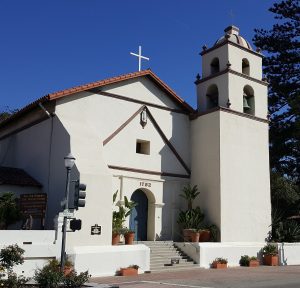
Mission San Buenaventura in Ventura, Calif., is seen in this undated photo. On July 15, 2020, Pope Francis elevated the mission church to the rank of minor basilica. (OSV News photo/Mike Nelson)
According to a Vatican decree on Jubilee Year indulgences, any person can gain a jubilee indulgence if they undertake a “pious pilgrimage” to any designated site and participate in Mass, adoration or receive the sacrament of penance there.
Across the country, basilicas, churches and shrines have begun opening their doors to local pilgrims.
These sites each have a unique history and hold significance in their local region, helping Catholics to encounter God in new ways.
In the densely populated East Coast, bishops have designated a multitude of jubilee sites located in dense cities and rural countryside.
Surrounded by dense forest, yet only a mere 50 miles away from New York City, sits Graymoor — the Holy Mountain.
Run by the Franciscan Friars of Atonement, Graymoor serves as a home for the friars and a retreat center. It also houses many ministries, such as St. Christopher’s Inn, a residential program for men battling drug addiction.
Cardinal Timothy M. Dolan of New York designated Graymoor as one of the eight jubilee pilgrimage sites in his archdiocese.
When Atonement Father Jim Gardiner, director of special projects, and the other friars learned about the designation, they were ecstatic.
“We’re grateful to be named a pilgrimage site because Cardinal Dolan could’ve named all kinds of other places,” Father Gardiner told OSV News. “We see it as a sign of support and encouragement, which is especially needed as these are tough times, since we, like many other places, have been struggling with vocations.”
In Father Gardiner’s own vocation story, a pilgrimage to Graymoor played a significant role. He said it launched his discernment journey.
“In 1948, I was in the first grade when I visited Graymoor,” Father Gardiner recalled. “It was so exciting. We had Mass outdoors and walked around the property. When we were preparing to leave, one of the friars stopped and asked me if I had a good day. I said yes, and he said, ‘I’m going to pray every day that you come back here.'”
“I have no idea who that friar was, but as a result of that pilgrimage, I’ve been here 60-plus years now,” he said.
While Father Gardiner does not know whether or not another pilgrim will find their vocation, he and the other friars are excited to welcome the busloads of pilgrims that are coming from the surrounding area.
“We want to be here for people and to host and support their pilgrimages,” Father Gardiner said. “We want people to take part in the liturgies we have here, to walk around our property and pray on the trails and just encounter the Lord here.”
To commemorate the Jubilee Year, Father Gardiner and other staff members have developed a variety of programs and events.
“We have great staff here that has been meeting regularly, coming up with all kinds of great ideas,” Father Gardiner said. “We have special Masses planned, special retreats; but really, we just have a great space that we want visitors to take part in.”
In the South, Sacred Heart Parish in downtown Tampa, Florida, is preparing to welcome a plethora of pilgrims.
Founded in the early 1850s, the parish became a cornerstone in the Tampa Bay area as the city grew around it.
“Sacred Heart was founded in the infancy of Tampa Bay as a city,” Rob Boelke, director of communications at Sacred Heart, told OSV News. “John Jackson, an Irish immigrant, and his wife, Ellen, arrived in the area as a surveyor. He surveyed the majority of our downtown and the older areas of the city itself, and those streets largely stand in the same grid that he had put together. Soon after arriving, he and his wife sent a petition to the Diocese of Savannah asking for a parish to be founded.”
In the 1850s, the area that now comprises the St. Petersburg Diocese was part of the Diocese of Savannah, Georgia.
Soon after the Jacksons’ request, a small wooden church was built, served by Jesuit missionaries. By the late 1800s, the parish had outgrown it and began constructing a new Romanesque-style church. Completed in 1905, the church remains today as a unique architectural fixture in Catholic Florida.
“Most of the churches in Florida were built in the ’60s and ’70s, and they are not architecturally significant,” Boelke said. “Sacred Heart has very unique architecture that is much more in line with churches that you would see across the Northeast or in the Midwest. It’s largely Romanesque with beautiful stained-glass windows so people are drawn to the parish for its beauty.”
In 2005, Franciscan friars assumed parish operations, promoting their unique charism within the parish and local community.
Sacred Heart is one of six Jubilee pilgrimage sites in the Diocese of St. Petersburg. Already, pilgrims are flocking to the church to commemorate both the Jubilee Year and the parish’s 120th anniversary.
“We are hosting lots of tours for both Catholic and secular schools; other parishes are calling us to set up times for large group visits,” Boelke said. “We have this unique history and we are excited to share and be able to share the Franciscan charism that we have with more people.”
Located in the Midwestern small town of Perryville, Missouri, the National Shrine of Our Lady of the Miraculous Medal is preparing to welcome pilgrims to its vast property for the Jubilee Year.
One of nine Jubilee sites in the Archdiocese of St. Louis, the national shrine has a robust history dating back to 1818, when a small log cabin church was founded on the property. The shrine encompasses 55 acres and includes a large church, a rosary walk and a grotto.
Run by Vincentian priests, Father Jim Osendorf, superior of the community, told OSV News that he hopes pilgrims will develop a deeper relationship with the Blessed Virgin Mary after visiting the site.
“Our facility is dedicated to the Blessed Mother and to commemorate the appearances of Mary to Catherine Labouré,” Father Osendorf said. “This just seems to be one of the perfect places to come just to kind of get away to pray, to meditate and to deepen our relationship with Mary, who leads us to Jesus.”
When the 2000 Jubilee Year took place, Father Osendorf’s predecessor asked the archbishop of St. Louis to designate the shrine as a pilgrimage site. So Father Osendorf did the same for the 2025 Jubilee.
“Jubilee years are focused on deepening one’s relationship with Christ, and Mary helps us to do that,” Father Osnedorf said. “As a community, we thought this would be the perfect way of helping us to fulfill our mission of helping people toward a deeper relationship with Jesus Christ through Mary.”
To commemorate the Holy Year, the community has planned various events throughout the year that include speakers, music and special liturgies.
“We have a number of guest speakers who will be coming and will have musicians regularly,” Father Osendorf said. “But really, we just want people to come and encounter God on our property. From my office, I can see people coming to pray, pray the rosary on our walk or sometimes just getting away to think, to ponder, to meditate. And it brings me so much joy to see this happening.”
Out in the West, historical shrines and churches are abundant, as they have been ministering to locals since Franciscan missionaries established them centuries ago.
One such church is Mission Basilica of San Buenaventura in California, which was founded in 1782. Since its founding, the basilica has played a critical role in the local community, Father Tom Elewaut, pastor of the mission, told OSV News.
“There are 21 original missions established by the Franciscan padres in what is now the state of California,” Father Elewaut explained. “The significance of our particular parish is that we were the last of the nine missions founded by St. Junipero Serra.”
The town of San Buenaventura, located 70 miles from Los Angeles, grew around the parish. The original church built in 1809 and refurbished in 1812 after an earthquake remains as the primary worship space.
“The church building that we have today was originally finished in 1809,” Father Elewaut said. “The artwork, the statues, the back altar — that is all original from 1809. Everything that was used to decorate the church had been shipped up from New Spain (today’s Mexico) … so there is a lot of history in the church.”
Father Elewaut is excited to welcome pilgrims from the surrounding area to the basilica. Everyday, pilgrims visit the historic church, and the priest uses these interactions and Sunday Mass as an opportunity to remind them to be pilgrims of hope.
“We are pilgrims of hope, and we certainly are including that message in our homilies weekly, and encouraging people to be hopeful in a world that sometimes wants to cast darkness; that we are to be people of hope in the light of Christ,” he said. “And not only for eternal life, but to be hope-filled in this life as well.”
Social
WASHINGTON (OSV News) – The U.S. bishops’ migration chair called recent comments by Vice President JD Vance about the church’s work with migrants “a tremendous mischaracterization” while speaking at an event in the nation’s capital Feb. 12. But he also invited Vance to sit down and talk with him to set the record straight.
Vance, who is Catholic, questioned the motives of the U.S. bishops’ criticism of Trump’s new immigration policies in a Jan. 26 interview — including reducing restrictions on raids on churches and schools and the suspension of a federal refugee resettlement program. He asked whether the bishops are actually concerned about receiving federal resettlement funding and “their bottom line.”
The U.S. Conference of Catholic Bishops responded by pointing to audited financial statements by an outside firm that show that the USCCB does not profit from the work they do with legally eligible refugees.
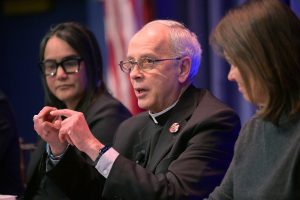
Bishop Mark J. Seitz of El Paso, Texas, speaks during a dialogue at Georgetown University in Washington Feb. 12, 2025, on “Migration, Refugee Resettlement, and Mass Deportation.” (OSV News photo/courtesy Georgetown University)
During remarks at a panel discussion hosted by the Initiative on Catholic Social Thought and Public Life at Georgetown University, Bishop Mark J. Seitz of El Paso, Texas, said, “The characterization of a bishop or a group of bishops as people who are more concerned about the bottom line … than to serve people is a tremendous mischaracterization.”
“He clearly does not know me,” Bishop Seitz said. “He does not know my heart.”
But Bishop Seitz added, “I would love to sit down sometime with Vice President Vance and talk to him about these issues in regard to our resettlement work and things like that because he clearly has been misinformed.”
“That is so unfortunate when it comes from a person who has a loud megaphone,” Bishop Seitz said. “It can be very harmful to this work of the church to very vulnerable people. So, it really is concerning.”
Bishop Seitz also thanked Pope Francis for a letter expressing his support for the U.S. bishops’ work with migrants and refugees amid what the pontiff called the current “major crisis” on immigration policies in the U.S.
“Pope Francis has once again come forward and spoken in a certain way on our behalf with an eloquence that few of us can,” Bishop Seitz said.
The Georgetown panel discussion, “Migration, Refugee Resettlement, and Mass Deportation: Moral, Human, and Policy Choices,” sought to examine recently implemented migration policy changes by the Trump administration, and to examine what the church teaches on the subject of migration.
In his letter to the U.S. bishops, Pope Francis acknowledged “the right of a nation to defend itself and keep communities safe from those who have committed violent or serious crimes while in the country or prior to arrival.” At the same time, the pontiff cautioned that “deporting people who in many cases have left their own land for reasons of extreme poverty, insecurity, exploitation, persecution or serious deterioration of the environment, damages the dignity of many men and women, and of entire families, and places them in a state of particular vulnerability and defenselessness.”
One Trump administration policy over which panelists expressed particular concern was the decision to rescind long-standing restrictions on Immigration and Customs Enforcement agents from making arrests at what are seen as sensitive locations, including houses of worship, schools and hospitals.
A spokesperson for the Department of Homeland Security previously said in a statement provided to OSV News the directive “gives our law enforcement the ability to do their jobs.” But panelists argued houses of worship in some locations were reporting lower attendance levels amid concerns about deportation or detention.
“When you talk to actual religious leaders about ‘what does religious freedom mean to you?’ Their answers almost never have to do with the law and almost always have to do with the right to serve, to take care of vulnerable people, to live out their faith,” Tim Schultz, president of the 1st Amendment Partnership, said during remarks on the panel.
“It is why we use the term free exercise,” he said. “Exercise is a great term for what the freedom of religion really is about. And I think when you have less of that exercise you have less of a just society.”
Schultz argued, “The First Amendment and free exercise of religion tends to offend people who are in power.”
Given that Republicans are currently in control of Congress and the White House, Schultz further argued, some perceptions of the concept might shift on the political left.
“I think we are going to see the Religious Freedom Restoration Act get popular with progressive people who have been skeptical about it,” he said. “And you’re going to see people on the right who used to really love the act,” might also change their perspective.
The Religious Freedom Restoration Act, sometimes referred to as RFRA, was approved in 1993 and aimed to prevent federal and state governments from “substantially burden(ing) a person’s exercise of religion.”
Social
(OSV News) – The numbers alone are impressive: 16 million people and 28 million meals served; services supporting strong families for 500,000 clients; basic needs and emergency financial services for 2.8 million people; behavioral health and wellness services for 526,000 individuals; 2.8 million nights of emergency shelter; emergency housing services for 295,000 without lodging; 52 disasters responded to in the U.S. and its territories.
These figures represent the work of Catholic Charities USA and its 168 diocesan affiliate agencies, work that has come under scrutiny by Vice President JD Vance, himself a Catholic, and some in the media.
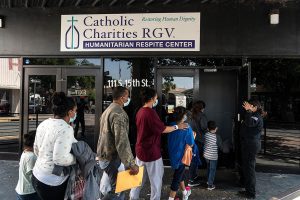
Migrants seeking asylum in the U.S. walk into a temporary humanitarian respite center run by Catholic Charities of the Rio Grande Valley in McAllen, Texas, April 8, 2021. (OSV News photo/Go Nakamura, Reuters)
In a Jan. 26 interview on CBS’s “Face the Nation,” Vance questioned the motives of the U.S. bishops’ criticism of the new Trump administration’s hardline immigration policies — including allowing raids on churches and schools — asking whether it had more to do with losing federal resettlement funding and “their bottom line.”
Fox News Channel’s Laura Ingraham, also a Catholic, said in a Jan. 29 broadcast, “I mean, no one wants to criticize Catholic Charities, but you can’t be facilitating illegal immigration.”
Such claims have ignited a vigorous rebuttal from U.S. Catholic bishops in defense of the church’s charitable agencies.
“Certain news outlets continue to make claims that Catholic Charities participates in illegal immigration and human trafficking, earning large profits while doing so,” Bishop Kevin C. Rhoades of Fort Wayne-South Bend, Indiana, said in a Feb. 3 message to the faithful. “As your Bishop and Chairman of the Board of Catholic Charities of the Diocese of Fort Wayne-South Bend, I can assure you these are false claims levied against our Catholic Charities agency.”
“The complete opposite is true,” he said. “Our diocesan Catholic Charities participates in pathways for legal immigration and supports survivors of human trafficking, while operating those programs at a fiscal deficit.”
According to Catholic Charities USA, only 5% of the services provided by its agencies last year were immigration and refugee services.
“Catholic Charities agencies serve migrants not because they are newcomers to the U.S., but because they are vulnerable and in need, like all those we serve. This work is a response to the Gospel mandate to feed the hungry, clothe the naked and welcome the stranger,” the CCUSA website states.
Catholic Charities agencies provide essential services, such as food, clothing and a place to sleep, as part of how the church puts the Gospel mandate from Jesus Christ into action.
Federal, state, and local governments have asked some Catholic Charities agencies — especially those near the U.S.-Mexico border — to assist migrants the federal government has processed and released with pending immigration court proceedings. Others also offer legal assistance to migrants navigating the complicated immigration legal system.
Such assistance, Bishop Rhoades emphasized, should not be mistaken for abetting illegal immigration — especially since federal authorities have regularly brought migrants to local Catholic Charities agencies after processing them through U.S.-Mexico ports of entry.
“This does not mean that we support open borders and disregard the rule of law,” he said.
“While the Catholic Church recognizes and respects the right of every nation to regulate its borders for the common good, we must balance this with the rights of vulnerable migrants to access protection, and with the fundamental right of all to life and dignity as human persons; as well as,” Bishop Rhoades added, “the rights of parents and the family, the cradle of life and love, the first and most vital cell of society.”
Bishop Rhoades also explained how Catholic Charities worked as a “contracted resettlement agency” working under the U.S. Conference of Catholic Bishops.
“Funds received are used to provide financial support for the first 90 to 240 days after arrival, until the refugee families become economically self-sufficient; provide immigration legal services as they study to become U.S. citizens; as well as to partially pay for the staff that provide those services,” he said.
In his own diocese, he said, Catholic Charities in the latest fiscal year “received $3.0 million in contract revenue and spent $3.2 million to administer the program.”
Bishop Joseph J. Tyson of the Diocese of Yakima, Washington, also spoke out concerning immigration and refugees in his Feb. 2 pastoral letter, “A Light for the Gentiles,” citing his six years leading the U.S. bishops’ efforts for the pastoral care for migrants and refugees. He had sharp words specifically for Vance’s “Face the Nation” claims.
“We follow the command to ‘love our neighbor’ and to ‘welcome the stranger,’ which are commands from the words of Jesus himself,” Bishop Tyson said, rejecting charges that the church’s assistance encourages illegal activity or profits from its immigration efforts.
“We receive no money to resettle ‘illegal’ migrants,” he said. But when it resettles refugees, he said the church loses money “on every resettlement.”
“The government contracts do not cover the cost of resettlement,” he explained.
He noted Washington state no longer has a Catholic Charities office that offers these services, because the church “could not sustain the loss.”
“In Central Washington, neither the Diocese of Yakima nor Catholic Charities receive any money from the government for resettling refugees or migrants. Not a single penny!” he said.
The bishop’s diocese is located in one of the world’s leading sources of apples and other produce, largely harvested through migrant labor. Any welcome extended to migrants, refugees and asylum-seekers, he said, is due to the diocese’s generous parishioners.
Bishop Tyson emphasized that people without legal immigration status are “our fellow parishioners and neighbors.” Regarding them, he shared how hundreds of Catholic youth in his diocese now fear their parents may be deported. He condemned Vance’s eager affirmation of deliberately instilling fear — such as by making schools generally open to immigration raids — as an immigration enforcement tactic.
“That the vice president — who refers to himself in the CBS interview as a devout Catholic — would want to engender fear as a tactic is deeply disturbing,” he wrote. “It’s also contrary to the teaching of Christ and the teachings of the Church.”
Bishop Rhoades also denounced attacks on the U.S. Refugee Admission Program, or USRAP, which his diocesan Catholic Charities agency has participated in since that federal program was launched in 1980.
“USRAP is the formal process by which people are legally resettled in the United States as refugees. Resettlement through USRAP is distinct from the U.S. asylum process,” he said.
Individuals resettled through USRAP are “screened, vetted, and approved by the U.S. government while outside of the United States,” he explained.
Bishop Tyson likewise in his letter emphasized that refugees resettled by the Catholic Church underwent 12-24 months of screening.
“That screening is conducted by the federal government itself. So, if there’s a problem with screening, it’s not because we have failed the federal government as a partner,” he said. “It’s because the federal government has failed us.”
More bishops have come to the fore to defend the church’s ministries to migrants and refugees.
In a Jan. 24 interview with Vatican News, Archbishop Timothy P. Broglio of the U.S. Archdiocese for the Military Services, president of the USCCB, likewise talked about the U.S. church’s “tremendous network — of Catholic Charities, of migration services that respond to people in these difficult situations — and we want to make those possibilities available to those most in need.”
Cardinal Timothy M. Dolan of New York, who offered prayers at both of President Donald Trump’s inaugurations — also expressed frustration with Vance’s comments on “Face the Nation” calling them “not only harmful” but demonstrably “not true,” pointing to the church’s audited financials.
“You think we make money caring for the immigrants? We’re losing it hand over fist,” Cardinal Dolan said Jan. 29 on his SiriusXM Catholic Channel. He said Vance’s remarks were a “let down” from “a guy that struck me as a gentleman and a thoughtful man and from whom I’m still expecting great things.”
At the same time, Bishop Mark J. Seitz of El Paso, Texas, who heads the U.S. bishops’ migration committee, told attendees at a Georgetown University event Feb. 12 that he wanted to offer the vice president an opportunity to dialogue over the church’s work with migrants and refugees.
“I would love to sit down sometime with Vice President Vance and talk to him about these issues in regard to our resettlement work and things like that because he clearly has been misinformed,” he said.
“That is so unfortunate when it comes from a person who has a loud megaphone,” Bishop Seitz said. “It can be very harmful to this work of the church to very vulnerable people.”