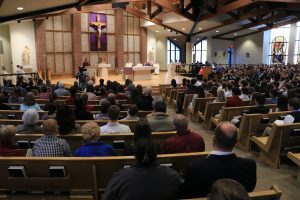
Pope Francis speaks during his general audience in the Paul VI hall at the Vatican Dec. 22, 2021. (CNS photo/Paul Haring)

VATICAN CITY (CNS) – The birth of the son of God in a humble stable, in the presence of both lowly shepherds and majestic Magi, is a “universal event that concerns all of humanity,” Pope Francis said.

During his weekly general audience Dec. 22, the pope said that only through humility can one truly understand God and oneself because it “opens us up to the experience of truth, of authentic joy, of knowing what matters.”

“The Magi may have even been great according to the world’s logic, but they made themselves lowly, humble, and precisely because of this they succeeded in finding Jesus and recognizing him. They accepted the humility of seeking, of setting out on a journey, of asking, of taking a risk, of making a mistake,” he said.

Among those present in the Paul VI audience hall were a group of asylum-seekers who, with the pope’s help, arrived in Italy Dec. 16 from Cyprus under a special humanitarian visa program.

Pope Francis thanked Italian authorities for facilitating their transfer and said those who seek refuge and a better life are not just the concern of the country they arrive in but “for all of humanity.”

“All we need to do is to open one door: the door of the heart,” the pope said. “Let us not forget that this Christmas.”

During the audience, the pope paused his series of talks on St. Joseph to reflect on the coming celebration of Christ’s humble birth in Bethlehem.

“Let’s think (about that),” he said. “The Creator of the universe was not given a place to be born.”

The shepherds, who visited the manger after receiving an announcement of Jesus’ birth by an angel, “personify the poor of Israel, lowly people who interiorly live with the awareness of their own want.”

“Precisely for this reason, they trust more than others in God. They were the first to see the son of God made man, and this encounter changed them deeply,” the pope said.

While little is known of the Magi, he continued, their journey to find Jesus represents those “who have sought God down through the ages, and who set out on a journey to find him.”

“They also represent the rich and powerful, but only those who are not slaves to possessions, who are not ‘possessed’ by the things they believe they possess,” he added.

Despite the vast differences between the shepherds and the Magi, both shared in the joy of Jesus’ birth because their humility led them to see God. The pope said that for Christians, humility “leads us also to the essentials of life, to its truest meaning, to the most trustworthy reason for why life is truly worth living.”

The celebration of Christmas, he added, is a time to invite everyone, especially the poor and those who do not believe in God, to see the “reason for our joy.”

The reason, Pope Francis said, is “knowing that we are loved without any merit, we are always loved first by God, with a love so concrete that he took on flesh and came to live in our midst. This love has a name and a face: Jesus is his name, he is the face of love — this is the foundation of our joy.”

Pope John Paul I walks at the Vatican in 1978. Pope Francis will beatify the late pontiff Sept. 4, 2022, at the Vatican. (CNS file photo/L’Osservatore Romano)

VATICAN CITY (CNS) – Pope Francis will beatify Pope John Paul I Sept. 4, 2022, at the Vatican, according to Stefania Falasca, a journalist and vice postulator of the late pope’s sainthood cause.

In October, Pope Francis had signed a decree recognizing a miracle attributed to the intercession of Pope John Paul I, clearing the way for his beatification. At the time, a date for the ceremony was not announced.

Writing Dec. 23 in Avvenire, the daily newspaper owned by the Italian bishops’ conference, Falasca said the date had been set.

Pope John Paul I, an Italian who was born Albino Luciani, served only 33 days as pontiff; he died in the papal apartments Sept. 28, 1978, three weeks shy of his 66th birthday, shocking the world and a church that had just mourned the death of St. Paul VI.

The miracle approved in his cause involved a young girl in Buenos Aires, Argentina, who developed a severe case of acute encephalitis, experienced uncontrollable and life-threatening brain seizures, and eventually entered septic shock.

After doctors told family members her death was “imminent,” the local priest encouraged the family, nurses and others to pray to the late pope for his intercession, according to the website of the Congregation for Saints’ Causes. A panel of experts studying the cause determined there was no scientific explanation for her complete recovery in 2011 and that it could be attributed to the late pope’s intercession.

Although his was one of the shortest papacies in history, Pope John Paul I left a lasting impression on the church that fondly remembers him as “the smiling pope.”

Born in the small Italian mountain town of Canale D’Agordo Oct. 17, 1912, the future pope and his two brothers and one sister lived in poverty and sometimes went to bed hungry.

He was ordained a priest in 1935 and was appointed bishop of Vittorio Veneto in December 1958 by St. John XXIII. More than 10 years later, he was named patriarch of Venice by St. Paul VI and was created a cardinal in 1973.

His surprise election, after St. Paul VI’s death, did not sway him from continuing his humble manner of living, such as rejecting the use of the traditional papal tiara and calling his first Mass as pope the “inauguration” of his papal ministry rather than a coronation.

Pope Francis has named Father Jeffrey J. Walsh, a priest of the Diocese of Scranton, Pennsylvania, as the sixth bishop of the Diocese of Gaylord, Michigan.

He succeeds Bishop Steven J. Raica, who was Gaylord’s bishop from 2014 until 2020 when he was installed to head the Diocese of Birmingham, Alabama. Since June 2020, Bishop Walter A. Hurley, the retired bishop of Grand Rapids, Michigan, has served as apostolic administrator of the Gaylord Diocese.

Bishop-designate Walsh currently serves as pastor of St. Rose of Lima Parish and Our Lady of Mount Carmel Parish, which are both in Carbondale, Pennsylvania.

His appointment was announced Dec. 21 by Archbishop Christophe Pierre, apostolic nuncio to the United States, in Washington.

Bishop-designate Walsh’s episcopal ordination and installation will be March 4 at St. Mary Cathedral in Gaylord.

“With gratitude to our Holy Father Pope Francis, and joy in the Lord, I am eager to begin a new chapter in my life of discipleship among the good people of the Diocese of Gaylord!” the 56-year-old bishop-designate said in a statement. “I am also most grateful to God for 27 years of priestly ministry in the Diocese of Scranton.

“I have been inspired and challenged to grow in faith through various diocesan assignments and will forever prayerfully remember all the lay faithful, religious, deacons, priests and bishops with whom and for whom I have served.”

Bishop-designate Walsh acknowledged “the kind support” of Scranton Bishop Joseph C. Bambera and also said, “The most important act of gratitude I can offer is for my parents, Jerome and Nancy (Doud) Walsh. They, as well as my deceased grandparents, have been the most significant formators of my life.”

“I have been blessed with a solid, but by no means ‘perfect,’ family that also includes my two brothers (James and Joseph), two nieces, one nephew, aunts and uncles and many close first cousins,” he added. “Looking forward, I hope to bring a missionary spirit to my episcopal ministry under the mantle of Divine Providence. From ‘Penn’s Woods’ to the land of ‘Great Lakes,’ I trust God’s loving plan.”

In a tweet posted, the appointment was announced at 6 a.m. local time, Bishop Bambera said he and the diocese celebrated the Scranton priest’s appointment “with pride and gratitude to God.”

Bishop Hurley stated, “I warmly welcome him to this diocese, a unique and special region of Michigan, and assure him of our prayers and support as he looks forward to taking on this responsibility and his upcoming ordination and installation in March.”

Born Nov. 29, 1965, in Scranton, Bishop-designate Walsh is a graduate of Scranton Central High School and in 1987 earned a bachelor’s degree in health and human resources from the University of Scranton, which is operated by the Jesuits.

He completed his priestly studies at Mount St. Mary’s Seminary in Emmitsburg, Maryland, where he earned a master of divinity degree. He also received a master of arts degree in Christian spirituality from Jesuit-run Creighton University in Omaha, Nebraska, in 1999 and earned a master of social work degree at Marywood University in Scranton in 2010.

He was ordained a priest for the Scranton Diocese by Bishop James C. Timlin at the Cathedral of St. Peter in Scranton June 25, 1994.

Then-Father Walsh’s first assignment after ordination was as assistant pastor at St. Rose of Lima Church in Carbondale and at Scranton’s Cathedral of St. Peter.

In July 1999, he was appointed pastor of St. Mary of the Lake Church in Lake Winola, Pennsylvania, and also became director of spiritual and liturgical formation at St. Pius X Seminary in Dalton, Pennsylvania.

From July 2004 to July 2006, he was pastor at Nativity of the Blessed Virgin Mary Church in Tunkhannock, Pennsylvania, until being named episcopal vicar for the Scranton Diocese’s Eastern pastoral region.

Prior to his current assignment as pastor at two Carbondale parishes, he was administrator at two other parishes and then served as pastor of the Church of St. John in East Stroudsburg, Pennsylvania.

VATICAN CITY (CNS) – Pope Francis asked people to celebrate a “real Christmas” by recognizing Jesus in their lives and cultivating peace in their hearts.

Pope Francis speaks as a boy plays during a meeting with children from Italy’s Catholic Action at the Vatican Dec. 18, 2021. (CNS photo/Vatican Media)

“What is Christmas? Is it a tree? A statue of a baby with a woman and a man nearby? Yes, it is Jesus, the birth of Jesus,” he said, so “stop for a bit and think of Christmas as a message, a message of peace.”

The pope’s words were aired Dec. 19, the last Sunday of Advent, on Italy’s Canale 5 in the special program, “Francis and the Invisible: The pope encounters the least.”

The program, recorded in the pope’s residence, featured a televised “dialogue” and interview with four people facing serious challenges in their lives: Giovanna, a mother of four who experienced domestic violence and lost her home and job during the COVID-19 pandemic; Maria, who lives in a shelter after sleeping on the streets; Pierdonato, who is serving two life sentences in prison; and Maristella, an 18-year-old student and Girl Scout who was representing all young people who felt isolated and abandoned because of the lockdown and restrictions in place during the pandemic.

Each gave the pope a brief account of the challenges they had been facing as well as their ongoing concerns, doubts and questions about what next steps to take.

For example, Giovanna said she lost her faith the day she and her kids managed to escape a life of poverty and violence and asked, “What can we do to regain our dignity?” and how could she give her children strength.

The pope said the abuse of women by their partners “is almost satanic because it is taking advantage of the weakness of someone who cannot defend herself,” and he also criticized the “humiliating” affront of a parent slapping a child on the face.

When reflecting on the dignity of women who have experienced abuse, the pope said the image that comes to mind is Michelangelo’s Pietà with “Our Lady humiliated before her child — naked, crucified and a miscreant in everyone’s eyes.”

“But she has not lost her dignity and to look at this image during difficult times like yours of humiliation and where you feel you’ve lost your dignity, looking at that image gives us strength,” he said.

He said she was already showing her kids’ strength and said the real problem was finding “a concrete way out — a job, a home and this does not depend only on you,” encouraging her to reach out for help and not be afraid of this moment of crisis, made worse by the pandemic.

He told Giovanna he could see the suffering on her face, but also her dignity, “because you would not be here” if she had none left. “You are on a journey, the danger is to give up” and to see no way out, but “you are still on your feet like Our Lady before the cross.”

Maria described the risks of having no shelter and how that leads to trying to be invisible for safety, but how sad and demeaning it is to feel invisible and hear criticism when people pass by. “Why is society so cruel toward the poor?” she asked the pope.

It is cruelty, he said, “it is the harshest slap in the face for you for society to ignore the problems of others,” perpetuating the culture of indifference which seeks to push aside real problems, such as the lack of housing and employment.

“Indifference is cruel, but do not lose hope, keep walking, keep going, perhaps someone will listen to this and help will arrive, not just material help, but the help of someone who will (touch your) heart and begin to understand the problem,” he said.

Speaking with Pierdonato, who asked whether there was hope for people who wanted to change their lives, the pope said true hope, which comes from God, never disappoints.

“God exists, not in outer space, but next to you, because the way of God is closeness, compassion and tenderness,” he said. God is always with those in prison and those experiencing hardship because his very nature is to be close and a “travel companion,” he added.

But it is also important that the prison system never close the door on hope by depriving people of the chance to change, which is why “the church is against the death penalty, because with death there is no ‘window,’ no hope, it ends a life,” he said.

Responding to Maristella, the pope encouraged her and her generation to continue to seek “real” dialogue and in-person relationships, not just virtual ones, and he assured her it is normal to have doubts, to question or even be angry with God.

The important thing is to have a heart at peace because “an anxious heart cannot seek God, cannot maintain a relationship with God,” so it is important to find serenity, even when experiencing suffering or difficulties, he said.

The Gospel is more than just words, in fact, “I’m worried about preachers who only want to heal a life in crisis with words, words, words. A life in crisis is healed with closeness, compassion, tenderness,” he said.

“You must have the courage to tell the Lord all of your feelings as they come — with the Gospel in hand and a heart at peace,” he added.

The pope concluded by wishing those with him and watching on TV “a real Christmas” with Jesus.

It is OK to celebrate, exchange gifts, eat and be merry, he said, “but do not forget Jesus. Christmas is Jesus who comes, who comes to touch our hearts,” families, homes and lives.

WASHINGTON (CNS) – The percentage of Catholics in the U.S. population in 2021 held steady at 21% in the latest Pew Research Center survey, issued Dec. 14.

The percentage of Protestants, however, dropped, while the percentage of “nones” – those who profess no particular denominational attachment – continued to rise, said the report, “About Three-in-Ten U.S. Adults Are Now Religiously Unaffiliated.”

The survey results also indicate the proportion of Christians in the U.S. population continues to slide. A decade ago, they constituted 75%, or three out of every four Americans. In the new survey, that percentage is down to 63%, or five out of every eight Americans.

“Christians now outnumber religious ‘nones’ by a ratio of a little more than 2-to-1,” the report said. In 2007, when Pew began asking its current question about religious identity, the ratio was almost 5-to-1, or 78% vs. 16%.

Since 2007, Protestantism has dwindled from 52% of all Americans to 40%, not quite twice the percentage of Catholics today. Within Protestantism, the percentage of those adults who profess evangelical or “born again” Christianity has shrunk by 6%; the number of those who are not evangelical or “born again” also has shrunk by 6%.

The dip in the percentage of Catholics is less pronounced; it was 24% in 2007 and 14 years later is 21%. The Orthodox churches make up about 1% of Americans, and members of the Church of Jesus Christ of Latter-day Saints comprises 2%.

That the year-to-year percentage of Catholics held steady is likely a combination of “religious shrinking” — people no longer identifying as Catholic — offset by immigration, said Gregory A. Smith, Pew’s associate director of research, in a Dec. 17 phone interview with Catholic News Service.

“Religious switching” also can come into play. “It is definitely more common earlier in life than later in life,” Smith said, among “people who no longer identify with their childhood religion either as young adults or even before entering adulthood.”

Prayer also has taken a hit since 2007. The percentage of those who said they prayed every day then was 58%; today, it’s 45%.

So too are those who consider themselves “very” religious. Fifty-eight percent of Americans had described themselves that way in 2007. Now, just 41% do. The number of those who feel “somewhat” religious has drifted downward from 28% in 2007 to 25% today. But those who say they’re either “not too” or “not at all” religious has more than doubled over the past decade and a half, from 16% to 33%.

The trend lines maintained themselves on the religiosity question even after Pew switched from a random-digit-dial protocol to find survey respondents, which ended in 2019, to its National Public Opinion Reference Survey, which debuted in 2020.

Smith cautioned against concluding that trend lines are accelerating, but said their progression is unmistakable.

“If I were to just drop down from outer space and (be) given only those two data points, I’d say that the results from 2021 look very similar to the results from 2020,” he said. “But that’s the value of having these long-term trends. We can look over these 14 years, 15 years, and we can see the trend lines moving very consistently in a single direction. We can say, ‘Look, here are the long-term trends.'”

Thirty-five percent of Catholics say they go to Mass at least monthly, with Hispanics outpacing whites, 36% to 33%. But those numbers are dwarfed by the 46% of Protestants who say they attend services at least monthly.

Catholics straddle the halfway mark about how often they pray — 51% say they pray daily — while 48% say religion is very important in their lives. Of this 48%, 54% of Hispanic Catholics say this is true for them, vs. 41% of their white counterparts.

While a combined 29% of those surveyed profess no specific religious identity, the percentage of those who say they’re “nothing in particular” (20%) is more than double the combined percentage of atheists and agnostics (9%).

The Pew survey interviewed 3,937 Americans who responded either on paper or online. Smith said it was part of a larger survey that asked about tech issues and political partisanship, but “these were the only religion questions on that survey.” The margin of error for the entire respondent group is plus or minus 2.1%. Among the 860 Catholics surveyed, the margin of error is plus or minus 4.5%.

– – –

Editor’s Note: The Pew report “About Three-in-Ten U.S. Adults Are Now Religiously Unaffiliated” can be found online at https://pewrsr.ch/3F3Ix22.

Through the intercession of “Virgen de Guadalupe,” plans for the Feast of Our Lady of Guadalupe are proceeding with the hopes of providing as much celebration as possible amid the continuing COVID-19 pandemic.

Particularly in the areas of large Latino populations in the Diocese of Scranton, the annual observance commemorates the appearance of the Virgin Mary to a Mexican Indian peasant — now venerated as Saint Juan Diego — in December 1531 in Tepeyac, near present-day Mexico City.

The Blessed Mother’s appearance is believed to have resulted in millions of conversions to Catholicism, and her message of hope continues to inspire those of Hispanic descent.

In 1946, Pope Pius XII declared Our Lady of Guadalupe as Patroness of the Americas.

The Our Lady of Guadalupe feast on Dec. 12 will culminate a host of celebrations being planned throughout the Diocese, especially in those parishes made up of significant Hispanic/Latino communities.


Saint Matthew Parish
East Stroudsburg

Novena
Saturdays 7 PM in the Church

December 11
7:00 p.m.- Vigil (Blessed Sacrament Exposed)
11:00 p.m. – Mañanitas

December 12
2:00 p.m. Mass with a reception following Mass

Annunciation Parish
Hazleton

December 3 – 11
6:30 p.m. Rosary
7:00 p.m. Mass

December 12
12:00 p.m. Mass
Holy Name of Jesus Parish
Hazleton

December 12
12:00 p.m. Mass

Sacred Hearts of Jesus & Mary Parish, Jermyn

December 12
12:00 p.m. Mass with a reception following Mass

Saint Joachim Parish
Meshoppen

December 12
3:00 p.m. Mass with a reception following Mass

Saint John Neumann Parish, Scranton

December 3-11
6:30 p.m. Novena
December 12
3:00 a.m. procession from the Cathedral of Saint Peter to Saint John Neumann Parish.

4:30 a.m. – 6:30 a.m. –
Mañanitas with Mariachi

6:30 a.m. Mass with Mariachi

1:00 p.m. Mass with Bishop Joseph C. Bambera with a reception after Mass
(Chinelo Danza at Mass and at the Gym)

Saint Nicholas Parish
Wilkes-Barre

December 11
6:00 p.m. – 9:00 p.m. Vigil
(Prayer and Danza)

December 12
5:00 a.m. Mañanitas

3:00 p.m. procession beginning at 368 Old River Road, Wilkes-Barre, PA 18702

5:00 p.m. Mass with Bishop Joseph C. Bambera with a reception after Mass

Saint Boniface Parish
Williamsport

December 12
4:30 p.m. Mass with a reception following Mass

Parroquia San Mateo
East Stroudsburg

Novena
Sábados 7 PM en la Iglesia

Diciembre 12
2:00 p.m. Misa
Recepción después de Misa

Parroquia Anunciación
Hazleton

Diciembre 3 – 11
6:30 p.m. Rosario
7:00 p.m. Misa

Diciembre 12
12:00 p.m. Misa

Parroquia Santo Nombre de Jesús, Hazleton

Diciembre 12
12:00 p.m. Misa

Parroquia Sagrado Corazón de Jesús y Maria, Jermyn

Diciembre 12
12:00 p.m. Misa
Recepción después de Misa

Parroquia San Joaquín, Meshoppen

Diciembre 12
3:00 p.m. Misa
Recepción después de Misa

Parroquia San Juan Neumann, Scranton

Diciembre 3-11
Novena 6:30 PM

Diciembre 12
3:00 a.m. Procesión desde la Catedral de San Pedro hasta la Iglesia San Juan Neumann

4:30 a.m. – 6:30 a.m. Mañanitas con Mariachi

6:30 a.m. Misa con Mariachi

1:00 a.m. Misa con el Obispo Bambera
Recepción después de Misa en el Gimnasio (Baile de Chinelos en misa y en el gimnasio)

Parroquia San Nicolás, Wilkes-Barre

Diciembre 11
6:00 p.m. – 9:00 p.m. Vigilia (Oración y Danza)

Diciembre 12
5:00 a.m. Mañanitas (Almuerzo después de las Mañanitas)
3:00 p.m. Procesión comenzando en 368 Old River Road Wilkes Barre, PA 18702

5:00 p.m. Misa
Recepción después de Misa

Parroquia San Bonifacio, Williamsport

Diciembre 12
4:30 p.m. Misa
Recepción después de Misa


A likeness of St. Joseph is seen in stained glass at Caldwell Chapel on the campus of The Catholic University of America in Washington May 25, 2021. (CNS photo/Tyler Orsburn)

VATICAN CITY (CNS) – Pope Francis closed the Year of St. Joseph with a private visit to a community in Rome that helps people experiencing marginalization, crisis or substance abuse.

“Do not be afraid of reality, of the truth, of our misery,” he told volunteers and the people they assist at the Good Samaritan home Dec. 8, the feast of the Immaculate Conception. “Don’t be afraid because Jesus likes reality as it is, undisguised; the Lord does not like people who cover their soul, their heart with makeup.”

The Good Samaritan fraternity or home is part of the worldwide “Comunità Cenacolo,” which was founded in 1983 by Italian Sister Elvira Petrozzi to offer “God’s tenderness to the cry of desperation of so many young people who were lost, deceived and disappointed,” and had been seeking “the true meaning of life in the false light of the world,” according to the community’s mission statement.

Dozens of guests and members of the community welcomed the pope, who listened to the experiences several of them shared and watched a segment of a film on the life St. Joseph, which was produced by young people living at two fraternities in Medjugorje.

Among those welcoming the pope were the two children of Andrea and Antonia Giorgetti, who both recovered from drug dependencies and now run the Good Samaritan fraternity, reflecting the fact that a number of young people who find help at the fraternities go on to assist others.

The pope encouraged all the residents to “have the courage to tell others, ‘there is a better way.'”

Pope Francis also visited and blessed the fraternity’s new chapel, built by residents out of discarded wooden beams, travertine marble and other materials reclaimed from dumpsters and landfills.

Building something new and wonderful out of things that have been thrown away “is a concrete example of what we do here,” Father Stefano Aragno told Vatican News Dec. 8.

The pope led the prayer dedicated to St. Joseph to conclude the special year with those present.

A composite photo shows damage to a statue of Our Lady of Fatima that stands with the three shepherd children near the Basilica of the National Shrine of the Immaculate Conception in Washington Dec. 8, 2021. The hands and nose of the statue of Mary were cut off and the cross on her crown was broken off. Shrine officials said that around 10:45 p.m. Dec. 5, the perpetrator got to the statue by climbing a locked fence that surrounds a rosary walk and garden that includes the statue. (CNS composite; photos by Tyler Orsburn)

WASHINGTON (CNS) – Days ahead of a major Marian feast day in the Catholic Church, a marble statue of Our Lady of Fatima near the Basilica of the National Shrine of the Immaculate Conception in Washington was vandalized, with Mary’s hands and nose cut off, her face scratched and the cross on her crown broken off.

On Dec. 8, the feast of the Immaculate Conception, a spokesman at the national shrine told Catholic News Service that around 10:45 p.m. Dec. 5, the perpetrator got to the statue by climbing a locked fence that surrounds a rosary walk and garden that includes the statue.

Video footage showed a masked person doing the damage, which was discovered the next morning. Police were investigating the vandalism.

“Though we are deeply pained by this incident, we pray for the perpetrator through the intercession of the Blessed Virgin Mary under her title of Our Lady of Fatima,” Msgr. Walter Rossi, rector of the national shrine, said in a statement.

The Fatima statue and the garden around it were completed in 2017, the 100th anniversary of Mary’s appearances to three shepherd children in a field near Fatima, Portugal, with her message that eucharistic prayer, recitation of the rosary and penance would save souls and bring peace to the world.

One on side of the national shrine’s garden is the white Carrara marble sculpture of Our Lady of Fatima with the three child-visionaries at her feet, Lucia dos Santos and Jacinta and Francisco Marto. On the opposite side is the crucified Christ, sculpted from the same kind of marble.

A paved walkway, symbolic of the thread connecting a rosary’s beads, circles through and around the garden, taking visitors past groupings of colorful mosaics that illustrate the 20 mysteries of the rosary.

On Sept. 23, 2017, Bishop Frank J. Caggiano of Bridgeport, Connecticut, blessed the new garden, walking to the Fatima statue, then around the path.

The blessing followed a Mass the bishop and other clergy concelebrated in the national shrine’s Upper Church for 2,000 pilgrims from the Diocese of Bridgeport, along with pilgrims from the Philippines and China, the New York area and the Washington region.

Our Lady of Fatima’s message about prayer, conversion and peace that she imparted in 1917 “is as important now as it has ever been since,” Bishop Caggiano said in his homily.

“We come here to ask for her intercession,” he said. “She might lead every human heart to answer the question, ‘What is it that you are looking for?’ And we will answer it: ‘We are looking for your Son, and lead us to him.'”

Four years later, the attack on the national shrine’s statue of Our Lady of Fatima became one of the latest attacks in dozens of incidents of arson, vandalism and other destruction that have taken place at Catholic sites across the United States since May 2020.

In an Oct. 14, 2021, news release, the U.S. Conference of Catholic Bishops said the bishops’ Committee for Religious Liberty began tracking such incidents that May and by the time the release was issued, there had been 100 such incidents.

“These incidents of vandalism have ranged from the tragic to the obscene, from the transparent to the inexplicable,” the chairmen of the USCCB’s religious liberty and domestic policy committees said in a joint statement included in the release.

“There remains much we do not know about this phenomenon, but at a minimum, they underscore that our society is in sore need of God’s grace,” they said, calling on the nation’s elected officials “to step forward and condemn these attacks.”

“In all cases, we must reach out to the perpetrators with prayer and forgiveness,” said Cardinal Timothy M. Dolan of New York, chairman of the Committee for Religious Liberty, and Archbishop Paul S. Coakley of Oklahoma City, chairman of the Committee on Domestic Justice and Human Development.

“Where the motive was retribution for some past fault of ours, we must reconcile; where misunderstanding of our teachings has caused anger toward us, we must offer clarity; but this destruction must stop. This is not the way,” they said.

“We thank our law enforcement for investigating these incidents and taking appropriate steps to prevent further harm,” Cardinal Dolan and Archbishop Coakley said. “We appeal to community members for help as well. These are not mere property crimes – this is the degradation of visible representations of our Catholic faith. These are acts of hate.”


Pope Francis prays at a tall Marian statue overlooking the Spanish Steps in Rome Dec. 8, 2021, the feast of the Immaculate Conception. (CNS photo/Vatican Media via Reuters)

ROME (CNS) – An hour before sunrise, Pope Francis set a basket of white roses at the base of a statue of the Immaculate Conception in the center of Rome, praying Mary would help all who suffer.

“While it was still night,” the Vatican press office said Dec. 8, the pope prayed to Mary, “asking her for the miracle of a cure for the many people who are sick, for healing for people who are suffering so much because of wars and the climate crisis, and for conversion so that she would melt the stony hearts of those who build walls to keep the pain of others away.”

The pope arrived at Piazza di Spagna, near the Spanish Steps, at about 6:15 a.m., the press office said. Because of the ongoing COVID-19 pandemic, it was the second year in a row that the pope made an unannounced, early morning visit to the statue to avoid drawing a crowd.

Pope Francis arrived, prayed and was gone even before a brigade of Rome firefighters had arrived to hang a wreath of flowers from the statue’s outstretched arms.

The feast of the Immaculate Conception is a public holiday in Rome, and the pope’s usual late afternoon visit to the Spanish Steps normally draws thousands of people.

Before returning to the Vatican, the pope also stopped at the Basilica of St. Mary Major to pray, the Vatican said.

At noon, Pope Francis led the recitation of the Angelus prayer with visitors in St. Peter’s Square and spoke about Mary’s humility and the miracles God accomplishes through people who rely totally on him.

The Gospel reading for the feast is St. Luke’s account of the Angel Gabriel appearing to Mary and telling her she would be the mother of Jesus.

“The angel calls her ‘full of grace,'” the pope noted. “If she is full of grace, it means the Madonna is void of evil: She is without sin, immaculate.”

Pope Francis noted how instead of saying Mary was surprised by the angel’s greeting, she was “greatly troubled.”

“Mary does not credit prerogatives to herself, she does not hold claim to anything, she accounts nothing to her own merit,” the pope said. “She is not self-satisfied, she does not exalt herself. For in her humility, she knows she receives everything from God.”

“Mary Immaculate does not look on herself,” he said. “This is true humility: not looking on oneself but looking toward God and others.”

Pope Francis prayed that Mary would help all Christians understand that if they are humble and focused on God and on serving others, God can accomplish great things through them.

“May she enkindle enthusiasm in us for the ideal of sanctity which has nothing to do with holy cards and pictures but is about living humbly and joyfully what happens each day, freed from ourselves, with our eyes fixed on God and the neighbor we meet,” he said.

Pope Francis uses incense to venerate a Marian image as he celebrates Mass in the Megaron Concert Hall in Athens, Greece, Dec. 5, 2021. (CNS photo/Paul Haring)

ATHENS, Greece (CNS) – God the Almighty almost always chooses the least mighty people and the most desolate places to reveal the power of his love, Pope Francis said.

Celebrating Mass Dec. 5 in Athens’ Megaron concert hall, the pope touched on a theme he had explored in depth with Catholic leaders the day before: the blessing and spiritual advantage of being a small community without power and without pretenses.

Catholics make up less than 2% of the population of Greece; more than 90% of the country’s residents belong to the Orthodox Church.

Noting how the day’s Gospel says the word of God came to John the Baptist “in the desert,” Pope Francis said, “There is no place that God will not visit.”

“Today we rejoice to see him choose the desert, to see him reach out with love to our littleness and to refresh our arid spirits,” he said. “Dear friends, do not fear littleness, since it is not about being small and few in number, but about being open to God and to others.”

The late-afternoon Mass was the pope’s last public event in Greece. After Mass he was to host a private visit by Orthodox Archbishop Ieronymos II, head of the Orthodox Church of Greece, and the next morning he was scheduled to visit a Catholic school before returning to Rome, concluding a five-day trip that began in Cyprus.

Celebrating Mass in the Greek capital after having flown to and from the outlying island of Lesbos for a meeting with migrants, Pope Francis’ homily focused both on recognizing God at work where he is least expected and on the Advent challenge of conversion.

St. Luke’s description of the call of St. John the Baptist lists the civil and religious leaders in office at the time. “We might have expected God’s word to be spoken to one of the distinguished personages” mentioned in the reading, the pope said. “Instead, a subtle irony emerges between the lines of the Gospel: from the upper echelons of the powerful, suddenly we shift to the desert, to an unknown, solitary man.”

“God surprises us,” the pope told the 2,000 people at Mass. “His ways surprise us, for they differ from our human expectations; they do not reflect the power and grandeur that we associate with him. Indeed, the Lord likes best what is small and lowly.”

The Gospel teaches that “being powerful, well-educated or famous is no guarantee of pleasing God, for those things could actually lead to pride and to rejecting him. Instead, we need to be interiorly poor, even as the desert is poor.”

The day’s reading also called for conversion, something that sounds difficult, he said, because too many people think of it as a rallying of personal strength in a struggle for perfection.

But the Greek word for conversion – “metanoia” – means “‘to think beyond,’ to go beyond our usual ways of thinking, beyond our habitual worldview – all those ways of thinking that reduce everything to ourselves, to our belief in our own self-sufficiency,” he said.

“To be converted, then, means not listening to the things that stifle hope, to those who keep telling us that nothing ever changes in life,” the pope said. “It means refusing to believe that we are destined to sink into the mire of mediocrity.”

“Everything changes when we give first place to the Lord. That is what conversion is,” Pope Francis insisted. “As far as Christ is concerned, we need only open the door and let him enter in and work his wonders.”