CRESCO – With a little more than three weeks left until Easter, many parish decorating committees will be working overtime to make sure their worship spaces are beautiful.
At Most Holy Trinity Parish in Cresco, which will celebrate Easter in its brand new home for the first time, volunteers have been preparing for several months.
“I do it to glorify and adore God, to show him that I am thankful for my gifts,” parishioner Madeleine Forssell said.
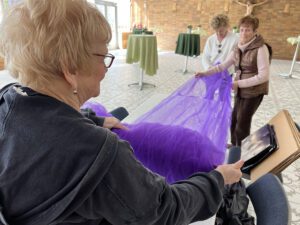
Barb Page, left, helps to organize decorations for Easter along with Julie Conroy and Arlene Calemmo at Most Holy Trinity Parish in Cresco on Feb. 15, 2023. (Photo/Eric Deabill)
Forssell helps to coordinate a large team of dozens of volunteers who constantly work to keep the church, its narthex and meeting areas properly decorated for each liturgical season.
“We get inspiration from Pinterest and Facebook or we capitalize on ideas or pictures that we see,” she explained. “We try to enhance the beauty that is already here. When we decorate this place, it’ll take your breath away.”
Rev. Brian J.W. Clarke, pastor, Most Holy Trinity Parish, said the decorating committee had 42 people volunteering at Christmas.
“There is just so much enthusiasm. Madeleine brings in people of all different age groups and abilities. She gets everyone included. Once they start working together and can see that they have a part to contribute, it just blossoms,” Father Clarke said.
Arlene Calemmo of Mount Pocono volunteers with the group because she loves to see the finished products.
“These ladies are incredible. They are unbelievable. They work so hard and really do a wonderful job,” she explained.
“Christmas was absolutely gorgeous. Everything was just so beautiful,” fellow volunteer Julie Conroy of Canadensis, added. “There are quite a few people that get involved and everybody does a little something.”
Most Holy Trinity Parish was formed as a consolidation of three area parishes so the decorating committee has plenty of supplies to work with.
“This is a family. Your church should be part of your extended family. Wherever they need me, that is where I go,” volunteer Ayleen Rios of Tobyhanna, emphasized.
“Everybody has a talent and you just have to find where their niche is and fit them in!”
The Most Holy Trinity Parish decorating committee invites everyone to see their work beginning Palm Sunday when there will be special palm decorations adorning each pew and then the following Sunday where Easter lilies will be prominently featured throughout the parish.
Social
SCRANTON – After working for the last seven years as a Department of Justice Immigration Counselor & Immigration Program Coordinator for Catholic Charities of Southern Colorado, Fikile Ryder, MSCJ, is bringing her knowledge and expertise to Catholic Social Services of the Diocese of Scranton.
Ryder started as the new full-time Director of Community for Catholic Social Services in October 2022. As part of that position, she will be responsible for Immigration and Refugee Resettlement Services.
“The work is very rewarding. I am an immigrant myself so I’ve been in the same shoes of those that I represent. I know how they feel,” she explained.
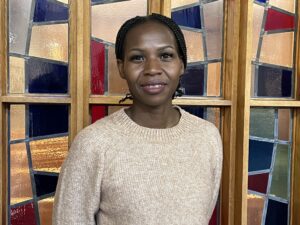
Fikile Ryder, MSCJ, has is the new Director of Community for Catholic Social Services of the Diocese of Scranton. Ryder will be responsible for Immigration and Refugee Resettlement Services. (Photo/Eric Deabill)
Ryder will oversee five immigration and refugee support programs for Catholic Social Services, many of which were inactive until recently because no employees possessed full accreditation with the U.S. Department of Justice.
“Our agency (Catholic Social Services) is recognized with the Department of Justice. With the immigration program itself, people who work in that program have to be accredited in order for them to do the legal part of the immigration process. If someone leaves the organization, then that accreditation is terminated,” she explained.
Joe Mahoney, Diocesan Secretary for Catholic Human Services and Chief Executive Officer of Catholic Social Services, said his agency’s work is rooted in the Gospel and Catholic social teaching, which emphasizes that migrants, refugees and asylum seekers are to be cared for with dignity and respect.
“I have known and worked with Fikile for years and she is a tremendous addition to our area,” Mahoney said. “She brings amazing skills and diverse experiences and I think we are lucky to be able to hire her.”
Born in Zimbabwe, Ryder first came to the United States in 2003 with a temporary work visa after being offered a job in Virginia to work with a child who had autism.
When her contract ended in 2009, she returned to Africa but her boyfriend at the time from America went to Zimbabwe and asked her to marry him.
She then came back to the United States in 2011 with her green card.
“My immigration process was done by Catholic Charities in Pueblo, Colorado, and took about eight months,” Ryder explained.
Thankful for the assistance of Catholic Charities, she started volunteering with the agency and was later hired as an administrative assistant. She worked her way up to a fully-accredited Immigration Counselor and Immigration Program Coordinator.
“The accreditation allows me to do everything that an attorney can do, an immigration attorney, like filing paperwork, giving legal advice, legal representation,” Ryder explained. “I can go to the United States Citizenship and Immigration Services (USCIS) with the clients and speak on their behalf.”
One of the newest refugee support service programs that Ryder now oversees for Catholic Social Services deals specifically with paroled Ukrainians who are referred from either Luzerne or Lackawanna Counties. The main job is to help the individuals find and maintain employment.
“We screen them to find out what kind of skills they have, what kind of availability they have and we also screen them on the barriers that will prevent them from finding a job,” she said. “The main goal is to have them be self-sufficient.”
Under its Resettlement & Replacement Program, Catholic Social Services helped welcome a family of six to northeastern Pennsylvania on January 24. The United States Conference of Catholic Bishops funds that program.
“They are with us for 90 days. We have to make sure they have a home, the kids are enrolled in school and we find them a job. Any needs they have, we help them in those 90 days,” Ryder explained.
While she admits she didn’t know much about Scranton before taking her new position, she has been pleasantly surprised how many immigrants and refugees are settling locally.
“I was shocked at how many refugees from Africa are here,” she said. “They like Scranton because it is more affordable. We’ve had people come in from New Jersey and New York wanting to settle here because the cost of living is way too much there.”
As she looks towards the future, Ryder says she hopes to educate people on who refugees are and why they are coming to the United States – whether it is because they’re fleeing war or persecution. She would also like to begin a volunteer program for the community and work with parishes and schools.
“We have a lot of work and we cannot do it by ourselves,” Ryder said. “It would be very helpful to work with our parishes. When I was in Colorado, I collaborated with parishes who provided space for me so that I could do ‘Know Your Rights’ presentations, consultations and case management services right there in the church.”
For more information on Immigration and Refugee Resettlement Services provided by Catholic Social Services, contact Fikile Ryder at (570) 207-2283, x2121 in Scranton and (570) 455-1521, x4304 in Hazleton.
Social
SCRANTON – Twenty-four long days and nights.
That is how long Khalil Yademovich Madadov spent seeking safety in the basement of his home in Eastern Ukraine after the Russian invasion of his country began Feb. 24, 2022. Joined by his wife, Leila, and their three young children in the makeshift shelter, the 37 year old described it as a terrifying time.
“I gathered my family at 4 a.m. and ran to the basement,” he said. “Only I went out to look for food and water.”
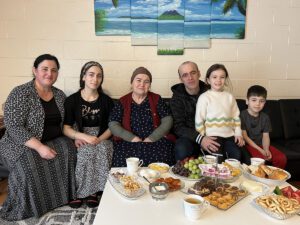
Khalil Yademovich Madadov, fourth from left, and his family arrived in the United States in June 2022 after the Russian invasion of Ukraine began. With the help of Catholic Social Services, the family has found housing in the Midtown Apartments in Scranton and their children are now enrolled in school. (Photo/Eric Deabill)
Madadov moved to Ukraine at the age of six and spent 30 years going to school, university, and making a living as a potato and tomato farmer. He says his life was “perfect” until Russia began launching attacks on his country.
“I began praying to God to help me and show me how to protect my family,” Madadov explained. “Good news came when we heard about a program called ‘Uniting for Ukraine,’ a program that saved our lives.”
In April 2022, the United States announced the ‘Uniting for Ukraine’ program. It provides a pathway for Ukrainian citizens and their immediate family members to come to the United States and stay temporarily for a two-year period of parole.
Ukrainians participating in the program must have a supporter in the United States who agrees to provide them with financial support for the duration of their stay in the United States.
Madadov’s sister, Lola Ahmetbeg, has lived in the U.S. since 2006 and is serving as sponsors for Madadov and his family.
After traveling four days by bus from Ukraine to Turkey, Madadov and his family finally arrived in the United States last June, four months after the war began.
“I took a very deep breath. I knew then that my family was safe and I was safe,” he explained.
After arriving in Scranton, Madadov and his family turned to Catholic Social Services of the Diocese of Scranton for assistance.
Through Refugee Support Services, Catholic Social Services was able to help the family find affordable housing in the Midtown Apartments, enroll their two oldest children in school and help Khalil get the proper work authorization paperwork so he could get a job as a warehouse packer.
“Catholic Social Services helped us find the resources we need to succeed in this new country,” Madadov said gratefully. “Thank you for everything you have done for us!”
Gulnar Siddiqi, the case manager who has been helping the family, said Catholic Social Services is always willing to help people in the community.
“I was a refugee when I came to the United States and Catholic Social Services helped me so it is time that we have to stand up for each other and hold each other’s hands,” Siddiqi said.
With the continued assistance of Catholic Social Services, Khalil Madadov says he feels very comfortable in the United States at this time.
“Our neighborhood is good. We like it here very much,” he said. “Thank you very much Catholic Social Services!”
Social
HAZLETON – After serving the people of Hazleton for nearly 35 years – including 28 years as director of Catholic Social Services’ Hazleton Office – Neil Oberto has decided to step back.
On Jan. 31, 2023, Oberto officially retired from his position, although he simply refers to the decision as a “transition” to be able to dedicate more time to his family.
“I have been truly blessed,” Oberto said in discussing his change with The Catholic Light. “My family (which includes his wife, four daughters and several grandchildren) came along for the ride this entire time.”
To honor Oberto’s dedication to the mission of Catholic Social Services and the people of the Hazleton area, Catholic Social Services will honor him at a retirement celebration/dinner on April 29 at 6:30 p.m. at the Hazleton Art League. Information on how to purchase tickets will be available soon on the Diocese of Scranton’s website or by calling the Catholic Social Services Office in Hazleton.
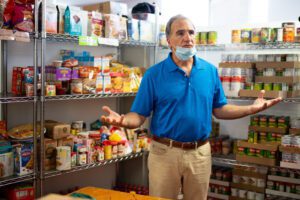
Neil Oberto, the longtime director of Catholic Social Services’ Hazleton Office, stands inside Saint Joseph Food Pantry during the height of the COVID-19 pandemic in 2000. After nearly 35 years working for Catholic Social Services, Oberto retired at the end of January 2023.
Oberto started his career with Catholic Social Services in October 1988 after previously working with Luzerne County Children & Youth. While the Hazleton native said he was hired for a counseling position, the job description incorporated much more.
“I was taking on counseling cases but also I was taking on social welfare cases,” he explained. “It was everything. You did everything.”
Oberto took over as director of the Catholic Social Services Hazleton Office in 1995. He saw programs begin, grow and change over all that time.
“When I started, our food pantry was a closet,” he reminisced. “Then the food closet turned into a walk-in closet … then the food pantry went from a walk-in closet to what was a former auditorium in the school … and then it had the whole lower level of the church.”
During all of his time, Oberto stressed his love for the Mountain City and its “close-knit” social service agencies that have worked together with the “CAN DO” attitude.
“We addressed needs as we needed to address them,” he stressed.
From programs involving adoption and foster care to maternal health and homeless, Oberto helped to oversee it all over the years.
“One of the things we tried to maintain throughout the years was a strong working relationship with the churches because we saw the work as living a call to service,” Oberto added.
Despite working with countless advisory and governing boards, volunteers, staff members and community partners, Oberto feels his biggest accomplishment will always be serving the people.
“The most important thing would be the individuals and families themselves who sought support, no matter what that need may have been. Hopefully, in some way, we were able to help make a difference,” Oberto stated. “The work itself was based on respecting the God-given dignity and self-worth of those served, no matter what the circumstances may have been, and through that, I hope those being served recognized their own human value.”
Until his final day on the job, Oberto said he was also “personally enriched” by those served – and that is why he continued to emphasize that he is “truly blessed.”
Danielle Matarella, who worked with Oberto for several years, is now serving as the Greater Hazleton Regional Coordinator for Catholic Social Services. Anyone in need of assistance can contact her at (570) 455-1521.
Social
SCRANTON – Before the 61st annual Saint Patrick’s Parade took to the streets of downtown Scranton March 11, 2023, hundreds gathered to celebrate their faith and devotion to the patron saint of Ireland at the Cathedral of Saint Peter.
The Most Rev. Joseph C. Bambera, Bishop of Scranton, served as principal celebrant and homilist for the Parade Day Mass. As he began his homily, the bishop addressed the morning’s weather.
“Not a few of us breathed a sigh of relief this morning as we dodged another proverbial bullet and snowstorm,” Bishop Bambera joked.
Between delays and cancellations associated with the COVID-19 pandemic and a nor’easter last year that pushed the parade back a week – coincidentally to the Feast of Saint Joseph – there have been a lot of challenges.
“My theory is the Scranton parade woes made it all the way to the halls of heaven. Neither Saint Joseph nor Saint Patrick were willing to share center stage again, so here we are, just where we belong!” the bishop said to laughter.
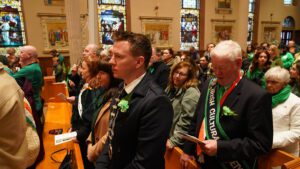
Mayor Mark Duffy of Ballina, Ireland, center, participates in the annual Parade Day Mass at the Cathedral of Saint Peter in Scranton March 11, 2023. (Photo/Mike Melisky)
During Mass, the bishop also acknowledged two special guests from Ballina, Ireland, in attendance at the Parade Day Mass. Ballina is Scranton’s sister city in Ireland.
“It is incredibly heartwarming to see the welcome that we’ve been given. We’re following the same tracks that our ancestors would have travelled in much more difficult times so it’s a privilege to be here in times of celebration,” Ballina mayor Mark Duffy said.
As the second youngest of 13 kids, Mayor Duffy explained the importance of Saint Patrick in his life. He attended Mass at Saint Patrick’s Church growing up and his home address is Saint Patrick’s Way in Ballina.
He said attending Mass at the Cathedral of Saint Peter before the parade was “very emotional.”
“Coming in the doors of the church, you see the colors and the life and the vibrancy of this building. It is breathtaking. When you come into this church, to hear the quality of the music and the service and the welcome that the Bishop gave us, it is really a lifetime memory being created,” Mayor Duffy added.
Bishop Bambera also reflected on the importance of Saint Patrick and the legacy he left.
“By his work, Saint Patrick fathered a people and a culture. From a little green island on the edge of the Atlantic, the message of God’s mercy and love was generously shared,” Bishop Bambera stated. “Countless numbers of lives have been touched. Our nation has been blessed. And we are all richer in our faith because of God’s gift of Saint Patrick to our Church and to our world.”
Social
DALTON – Teddy Novak, a senior at Holy Cross High School, first experienced the International Student Leadership Institute (ISLI) as a freshman right before the COVID-19 pandemic hit in February 2020.
He had such a good time he knew he wanted to go back. He was thrilled that ISLI was able to make its triumphant return after a three-year hiatus last month.
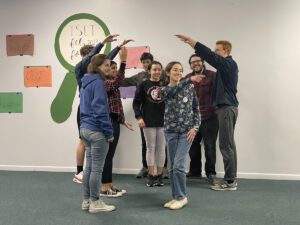
High school students participate in a small group activity as part of the International Student Leadership Institute on Feb. 17, 2023.
“I had to come back and re-experience it,” he said.
ISLI is a peer-facilitated, faith-based leadership retreat designed by Fr. Thomas Chambers, C.S.C., at the University of Notre Dame. The retreat is designed to help high school students gain the knowledge and skills necessary to excel in both the leadership and membership roles of task-oriented groups.
“We break up into small groups and form circles and have reflective conversations,” Novak explained. “We reflect on who we are right now, who we have been and who we want to be.”
Annie Reilly, a parishioner of Saint Paul Parish in Scranton and freshman at Scranton Preparatory School, attended ISLI for the first time this winter.
“We did a lot of group projects,” she said. “We had a lot of tasks around five main ideas that included support, awareness, self-confidence, positive thinking and values.”
Reilly said the weekend retreat helped her grow in her leadership abilities. “I came in personally knowing absolutely no one so they really helped me make friendships and meet new people,” she said. “I watched my facilitators and how they led our group. I feel like I’ve grown as a person and definitely as a leader too.”
During the weekend, the students participate in activities that help them learn about positive communication, develop self-motivational skills, learn problem solving, and examine different leadership styles.
The students also celebrate Mass together and participate in Adoration.
“I’m planning on coming again in the summer and coming back next year,” Reilly added. “I’ve already recommended it to multiple friends to come with me during the summer so I definitely recommend it for other people.”
The next ISLI retreat is scheduled to take place from June 20-23 at Marywood University in Lackawanna County.
Social
SCRANTON – As hundreds of people gathered to begin the Lenten season at the Cathedral of Saint Peter on Ash Wednesday, they were reminded of their need for God and encouraged to trust more deeply in God’s merciful presence.
“Saint Matthew, in today’s Gospel, reinforces the words of the prophet Joel and sets forth in practical terms the lifestyle that we are called to embrace as authentic disciples of the Lord Jesus,” the Most Rev. Joseph C. Bambera, Bishop of Scranton, said during his homily. “Pray, fast, and give alms in support of the poor. But do so not because such behavior will make us appear to be righteous. Do so because such acts for a Christian are the consequence of faithful lives rooted in Jesus, who teaches us how best to live.”
Bishop Bambera told those who had gathered for the rite of the imposition of ashes that the Lenten journey draws each one of us to the very heart of what it means to be a Christian.
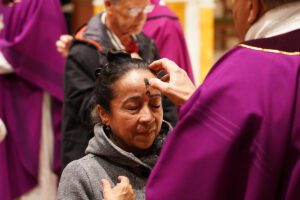
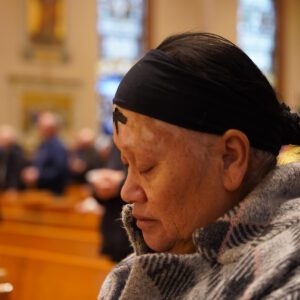
The faithful receive ashes during the 12:10 p.m. Daily Mass at the Cathedral of Saint Peter in Scranton on Feb. 22, 2023. (Photos/Mike Melisky)
“Through baptism, we are brought into the life, death and resurrection of Jesus, which, in turn, invites us to trust in the power of God more deeply and equips us for mission – the proclamation of the “Good News” of Jesus – and the service of our sisters and brothers,” the bishop explained.
As Pope Francis marked the beginning of Lent at Rome’s Basilica of Santa Sabina, he told the faithful that Lent is the time to let go of the frivolous.
Lent is the time, Pope Francis said, “to proclaim that God alone is Lord, to drop the pretense of being self-sufficient and the need to put ourselves at the center of things, to be the top of the class, to think that by our own abilities we can succeed in life and transform the world around us.”
“How many distractions and trifles distract us from the things that really count? How often do we get caught up in our own wants and needs, lose sight of the heart of the matter, and fail to embrace the true meaning of our lives in this world!” he added.
The faithful receive ashes during the 12:10 p.m. Daily Mass at the Cathedral of Saint Peter in Scranton on Feb. 22, 2023. (Photos/Mike Melisky)
“Lent is a time of truth, a time to drop the masks we put on each day to appear perfect in the eyes of the world,” he said, and to “reject lies and hypocrisy. Not the lies and hypocrisies of others, but our own.”
Pope Francis also asked that the faithful use the 40 days of Lent to: “rediscover the joy, not of accumulating material goods, but of caring for those who are poor and afflicted”; to put God at the center of one’s life and pray and dialogue with him from the heart; and to become free “from the dictatorship of full schedules, crowded agendas and superficial needs, and choose the things that truly matter.”
Social
ROARING BROOK TWP.– Saint Eulalia Parish and Saint Francis of Assisi Kitchen are joining forces to make sure no one in the North Pocono area goes hungry.
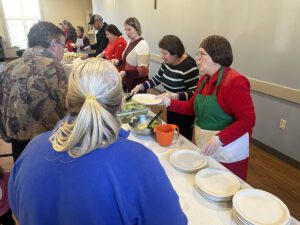
Starting Feb. 7, 2023, a free community meal is now being hosted in the parish hall of the Roaring Brook Township parish every Tuesday from noon until 12:30 p.m. The warm, nutritious meal is prepared by Saint Francis Kitchen in Scranton and served by parish volunteers. Each week the meal includes meat, vegetables, fruit salad, garden salad, lemonade and dessert.
“It’s local people serving local people. The kitchen provides the food, the van and the driver and a lot of the material things,” Rob Williams, Executive Director of Saint Francis of Assisi Kitchen, explained. “We send one person from Scranton but they provide 10-12 local volunteers to serve the meal. All of the hospitality and all the meal service happens with local people serving local people.”
Volunteers from Saint Eulalia Parish serve a free, nutritious meal to people in the community on Tuesday, Feb. 14, 2023.
More than sixty volunteers from the parish have stepped forward to help.
“I have been very blessed in my life. Right now is my time to give back,” Donna Caputo, a volunteer from Saint Eulalia Parish, said. “We don’t realize that there are people in our own community who need help and I never really saw that until now.”
The idea for the partnership started when Saint Eulalia parishioners realized that the nearby North Pocono food bank served more than 200 local families a month and nearly 30 percent of students in the public school system receive free or reduced lunches.
“There was just a desire to serve and give,” Rev. David Cramer, Pastor of Saint Eulalia Parish, explained.
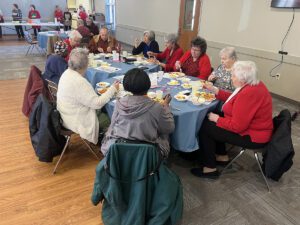
Dozens of people have taken advantage of the free meal each Tuesday since the effort launched. Some people come out to help them stretch their food budget while others just enjoy the hospitality and camaraderie.
The free community meal at Saint Eulalia Parish is open to everyone in the community. It is held every Tuesday from noon to 12:30 p.m.
“I think it’s wonderful. It is very kind of the parish to put this on for the people,” Cathy Manley said. “They can’t do enough for you. It is unbelievable. You walk in the door and they greet you. They can’t help you enough.”
“The meals are so great. They are full servings of chicken parmesan. I have never eaten so well,” Katie Babilon added. “The volunteers are really friendly. They really help out. They fill your plate.”
Saint Eulalia Parish is the newest stop for the Saint Francis of Assisi Kitchen Community Outreach Program. On Wednesdays, the Kitchen provides 130 meals to Holy Cross Parish in Olyphant and on Thursdays, it provides 170 servings to Saint Rose of Lima Parish and the nearby high rises in Carbondale.
“I love these collaborations with the parishes because it helps us to extend our reach and multiply the impact that we can have,” Williams said.
Saint Eulalia Parish is located at 214 Blue Shutters Road in Roaring Brook Township. If the North Pocono School District cancels or delays classes on any given Tuesday, there will be no meal served.
Social
SCRANTON – Catholic Social Services of the Diocese of Scranton is preparing to assist more individuals and families with putting food on the table after a pandemic-era program that provided extra payments to Americans who quality of food stamps ended on March 1.
During the COVID-19 pandemic, Congress permitted states to issue extra money to food stamp recipients under the Supplemental Nutrition Assistance Program, or SNAP, a move advocates said would help low-income families who lost their jobs amid the crisis.
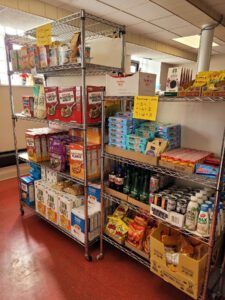
The Saint Joseph Food Pantry in Hazleton is one of the Catholic Social Services facilities ready to meet increasing needs with the reduction in SNAP benefits.
The change affects Pennsylvania’s 1.9 million SNAP recipients. The average eligible household will lose $95 a month for groceries and comes at a time when many grocery items – including milk, eggs and wheat – remain high due to inflation.
“We are already starting to see an abundance of new individuals and families,” LeeAnn Lywiski, manager of the Saint Joseph Food Pantry in Hazleton, said. “In one day alone, we registered 15 new families.”
Catholic Social Services operates food pantries in Carbondale, Hazleton and Wilkes-Barre and partners with Saint Francis Kitchen in Scranton, which operates the Saint Francis Client-Choice Food Pantry.
Catholic Social Services pantry managers expect people to have a lot of anxiousness and anxiety but want to reassure those in need their agency is ready to help people access the food they need and deserve.
“In speaking to one of our senior citizen clients recently about the change, they were concerned about not having enough food for the month,” Mike Cianciotta, manager of the Saint Vincent de Paul Pantry in Wilkes-Barre, said. “I reassured them that we will be increasing the amount of products we provide at our food bank.”
Since the beginning of the pandemic, Catholic Social Services has continued to respond to increasing need at its food pantries.
For example, between January 2022 and 2023, the Carbondale food pantry saw nearly a 20-percent increase in the number of families served – going from 687 to 835 families in each respective month.
“We are dedicated to making sure every client that walks through the door is served with the utmost respect. We strive to make sure our brothers and sisters feel better about their situation when they walk out our door,” Kara Gnall, Carbondale office supervisor, explained.
In Scranton, the numbers are even more startling.
Prior to the pandemic, the Saint Francis Client-Choice Food Pantry served approximately 300 families each month. Now, the facility is consisting hitting the 700 family mark.
“We get new families every day. We have committed to having fresh produce, milk, eggs and meat when we can. I am anticipating an even larger uptick” manager Adam Lynch said. “We have a Food Policy Council meeting once a month to discuss changes and what is coming next and this was in our last discussion, the food stamps and benefits changing and the need that will be increasing.”
The federal reductions to SNAP benefits is the first of two major changes that will likely impact Catholic Social Services food pantries.
Additionally, the 2023 cost of living adjustment for Social Security Income (SSI), which is set by the federal government, prompted an 8.7 percent increase to SSI income. SNAP eligibility thresholds – also set at the federal level – did not rise proportionally. Because of this, approximately 249,000 Pennsylvania households will experience a decrease in their base SNAP benefits by an average of $40 per household, which also took effect March 1. Approximately 5,000 to 20,000 households will lose SNAP altogether due to the SSI increase. These federal reductions will primarily affect older Pennsylvanians and seniors.
Catholic Social Services is only able to meet the increasing needs in our community because of generous donors who support its live-saving work.
“Northeastern Pennsylvania has always been known as the Valley with a Heart and because of many kind-hearted people, who donate $20, $50 or whatever they can, we are able to make sure food and other resources are available,” Joe Mahoney, Diocesan Secretary for Catholic Human Services and Chief Executive Officer of Catholic Social Services, emphasized.
Social
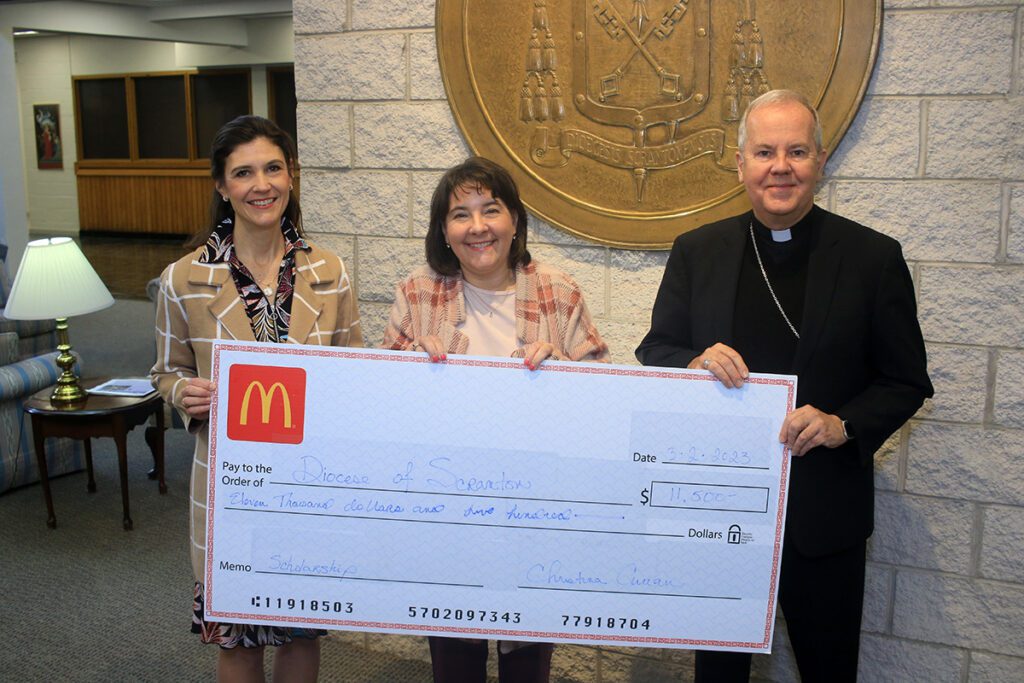
SCRANTON – Christina Mueller of the Mueller Family McDonald’s presented an $11,500 check to the Diocese of Scranton Scholarship Foundation on March 2, 2023.
The donation was a result of the sixth annual Fry Fundraiser that kicked off National Catholic Schools Week Jan. 29 and ended Feb. 19, 2023. All nineteen Mueller Family McDonald’s participated by donating a portion of every large order of french fries sold during that period.
The Mueller Family McDonald’s presented a check for $11,500 to the Diocese of Scranton Scholarship Foundation on March 2, 2023. Pictured are, from left: Kristen Donohue, Diocesan Secretary of Catholic Education/Superintendent of Catholic Schools; Christina Mueller, Mueller Family McDonald’s; Most Reverend Joseph C. Bambera, Bishop of Scranton.
“We are so happy to be able to partner with the Diocese of Scranton to provide scholarship money for Catholic schools. We couldn’t be happier to be participating. We really enjoyed all of the Activity Nights and the engagement of our restaurants with the schools,” Christina Mueller said.
The Diocese of Scranton Scholarship Foundation helps students in our 19 schools experience a Catholic education and achieve their God-given potential in an academically excellent, safe, and spiritual environment.
With restaurants located in Scranton, Wilkes-Barre, Shavertown, Mountain Top, Old Forge, Clarks Summit, Dickson City, Eynon, Carbondale, Tunkhannock, Honesdale, Allentown and Bethlehem, the Mueller Family McDonalds restaurants are deeply invested in their communities.