ST. PAUL, Minn. (OSV News) — Archbishop Bernard A. Hebda is encouraging the faithful of the Archdiocese of St. Paul and Minneapolis and all community members to be “beacons of light” as the one-year mark of a fatal shooting during an all-school Mass at Annunciation School and Church in Minneapolis is marked.
In a newsletter released Aug. 24, the archbishop wrote that Aug. 27, 2025, “continues to have an impact on so many others connected with the parish, its school, and its families.”
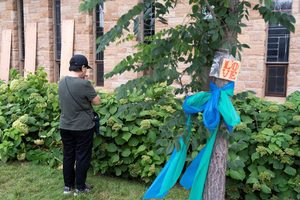
A woman prays outside Annunciation Church in Minneapolis Sept. 2, 2025, following a shooting Aug. 27. A shooter opened fire with a rifle through the windows of the parish church and struck children attending Mass during Annunciation School’s first week, killing two and wounding two dozen others in an act of violence the police chief called “absolutely incomprehensible.” (OSV News photo/Tim Evans, Reuters)
In reflecting on the loss of 10-year-old Harper Moyski and 8-year-old Fletcher Merkel that day, the archbishop wrote that “I have no doubt that their absence will be forever felt. My heart continues to go out to all who feel their loss.”
The archbishop also wrote that “I give thanks to God for the many ways in which he continues to bring healing into the lives of the others who were directly impacted by last year’s shooting. How blessed we are to have such excellent first responders and medical care here in our corner of Minnesota! I know that the Lord was compassionately working through them and through the perseverance and courage demonstrated by each of those who were injured.”
The archbishop also acknowledged an Aug. 19 gathering of parishioners and visitors in Edina, a Minneapolis suburb.
“The four speakers who shared their experiences from last Aug. 27 (an Annunciation teacher, two parents, and a student wise beyond her years) each provided proof that even in the midst of such tragedy, there can be an outpouring of compassion, a meeting of hearts, a deepening sense of solidarity, and a turning to the Lord,” the archbishop wrote.
The archbishop continued: “I am grateful that the over 300 attendees who were privileged to hear their stories, to pray with them, and to break bread with them could walk away that evening with assurances that faith had been shaken, but not destroyed. While many hearts are understandably still hurting, we can also see how they have been fortified by the love, prayers and support that have been poured out in response to this tragedy. I sure hope that the Annunciation Light Alliance, the sponsor of the event, will be welcomed into other parishes and schools for similar evenings.”
Archbishop Hebda wrote that as Annunciation’s theme for the 2026-2027 school year — “Guide our feet into the way of peace” (Lk 1:79) — was announced, the school’s Principal Matt DeBoer “explained that ‘peace is not passive — we must work towards it.'”
“That certainly resonates in my heart, and I hope that it will touch the hearts of the Annunciation community and your hearts as well,” the archbishop wrote. “We are blessed that the families of Annunciation continue to choose ‘to be beacons of light and to pursue peace.’ What a necessary and powerful reminder for our world.”
As Annunciation leaders encourage acts of service and prayer on Aug. 27, the city of Minneapolis will hold a community remembrance event at Pearl Park.
“The City and our partners invite community members to join us to plant flowers and trees, assemble care kits for youth and collect school supplies,” officials wrote on the city’s website, which includes details about Annunciation Remembrance Day.
“As we approach Aug. 27, I invite you to find a way to be a beacon of light within your own community, no matter your state in life,” Archbishop Hebda wrote in his reflection. “Our sisters and brothers at Annunciation will be spending the day engaged in acts of service, and they have invited us — in our own communities and homes — to do the same. Please join me in praying for Annunciation and for all those in need of healing as we are guided to walk together in the way of peace.”
Social
(OSV News) – The Diocese of Knoxville, Tennessee, is remembering the late Dolly Parton — whose career as a singer, songwriter, actress, businesswoman and philanthropist spanned decades — as “one of our own.”
Bishop Mark Beckman said he was “very sorry to hear of her passing” and “praying for those who are mourning her loss.”
“She made a wonderful contribution to our world and our community, and she will be greatly missed,” said Bishop Beckman.
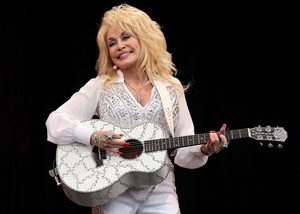
American country music star Dolly Parton performs on the Pyramid Stage at Worthy Farm in Somerset, England, during the Glastonbury Festival June 29, 2014. The iconic singer-songwriter-actress, whose glittering country music stardom was matched by her pop fame and popular parallel careers in film and TV, died Aug. 25, 2026, at age 80, after a brief battle with cancer. (OSV News photo/Cathal McNaughton, Reuters)
The 80-year-old Parton, whose many honors included 10 competitive Grammy Awards, a Grammy Lifetime Achievement Award, and a National Medal of the Arts, died Aug. 25 at Nashville’s Vanderbilt-Ingram Cancer Center, following what her representatives described as a “brief battle with cancer.”
Her late husband of 58 years, Carl Thomas Dean — whom she met at a laundromat in 1964 on her first day in Nashville — died in 2025 at the age of 82.
Born in 1946 in Locust Ridge, Tennessee, Parton — the fourth of 12 children — was “a daughter of Sevier County,” said the Diocese of Knoxville in an Aug. 26 statement.
Parton spoke candidly about the poverty she and her family had experienced, as well as the faith and the musical gifts they shared in the heart of Appalachia.
As a child, she sang in both church and on television, even debuting at the Grand Ole Opry — the self-described “mother church of country music” — in 1959 when she was just 13.
“Dolly was born and raised in the foothills of the Great Smoky Mountains,” said the Diocese of Knoxville in its statement. “She first sang in a small Pentecostal church, long before the world knew her name. She never hid her faith. It showed up in the hymns she recorded across six decades, in how openly she talked about God.”
Parton’s choir-backed cover of Don Francisco’s song “He’s Alive” — which recounts the Resurrection from Peter’s perspective — galvanized fans at the 1989 Country Music Awards, with Parton often performing and posting the song on social media over the years.
As she ascended in the entertainment industry — finding success in the fields of country and pop music, developing a career in film, launching multiple business enterprises and supporting numerous charitable efforts — Parton’s impact spread.
“Her life carried the spirit of our mountain home far beyond the Smokies,” said the Diocese of Knoxville in its statement.
In particular, the diocese noted Parton’s Imagination Library, which began in 1995 as an effort to provide books to children in Sevier County and now delivers free books to kids throughout the U.S., Canada, the United Kingdom, and Ireland. As of 2025, the library had distributed close to 305 million books in total.
Parton had launched the effort in honor of her father, a sharecropper who had never learned how to read or write.
“East Tennessee knew Dolly Parton as more than a world-famous star,” said the diocese. “We knew her as one of our own. She was shaped by these hills and these churches. Her life shows what can grow from faith, perseverance, imagination, and love for one’s neighbors — even from humble beginnings.”
Social
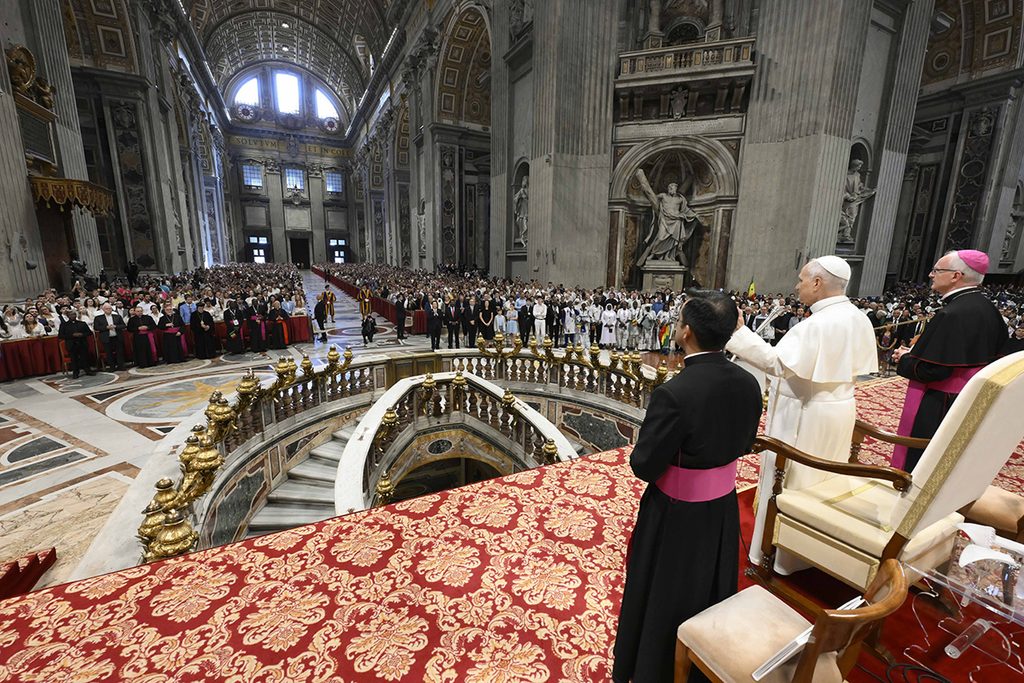
Pope Leo XIV greets visitors and pilgrims during his weekly general audience in St. Peter’s Basilica at the Vatican Aug. 26, 2026. (CNS photo/Vatican Media)
VATICAN CITY (CNS) – “Firmly rooted” in the Church’s living tradition, the liturgical reform put forth by the Second Vatican Council grew from the need for the faithful to celebrate the liturgy more “consciously and actively,” and not “as strangers and silent spectators,” Pope Leo XIV said.
“The faithful ‘cannot and must no longer remain silent and passive. Their physical presence cannot be reconciled with their spiritual absence,'” he said, quoting Cardinal Giovanni Battista Montini of Milan, the future Pope Paul VI and saint, who was attending the council’s first session at the time in 1962.
The Council Fathers expressed “a renewed awareness of the value of the liturgy,” Pope Leo said during his general audience talk in St. Peter’s Basilica Aug. 26, which focused on the constitution on the sacred liturgy, “Sacrosanctum Concilium,” and why the council sought to promote the liturgy’s reform.
It was the pope’s final catechesis dedicated to the council’s first constitution after beginning his new series of talks on the documents of the Second Vatican Council Jan. 7, so people would be motivated to reread and reflect on them rather than base their understanding of the texts on “hearsay” and the interpretations of others, he had said.
While the liturgical reform promoted by the council is “firmly rooted in the living tradition of the Church,” Pope Leo said, the reform must also be properly understood.
“A correct understanding of it also enables us to reject the abuses that occurred in certain sectors of the Church during the post-conciliar period, and which, unfortunately, still occur from time to time today, where some of the principles underlying the reform itself have been taken to extremes or misunderstood,” he said.
During the liturgy, “the memorial of the work of salvation is celebrated,” and the Church’s ritual actions also provide an opportunity “to experience a true relationship with God, coming into contact with the salvific event,” the pope said. “Since the gestures and words of the sacred liturgy are critical to realizing this experience, the participation of the faithful cannot be passive.”
The council’s reform put “at the center that which constitutes the heart of the ecclesial experience,” he said. Therefore, the intention was “to allow the liturgy to shine forth as ‘the primary source of that divine exchange in which the life of God is communicated to us.'”
Because of the importance of language, teaching and “intelligibility,” there was “the need to make the richness of the biblical texts and prayers more accessible to all the faithful, and to streamline the order of the celebration compared with that set out in the liturgical books then in use,” he said.
The liturgy is “a living entity,” he said, and it has always been subject to developments and changes over the centuries.
Therefore, it is “not surprising that the Second Vatican Council, too, with the utmost respect for the heritage of tradition, and precisely in order to make it more accessible, considered it necessary to revise the liturgical books,” Pope Leo said.
Quoting the conciliar constitution, he said, “the liturgy is made up of immutable elements divinely instituted, and of elements subject to change. These not only may but ought to be changed with the passage of time if they have suffered from the intrusion of anything out of harmony with the inner nature of the liturgy or have become unsuited to it.”
Texts and rites should thereby be “drawn up so that they express more clearly the holy things which they signify; the Christian people, so far as possible, should be enabled to understand them with ease and to take part in them fully, actively, and as befits a community,” he said, citing the constitution.
“In this way, the Christian people learn to recognize sacred realities, offer themselves with and through the hands of the priest, and become more open to receiving God’s grace,” he said in his summary to English speakers.
In his main catechesis in Italian, he said it is still the primary responsibility of bishops and priests “to safeguard and promote a liturgy which, while respecting liturgical norms, shines with noble simplicity and thus manifests the one, holy, catholic and apostolic Church.”
As the council teaches, “Liturgical services are not private functions,” but are celebrations that pertain to the whole body of the Church, “which is the ‘sacrament of unity,’ namely, the holy people united and ordered under their bishops,” he said, quoting from the constitution.
“At every celebration of the Sacraments, especially the Eucharist, let us ask for God’s help to be strengthened on our journey and to enter into a deeper relationship with the Lord,” he said in his English summary.
Social
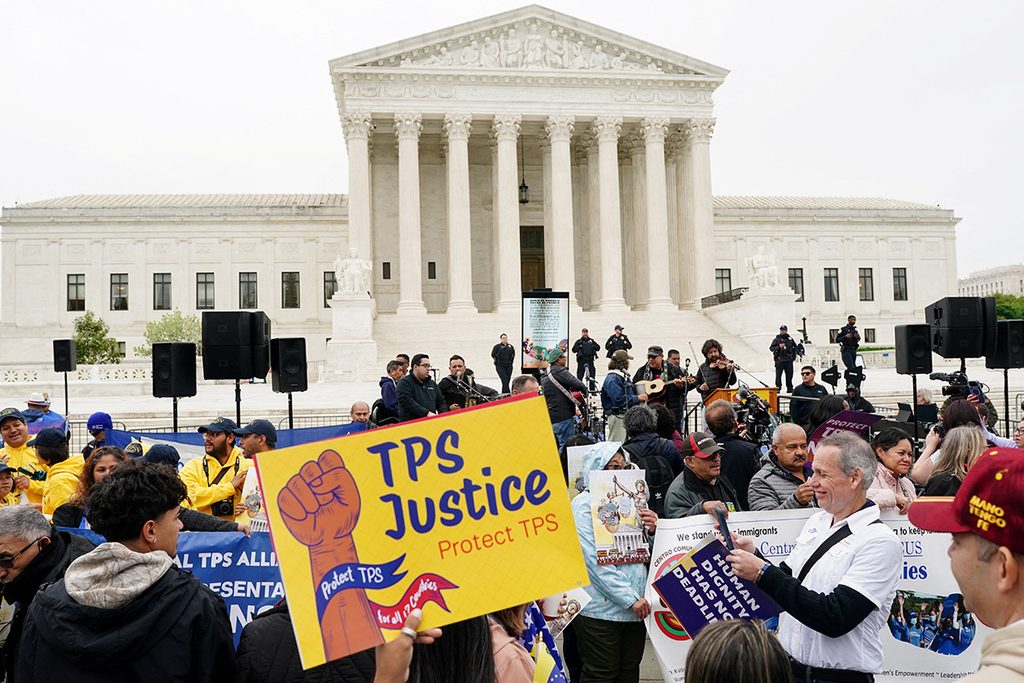
Immigrants’ rights activists and demonstrators attend a rally outside the U.S. Supreme Court in Washington April 29, 2026. Hundreds of faith leaders and organizations urged the Trump administration to extend Temporary Protected Status (TPS) for El Salvador before it expires in September. (OSV News photo/Nathan Howard, Reuters)
WASHINGTON (OSV News) – Hundreds of faith leaders and organizations urged the Trump administration to extend Temporary Protected Status, or TPS, for El Salvador before it expires in September.
A TPS designation grants the U.S. government the power to shield eligible migrants from deportation if they are from countries experiencing dangerous conditions such as war, disaster, or other unrest. El Salvador’s TPS designation is scheduled to expire Sept. 9, according to U.S. Citizenship and Immigration Services. The removal of that legal status would impact about 170,000 Salvadoran nationals in the U.S., according to the Congressional Research Service.
In an Aug. 21 letter to President Donald Trump, Secretary of State Marco Rubio, and Department of Homeland Security Secretary Markwayne Mullin, more than 270 faith leaders and organizations — including several U.S. bishops and many Catholic groups including the Catholic Legal Immigration Network, also known as CLINIC — argued that Mullins should extend El Salvador’s TPS designation to prevent disruption to U.S. communities where Salvadoran migrants have established ties and prevent family separation due to remaining dangerous conditions in that country.
“We believe that sending hundreds of thousands of Salvadoran TPS holders back into an unstable and unfamiliar country that does not have the capability to support its own nationals is a danger to those individuals and a decision that would have severe negative consequences for years to come,” the letter said. “A thoughtful review of the current conditions in El Salvador, consideration of their contributions as TPS holders to the United States and the administration’s obligation to respect the statutory framework which governs TPS, supports an extension of El Salvador’s TPS designation.”
In their letter, the signatories added that although they “all come from various faith backgrounds, we have a shared purpose in respecting human life, upholding the inherent dignity of every individual person, maintaining the family unit, and protecting those who are unable to safely return to their home country due to conflict, natural disasters, or some other extraordinary condition.”
Among the many Catholic signatories on the letter were Archbishop Thomas G. Wenski of Miami, Archbishop Gregory J. Hartmayer of Atlanta, Atlanta’s auxiliary bishops and Bishop Stephen D. Parkes of Savannah. The Maryknoll Office for Global Concerns, Ignatian Solidarity Network, and CLINIC were also among the many Catholic groups signing the letter, as were religious orders such as the Sisters of Mercy and the Sisters of St. Francis of Perpetual Adoration.
In a statement, Elnora Bassey, a policy attorney at CLINIC, argued, “Sending Salvadoran TPS holders back into unsafe conditions at a time where deportees in El Salvador are being detained without adequate representation, kidnapped, or potentially face some other harm, is cruel and can have a long-lasting harmful impact on those forced to return.”
“At a time where immigrants are being targeted and lawful protections are becoming less available to those who need it, the administration has an opportunity to make a choice that demonstrates its ability to protect vulnerable populations and that we are a nation that demonstrates compassion for all people regardless of status,” Bassey said.
Earlier this year, the U.S. Supreme Court allowed the Trump administration to end TPS designation for Haitian and Syrian nationals. Catholic leaders have also urged protection for nationals from those countries who would be subject to dangerous conditions in their countries of origin.
Social
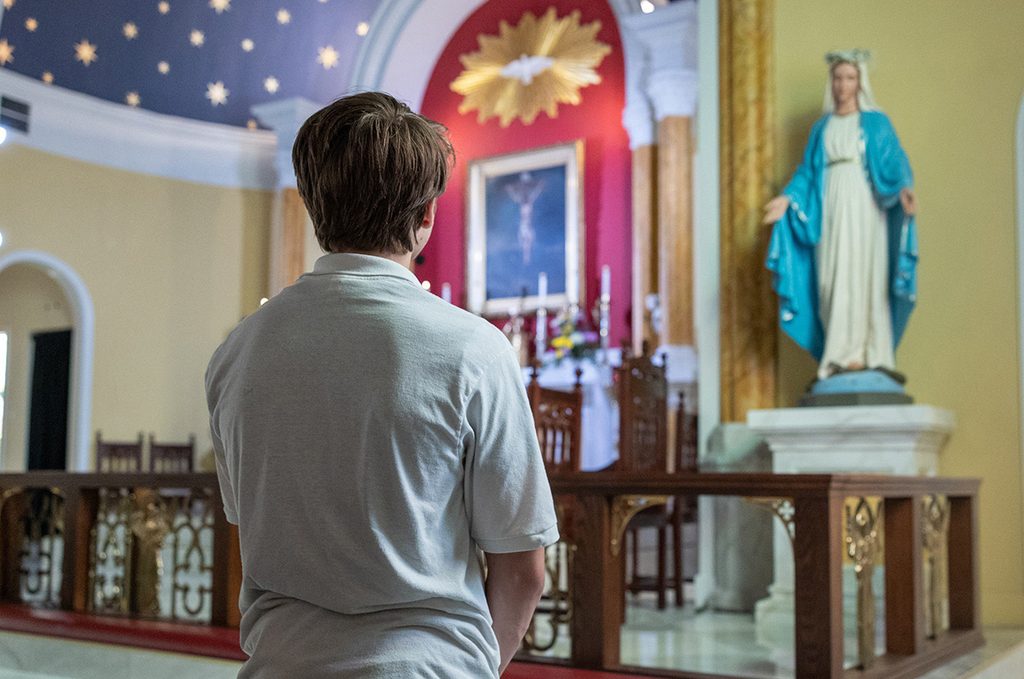
A counselor with the St. John’s Summer Program prays in front of a statue of Mary during Eucharistic adoration July 21, 2026, at St. John Francis Regis Church in Hollywood, Md. (OSV News photo/Mihoko Owada, Catholic Standard)
HOLLYWOOD, Md. (OSV News) – Teenagers and young adults serving at St. John’s Summer Program at St. John Francis Regis Parish in Hollywood told the Catholic Standard, Washington’s archdiocesan news outlet, what draws young people to the Church and gives them a reason to stay.
They talked about friends who invited them, Catholics they admired, communities where they felt at home and moments that helped the faith become their own.
For many, those experiences helped them come to know Christ personally.
Start with an invitation
Several of the young people at St. John’s, a Catholic day camp for ages 4 to 14, said they found their way into Catholic community because someone invited them or encouraged them to come.
Betsy Pieniadz, 19, came from New Mexico after hearing about the program through people connected to St. John’s. Ethan Lansing, 18, learned about it from a friend at Ave Maria University in Florida.
Carmen Davidson, 21, arrived from Baylor University in Texas after a friend urged her to apply, while Caroline Grifone, 21, came from Pennsylvania through people already connected to the program.
Authentic relationships matter
Grifone said young people need to meet Catholics whose faith is part of their everyday lives.
“I met people who were involved in their faith but were also athletic, fun and outgoing,” she said. “That drew me in.”
Pieniadz said negative experiences with Catholics had caused her to drift away from the Church.
“Then I came here and met people who really lived their faith,” she said.
Addie Lyons, 19, said relationships can make young people more open to the faith. Rather than beginning with a theology talk, she said, counselors build friendships, have fun with the children and let questions about faith come naturally.
Build a place where they belong
Rachel Mroz, 22, became more involved in her faith through the Catholic Student Center at the University of Maryland and returned to St. John’s looking for that same kind of community during the summer.
She said young Catholics need people around them who encourage them in the faith, “other people who want to run to heaven with us.”
Rollins Don-Simmons, 19, said the community at St. John’s gave him confidence to seek out Catholic life at the University of Maryland.
For Summer Phan, 16, and Maria Northrup, 17, older staff members offered an example to follow. Both saw teenagers and college students return year after year, showing them what staying active in the faith could look like as they grew older.
Teach the faith so they can understand it
Don-Simmons said parishes hoping to reach young people should think carefully about how they communicate the faith.
“I think we can best engage young people in the faith by explaining the faith in a way that they can understand,” he told the Catholic Standard.
Carlton Costanzo, 17, made a similar point.
“Stay rooted in our tradition while also presenting it in a way that’s accessible to younger generations,” he said.
Christopher Damron, 19, said young people respond when the faith is explained clearly and in a way they can understand.
Keep Christ at the center
Many pointed to the Eucharist as central to Catholic life.
Lansing said helping young people understand what happens at Mass can change the way they see the Church.
“If more people really understood what is happening at Mass and believed it with their whole hearts, I think it would completely change the way they look at the Catholic faith,” he said.
Hannah Lawrence, 29, said friendships first brought her to St. John’s, but daily Mass and Eucharistic adoration helped transform her faith.
Help them ask what God wants for their lives
Several also spoke about faith in terms of vocation and discernment.
Pieniadz said she initially did not want to come to St. John’s, but eventually believed God was asking her to go.
“God called me to,” she said. “God told me to.” she said.
Lansing had spent months asking St. Joseph the Worker to help him find a summer job before his friend told him about St. John’s.
“This was the opportunity that opened up,” he said. “I took it as God showing me where he wanted me to be.” he said.
Costanzo is considering college, military service, the trades and priesthood as he discerns his future.
“I think every Catholic man should be open to the possibility of seminary until he’s called to marriage,” he said.
For the young people at St. John’s, faith has grown through friendships, invitations and the example of people who took their relationship with Christ seriously.
And many of them are now doing the same for someone else.
Social
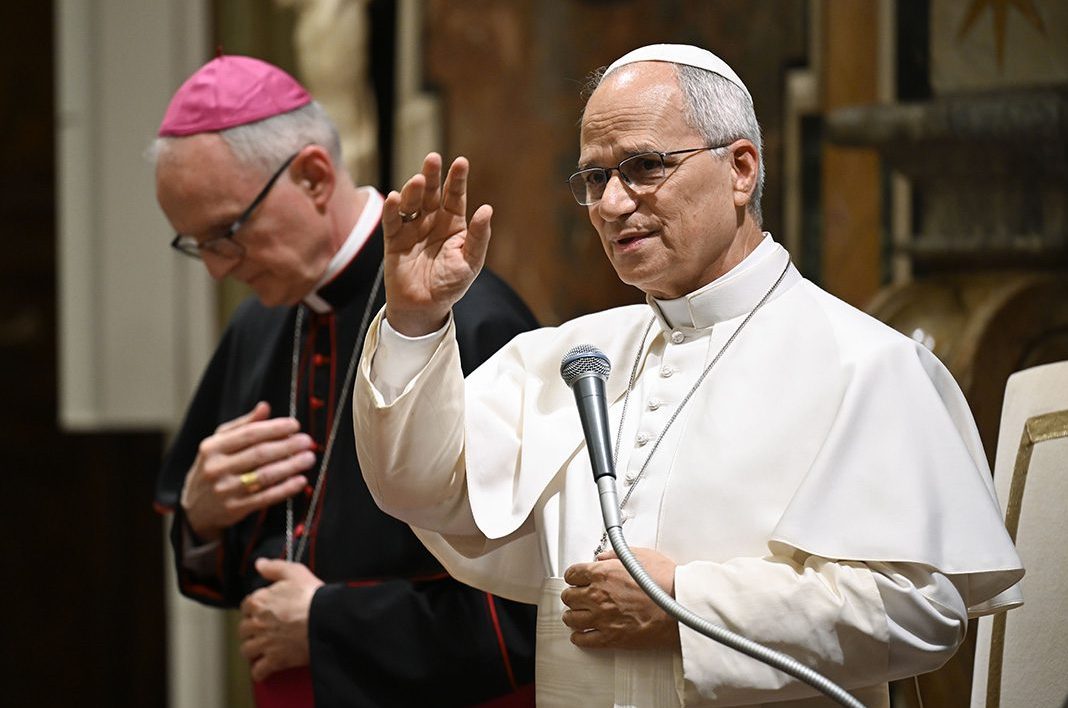
Pope Leo XIV gives a blessing as he meets with participants of the XVII Annual Meeting of International Catholic Legislators Network at the Vatican Aug. 21, 2026. (OSV News photo/Matteo Pernaselci, Vatican Media)
(OSV News) – Pope Leo XIV called on Catholic legislators to establish oversight of artificial intelligence so that technology serves the common good rather than eroding human dignity.
“The world does not need an artificial intelligence that diminishes humanity; rather, it needs human intelligence enlightened by wisdom, political authority guided by conscience and technological innovation directed by charity,” the pope told members of the International Catholic Legislators Network Aug. 21.
“Only then will artificial intelligence become not a rival to humanity but a servant of the common good,” he said.
According to its website, the ICLN, which was founded in 2010, seeks to provide “Christians in public office with faith formation, expert education and a global network of peers and friends” to encourage leadership “that is committed to the dignity of every human being.”
The group held its annual meeting Aug. 20-23 in Rome to discuss the theme, “Human Dignity and Artificial Intelligence: Challenges, Chances and Control.”
Reflecting on the meeting’s theme, the pope said its focus on artificial intelligence was an “opportunity to reflect upon one of the defining questions of our age.”
“The extraordinary progress of artificial intelligence is opening horizons that previous generations could scarcely have imagined,” he said. “Yet every technological achievement also confronts humanity with a moral question: not merely what can we do, but what ought we to do?”
Citing his encyclical on safeguarding the human person in the age of artificial intelligence, “Magnifica Humanitas” (“Magnificent Humanity”), Pope Leo said humanity is facing “a decisive choice.”
Humanity, he said, can either “be tempted to construct a new Tower of Babel, where power, efficiency and control obscure the face of the human person; or we can build a civilization in which technology serves the integral development of every person.”
The pope told the Catholic legislators that their vocation places them “at the heart of this challenge” and that the Church’s social teaching can help them discern whether technology helps people “become more fraternal and responsible toward themselves and toward one another.”
“Sound legislation should encourage scientific and technological creativity while safeguarding fundamental human rights and freedoms,” he said. “It should protect users from exploitation, preserve personal privacy, ensure transparency in the use of emerging technologies and guarantee that they strengthen democratic institutions.”
Independent oversight and legal frameworks, the pope continued, are necessary guardrails for artificial intelligence that help ensure “that no single ideology or interest dictates the values embedded in artificial intelligence systems.”
Nevertheless, he added, AI’s rapid development “risks creating new forms of technological dependence, with poorer nations increasingly reliant on wealthier ones.”
Pope Leo warned that such developments “reveal a new face of the ancient temptation to domination and mastery without service.”
“We must remain vigilant in this regard, lest innovation become another vehicle for ideological or economic colonialism,” he said. “Sadly, we are presented with a subtle form of domination when algorithms decide who is seen and who remains invisible, when digital platforms shape public discourse without accountability, and when the dignity of workers is subordinated to the optimization of systems.”
For this reason, the Catholic Church proposes “the civilization of love” as a response to the “culture of power,” which would govern artificial intelligence through “charity, compassion and responsibility.”
The family, the pope said, is at the heart of this response as the first place one learns “trust before calculation, generosity before competition, dialogue before division, and love before power.”
Pope Leo encouraged the group of Catholic lawmakers to promote policies that “strengthen marriage and families,” as well as support parents in “their educational mission and enable young people to look to the future with confidence.”
“Artificial intelligence must never be allowed to erode this primary cell of society — whether by reducing persons and relationships to data and simulations, by flooding young minds with content that distorts desire, or by economic models that make family life economically precarious,” he said.
Social
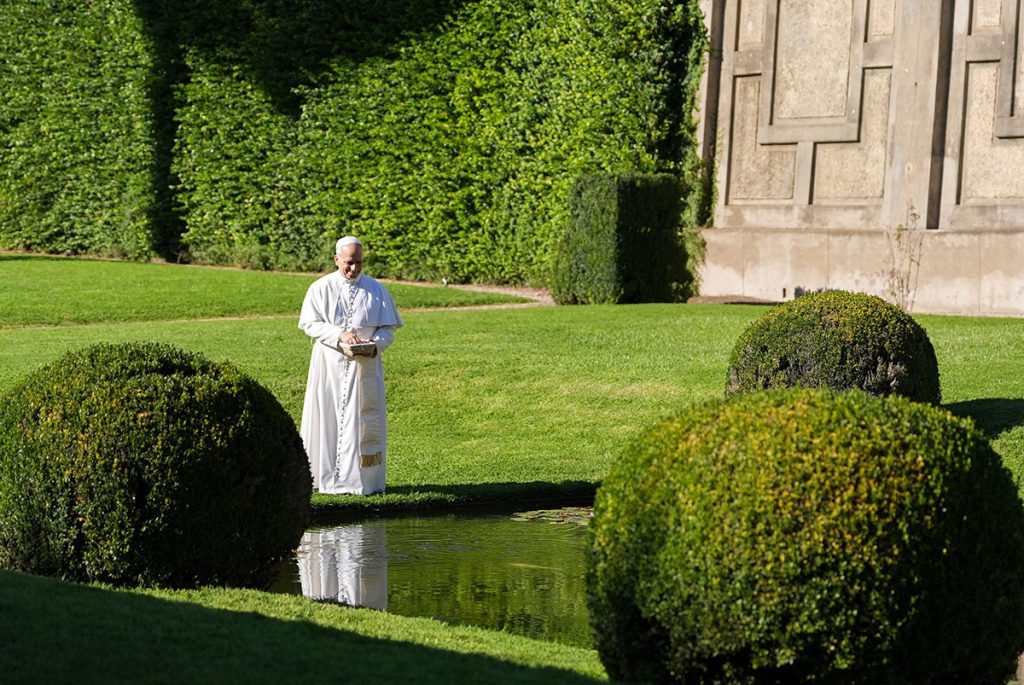
Pope Leo XIV feeds fish at a pond in the Pontifical Gardens of Castel Gandolfo, Italy, Sept. 5, 2025. The Vatican released Pope Leo’s message for the World Day of Prayer for the Care of Creation which will be celebrated Sept. 1.(CNS photo/Lola Gomez)
(OSV News) – The social and ecological devastation wrought by war represents not just a political failure, but a moral crisis rooted in a divided heart in need of conversion, Pope Leo XIV said.
Violence, injustice and environmental damage are not just “the result of flawed systems or structures; it is ‘a symptom of the deeper dichotomy that is rooted in humanity itself,'” the pope said in his message for the 2026 World Day of Prayer for Creation, which will be celebrated Sept. 1.
“The wounds of war and the degradation of the earth, then, are profoundly linked to the condition of the human heart,” Pope Leo wrote. “The conflicts that torment humanity are in many ways the outward expression of interior discord and division. When the heart is distorted, relationships suffer, and the structures we build begin to reflect that disorder.”
The World Day of Prayer for Creation marks the start of the ecumenical “Season of Creation,” which concludes Oct. 4, the feast day of St. Francis of Assisi, patron saint of ecology.
The theme for 2026 is “They shall beat their swords into plowshares and their spears into pruning hooks,” based on the verse from the book of Isaiah. The Vatican said June 2 that the celebration’s theme “highlights the connection between armed conflict and environmental degradation.”
“The title — a passage in which Isaiah prophesies the transformation of weapons into agricultural tools — is an explicit invitation to prioritize development and sustainability over violence and destruction,” the Vatican said.
In his message, Pope Leo said the world is “witnessing many crises and much human suffering” as well as the accelerating “disruption to the harmonious balance of creation.”
“These phenomena are not unrelated; they are a single plea for healing and peace arising from a wounded world,” he said.
Reflecting on the day’s theme, the pope said that although Isaiah spoke of a time when nations transform “what destroys life into what sustains it,” in today’s world, “we too often witness the very opposite, as efforts continue to be directed toward violence and war.”
“War leaves wounds that extend far beyond the battlefield. It claims lives, tears families apart and forces millions to flee their homes, thereby deepening fear, injustice and division,” he wrote. “War also leaves behind social and ecological destruction that endures for generations.”
Armed conflicts, coupled with environmental degradation, he added, create a “vicious cycle” that “destroys ecosystems, contaminates essential resources, such as air and water, and undermines food security,” thus creating further conflicts.
The pope noted that war not only creates wounds that damage individual people and communities, but also the bonds of the human family, revealing “a deeper failure to live in God’s image and likeness, to respect life and to care for the earth entrusted to us.”
“This is not only a political failure, but also a moral and spiritual one,” Pope Leo wrote. “Rooted in distorted desires and the misuse of human freedom and power, war stands as a counter-witness to the Gospel of peace.”
The building of a peaceful society, he continued, requires not just a reform of structures but also a renewal of hearts that are facing “an ethical and cultural crisis,” evidenced by the desire “for domination, the pursuit of immediate profit, and the inability to recognize the God-given dignity of each human person.”
Isaiah’s prophetic call to “beat swords into plowshares” is a call for both individuals and nations to “transform harm into life,” not just through external changes, but through a return to God “who will reorder our desires, heal our wounds and help us grow in virtue,” he wrote.
Pope Leo warned that without an “inner transformation, peace will remain fragile and short-lived.”
“But where hearts are renewed, new possibilities begin to open. What has been used for destruction can be redirected toward life, toward the care of the poor, the nourishment of the hungry, and the safeguarding of creation,” he wrote.
“The true tools for building peace are not weapons of destruction; instead, they are truth, dialogue, patience, goodness, justice, mercy, understanding, care and love. These flow from hearts shaped by the Gospel and sustained by God’s grace. Only these qualities possess the power to transform individuals, renew communities and heal the wounds of our world,” the pope wrote.
Social
SCRANTON – Forty-eight years ago, a young Joseph Bambera walked through the doors of Saint Pius X Seminary in Dalton as a seminarian on his own journey toward the priesthood.
On Sunday, Aug. 23, 2026, he stood on the other side of that journey, now as Bishop of Scranton, welcoming a new generation of seminarians as the Diocese of Scranton re-established Saint Pius X Seminary in the former Cathedral Convent building in downtown Scranton.
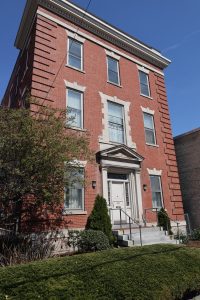
The Diocese of Scranton has re-established Saint Pius X Seminary in the former Cathedral Convent building on Wyoming Avenue in Scranton.
Four new seminarians have officially moved into the newly renovated building at 333 Wyoming Avenue, beginning the Propaedeutic Stage of their priestly formation and opening a new chapter in the history of a seminary that helped form generations of priests for the Diocese of Scranton.
“As we re-establish the ministry of Saint Pius X Seminary, what an incredible gift this is,” Bishop Bambera said during his welcome at the Seminary’s first Mass, offering thanks to God for the blessing of faith, families and the many ways people are called to a life of service in Christ and His Church.
The four men beginning their formation at Saint Pius X this fall are Kenneth Francis of Nativity of Our Lord Parish, Duryea; Matthew Kelly of Saint Gregory Parish, Clarks Green; Zachariah Levin of Our Lady Queen of Peace Parish, Brodheadsville; and Stephen Chronowski of Saints Peter and Paul Parish, Plains.
For Father Alex Roche, Diocesan Secretary for Clergy Formation and Rector of Saint Pius X Seminary, the opening represented the culmination of months of planning, renovation and anticipation.
“We are excited because it’s going to give these men, as they start seminary, an opportunity to get to know the Diocese better,” Father Roche said. “It’s also going to give the people of the Diocese a chance to get to know our seminarians before they go elsewhere to continue their studies in theology.”
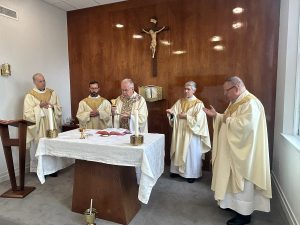
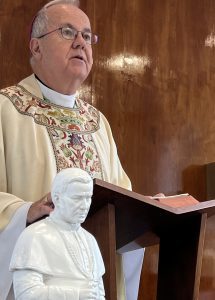
On Sunday, Aug. 23, 2026, Bishop Joseph C. Bambera celebrated an opening Mass for Saint Pius X Seminary in its chapel. (Photo/Eric Deabill)
The decision to re-establish Saint Pius X Seminary locally grew out of new Vatican guidelines for the Program for Priestly Formation and Bishop Bambera’s desire to make the first stage of priestly formation more closely connected to the Diocese of Scranton and the people the seminarians may one day serve.
“I think this house is a sign of hope and growth,” Father Roche explained. “Our number of seminarians has increased in the country and in this Diocese. Just being able to house a part of formation here in the Diocese is a sign that there are wonderful things happening and that we’ve got a lot of great young men who are considering and discerning a call to serve the Diocese as priests.”
The building that will now serve as Saint Pius X Seminary was formerly home to the Cathedral Convent. Located directly across from the Diocesan Pastoral Center and just steps from the Cathedral of Saint Peter, the facility has undergone months of renovations to prepare it for its new mission.
The building includes individual bedrooms for seminarians, common areas designed to foster fraternity, a dining area and kitchen, and spaces for priests in residence. A chapel provides a place for Mass, Eucharistic Adoration and the Liturgy of the Hours.
The Propaedeutic stage is intentionally focused on preparation. Seminarians will develop habits of prayer, learn to live in community, deepen their understanding of the Catholic faith and participate in pastoral and service opportunities throughout the Diocese.
They also will take coursework at The University of Scranton while participating in retreats and other opportunities.
“As the year goes on, things are going to take shape, we’re going to discover things and we’re going to have new ideas and we’re going to find all the advantages of beginning formation here in the Diocese that maybe we didn’t even anticipate,” Father Roche added.
A NEW BEGINNING
The name Saint Pius X Seminary carries a special place in the history of the Diocese of Scranton.
For more than four decades, from 1962 to 2004, the original Saint Pius X Seminary operated in Dalton, forming many men for priestly ministry.
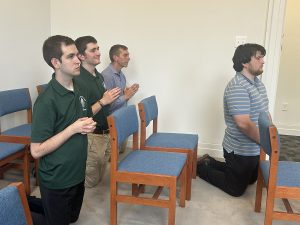
The first four seminarians kneel during Mass. (Photo/Eric Deabill)
As he celebrated the opening Mass for the new Seminary, Bishop Bambera wore two specific items to connect the past and present.
First, the Bishop wore the episcopal cross that belonged to Bishop William O’Hara, the first Bishop of Scranton.
“I thought it would be appropriate to wear it,” Bishop Bambera explained at the beginning of his homily.
He also pointed to the ring he was wearing – the ring he wore at his own episcopal ordination and one that had previously been given to Bishop Jerome Hannan, who established the first Saint Pius X Seminary.
“So, when people ask, you can tell people that I can be sentimental,” the Bishop joked.
The Bishop’s message to the four seminarians then turned more serious to the reality of what they were beginning.
Reflecting on his experience at World Youth Day in Denver in 1993, when he traveled with hundreds of young people from the Diocese to see Saint John Paul II, Bishop Bambera recalled words from the Pope that have remained with him for decades.
“Do not be ashamed of the Gospel. Be proud of the Gospel,” the Pope told young people.
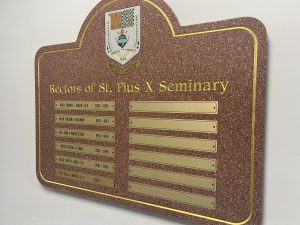
A plaque with the names of the Saint Pius X seminary rectors hangs in the front hallway of the new seminary. (Photo/Eric Deabill)Mas
Bishop Bambera said those words remain relevant for seminarians, priests and all Catholics today.
“We are challenged every day of our lives by a world that does not always appreciate, much less live out, the values of the Gospel for which Jesus gave his life,” he said.
The Bishop also focused on a question Jesus asked his disciples in the Gospel for the 21st Sunday in Ordinary Time: ‘Who do you say that I am?’
Bishop Bambera challenged the four seminarians to bring that question into their own lives in 2026.
“What about us? Who do you – who do we say that Jesus is he?” he asked. “Who is Jesus for you?”
It is easy, the Bishop noted, to proclaim faith in Jesus within the safety of a chapel.
The greater challenge comes outside those walls.
He offered hypothetical scenarios of being in a social setting, out to dinner, or standing beside someone whose life is falling apart because a loved one is suffering from cancer.
“How readily do we affirm Jesus?” he asked. “What do you say about Jesus then?” He reminded the seminarians that even Peter, who boldly proclaimed Jesus as the Messiah, would later struggle and deny knowing him.
Sometimes, the Bishop said, believers struggle with their faith more than they might want to admit. But, he said, those moments do not have to be failures. He said that can become opportunities to encounter the mercy of Christ even more deeply.
“That is what I hope for you brothers, as you begin your priestly formation, that you will come to know Jesus more deeply than you do, that you affirm who Jesus is through thick-and-thin, and when you don’t, you will know where to turn, back to that same Jesus, who will forgive you and who will bring you closer to Himself through that struggle and through the honesty of your lives,” Bishop Bambera added.
Bishop Joseph C. Bambera delivers the homily during an opening Mass for the new Saint Pius X Seminary in Scranton on Aug. 23, 2026. (Photo/Eric Deabill)
BEGINNING JOURNEY TOGETHER
For the four men who will now call Saint Pius X Seminary home, they are excited about the journey that is beginning.
“For a long time, I’ve wanted to live in the city and meet more people,” Levin said. “I’ve wanted to serve others and finally I’ll begin to start doing pastoral work and I get to live right alongside all my brothers learning the same.”
Francis said being able to begin formation close to home offers an important witness to others.
“It’s a nice example for other people, to show them that the church is growing and there are young men willing to enter formation and hopefully one day become priests,” he said.
Kelly believes the small community will help the four seminarians develop the fraternity they will need as future priests.
“The whole goal is to eventually serve the people in unison with each other,” he said. “To truly be in unison with each other, we have to build friendships, and we have to build fraternity and this right here, is where it all begins and starts.”
Social
SCRANTON – In the coming days, classrooms in the Diocese of Scranton’s 19 Catholic schools will once again be filled with students, teachers, and the excitement of a new academic year.
This year, a simple invitation will serve as a guiding light for the year ahead: Shine His Light.
That is the theme for the 2026-2027 school year, calling students, families, faculty, staff, and administrators to live out their Catholic faith not simply in words, but through acts of service, compassion and love.
Rooted in Jesus’ words from the Gospel of Matthew – “Let your light shine before others, that they may see your good works and glorify your Father in heaven” (5:16) – the theme will be highlighted throughout the school year through the principles of Catholic Social Teaching.
Each month, students will explore a unique way of shining Christ’s light, beginning with solidarity. Throughout the rest of the school year, they will also focus on respect for life and the dignity of the human person; care for the poor and vulnerable; call to family, community and participation; rights and responsibilities; care for God’s creation; and ending with the dignity of work and rights of workers.
The goal is not simply to teach students about the seven themes of Catholic Social Teaching, but to help them put their faith into action.
“Catholic education is about forming the whole person,” Kristen Donohue, Diocesan Secretary for Catholic Education/Superintendent said. “As we continue to implement our Catholic Schools Strategic Growth Plan, we want our students to understand their faith is not something they simply learn about in a classroom or experience at Mass on a weekend. It is something they live. Focusing on the theme ‘Shine His Light,’ we will help our students see Christ in others, serve those in need and recognize they have a responsibility to bring His light into the world.”
The implementation of the ‘Shine His Light’ initiative reflects one of the central priorities outlined in the Diocese’s “Our Faith. Our Students. Our Future” Strategic Growth Plan, which was released in January 2025 following two years of consultation. The plan outlined goals in seven areas for continued growth: Catholic Mission & Identity, Academic Excellence, Governance & Leadership, Enrollment Management, Development, Infrastructure and Financial Stability.
Now in its implementation phase, the plan is increasingly visible throughout the Catholic School System, with work underway to strengthen student support and expand development efforts.
SUPPORTING INDIVIDUAL STUDENTS
Brittany Krupski, the former principal of All Saints Academy in Scranton, has joined the Catholic Schools Administrative Office in a new role of Director of Student Services.
Krupski will oversee student data and enrollment while also working with special programs, including the ABC Council and Individualized Instruction Program.
Her work will further advance the Strategic Growth Plan’s goal of ensuring that student support services are clearly defined, assessed, and refined so that data can help inform student learning.
“Our goal has always been to look at each student as an individual and use the information we have to understand where that student is and where he or she needs to go next,” Krupski explained.
The Diocese’s use of NWEA Map Growth assessments several times throughout the school year provides educators with valuable information about individual student progress and helps teachers determine what students are ready to learn next.
“Growth data gives our teachers a valuable tool to differentiate instruction and make sure we are meeting students where they are, while helping them reach their full potential,” Krupski added.
The approach reinforces the Diocese’s commitment to academic excellence while recognizing that every student brings different gifts, needs, and challenges into the classroom.
CREATING SAFER SCHOOLS
The new school year will also bring significant investments in safety.
Diocesan Catholic schools recently received more than $1.1 million in Pennsylvania Commission on Crime and Delinquency (PCCD) safety grant funding. This money will support a wide range of projects designed to strengthen security throughout individual school communities.
The awards will support projects including new security cameras, access-control systems, door and classroom locks, exterior lighting, bollards and school resource officers.
The funds will help fulfill the Strategic Growth Plan’s commitment to infrastructure and ensuring that Catholic schools provide safe, secure environments where students can learn and grow.
NEW MODEL FOR LEARNING
The new school year will also bring a notable change to the academic calendar at Saint John Neumann Jr./Sr. High School in Williamsport, where students in grades 6 through 12 will begin a four-day school week.
With the innovative learning model, students will attend classes Monday through Thursday, with extended school days allowing the school to meet and exceed Pennsylvania’s required instructional hours.
Fridays are being reimagined as opportunities for enrichment rather than simply an additional day away from school. Students will have opportunities for academic support, tutoring, internships, college visits, field trips, guest speakers, and other experiences designed to complement classroom learning.
In line with the Strategic Growth Plan, school leaders believe the change will create new opportunities for academic and personal growth.
INVESTING IN THE FUTURE
The Diocese is also continuing to strengthen the financial foundation of Catholic education through advancement and development initiatives.
A new Diocesan advancement and development position specifically for Catholic schools has been established to assist individual schools with third-source funding, philanthropy, and fundraising.
Sandra Snyder is overseeing this effort, concentrating on growth of the Educational Improvement Tax Credit (EITC) Program, which provides scholarships for eligible students and makes a Catholic education more accessible to families.
“The EITC Program is an incredible opportunity for individuals and businesses to invest in the future of our students. By redirecting state tax dollars you’re already paying to scholarships, donors can make a Catholic education possible for more families while receiving a 90 percent tax credit,” Snyder said. “We are so grateful for the support we have already received and encourage even more people to take advantage of this opportunity.”
Social
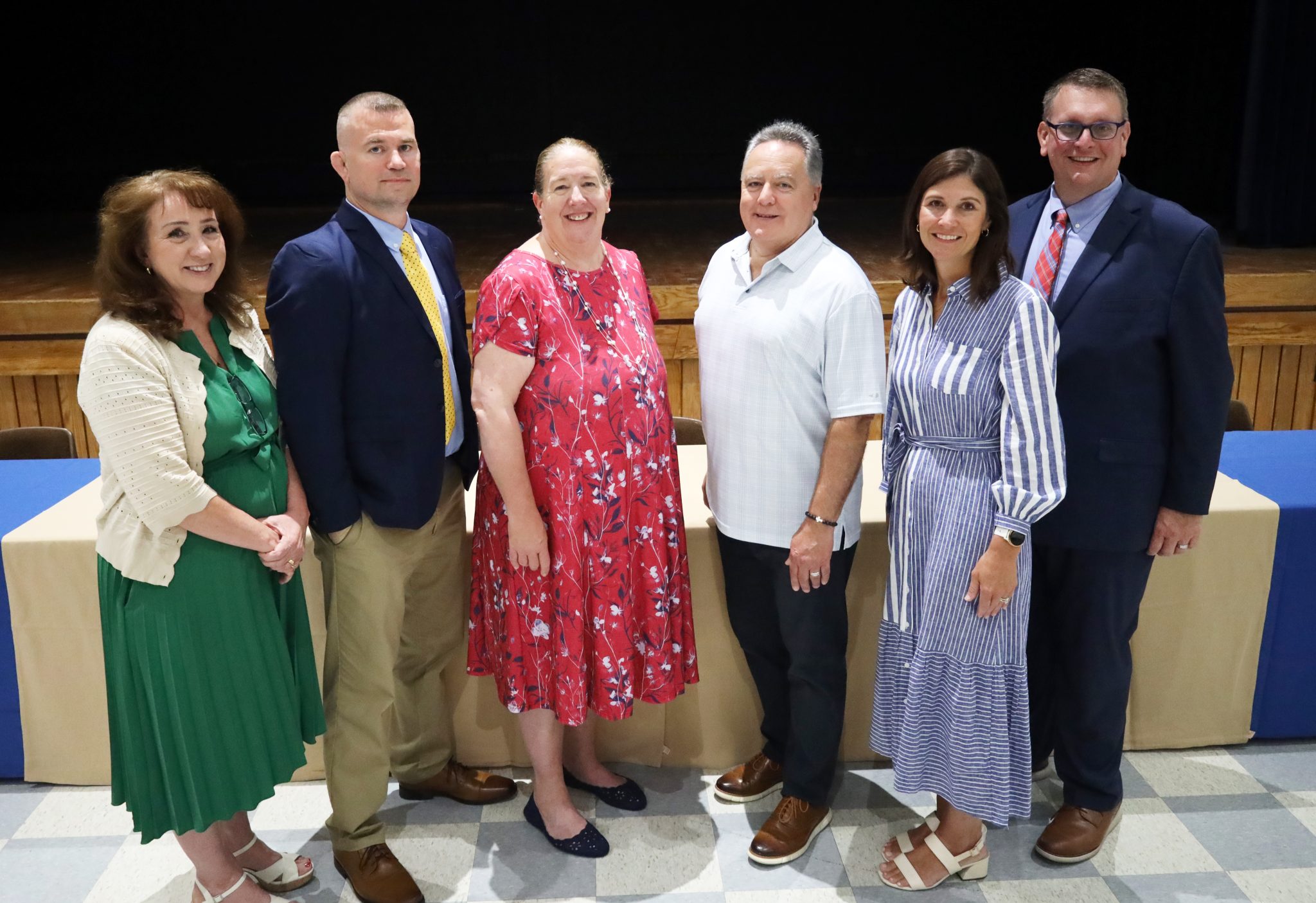
The Diocese of Scranton is welcoming three new principals for the 2026-2027 academic year. Pictured, from left: Charlene Haggerty, Assistant Superintendent; Jason Schlingman, Holy Family Academy; Kathy Maguire, All Saints Academy; Michael Catrillo, Notre Dame Jr./Sr. High School; Kristen Donohue, Diocesan Secretary of Catholic Education/Superintendent; and Christopher Tigue, Assistant Superintendent.
SCRANTON – As the new school year begins, three Catholic schools in the Diocese of Scranton are welcoming new principals.
Kathy Maguire will serve as principal of All Saints Academy in Scranton, Jason Schlingman has taken the helm at Holy Family Academy in Hazleton, and Michael Catrillo has become principal of Notre Dame Jr./Sr. High School in East Stroudsburg.
While their paths to Catholic school leadership are different, the three new principals share a common desire to place students at the center of their work while strengthening the faith and academics in their buildings.
For Catrillo, becoming a Catholic school principal is a dream that came unexpectedly after five years of retirement.
A veteran educator entering his 40th year in education, Catrillo spent much of his career in public education, most recently serving as principal of East Stroudsburg High School South. He retired in 2021 and spent the next several years traveling with his wife.
In June, during a conversation with his parish priest, Father Brian J.T. Clarke of Saint Matthew Parish, Catrillo casually mentioned that he had always wanted to lead a Catholic school.
When Father Clarke asked if he was interested in Notre Dame, Catrillo said he felt the Holy Spirit urging him to take the opportunity.
“I want to do this to continue my work with teachers and young people and be able to share my faith with them,” he said.
Catrillo is particularly looking forward to the smaller school environment at Notre Dame, where he hopes to know students and staff personally – greeting students outside, visiting classrooms and talking with them in the cafeteria.
He also plans to make prayer a more visible part of daily life at the school, leading morning and afternoon prayer and utilizing a simple message he hopes students will carry with them: “Pray on it, pray over it, pray through it.”
His goals also include increasing student engagement in the classroom, providing additional help for struggling students and strengthening relationships with families.
Catrillo currently serves as president of the East Stroudsburg School Board and as Grand Knight of the Knights of Columbus at Saint Matthew Parish.
At Holy Family Academy, Schlingman brings 24 years of experience in education and leadership, including time in both Catholic and public schools.
“Returning to Catholic education was more than a career decision,” Schlingman said. “It felt like coming home to an environment where education is about more than academics.”
He hopes to build upon Holy Family Academy’s family-centered atmosphere while creating a school where students are excited to learn, teachers feel supported and families know they are genuine partners in their children’s education.
His vision extends beyond the classroom. Schlingman hopes to grow enrollment and create new opportunities for students through sports, clubs and extracurricular activities.
Most importantly, he wants the entire school community to develop a renewed sense of pride.
“I want people to be excited about coming to school, excited about what we are building, and proud to say, ‘This is my school,’” he said.
Schlingman also brings a personal appreciation for perseverance and teamwork to his new role. A graduate of King’s College, he was an All-American wrestler and is on the college’s Sports Wall of Fame. He credits wrestling with teaching him lessons in discipline, perseverance and never giving up – lessons that continue to influence his leadership today.
At All Saints Academy, Maguire brings more than two decades of experience in education and a commitment to lifelong learning. She has earned two master’s degrees and is currently pursuing a Doctor of Education degree.
As her career developed, Maguire said she increasingly felt drawn toward school leadership, particularly within the Diocese of Scranton.
“I am looking forward to meeting students and families. I am beyond excited to be a part of the All Saints Academy community,” she said.
For Maguire, her new job also represents a chance to give back to the Catholic educational community that played an important role in her own life. A graduate of Saint Paul’s School, she fondly remembers her experience as a Catholic school student as one that shaped who she has become.
“It was an incredible experience for me personally, academically and socially,” Maguire said. “I am thankful to be able to give back to the Catholic community within the Diocese of Scranton.”
As she begins her first year, Maguire hopes to foster an exceptional school environment where both students and staff can grow academically and spiritually.