(OSV News) – Pope Leo XIV named Archbishop Edgar Peña Parra, the substitute secretary for general affairs at the Vatican Secretariat of State, as the apostolic nuncio to Italy and the Republic of San Marino, the Vatican said.

Archbishop Peña Parra’s new assignment was among several papal appointments the Vatican announced March 30. The pope named Italian Archbishop Paolo Rudelli, who served as apostolic nuncio to Colombia since 2023, as the new substitute secretary, a role equivalent to a papal chief of staff.

In a statement published March 30 by SIR, the news agency of the Italian bishops’ conference, Archbishop Rudelli called his appointment “a gesture of undeserved trust, which deeply honors me.”
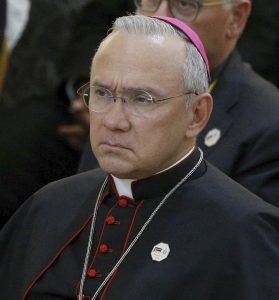
Archbishop Edgar Peña Parra is pictured in a 2019 file photo. It was announced March 30, 2026, that Pope Leo XIV named Archbishop Peña Parra, the substitute secretary for general affairs at the Vatican Secretariat of State, as the apostolic nuncio to Italy and the Republic of San Marino, the Vatican said. (CNS photo/Paul Haring)

Entrusting his new role to the intercession of St. John XXIII, the Italian prelate said he was ready to take on “this service in the spirit indicated by the Apostolic Constitution Praedicate Evangelium.”

The pope also named Archbishop Petar Rajic, who served as apostolic nuncio to Italy and San Marino as prefect of the Papal Household, a role that has been left vacant for several years.

The last to hold the title was Archbishop Georg Gänswein, the longtime personal secretary of the late Pope Benedict XVI who now serves as apostolic nuncio to the Baltic states. In 2020, the German prelate, although allowed to retain his title as “prefect,” was assigned by Pope Francis to assist Pope Benedict XVI. His term officially ended in 2023 and no one was assigned as his successor until now.

–‘A renewed call to service’–

In a letter addressed to Vatican secretary of state Cardinal Pietro Parolin and staff members at the Secretariat of State, Archbishop Peña Parra reflected on his time at the dicastery as well as his years of service, comparing his life to that of “a train that sets off toward a final destination.”

“It has been intense and interesting, full of lessons and challenges; a remarkably beautiful and enriching adventure, especially because of the people whom Divine Providence has allowed me to meet,” he wrote.

He also noted both difficult moments during his tenure, including the COVID-19 pandemic, the death of Pope Benedict XVI as well as the illness and subsequent death of Pope Francis. The Venezuelan archbishop also highlighted the “delicate phases leading up to the conclave, which culminated in the joyful election of Pope Leo XIV, who was welcomed as a gift of the Spirit to the Church.”

Most notably, Archbishop Peña Parra also highlighted “moments of institutional suffering,” including the trial related to the London property scandal.

The Vatican’s controversial investment in a property in London led to huge financial losses was a problem inherited by the archbishop from his predecessor, Cardinal Angelo Becciu.

Cardinal Becciu, along with several defendants, was found guilty and sentenced to five and half years in prison. However, the Vatican’s appeals court declared a partial mistrial March 17, citing procedural errors by Vatican prosecutors.

Archbishop Peña Parra, who testified at the trial in 2023, said the legal proceedings “exposed the Holy See — and in particular our Secretariat of State — to unprecedented media and judicial scrutiny, requiring rigor, transparency, and a sense of responsibility on our part.”

“In each of these circumstances, the Section for General Affairs was called upon to safeguard, coordinate and sustain a service that is quiet, often invisible, yet essential to the life of the universal Church,” he wrote.

Nevertheless, the Venezuelan prelate likened his time at the Secretariat of State to a high-speed train “since the life of the Church moves quickly.”

“At a certain point, the Lord has us board a train car, entrusts us with a stage of the journey, and asks us to care for the passengers we encounter,” he said. “Later on, we arrive at a station, which is not the end of the journey, but a transition. We get off, hand the next stage over to others, and we change direction. The train continues its journey.”

“The train of life continues its journey; what matters is remaining faithful to the Master who calls us to board, to disembark and to set out again, always for the love of his Church,” the archbishop said.

–Other appointments as Holy Week starts–

On March 30, the pope also named two new members to the Pontifical Commission for the Protection of Minors, including Susan Lynn Bissell, a Canadian academic and visiting scholar at the FXB Center for Health and Human Rights at Harvard University; and French lawyer Laurent Delvolvé, a member of the Paris Bar Association.

Pope Leo also named several new members to the Dicastery for Integral Human Development, including Father Daniel Groody, vice president and associate provost for undergraduate education at the University of Notre Dame; Meghan J. Clark, professor of moral theology and assistant chair of the Department of Theology and Religious Studies at St. John’s University in New York; and Léocadie Lushombo, assistant professor of theological ethics at Santa Clara University in Berkley, California.
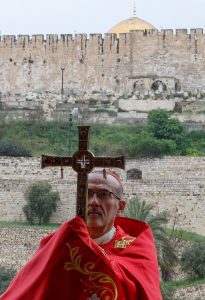
(OSV News) – The Latin Patriarchate of Jerusalem said an agreement has been reached with Israeli authorities to allow Holy Week and Easter celebrations to take place at the Church of the Holy Sepulcher after they were initially barred from celebrating Palm Sunday.

In a statement published March 30, the Latin patriarchate said that “access for representatives of the Churches has been secured in order to conduct the liturgies and ceremonies and to preserve the ancient Easter traditions at the Church of the Holy Sepulcher.”

Cardinal Pierbattista Pizzaballa, the Latin patriarch of Jerusalem, holds a prayer service to mark Palm Sunday, following the cancellation of the traditional Palm Sunday procession from the Mount of Olives, amid restrictions on gathering in large groups and the U.S.-Israeli war with Iran, in Jerusalem, March 29, 2026. (OSV News photo/Ammar Awad, pool via Reuters)

“Naturally, and in light of the current state of war, the existing restrictions on public gatherings remain in force for the time being. Accordingly, the Churches will ensure that the liturgies and prayers are broadcast live to the faithful in the Holy Land and throughout the world,” the statement read.

The agreement was reached a day after Israeli police barred Cardinal Pizzaballa and Father Francesco Ielpo, the custos of the Holy Land, from entering the church March 29, drawing global condemnation.

In a statement published shortly after the incident, the Latin Patriarchate of Jerusalem said barring Catholic leaders from celebrating the start of Holy Week set “a grave precedent, and disregards the sensibilities of billions of people around the world who, during this week, look to Jerusalem.”

Following the backlash, Israeli President Isaac Herzog said he called Cardinal Pizzaballa to “express my great sorrow over this morning’s unfortunate incident in the Old City of Jerusalem.”

“I clarified that the incident stemmed from security concerns due to the continuous threat of missile attacks from the Iranian terror regime against the civilian population in Israel, following previous incidents in which Iranian missiles fell in the area of the Old City of Jerusalem in recent days,” he explained.

Herzog also reaffirmed Israel’s “unwavering commitment to freedom of religion for all faiths and to upholding the status quo at the holy sites of Jerusalem.”

In its March 30 statement, the Latin Patriarchate of Jerusalem expressed its gratitude to Herzog “for his prompt attention and valued intervention.”

“We also extend our appreciation to the Heads of State and officials who acted swiftly to convey their firm positions, many of whom personally reached out to express their closeness and support,” it said.

–Swift reactions–

Religious and political leaders worldwide swiftly denounced Israeli authorities after the news quickly spread March 29 that entrance to the church had been barred for the two Catholic leaders.

The X account of Palestine’s mission to the United Nations said the Israeli authorities’ actions against religious leaders were not without precedent, as “for decades, Israel has always denied Palestinian Christians access to the Church of the Holy Sepulcher with full impunity.”

In a subsequent post, Palestinian government authorities said the barring of church leaders from performing their religious rites “constitutes a crime and an illegal military measure, and represents a flagrant violation of the basic rights of the Palestinian people, foremost among them freedom of worship.”

The Israeli police’s actions, it added, show disregard for “the sentiments of hundreds of millions of people around the world, and an affront to the feelings of Christians and Muslims who share in the sanctity of the city of Jerusalem and its religious and historical status, and a violation of the current legal and historical status quo.”

Prominent Western leaders also took to social media to denounce the incident.

Among the immediate reactions were from Italy, where the country’s foreign minister, Antonio Tajani, called the incident “unacceptable” and announced that he had summoned Israel’s ambassador to Italy “to receive clarifications on the decision to prevent Cardinal Pizzaballa from celebrating Palm Sunday.”

Mike Huckabee, the U.S. ambassador to Israel, issued a rare condemnation, acknowledging that while holy sites in the Old City of Jerusalem were closed due to safety concerns, preventing Catholic leaders from entering the church was “an unfortunate overreach (that is) already having major repercussions around the world.”

“Home Front Command Guidelines restrict any gatherings to 50 people or less. The 4 representatives of the Catholic Church were well below that restriction,” he wrote. “For the Patriarch to be barred from entry to the Church on Palm Sunday for a private ceremony is difficult to understand or justify.”

In posts in French, Hebrew and Arabic, French President Emmanuel Macron expressed his support for Cardinal Pizzaballa and Christians in the Holy Land, saying that the “free exercise of worship in Jerusalem must be guaranteed for all religions.

“I condemn this decision by the Israeli police, which adds to the alarming proliferation of violations of the status quo of Jerusalem’s Holy Sites,” he wrote.

Spanish Prime Minister Pedro Sanchez, who has criticized the U.S. and Israel-led war against Iran, directly blamed Israeli Prime Minister Benjamin Netanyahu for the incident, saying he “prevented Catholics from celebrating Palm Sunday in Jerusalem’s Holy Places. Without any explanation. Without reasons or motives.”

“The government of Spain condemns this unjustified attack on religious freedom and demands that Israel respect the diversity of beliefs and international law. Because without tolerance, coexistence is impossible,” he wrote.

Kaja Kallas, the European Union’s foreign policy chief, said barring Cardinal Pizzaballa and Father Ielpo from entering the Church of the Holy Sepulcher constituted “a violation of religious freedom and long-standing protections governing holy sites.

“Freedom of worship in Jerusalem must be fully guaranteed, without exception, for all faiths,” she wrote on X. “Jerusalem’s multi-religious character must be protected.”

Polish President Karol Nawrocki also took to X to say that he strongly objects “the refusal to allow the celebration of Holy Mass at the Church of the Holy Sepulchre in Jerusalem.

“Palm Sunday marks the beginning of Holy Week, and Christians are preparing for the resurrection of Jesus Christ,” the Polish president, who is Catholic, wrote.

“The actions of the Israeli police, which I condemn, are an expression of disrespect for Christian tradition and culture.”

Traditional allies of Netanyahu also offered rare criticisms, including Hungarian Prime Minister Viktor Orban, who called the situation “painful.”

“This is unacceptable for us as Christians, even taking into account the wartime situation and general security measures,” he wrote. “We must not allow war to exclude followers of any religion from our shared holy city, Jerusalem.”

–Easing tensions–

Responding to the incident in a series of tweets, Israel’s prime minister’s office noted that Iran “has repeatedly targeted the holy sites of all three monotheistic religions in Jerusalem with ballistic missiles” and that missile fragments from one strike crashed near the Church of the Holy Sepulcher.

The police, he said, prevented Cardinal Pizzaballa and Father Ielpo from entering the church “out of special concern for his safety” and that “there was no malicious intent.”

“However, given the holiness of the week leading up to Easter for the world’s Christians, Israel’s security arms are putting together a plan to enable church leaders to worship at the holy site in the coming days.”

Several hours later, in a post on his personal X account, Netanyahu said he instructed authorities that Cardinal Pizzaballa “be granted full and immediate access to the Church of the Holy Sepulchre in Jerusalem.”

“Even though I understand this concern, as soon as I learned about the incident with Cardinal Pizzaballa, I instructed the authorities to enable the Patriarch to hold services as he wishes,” he wrote.

Responding to Netanyahu’s post, Huckabee said he was glad Netanyahu “personally and promptly intervened to allow Cardinal Pizzaballa access to Church of Holy Sepulcher.”

“ALL holy sites have restrictions due to Iranian missiles and safety issues, but private access on Palm Sunday was reasonable and the issue now resolved,” the U.S. ambassador tweeted.

Cardinal Pizzaballa also sought to ease tensions in the aftermath of the incident. In an interview with TV2000, the television network owned by the Italian bishops’ conference, the Latin patriarch said the incident was the result of a “misunderstanding.”

“There were no clashes; everything was done very politely. I don’t want to force things; we want to use this situation to better clarify in the coming days what to do, respecting everyone’s safety but also respecting the right to prayer,” he said.

He also noted that while the Palm Sunday incident was important, it must also be considered within “the broader context.”

“There are people who are much worse off than we are and cannot celebrate for very different reasons,” he said. “Once again, we are celebrating a subdued Easter.”

(OSV News) – Cardinal Pierbattista Pizzaballa, the Latin patriarch of Jerusalem, and Franciscan Father Francesco Ielpo, the custos of the Holy Land, were prevented from entering the Church of the Holy Sepulcher by Israeli police on Palm Sunday, the Latin patriarchate said.

In a statement published March 29, the Latin Patriarchate of Jerusalem said that although abiding by restrictions due to the Israeli-U.S.-led war in Iran, “the two were stopped en route, while proceeding privately and without any characteristics of a procession or ceremonial act, and were compelled to turn back.”

Cardinal Pierbattista Pizzaballa, the Latin patriarch of Jerusalem, holds a prayer service to mark Palm Sunday, following the cancellation of the traditional Palm Sunday procession from the Mount of Olives, amid restrictions on gathering in large groups and the U.S.-Israeli war with Iran, in Jerusalem, March 29, 2026. (OSV News photo/Ammar Awad, pool via Reuters)

“As a result, and for the first time in centuries, the Heads of the Church were prevented from celebrating the Palm Sunday Mass” at the Church of the Holy Sepulcher, the patriarchate said.

“This incident is a grave precedent, and disregards the sensibilities of billions of people around the world who, during this week, look to Jerusalem,” it said.

The Church of the Holy Sepulcher was among several holy sites in the Old City of Jerusalem, including the Western Wall and the Temple Mount, that were closed since Feb. 28, after Israel and the U.S. launched their joint attack against Iran.

The Custody of the Holy Land said in a statement March 21 it was in dialogue with authorities and was awaiting “clear indications” regarding Holy Week celebrations.

Italy’s Prime Minister Giorgia Meloni expressed her solidarity with Cardinal Pizzaballa and Father Ielpo, the Italian newspaper La Repubblica reported.

Noting that the Church of the Holy Sepulcher is “a sacred place of Christianity,” the prime minister said the church “must be preserved and protected for the celebration of sacred rites.”

“Preventing the patriarch of Jerusalem and the custos of the Holy Land from entering, especially on a solemnity central to the faith such as Palm Sunday, constitutes an offense not only to believers, but to every community that recognizes religious freedom,” she said.

In a post on the X social media platform March 29, Antonio Tajani, Italy’s foreign minister, announced that he summoned Jonathan Peled, Israel’s ambassador to Italy, “to receive clarifications on the decision to prevent Cardinal Pizzaballa from celebrating Palm Sunday.”

In a separate post, Tajani said the actions by Israeli authorities to prevent Church leaders from celebrating Palm Sunday was “unacceptable.”

“I have given immediate instructions to our ambassador in Israel to convey to the authorities in Tel Aviv our government’s protest and to confirm Italy’s position in defense, always and in every circumstance, of freedom of religion,” he wrote.

The Israeli authorities’ action took place as Houthi militants in Yemen became the latest combatants to enter the Iran war by firing missiles at Israel March 28 in support of their Iranian backers and threatening Red Sea shipping.

Since the U.S. and Israel launched a massive surprise attack on Iran Feb. 28, amid ongoing negotiations over Iran’s nuclear program, the war has engulfed more and more countries in the Middle East, sending shockwaves through the global economy.

In Lebanon, Israel launched an airstrike March 28 that killed three journalists, claiming one of them was involved in providing intelligence to Hezbollah, the Shia Lebanese militia group that joined the war on the side of Iran March 2. Lebanon’s President Joseph Aoun, a Maronite Catholic, denounced the targeted killing as a “flagrant crime” against international laws protecting journalists.

The same day, Israel’s military said Hezbollah, which is officially banned from fighting by Lebanon’s government, fired 250 missiles against Israel within the past 24 hours.

Israel’s ground invasion and air strikes have displaced a million Lebanese from their homes in the country’s south, killing 1,000 people and raising fears that one of the last major enclaves for Christians in the Middle East will face the kind of destruction Israel inflicted on the Gaza Strip in its war against Hamas.

In the joint statement March 29, the Custody of the Holy Land and the Latin Patriarchate of Jerusalem said that since the start of the Iran war, it had complied with “with all imposed restrictions,” including cancelling public gatherings and making arrangements for Holy Week celebrations to be broadcast.

However, the Israeli authorities’ actions in preventing the entrance of Cardinal Pizzaballa and Father Ielpo, “who bear the highest ecclesiastical responsibility for the Catholic Church and the Holy Places, constitutes a manifestly unreasonable and grossly disproportionate measure,” the statement read.

“This hasty and fundamentally flawed decision, tainted by improper considerations, represents an extreme departure from basic principles of reasonableness, freedom of worship, and respect for the status quo,” it said.

The Latin patriarchate and the custody expressed their “profound sorrow” to Christians around the world, noting that prayers “on one of the most sacred days of the Christian calendar have thus been prevented.”

Pope Leo XIV echoed those sentiments before praying the Angelus prayer with the faithful gathered in St. Peter’s Square to celebrate Palm Sunday.

The pope offered prayers for the Christians of the Middle East “who are suffering the consequences of a brutal conflict and, in many cases, are unable to observe fully the liturgies of these holy days.”

“Just as the Church contemplates the mystery of the Lord’s Passion, we cannot forget those who today are truly sharing in his suffering. Their ordeal challenges all our consciences,” the pope said.

“Let us raise our prayer to the Prince of Peace that he may sustain the peoples wounded by war and open concrete paths to reconciliation and peace,” he said.

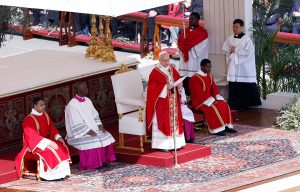
VATICAN CITY (OSV News) – In his first Palm Sunday homily, Pope Leo XIV proclaimed that Jesus, the King of Peace, embraces all suffering in human history and cries out from the cross against war.

“Brothers and sisters, this is our God: Jesus, King of Peace, who rejects war, whom no one can use to justify war,” the pope said in St. Peter’s Square March 29.

“He does not listen to the prayers of those who wage war, but rejects them, saying: ‘Even though you make many prayers, I will not listen: your hands are full of blood’ (Is 1:15).”

Pope Leo XIV delivers a homily during the Palm Sunday Mass in St. Peter’s Square at the Vatican, March 29, 2026. (OSV News photo/Remo Casilli, pool via Reuters)

Pope Leo repeated the phrase “King of Peace” seven times throughout his homily, weaving it through different moments of the Passion of Christ, pointing to Jesus as a victim of unjust violence who never took up arms in his own defense.

“Christ, King of Peace, cries out again from his cross: God is love! Have mercy! Lay down your weapons! Remember that you are brothers and sisters,” Pope Leo said.

He emphasized that Jesus, in allowing himself to be nailed to the cross embraced “every cross borne in every time and place throughout human history.”

“As we set our gaze upon him who was crucified for us, we can see a crucified humanity. In his wounds, we see the hurts of so many women and men today,” the pope said.

“In his last cry to the Father, we hear the weeping of those who are crushed, who have no hope, who are sick and who are alone. Above all, we hear the painful groans of all those who are oppressed by violence and are victims of war.”

Pope Leo’s first Holy Week began under sunny skies with a solemn Palm Sunday procession through St. Peter’s Square, where cardinals, bishops and lay people carried large palm branches. The congregation held olive branches, as is customary in Italy.

The Passion narrative from the Gospel of Matthew was solemnly chanted during the Mass; at the moment of Jesus’ death, the square fell silent as tens of thousands of people, including the pope, knelt down in prayer.

At the end of the Mass, Pope Leo led the crowd in the Angelus prayer in Latin and made an impassioned appeal for Christians in the Holy Land, where the Latin Patriarchate of Jerusalem has had to cancel or postpone key Holy Week liturgies, including Palm Sunday due to wartime restrictions.

Cardinal Pierbattista Pizzaballa, the Latin patriarch of Jerusalem, and Father Francesco Ielpo, the custos of the Holy Land, were prevented from entering the Church of the Holy Sepulcher by Israeli police on Palm Sunday, the Latin patriarchate said March 29.

“At the beginning of Holy Week, our prayers are more than ever with the Christians of the Middle East, who are suffering the consequences of a brutal conflict and, in many cases, are unable to observe fully the liturgies of these holy days,” Pope Leo said at the Angelus.

“Just as the Church contemplates the mystery of the Lord’s Passion, we cannot forget those who today are truly sharing in his suffering,” he said, adding “their ordeal challenges all our consciences.”

The pope also prayed for migrants who have died at sea, particularly those who perished recently off the coast of Crete.

In his homily, Pope Leo quoted Servant of God Antonio “Tonino” Bello, an Italian bishop and vocal critic of the Gulf War who died of cancer in 1993 and is on the path to sainthood.

“‘Holy Mary, woman of the third day, grant us the certainty that, in spite of all, death will no longer hold sway over us; that the injustices of peoples are numbered; that the flashes of war are fading into the twilight; that the sufferings of the poor are breathing their last. And grant, finally, that the tears of all the victims of violence and pain will soon be dried up like frost beneath the spring sun,'” the pope said, quoting Bello, whom he referred to by his nickname “Tonino.”

Pope Leo has a busy Holy Week schedule ahead, which includes a return to the tradition of Holy Thursday Mass in St. Peter’s Basilica and includes Stations of the Cross in the Colosseum.

MONACO (OSV News) – In the principality known for super yachts and sports cars, Pope Leo XIV urged Monaco’s wealthy citizens to remember the poor and protect every human life, calling on them to remember that the Last Judgment “places the poor at its center.”

“Within your community, many people hold positions of considerable influence in the economic and financial spheres,” Pope Leo said in his speech from the balcony of the Prince’s Palace of Monaco March 28.

Pope Leo XIV celebrates a public Mass at the Louis II Stadium as part of a one-day trip in Monaco, March 28, 2026. (OSV News photo/Guglielmo Mangiapane, Reuters)

“The kingdom of God, to which Jesus dedicated his life … comes among us and shakes up the unjust configurations of power — those structures of sin that create chasms between the poor and the rich, between the privileged and the discarded,” he said.

Pope Leo became the first pope in modern history to visit Monaco March 28, traveling the streets of the famed Formula 1 Monaco Grand Prix Circuit by popemobile, instead of by race car, to meet the faithful of the tiny Catholic Mediterranean principality.

Flanked by Prince Albert II of Monaco and Princess Charlene on the palace balcony, Pope Leo addressed an elegantly-dressed Monégasque crowd in his first speech of the quick 13-hour trip to Monaco, the world’s second smallest state after Vatican City. The visit is Pope Leo’s first international journey of 2026 and only the second of his pontificate.

In his speech in the palace, Pope Leo entrusted the Catholic principality with the task of “protecting every human life” and deepening its “commitment to the social doctrine of the Church.”

Roman Catholicism is the official state religion of Monaco, where roughly 82% of the population is Catholic.

“You are among the few countries in the world to have the Catholic faith as a state religion,” Pope Leo said in his speech at the Prince’s Palace.

“This faith places us before the sovereignty of Jesus, who calls Christians to become in the world a kingdom of brothers and sisters — a presence that does not cast down but raises up, that does not separate but connects, always ready to protect every human life with love, at any time and in any condition.”

School children in yellow hats eagerly waved the flags of Monaco and Vatican City as Pope Leo traveled by popemobile through Monaco’s famed streets with panoramic views of the Mediterranean below. On the way, he stopped numerous times to bless babies.

At Monaco’s Cathedral of the Immaculate Conception in Monaco-Ville, the pope prayed midday prayer with the local Catholic community and members of the royal family, urging Monaco’s faithful to “proclaim the Gospel of life, hope and love.” The cathedral, consecrated in 1911 on the site of a parish church dating to 1252, contains the tombs of Monaco’s royal family, including Princess Grace Kelly, an Irish American Catholic actress from Philadelphia, who married Prince Rainier III there in 1956 and died in 1982.

“Bring the light of the Gospel to everyone so that the life of every man and woman may be defended and promoted from conception until natural death. Offer new pathways capable of stemming the tide of secularism, which risks reducing humanity to individualism and basing social life on the production of wealth,” Pope Leo said.

Catherine Sassi was among the local Monégasque Catholics who prayed midday prayer with Pope Leo.

“It’s a great pleasure, a great honor and we are so happy to welcome His Holiness Leo XIV,” Sassi told OSV News.

“It’s an amazing day,” she said. “I was so pleased to be able to live it with my family, my husband, my two children. And so it will be a day we will always remember.”

Pope Leo then made his way to the Church of St. Devota, one of Monaco’s most cherished religious sites. Dedicated to the patron saint of Monaco, an early Christian martyr from Corsica executed during the reign of the Roman Emperor Diocletian, the chapel lends its name to the first corner of the Formula 1 Monaco Grand Prix Circuit. At St. Devota, the pope met with young people and catechumens, including 70 adults preparing to receive the sacraments of baptism, first Communion and confirmation.

Inside the chapel, he spent a few moments in prayer before the Blessed Sacrament and paused to venerate the relics of St. Devota.

Under the bright Mediterranean sun, Pope Leo answered questions from young people and soon-to-be baptized catechumens about how to maintain hope in difficult times, witness to God’s love, and comfort those who feel abandoned by God.

In his speech Pope Leo pointed to the witness of both the ancient Roman martyr, St. Devota, and the modern millennial saint, St. Carlo Acutis.

Highlighting St. Carlo’s Eucharistic devotion, the pope told young people to make time for “prayer, moments of silence and reflection to quiet the frenzy of doing and saying, of messages, reels and chats, and to delve deeper into and savor the beauty of truly and genuinely being together.”

“Monaco is a beautiful country, but its true beauty comes from you, when you are able to look into the eyes of those who suffer or who feel invisible amid the city lights,” he told the young people and those preparing to come into the full life of the Catholic Church.

As Pope Leo was speaking about peace during his meeting with Monégasque youth, yachts in the nearby harbor were blowing their horns in the port. The pope laughed, saying, off-the-cuff, “We also desire peace.”

Pope Leo then attended a private lunch at the residence of Archbishop Dominique-Marie David of Monaco. It was a moment of rest before the day’s culminating event, a 3:30 p.m. Mass at Louis II Stadium.

“Dear young people, do not be afraid to give everything — your time, your energy — to God and to your brothers and sisters, to pour yourselves out completely for the Lord and for others,” the pope told the young crowd at the Church of St. Devota.

“Only in this way will you find an everlasting joy and an ever-deeper meaning in life,” he said. “The world needs your witness to overcome the errors of our time, face its challenges and, above all, to rediscover the sweet taste of loving God and neighbor.”

The day concluded with Mass at Louis II Stadium, the home ground of AS Monaco football club, before a crowd of approximately 15,000 faithful.

Arnold Atiomo Noudem, a 16-year-old high school student in Monaco, was among the thousands of people attending the Mass. He told OSV News that he believes religion is something that unites the very international population in Monaco, adding that he was “very excited that Pope Leo chose to come here.”

In his homily, Pope Leo appealed for peace in the face of war, saying, “Every life cut short wounds the body of Christ.”

“Let us not grow accustomed to the clamor of weapons and images of war,” he said. “Peace is not merely a balance of power; it is the work of purified hearts, of those who see others as brothers and sisters to be protected, not enemies to be defeated.”

In remarks after Communion at the papal Mass, Monaco’s Archbishop David addressed the pope for this affirmation of “how beautiful and luminous the Gospel of Christ is, how it can still give taste and meaning to our lives.”

The archbishop said Pope Leo has “encouraged us to face the challenges of our time without fear, aware that we carry a treasure capable of sustaining hope, ours and that of the world.”

“You have reminded our country that its identity does not consist solely in preserving an inheritance, but that it requires responsibility, selflessness and a sense of service,” he said.

“Encouraged by your presence and your words, we want to again say, ‘Yes, Jesus is the way,'” Archbishop David added. “And we want to walk together, covered by the power of the Holy Spirit, and we want to proclaim the way is open to all and for all. Jesus is the truth that enlightens, liberates and gives meaning to life.”

Pope Leo departed Monaco by helicopter around 5:30 p.m. and headed back for Vatican City.

He arrived in Rome hours later just in time for a packed Holy Week schedule that includes presiding over Palm Sunday Mass in St. Peter’s Square the following morning at 10 a.m.